2027 Choosing a BS in Business Administration When You Work Full Time and Can Take Only One Class at Once
Audited and Verified:
Our Editorial and Data Verification Process
Research.com uses government datasets, official education statistics and primary institutional information to support its career and degree guides. Our review process checks factual accuracy, occupational definitions, source dates and the requirements associated with the credentials discussed.
How This Article Was Fact-Checked
Our editorial team verifies salary estimates, employment projections, education requirements and program information against original data providers and official organizations. Salary figures are checked against the relevant occupational definitions and reporting periods. Information about licensure, accreditation and required in-person training is reviewed separately.
Fact-checked and verified on:

Co-Founder and Chief Data Scientist
Working full time may leave room for one business course, but not for a program that requires overlapping classes, live meetings, or unpredictable group work. If you are starting or finishing a BS in Business Administration, the useful comparison is not simply "online versus campus." It is whether each required course can be taken in a workable sequence, at a sustainable cost, without disrupting your job.
This guide shows you what to verify before enrolling and how to estimate a realistic path to graduation.
Key Things You Should Know
- Choose a program that permits one course in every term you plan to attend - not merely one that advertises part-time enrollment.
- Ask for a course-by-course degree plan: prerequisites, course rotation, and transfer-credit placement can determine your finish date.
- One class may fall below the enrollment level required for federal Direct Loans. Confirm your school's classification before relying on aid.
What Is a Flexible BS in Business Administration for Working Adults?
A BS in Business Administration is an undergraduate degree combining general education with subjects such as accounting, management, marketing, finance, and operations. For a full-time worker, flexible should mean that the degree - not just a few introductory courses - can be completed at one class at a time.
Programs may use semester courses, shorter consecutive sessions, or another term structure. An online course can still require scheduled meetings, timed exams, or group presentations. A campus program with reliable evening classes may fit better than an online program whose required courses conflict with your shifts.
Start with your next job goal. If a bachelor's degree is a stated requirement for advancement in your current function, broad business study may be useful; if you need one specific skill, employer training or a shorter credential may be more direct. Online business administration pathways alongside an existing career can provide candidates to investigate, but confirm each school's actual one-course schedule.
How Does Taking One Class at a Time Work in a Business Degree Program?
"One at a time" can mean one course per semester or a continuous sequence of shorter courses. Those arrangements may feel similar week to week but produce different annual progress. Neither guarantees a lighter workload: a compressed course may cover the same material in fewer weeks.
Request a sample syllabus and a projected schedule covering every remaining requirement. These checks reveal whether the advertised pace works when you reach advanced courses:
- Which classes have prerequisites, and how often is each required class offered?
- Are lectures, exams, presentations, and group meetings scheduled or asynchronous?
- Can you take a term off, and what happens to your place in a course sequence?
- Do internships, capstones, or campus visits impose hours outside your normal study window?
If you hope to move faster later, business degrees through accelerated online learning offer another format to compare. Ask whether shorter terms let you take courses consecutively; "accelerated" does not establish that you can reduce total study hours.
How Can You Choose an Accredited Online or Campus Business Administration Program?
First verify the institution's accreditation through the accreditor and the U.S. Department of Education's accreditation resources. Then check whether any advertised AACSB, ACBSP, or IACBE accreditation covers the business school or program you would enter. Institutional accreditation and business-specific accreditation are different claims; neither proves that a particular schedule will work for you.
Ask an adviser for the current catalog, a tentative degree audit, a rotation of required courses, and policies on part-time study, absences, and reentry. Confirm that those policies apply to your intended enrollment term. Student support matters when you study around work: compare advising availability, tutoring hours, technical help, and access to instructors outside business hours.
If financial aid is essential, use affordable accredited business administration programs accepting FAFSA as a starting list, not a promise of eligibility. The school's financial-aid office must confirm your program's eligibility and whether your planned course load qualifies for the aid you need.
Expect general education alongside a business core that commonly includes accounting, economics, statistics or quantitative reasoning, marketing, finance, management, and business law. Programs differ in required mathematics, upper-level electives, concentrations, and capstones. Read the course descriptions rather than assuming two degrees with similar names teach the same skills.
For one-course-at-a-time study, sequence matters as much as content. An accounting prerequisite offered infrequently can delay finance; a concentration with limited elective availability can extend your plan. Ask whether an approved workplace project can satisfy a capstone, and do not assume your current job automatically qualifies or that you may use confidential employer data.
If your goal is primarily supervising teams rather than broad business preparation, compare the required coursework with accelerated organizational leadership college programs. Choose by the skills and remaining requirements you need, not by the degree title alone.
Requirements vary by school and by whether you enter as a first-time student, transfer student, or returning student. Schools may request previous college transcripts, secondary-school records, and evidence that you meet any business-major prerequisites. An enrollment gap or a non-business background does not, by itself, tell you whether you qualify.
If you have prior coursework, ask for an official evaluation showing where accepted credits apply: general education, business core, prerequisites, electives, or neither. Also check residency requirements and whether older quantitative courses need review. A preliminary estimate is not a graduation plan.
Ranked programs for finishing a business bachelor's sooner can help you identify schools to contact. Send each school the same transcript history and ask for a requirement-level evaluation before comparing finish dates.
Your timeline depends on credits that apply to the degree, prerequisites, course length, annual course availability, and whether you take breaks. Ask each school to map your remaining classes to actual upcoming terms. That plan is more useful than a general completion-time claim.
Compare costs using the same remaining-credit and enrollment assumptions. The components below explain why a lower advertised tuition rate may not mean a lower completion cost.
| Cost or timing factor | What to verify |
| Tuition and required fees | Whether charges are per credit, course, or term, including technology and proctoring fees |
| Credits remaining | Which transfer credits fulfill requirements and which courses must be taken at the school |
| Course availability | Whether a missed course delays graduation or adds another paid term |
| Books and attendance | Software, materials, travel, parking, or required campus visits |
| Funding and cash flow | Aid eligibility at your enrollment level and when employer reimbursement arrives |
Federal Direct Loans generally require at least half-time enrollment; your school determines how your course load is classified for its terms. Ask its aid office about grants, satisfactory academic progress, and loan eligibility before budgeting around them. If an employer pays tuition, verify annual caps, grade rules, reimbursement timing, and what happens if you leave the job. To identify lower-priced candidates, reduce tuition costs for a business degree by comparing estimated completion costs after each school evaluates your credits.
Delivery mode changes where you study; course policies determine when you must be available. This comparison helps identify the constraints to test against your work schedule.
| Format | Potential advantage | Constraint to check |
| Asynchronous online | Study sessions can often fit around shifts | Fixed deadlines, timed exams, and group coordination |
| Live online | Scheduled discussion without a commute | Required attendance at times you may be working |
| Evening or weekend campus | In-person access to classmates and faculty | Commute, fixed meeting times, and limited course rotation |
| Hybrid | Some remote work with periodic in-person study | Required visits that may change by course |
Before choosing, compare a required upper-level course - not just an introductory one - in each format. Compare leading American online business degree schools to build a shortlist, then ask for sample schedules and assessment requirements. If your shifts change, confirm whether attendance exceptions are possible rather than assuming recorded lectures solve every conflict.
A BSBA can support applications for roles in operations, sales support, human resources, marketing, procurement, and project coordination. Your existing work history often determines which transition is realistic. Someone who already coordinates staff schedules might use business coursework to pursue operations responsibilities; someone moving into finance may need deeper quantitative preparation and relevant experience.
Look at the tasks in target postings, not just job titles. Show evidence such as a spreadsheet model, a documented process improvement, customer-facing results, or an approved academic project. Do not present confidential workplace material without permission. A business degree alone does not make a graduate a manager or qualify them for every specialist role.
If project coordination is your specific goal, compare BSBA electives and work experience with online project management programs for smaller budgets. A specialized program may be a better fit if its courses address the skills your target employers request and its remaining cost is manageable.
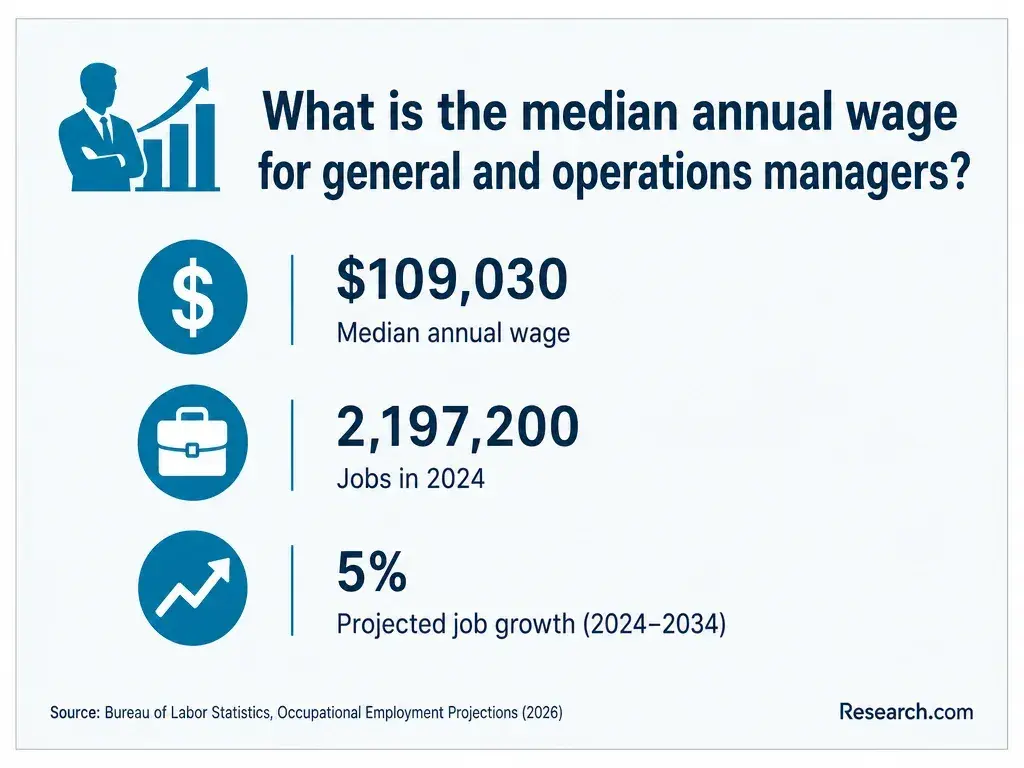
There is no single BSBA salary: pay depends on occupation, experience, location, industry, and responsibilities. For one relevant occupation, the U.S. Bureau of Labor Statistics reports a $75,940 median annual wage for human resources specialists in May 2025 and projects 6% employment growth from 2025 to 2035. Those are occupation-wide measures, not a starting salary or job forecast for new BSBA graduates.
Use labor data only after identifying a plausible target role. If your current experience is in purchasing or logistics, for example, compare its duties and hiring requirements with the roles you want before using a supply-chain salary figure to justify a degree. Economical study options for supply chain careers may be worth comparing if that function - not general business - is your aim.
Do Business Administration Careers Require Licenses or Professional Certifications?
Many general business roles do not require an occupational license, but requirements depend on the work, employer, and state. A BSBA does not itself grant CPA licensure, a financial-services license, or a professional designation. Certifications in areas such as HR or project management have separate eligibility rules that may include examinations and experience.
Check the exact credential named in job postings before paying for a program on the assumption it qualifies you. If HR is your goal, compare the business curriculum with college pathways into human resources, then verify any certification requirements with the issuing organization. Relevant work experience may matter more than an additional credential for the next role you can realistically pursue.
Other Things You Should Know About Business Administration
Diploma wording is set by the institution. Ask for its diploma and transcript policies if the distinction matters to you.
Tuition assistance does not automatically give a supervisor access to your academic records. Review the school's disclosure process and the documentation your employer requires for reimbursement.
Possibly, but confirm leave, reentry, catalog, and course-rotation rules first. A break can change when your next required class is available.
Only if the program approves the role and its learning objectives, supervision, and assessment requirements. Employment alone does not award internship credit.
- Academic Years, Academic Calendars, Payment Periods, and Disbursements | 2024-2025 Federal Student Aid Handbook https://fsapartners.ed.gov/knowledge-center/fsa-handbook/2024-2025/vol3/ch1-academic-years-academic-calendars-payment-periods-and-disbursements
- Measuring Student Success In IPEDS: Graduation Rates (GR), Graduation Rates 200% (GR200), And Outcome Measures (OM) https://nces.ed.gov/ipeds/use-the-data/measuring-student-success-in-ipeds
- Staying Eligible | Federal Student Aid https://studentaid.gov/understand-aid/eligibility/staying-eligible
- Chapter 3 - Courses and Enrollment, Full Course of Study, and Reduced Course Load | USCIS https://www.uscis.gov/policy-manual/volume-2-part-f-chapter-3
- Transfer Credit | Blue Ridge Community College https://www.blueridge.edu/services-support/transfer-credit/
- Business Administration, BSBA - Online - Academics https://academics.charlotte.edu/program/business-administration-b-s-b-a-online/
- Online B.S. in Business Administration for Transfer Students | sonoma.edu https://business.sonoma.edu/programs/undergraduate/bachelors-online-degree-completion-program
- Tuition in Detail - One Stop Student Services https://onestop.utk.edu/billing-payments/tuition-detail/
- Business Administration, B.S.: Degrees: Indiana University | iu.edu https://online.iu.edu/degrees/business-administration-bs-undergraduate.html
- Undergraduate and Graduate Tuition and Fees | Purdue Global https://www.purdueglobal.edu/tuition-financial-aid/undergraduate-graduate-tuition-and-fees/