2027 Comparing Online BS in Business Administration Options for Students Working in Several Time Zones
Audited and Verified:
Our Editorial and Data Verification Process
Research.com uses government datasets, official education statistics and primary institutional information to support its career and degree guides. Our review process checks factual accuracy, occupational definitions, source dates and the requirements associated with the credentials discussed.
How This Article Was Fact-Checked
Our editorial team verifies salary estimates, employment projections, education requirements and program information against original data providers and official organizations. Salary figures are checked against the relevant occupational definitions and reporting periods. Information about licensure, accreditation and required in-person training is reviewed separately.
Fact-checked and verified on:

Co-Founder and Chief Data Scientist
An online business degree can fit around work in several time zones—but "online" does not mean every class can be completed whenever you are available. A live presentation, group meeting, or exam window may fall outside your working hours after you change locations.
This guide is for students who travel, work with distributed teams, or move between time zones. It shows how to compare online BS in business administration programs by their actual scheduling rules, then weigh academic quality, completion time, cost, and career value before enrolling.
Key Things You Should Know
- Choose by required attendance and deadline policies, not the word "asynchronous." Confirm the time zone used for due dates, exams, and group work in required courses.
- Many bachelor's degrees require about 120 semester credits, but accepted transfer credits may not satisfy business-core or residency requirements. Request an official degree audit before estimating your finish date.
- Compare a realistic term of coursework against your busiest work schedule. A faster calendar does not reduce the coursework or guarantee lower total cost.
What is an online BS in business administration?
An online Bachelor of Science in Business Administration (BSBA) is an undergraduate degree covering several business functions, commonly including accounting, finance, marketing, management, and operations. Students complete most or all instruction remotely, but the school—not the degree name—determines whether classes require live meetings, timed exams, internships, or campus visits.
A BSBA is a broad business degree, not an MBA or a license to practice a regulated profession. A BBA or another business bachelor's degree may cover similar subjects, but requirements differ by institution. An accelerated option can shorten the calendar while intensifying weekly work; flexible fast-track routes in business education are worth considering only after checking their attendance and course-sequencing rules.
How do you compare online business administration programs for different time zones?
Start with the required courses you would actually take, not a general description of the online program. The formats below have different consequences for someone whose workday or location changes:
| Course format | Typical scheduling pattern | Main time-zone concern |
| Asynchronous with weekly deadlines | Recorded or written instruction; assignments due on set dates | The deadline may use the school's time zone rather than yours |
| Live online | Scheduled classes, discussions, or presentations | Attendance may become difficult after travel or a shift change |
| Self-paced or competency-based | Some work can be completed at variable times | Exam, mentor, and term-end rules may still be fixed |
| Accelerated term | Required work is concentrated into shorter courses | Less room to recover from a busy week or missed group meeting |
For each program, ask an adviser for recent syllabi or written answers covering required live attendance, whether sessions are recorded, and the consequences of missing one. Confirm the time zone and daylight saving time convention for deadlines; exam-window length and remote-proctoring availability; and how students schedule group projects across regions. Ask whether required courses rotate by term and whether tutoring, advising, and technical support are available during your usable hours.
Test the answers against a demanding workweek. Reserve time for reading, assignments, and team coordination—not just scheduled class meetings. If your availability changes frequently, a longer part-time route with predictable deadlines may be safer than a faster route. When comparing US business bachelor's fast-track rankings, treat advertised completion time as a question to investigate, not a personal graduation estimate.
Are online business administration degrees accredited and respected by employers?
An online BSBA can be a credible degree when the institution holds recognized institutional accreditation and the program meets an employer's requirements. Accreditation does not, by itself, establish that a course schedule is workable or that graduates secure particular jobs. Verify the institution and its accreditation status directly, then check whether any claimed business accreditation from AACSB, ACBSP, or IACBE covers the relevant school or program.
Employers may care more about the accredited degree, relevant skills, and evidence of work than the delivery format, but hiring standards vary. Ask career services what support remote students can use across time zones and whether published outcomes distinguish online students from other cohorts. When browsing business administration online programs with competitive tuition, apply the same accreditation and outcomes checks to each institution rather than treating price as a quality signal.
Expect general education alongside a business core that may include financial and managerial accounting, economics, statistics, finance, marketing, organizational behavior, and operations. The exact curriculum matters more than the shared BSBA label. A student aiming for operations work, for example, should examine whether the program offers substantive work in process analysis, spreadsheets, and supply chains—not merely an introductory management course.
Inspect assessment methods as carefully as course titles. A capstone may involve a team presentation at a fixed hour; a simulation may require coordinated decisions; and an internship may require approved supervision and scheduled work. Ask whether individual projects are available when team members live in different regions. If project coordination is your specific goal, compare the BSBA's relevant courses with online degree options in project management at lower cost, while checking whether the specialized program sacrifices the business breadth you need.
Requirements vary between first-year, transfer, and degree-completion programs. Schools may request a secondary-school record or previous college transcripts; some require a minimum academic standing or completion of specified courses before entry to the business major. Admission to the university does not necessarily mean admission to every concentration or acceptance of prior courses as business-core equivalents.
If you have college credit, request an evaluation showing where each accepted course applies: general education, business core, concentration, or elective credit. Ask separately about quantitative prerequisites, credit recency, and the number of credits you must earn at the institution. A student considering HR as an alternative focus can examine human resources bachelor's credit transfer options, but only the receiving school can determine how that student's courses apply.
Many bachelor's degrees require about 120 semester credits. Your remaining time depends on credits that satisfy specific requirements, course availability, prerequisites, and how many courses you can sustain alongside work. Shorter terms may speed completion for some students but can make a cross-time-zone schedule less forgiving.
Compare total remaining cost, not just tuition per credit. Include required fees, books and software, proctoring, any travel, and interest if you borrow. Ask whether tuition is charged per credit or term, whether part-time enrollment changes aid eligibility, and when any employer reimbursement arrives. If you are also weighing a specialized route, project management bachelor's scholarship options illustrate why funding must be checked for the actual degree and institution you choose; an award is never automatic.
The central difference for a student working across time zones is how participation happens. Campus courses generally provide predictable meeting times and in-person access to classmates and services, but require you to be in one location. Online courses remove routine commuting while shifting more responsibility to you to track deadlines, obtain help remotely, and coordinate collaborative work. Either format can include live instruction and fixed assessment times.
A campus option may suit someone who will remain near the school and benefits from in-person recruiting. An online option may better preserve employment across locations—provided required activities fit the schedule. Compare equivalent degree requirements and services, then price the full route; online business degrees with lower tuition are not necessarily cheaper after differing transfer decisions, fees, or added terms.
A BSBA can support applications for business operations, sales support, marketing coordination, procurement, HR support, and project coordination roles. Which roles are realistic depends on your prior experience and evidence of specific skills. Someone who already tracks inventory or coordinates vendors, for example, can connect that work to operations coursework and a documented process-improvement project. A new graduate should not assume the degree alone qualifies them to manage staff or budgets.
Use your target job postings to identify recurring tasks, then choose electives and permitted projects that produce relevant work samples. If listings consistently call for specialized logistics knowledge, compare a broad BSBA with supply chain degree duration and salary considerations. The more specialized route may fit that goal better; the BSBA may preserve more options if your target function is unsettled.
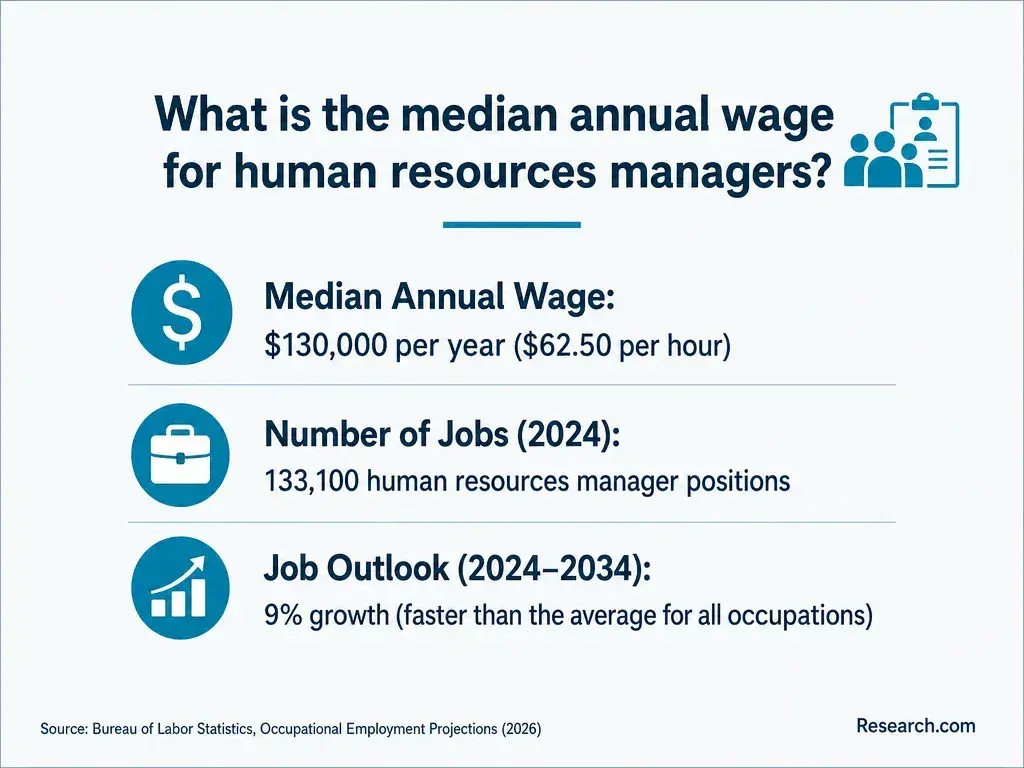
There is no single salary or growth rate for BSBA graduates: labor statistics describe occupations, not outcomes for everyone with a particular degree. For one possible destination, the U.S. Bureau of Labor Statistics reports a May 2025 median annual wage of $75,940 for human resources specialists and projects 6% employment growth from 2025 to 2035. That median includes workers with different experience levels; it is not an entry-level offer or a return promised by an online degree.
Compare pay evidence for the specific role and location you intend to pursue, alongside its experience requirements. Then weigh likely opportunities against what you would spend and the time you would need to finish. A resource for evaluating price, duration, and outcomes of business administration degrees can help frame that comparison, but your transfer audit and target-role qualifications remain decisive.
Do business administration graduates need licenses or professional certifications?
Most general business roles do not require a license merely because the worker has a BSBA. Requirements change with the job: regulated accounting or financial-services activities may have separate education, examination, and licensing rules. Voluntary HR or project-management certifications also have their own eligibility standards; a related course or concentration does not award the credential.
Check the requirements of the actual role before paying for extra education. If project management is your long-term focus, distinguish a degree from professional certification while reviewing accredited project management programs with low tuition. Verify the institution's accreditation and the certifying organization's rules separately—neither substitutes for the other.
Other Things You Should Know About Business Administration
Possibly. Before moving, ask the school whether it can continue enrolling you in your new state and whether the move affects tuition, aid, or any required placement.
Ask the institution whether it permits participation from that country and whether course software or proctoring will work there. Enrollment in a US online degree does not itself provide US immigration or work authorization.
Notify the instructor promptly using an available contact method and follow the course's documented extension or technical-incident procedure. Keep evidence of the outage; exceptions are governed by school policy.
Diploma wording is set by the institution. Ask the registrar for a sample or written policy if the distinction matters to you; do not assume the diploma matches the wording on a program webpage.
- Academic Years, Academic Calendars, Payment Periods, and Disbursements | 2025-2026 Federal Student Aid Handbook https://fsapartners.ed.gov/knowledge-center/fsa-handbook/2025-2026/vol3/ch1-academic-years-academic-calendars-payment-periods-and-disbursements
- Synchronous vs. Asynchronous Online Classes - ANU Alumni https://alumni.an.edu/synchronous-vs-asynchronous-online-classes-which-works-better-for-adult-learners/
- How to set the Time Zone in Brightspace | DSI https://www.vanderbilt.edu/brightspace/on-demand-resources/how-do-i-set-my-time-zone/
- Flex Terms FAQ | STCC https://www.stcc.edu/flexterms/faq/
- Tuition and Fees | WSU Global Campus Current Student https://online.wsu.edu/currentstudent/costs/tuition-and-fees/
- For Students - Testing Services | The University of Alabama https://testing.ua.edu/ua-online-testing-services/for-students/
- Academic Success | New York Tech https://www.nyit.edu/academics/academic-success/
- Search Accredited Schools | AACSB https://www.aacsb.edu/accredited
- Understanding Time Zones in Blackboard Ultra | TCSG Distance Education Training https://online.tcsg.edu/training/understanding-time-zones-in-blackboard-ultra/
- Tuition & Fees | National University https://www.nu.edu/admissions/tuition/