2027 Choosing a BS in Business Administration for Business Roles in Home Services Businesses
Audited and Verified:
Our Editorial and Data Verification Process
Research.com uses government datasets, official education statistics and primary institutional information to support its career and degree guides. Our review process checks factual accuracy, occupational definitions, source dates and the requirements associated with the credentials discussed.
How This Article Was Fact-Checked
Our editorial team verifies salary estimates, employment projections, education requirements and program information against original data providers and official organizations. Salary figures are checked against the relevant occupational definitions and reporting periods. Information about licensure, accreditation and required in-person training is reviewed separately.
Fact-checked and verified on:

Co-Founder and Chief Data Scientist
Running the business side of an HVAC, plumbing, cleaning, landscaping, or other home services company takes more than technical knowledge. Scheduling crews, pricing work, managing cash flow, and retaining customers call for different skills - and a BS in Business Administration may help develop them.
This guide is for technicians considering office leadership, current coordinators seeking advancement, and future owners. It explains which roles the degree can support, where field experience matters more, and how to judge whether a program is worth its time and cost.
Key Things You Should Know
- A BS in Business Administration can build skills for dispatch, customer operations, budgeting, marketing, and growth planning; it does not replace trade experience or qualify you automatically to manage a company.
- A typical bachelor's program requires about 120 semester credits and is often designed for four years of full-time study; transfer credit and course scheduling can substantially change the remaining time and cost.
- For perspective, the U.S. Bureau of Labor Statistics reports a May 2025 median wage of $105,770 for general and operations managers and projects 5% employment growth from 2025 to 2035. That occupation-wide median is not a starting salary for business graduates.
What is a BS in Business Administration for Home Services Businesses?
A BS in Business Administration is a broad undergraduate business degree, not a home services trade qualification. Its accounting, operations, marketing, management, and analytical coursework can help a student make decisions about service capacity, customer acquisition, staffing, and profitability. A BBA or BS in Management may cover similar ground, but course requirements vary by school; compare the curriculum rather than relying on the degree title.
In home services, the distinction between doing the work and running the business matters. A technician may know why a repair takes longer than planned, while a business coordinator may see its effect on appointments, labor utilization, and customer communication. Someone who understands both perspectives can make better operational recommendations. To explore the range of general programs, use ranked American online business degree options as a starting point, then inspect each school's actual course list and applied-learning requirements.
Which home services business roles can a BS in Business Administration prepare you for?
The degree is most useful when paired with evidence that you can handle the tasks of a particular role. These distinctions help separate realistic entry points from jobs that usually require substantial operating experience.
| Role or pathway | Typical business responsibilities | Evidence beyond coursework |
| Service or operations coordinator | Track appointments, dispatch capacity, job completion, and customer follow-up | Scheduling-system experience and examples of resolving service problems |
| Office or customer operations lead | Oversee billing workflows, customer communication, and administrative staff | Process documentation, supervision, and handling of sensitive records |
| Marketing or sales coordinator | Manage lead sources, campaigns, estimates, and follow-up reporting | Campaign samples and an ability to distinguish booked jobs from inquiries |
| General or operations manager | Balance staffing, service quality, budgets, and business performance | Documented responsibility for people, decisions, and results; usually substantial experience |
Inventory and purchasing may also become important as a company grows. If that function - not overall service management - is your target, compare business administration with three-year supply chain undergraduate degree routes. Check whether their specialized courses are more relevant to your goal and whether their advertised pace works with your job.
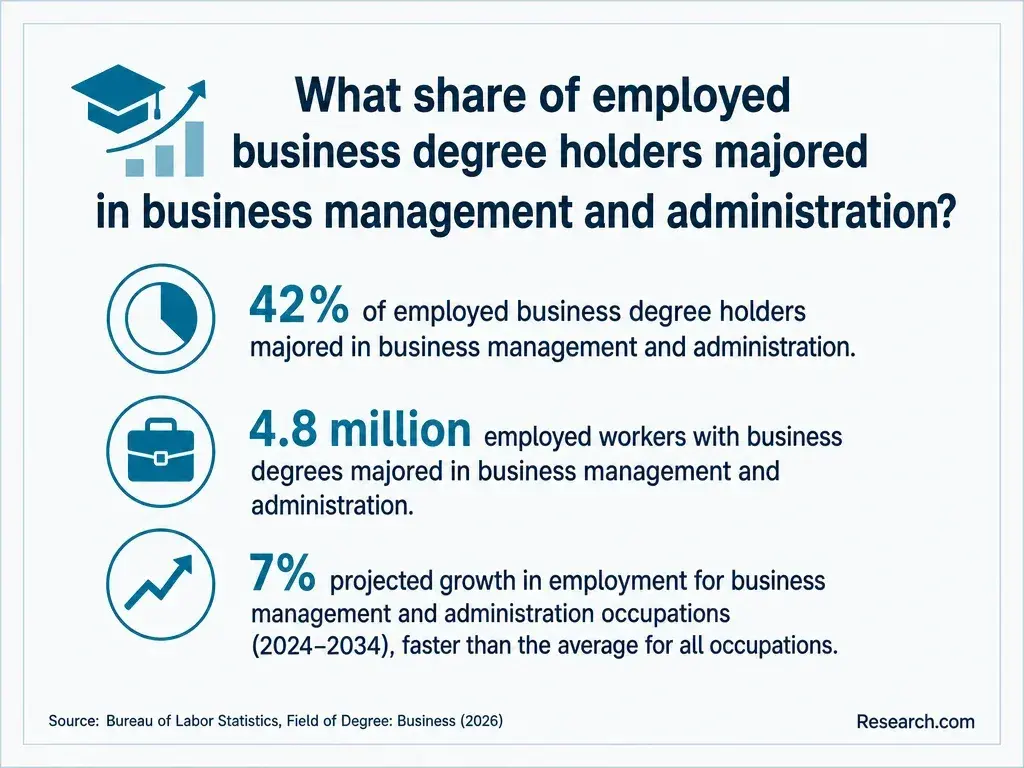
Is a BS in Business Administration worth it for home services management?
It may be worth pursuing if your target employer requires a bachelor's degree, you want to move across several business functions, or you intend to manage a growing company whose financial and staffing decisions have outgrown informal systems. The strongest case combines the degree with field experience and a way to apply coursework to real service operations.
A full degree may be a poor first investment if your immediate gap is narrow: learning a dispatch platform, reading job-cost reports, supervising a small crew, or meeting a trade-license requirement. Employer training, mentorship, accounting courses, or a focused credential may address that gap sooner. If your aim is specifically purchasing and inventory, compare the remaining credits and total cost of the BS with low-cost shorter supply chain degree options; the shorter advertised route is not necessarily shorter after your credits are evaluated.
Judge the return against your next plausible role, not a manager's median wage. Ask employers which degree, industry experience, and supervisory responsibilities they actually expect. Then compare your expected out-of-pocket cost, time away from paid work, and available employer assistance with less expensive ways to close the same skill gaps.
Most programs combine general education with a business core, electives, and sometimes a formal concentration or capstone. For home services, managerial accounting and finance can clarify job costs, cash flow, and equipment decisions; operations courses can address scheduling and capacity; marketing can help assess lead quality and customer retention. Statistics and spreadsheets matter when a manager must interpret performance reports rather than simply collect figures.
Look for assignments that let you test those concepts against the realities of travel time, seasonal demand, callbacks, and limited crew availability. A project management course may help you plan a service-process improvement, but it is not itself a professional certification. If you are comparing that course with a separate project management degree, account for project management fees books and aid considerations as well as tuition; different programs can impose different total costs.
Check whether useful subjects are required courses, occasional electives, or part of an official concentration. An operations elective does not create a concentration on your transcript, and a proposed class project is not evidence that a company adopted your recommendations.
Business coordinators generally do not need a license simply to schedule work, handle customer accounts, or analyze operations. Requirements change when a person performs regulated trade work, signs off on technical work, contracts for services, or holds a regulated professional role. Rules vary by state, locality, trade, and the individual's duties; confirm them with the relevant licensing authority before accepting responsibility.
Software training and voluntary credentials can be useful when an employer uses a particular field-service system or needs stronger project, HR, or accounting processes. They are separate from a BS and should be chosen for the work you expect to do. If you are weighing a project management bachelor's against targeted training, funding sources for a bachelor's in project management may help frame the education-cost side of that comparison. Neither degree substitutes for any license required to perform or supervise regulated trade work.
Choose the format that lets you complete required work while maintaining your job and any field experience you need. Online study can reduce travel, but it may still include fixed deadlines, live presentations, group assignments, proctored exams, or an internship. Campus study may make in-person recruiting and collaboration easier but can conflict with early service calls or changing shifts.
Before enrolling, request sample course schedules and ask whether required classes are offered in the terms you need. Confirm live attendance, exam arrangements, group-work expectations, and whether a current job can be used for an approved project. If staying employed is essential, compare online business administration pathways alongside an existing career against those specific obligations - not the word "flexible" in a program description.
Requirements depend on the institution and sometimes on whether you enter as a first-year student or a transfer applicant. Schools commonly request prior academic transcripts and evidence that applicants meet their stated academic standards; some business majors also have separate entry requirements or course prerequisites. Ask admissions to distinguish acceptance to the university from admission to the business major.
If you have trade-school, community-college, or previous university coursework, request an evaluation showing which credits satisfy general education, the business core, electives, and any residency requirement. Accepted credits do not necessarily replace required accounting, statistics, or upper-level business courses. Before choosing among faster-paced business degree study options, get a degree audit and a term-by-term course plan; accelerated calendars cannot eliminate unmet prerequisites or unavailable classes.
A typical bachelor's degree is designed around approximately 120 semester credits and four years of full-time study. Your remaining timeline depends on applied transfer credit, part-time enrollment, prerequisite sequencing, and when required courses run. An accelerated term can shorten the calendar without reducing the coursework.
Published tuition alone is not a reliable completion price. Add mandatory fees, books, software, possible travel or proctoring, and the earnings you might forgo if study reduces your work hours. Compare schools using the same remaining-credit estimate; a lower price per credit can lose its advantage if more courses remain. A business degree tuition comparison guide can help you identify candidates, but obtain a school-specific cost estimate after your credit evaluation.
If your employer offers education assistance, confirm eligible programs, grade rules, payment timing, and any obligation to repay benefits after leaving. Ask the financial-aid office how your enrollment level and remaining coursework affect aid rather than assuming an advertised award will cover the full program.
There is no single salary for a BS in Business Administration graduate in home services. Pay depends on the actual job, market, company size, and experience. Many graduates will first compete for coordinator or specialist positions, while general and operations managers usually have broader responsibility and prior experience.
For context, the U.S. Bureau of Labor Statistics reports a $105,770 median annual wage for general and operations managers in May 2025 and projects 5% employment growth for that occupation from 2025 to 2035. Those figures cover managers across industries; they do not predict a new graduate's pay or home services hiring specifically. Use local job postings and employer conversations to assess your intended role. For a broader discussion of degree duration and occupation-level earnings, see the business administration education length and salary outlook guide.
How can you choose an accredited business administration program?
First verify that the institution holds recognized institutional accreditation. Then check whether it claims separate business-school or programmatic accreditation, such as AACSB, ACBSP, or IACBE, and whether that recognition actually covers the business program you would enter. Accreditation is an important screening factor, not proof of affordable completion or a job offer.
Compare finalists on their current catalog requirements, applied transfer credits, required-course availability, total estimated cost, and opportunities to work on service-business problems. Ask career services whether it supports students seeking local small-business roles, not just corporate recruiting. To begin an affordability shortlist, you can compare low-tuition business administration schools accepting FAFSA; verify each school's current accreditation, aid eligibility, and charges directly before applying.
The best fit is the program you can finish and use for your target responsibilities. Request a written degree audit, a realistic schedule, and a full cost estimate before committing.
Other Things You Should Know About Business Administration
Seasonality makes cash planning, staffing, and appointment capacity especially important. When evaluating coursework, look for opportunities to model demand under different assumptions rather than treating a busy month as a dependable annual forecast.
Possibly, depending on your goal. Franchise training may teach its operating system and standards, while a degree can provide broader accounting and management foundations. Compare the franchise's actual training and your responsibilities before paying for additional education.
It can help you read financial statements and evaluate operating assumptions, but coursework is not a substitute for independent legal, financial, and trade-specific due diligence. Verify licenses, obligations, and the condition of the business before making a purchase decision.
Not without the appropriate permissions. Ask your employer and instructor about confidentiality, data-use rules, and an acceptable alternative, such as anonymized information or a clearly labeled hypothetical example.
- Types of Business Degrees: Your Complete Guide | UWA Online https://online.uwa.edu/news/types-business-degrees/
- Which Courses are Best for a Business Administration Degree? - Florida National University (FNU) https://www.fnu.edu/business-administration-degree-courses/
- 10 Best Business Degrees for High Pay and Career Growth | Pace University New York https://www.pace.edu/news/best-business-degrees-undergrad-grad
- What jobs can you get with a business administration degree? | Northwest Media Center https://nwmissouri.edu/media/news/2025/06/what-jobs-can-you-get-with-a-business-administration-degree.htm
- What Can You Do With a Business Degree? | snhu.edu https://www.snhu.edu/about-us/newsroom/business/what-can-you-do-with-a-business-degree
- Opportunities With a Business Administration Degree | Saint Mary's University of Minnesota https://www.smumn.edu/blog/what-doors-can-a-business-administration-degree-open/
- Bachelor of Science in Business Administration Online | Winthrop University https://online.winthrop.edu/online-programs/bs-business-administration/
- What Is Business Administration? (Career Overview) | allbusinessschools.com https://www.allbusinessschools.com/business-administration/
- Business Administration Jobs: Roles, Skills & Career Paths | Florida Coastal University https://www.floridacoastaluniversity.com/business-administration-jobs-career-paths-skills-and-how-to-get-started/
- What Do You Learn in a Business Administration Degree? | Rowan Blog https://rowanblog.com/2026/07/what-do-you-learn-in-business-administration-degree/