2027 Choosing a BS in Business Administration: How to Check a Degree That Does Not Automatically Meet Licensing Requirements
Audited and Verified:
Our Editorial and Data Verification Process
Research.com uses government datasets, official education statistics and primary institutional information to support its career and degree guides. Our review process checks factual accuracy, occupational definitions, source dates and the requirements associated with the credentials discussed.
How This Article Was Fact-Checked
Our editorial team verifies salary estimates, employment projections, education requirements and program information against original data providers and official organizations. Salary figures are checked against the relevant occupational definitions and reporting periods. Information about licensure, accreditation and required in-person training is reviewed separately.
Fact-checked and verified on:

Co-Founder and Chief Data Scientist
A BS in Business Administration can build useful accounting, management, and analytical skills without qualifying you for every job that uses them. That distinction matters if you are choosing a degree with a licensed occupation in mind. This guide is for prospective students comparing business programs with requirements set by state boards, professional organizations, or employers.
You will learn how to check a program's accreditation and coursework, identify any separate credential requirements, and decide whether a general business degree, or a more specialized path, better serves your goal.
Key Things You Should Know
- A BS in Business Administration is an academic degree, not a professional license; verify the rules for your intended occupation and state before enrolling.
- Check both institutional accreditation and whether any advertised AACSB, ACBSP, or IACBE accreditation actually covers the business program you would enter.
- Compare required courses with the licensing authority's rules. An accounting or finance concentration may add relevant study without satisfying all education, examination, or experience requirements.
What Is a Business Administration Degree?
A BS in Business Administration is an undergraduate degree covering several business functions rather than preparing students for one regulated occupation. Its requirements commonly combine general education, a business core, electives, and sometimes a formal concentration. The balance of quantitative coursework and specialization varies by school; a BS, BBA, and specialized accounting or finance bachelor's degree should not be treated as interchangeable.
Start with the work you want to do. A broad BS may suit someone seeking flexibility across operations, marketing, or administrative roles. If your goal is specifically CPA licensure, compare the business degree's accounting requirements with those of an accounting major. You can compare leading American online business degree schools to identify candidates, but use each school's current catalog, not a ranking, to confirm the exact degree and courses.
Does a Business Administration Degree Require a Professional License?
No license is required simply to earn a BS in Business Administration or to work in many general business roles. Licensing attaches to particular activities, not to the degree title. For example, a graduate can study accounting without thereby becoming a licensed CPA; certain financial-services activities can require separate registration or licenses. Rules depend on the work, jurisdiction, and credential.
The distinction is easier to see when the intended occupation is named. The examples below show why relevant coursework should not be mistaken for authorization to practice.
| Goal | What a business degree may provide | What to check separately |
| Become a CPA | Accounting and related business courses, depending on the curriculum | State board education, examination, and experience rules |
| Perform regulated financial-services work | Finance and business fundamentals | Requirements for the specific activity, license, registration, and employer sponsorship, if applicable |
| Work in HR or project coordination | Management, communication, and organizational skills | Employer requirements; any voluntary certification has separate eligibility rules |
A management-focused degree does not change that distinction. For instance, online leadership bachelor's programs with compressed schedules may develop supervisory knowledge, but neither a leadership nor a business degree automatically grants a professional license or management position.
Before choosing a program, use this sequence to avoid relying on an admissions claim about eligibility:
- Name the exact job duties and the state where you expect to work.
- Ask the responsible licensing board or regulator which education, examinations, experience, and application steps apply to you.
- Compare those rules with the program's required courses, credits, and any written credential-pathway guidance.
- Ask the school who can confirm course coverage, then resolve any uncertainty with the licensing authority before enrolling.
How Can You Verify Business Degree Accreditation?
First verify the institution's accreditation through the accreditor and the U.S. Department of Education or Council for Higher Education Accreditation directories, checking the school's exact name and campus or online entity. Then verify any separate business accreditation directly with AACSB, ACBSP, or IACBE. Confirm its scope: accreditation of a business school, a specified group of programs, or a particular degree is not the same claim.
Accreditation supports an assessment of educational oversight; it does not establish that a degree meets a licensing board's course rules. If you compare accredited schools with no application charge, check accreditation scope and licensing fit independently of the application-fee policy. Ask the school for the catalog applicable to your enrollment term and a written explanation of any claimed credential pathway.
Business cores often include accounting, economics, finance, marketing, management, operations, business law, statistics, and communication. A program may also require a capstone or allow a concentration. The presence of an accounting course on a course list says little about its depth, credit value, prerequisites, or acceptance by a licensing board.
For a regulated goal, compare course descriptions and required credits against the regulator's categories, not just course titles. Check whether advanced classes are required or merely available as electives, and whether prerequisites fit your remaining time and budget. Students considering supply chain work can use accelerated degree planning for supply chain undergraduates as a comparison point, while verifying that their chosen concentration is formally offered and its courses are scheduled when needed. A concentration is not a separate license or degree.
A bachelor's degree is commonly planned as four years of full-time undergraduate study, but your completion date depends on accepted and applicable transfer credits, enrollment pace, prerequisites, and course availability. Credits accepted as electives may not satisfy a required accounting sequence or concentration. A faster calendar does not waive a licensing board's education or experience rules.
If you are returning to college, request an official degree audit before treating an advertised timeline as your own. Ranked online business bachelor's completion routes can help you find programs to investigate; ask each school which requirements remain, when required courses run, and whether additional courses outside the degree would still be needed for your target credential.
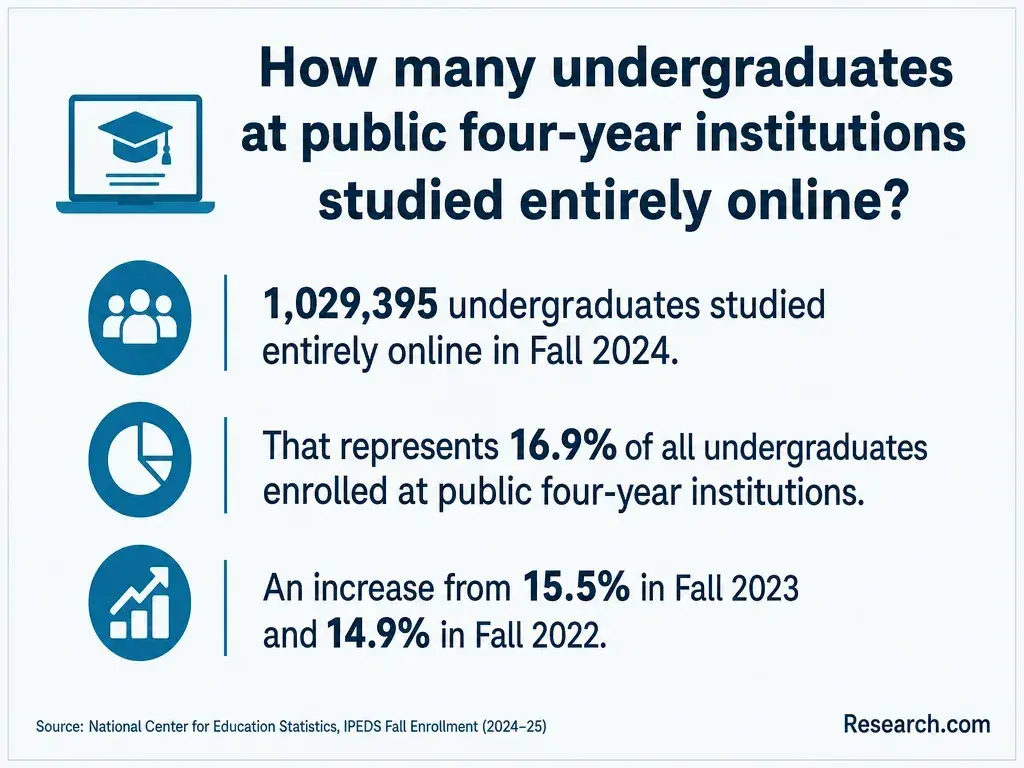
Choose the format that lets you complete the right courses consistently. Online delivery can reduce commuting, but classes may still have live meetings, fixed deadlines, proctored exams, group projects, or in-person components. Campus study may offer easier access to certain classes and local employers, yet its schedule can be harder to combine with work or caregiving.
If you need to keep working, flexible online study for business administration career growth offers programs to compare. Request a sample term schedule and assessment policy. For a licensed goal, also confirm that the courses and their documentation can be evaluated by the relevant authority; online format alone neither establishes nor rules out eligibility.
Schools set their own requirements for first-year, transfer, and returning applicants. Depending on the program, you may need secondary-school or college transcripts and may have to meet separate requirements for admission to the business major. Admission does not mean previous coursework will satisfy the business core - or that the eventual degree will meet licensing rules.
Ask admissions which requirements apply to you, then ask the registrar or transfer office for a course-by-course evaluation and the business department about major prerequisites. Online colleges with accelerated business programs are worth comparing if timing matters, but verify entry requirements and the actual sequence of required courses before assuming you can accelerate completion.
Your decision should use the cost of finishing your goal, not only advertised tuition. Request a written estimate based on your degree audit that includes remaining tuition, mandatory fees, books or software, and any travel or proctoring costs. Then ask what additional coursework, exams, applications, or supervised experience your intended credential may require outside the degree. Do not assume financial aid will cover those later expenses.
Affordable online business program comparisons can narrow your search, but compare schools using the same transfer-credit and enrollment assumptions. A lower per-credit price may cost more overall if it leaves you with more required courses or delays a prerequisite sequence.
Depending on your experience and the employer, a business graduate might pursue operations coordination, marketing coordination, HR support, sales operations, procurement support, or administrative roles. These jobs differ in their tools and responsibilities. A new graduate should not assume that a general business degree alone qualifies them to manage staff, practice public accounting, or perform regulated financial activities.
Match the job's tasks to evidence you can show: relevant coursework, spreadsheet or reporting work, an internship, or a supervised project. If purchasing and logistics are your clear target, online supply chain programs balancing cost and completion time provide an alternative to compare with a general BS. Choose based on the target role's skills and hiring requirements, not on a degree title alone.
What Salary and Job Outlook Can Business Graduates Expect?
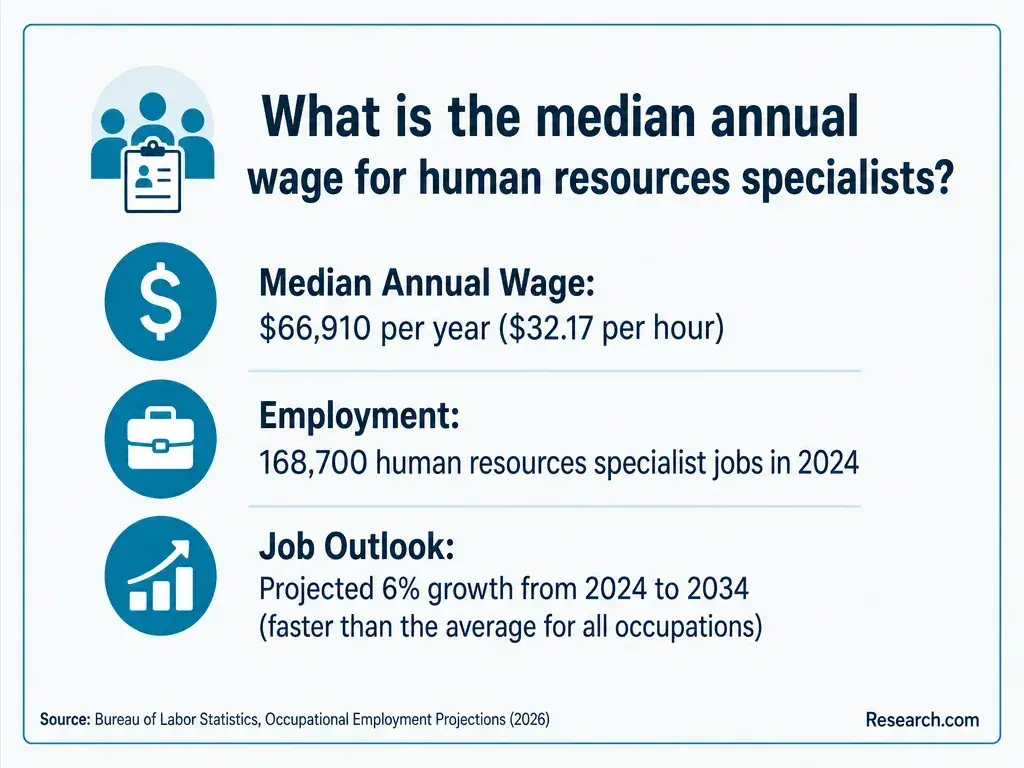
There is no single salary or growth rate for BS in Business Administration graduates: labor data describe occupations, not the earnings caused by a particular degree. For context, the U.S. Bureau of Labor Statistics reports a May 2025 median annual wage of $75,940 for human resources specialists and projects 6% employment growth from 2025 to 2035. Those figures cover workers across experience levels; they are not a starting-pay estimate or a promise that a business graduate will enter HR.
When weighing cost against career prospects, compare job postings in your intended location and function, including experience and credential requirements. You can compare shorter business administration college programs, but assess their total completion cost alongside realistic entry roles, not the wages of established managers or licensed professionals.
Other Things You Should Know About Business Administration
Yes, but the degree is not required to start most businesses. Your activity and location may require business registration, permits, or an occupational license; check those obligations separately.
Possibly. Exam eligibility and timing belong to the relevant board or credentialing organization. Check its applicant rules rather than assuming enrollment in a business program is enough.
Check the destination state's rules before choosing courses. Requirements and procedures can differ, and completing a degree under one state's expectations does not establish eligibility elsewhere.
List the degree, any officially awarded concentration, and separately earned credentials accurately. Describe relevant projects or work experience without presenting coursework as a license or an unawarded certification.
- Education Requirements | texas.gov https://www.tsbpa.texas.gov/applicants/education/
- Accreditation in the U.S. | ed.gov http://www.ed.gov/laws-and-policy/higher-education-laws-and-policy/college-accreditation/accreditation-in-the-us
- Requirements for an Ohio Real Estate Salesperson's License https://com.ohio.gov/divisions-and-programs/real-estate-and-professional-licensing/salespersons-and-brokers/guides-and-resources/requirements-for-an-ohio-real-estate-salespersons-license
- Understanding U.S. Accreditation | EducationUSA https://educationusa.state.gov/understanding-us-accreditation
- Complying with Professional Licensure Requirements | wiche.edu https://wcetsan.wiche.edu/resources/complying-professional-licensure-requirements-beginners-checklist
- Occupational Licensure and State Reciprocity Disclosures (HB 1508) - Dallas College https://www.dallascollege.edu/about/legal/occupational-licensure/
- Colorado Real Estate Licensing - CSU College of Business https://biz.colostate.edu/centers-institutes/everitt-real-estate-center/real-estate-licensing
- Certified Public Accountant (CPA) | Certifications | Lynn Pippenger School of Accountancy | USF Muma College of Business https://www.usf.edu/business/schools/accountancy/certification-cpa.aspx
- State Professional Licensure Disclosures | Otterbein University https://www.otterbein.edu/about/sara/professional-licensure-disclosures/
- Professional Licensure & Location | College of St. Scholastica https://services.css.edu/TDClient/354/Portal/KB/Article/11783/Professional-Licensure-Location