2027 BS in Business Administration: Accelerated Terms Versus Standard Semesters
Audited and Verified:
Our Editorial and Data Verification Process
Research.com uses government datasets, official education statistics and primary institutional information to support its career and degree guides. Our review process checks factual accuracy, occupational definitions, source dates and the requirements associated with the credentials discussed.
How This Article Was Fact-Checked
Our editorial team verifies salary estimates, employment projections, education requirements and program information against original data providers and official organizations. Salary figures are checked against the relevant occupational definitions and reporting periods. Information about licensure, accreditation and required in-person training is reviewed separately.
Fact-checked and verified on:

Co-Founder and Chief Data Scientist
A shorter business course can fit your calendar - or overwhelm it. Accelerated terms compress coursework into fewer weeks, while standard semesters spread it across a longer period. For prospective and returning BS in Business Administration students, that distinction affects weekly study time, course sequencing, work commitments, and the date a degree is actually finished.
This guide compares both formats and shows what to verify with a school before choosing a pace.
Key Things You Should Know
- Accelerated courses may run for about 7 or 8 weeks instead of a roughly 15-week semester, but shorter courses do not necessarily mean fewer credits or less work.
- Finishing sooner requires completing more applicable credits each year - not merely enrolling in shorter terms.
- Required-course availability and transfer evaluations can change the timeline. Choose the format around your sustainable weekly workload, verified degree plan, and total cost; online delivery alone does not make an accelerated course self-paced.
What is the difference between accelerated terms and standard semesters in a BS in Business Administration?
Accelerated terms compress a course into a shorter teaching period; standard semesters spread it over more weeks. The formats can award the same credit for a course with comparable learning outcomes, but the shorter term requires students to complete readings, assignments, and assessments faster. Schools set their own calendars, so confirm the dates for the specific program rather than relying on its "accelerated" label.
This comparison separates the course calendar from the degree timeline - two things that are easy to confuse.
| Feature | Accelerated terms | Standard semesters |
| Typical course span | Often about 7 or 8 weeks, though schedules vary | Often roughly 15 weeks |
| Weekly pace | More frequent deadlines for each course | More time between milestones for each course |
| Courses at once | May be fewer, but the number depends on the student's plan | Often several courses running together |
| Time to degree | Potentially shorter if enough required courses are offered and completed each year | Typically follows fall and spring schedules, with summer study sometimes available |
A short term can be useful if you prefer concentrating on fewer subjects at once. A semester may suit you better if you need more time to practice accounting or statistics between assessments. When reviewing accelerated business bachelor's school comparisons, check the assumptions behind each advertised completion time, particularly transfer credits and year-round enrollment.
Is an accelerated BS in Business Administration as credible as a traditional degree?
It can be. Term length alone does not determine whether a BS in Business Administration is credible. Verify that the institution holds recognized institutional accreditation, that it actually awards the stated degree, and that accelerated students complete the applicable curriculum and graduation requirements. Ask the school whether its short-term and semester versions use the same course outcomes and appear differently on transcripts.
Business-school or programmatic accreditation is a separate question. If a school cites AACSB, ACBSP, or IACBE, confirm the accreditor's scope and whether it covers the business program you intend to enter; do not assume institutional accreditation and business accreditation are interchangeable. Published listings of American business schools offering online degree study can help identify programs to investigate, but the institution and accreditor should confirm their current status.
For employers, evidence of business skills also matters. An accelerated student should have opportunities to produce credible work - such as a financial analysis, operations proposal, or supervised project - rather than choosing a program solely for its shortest advertised timeline.
How long does it take to complete an accelerated versus traditional business degree?
A traditional full-time bachelor's path is commonly planned around four academic years. An accelerated path may finish sooner, but the decisive measure is how many credits that satisfy degree requirements you complete over the year. Taking one course in each short term is not automatically faster than taking several courses each semester.
Start with the school's official degree audit: identify remaining general education, business core, concentration, elective, capstone, and residency requirements. Then check when each required course runs and whether prerequisites block a later course. For transfer students, accepted credits may count only as electives rather than replace a required business class; the receiving institution makes that determination.
Summer enrollment and multiple start dates can shorten gaps, while a course offered only occasionally can erase the apparent advantage of shorter terms. Use accelerated online business degree programs as a starting point, then request an individualized, term-by-term graduation plan before relying on a completion date.
Accelerated study concentrates a course's work into fewer weeks. A student who can reserve regular, substantial study blocks may appreciate focusing on one subject at a time. Someone with unpredictable shifts, caregiving duties, or limited time to practice quantitative material may find the longer runway of a semester more manageable.
The key comparison is total weekly commitments across all active courses, not just the number of courses on the schedule. An accelerated accounting class may require frequent problem sets and prompt feedback; a marketing or management class may add group meetings and presentations. Standard semesters can also be demanding when several courses have deadlines in the same week.
Before enrolling, obtain sample syllabi and ask when work is due, whether live sessions are required, and how quickly assignments build on one another. If you want a supply chain focus, check prerequisite order and course rotation as well as pace; economical supply chain study timelines are most useful when compared with the specific courses your degree requires. If your available hours fluctuate sharply, a lighter semester load may lead to steadier progress than repeated short-term withdrawals.
Most BS in Business Administration programs combine general education with business subjects such as accounting, economics, finance, marketing, management, operations, statistics, and business law. Many also require a strategy course or capstone. Exact requirements vary: a BS, BBA, and specialized business bachelor's degree should not be treated as identical curricula.
The format changes when you encounter these subjects more than which subjects a school requires. In a compressed term, take particular care with sequences such as introductory accounting before finance or statistics before advanced analytics. An official concentration may have its own required courses and limited offering dates; a collection of electives is not automatically a concentration.
If your interest is HR, compare the depth of the school's HR courses and applied work with a broader human resources program selection guide. If it is project management, ask whether the business core provides enough practice for your goal or whether focused electives or separate training would serve you better. Course titles alone do not establish professional competence or certification eligibility.
An online accelerated program can lead to the same named degree as a campus program, but equivalent credentials do not guarantee equivalent schedules or experiences. Compare required outcomes, faculty access, advising, library and software access, career services, and opportunities for internships or applied projects. Confirm whether any component requires a campus visit or a placement near your home.
Online also does not mean self-paced. Courses may have fixed weekly deadlines, live presentations, team meetings, proctored exams, and software requirements. Ask for the schedule and assessment rules for required business courses, not just a general description of the online program. If you are comparing several schools, application-cost-free online school options may reduce the expense of exploring alternatives, but application fees should not outweigh academic fit.
Requirements depend on whether the program admits first-time students, transfer students, or degree-completion applicants. A school may request prior transcripts and impose institution-wide admission rules, while its business major may have separate GPA or prerequisite conditions. Accelerated scheduling is not, by itself, a distinct admission credential.
Before applying, review what to check before applying for a business administration degree, then ask the prospective school to evaluate your own record. Returning students should supply transcripts from every prior college and request a written explanation of which credits apply to the major - not simply how many credits are accepted. If mathematics, accounting, or economics preparation is needed, find out whether it must be completed before admission or can fit into the degree plan.
Finally, distinguish admission from a graduation commitment. Only an approved evaluation and current course schedule can support a realistic estimate of remaining study.
There is no single accelerated-degree price. A shorter calendar can reduce some living or commuting costs, but it does not necessarily reduce tuition. Schools may charge by credit, course, or term; fees, remaining required credits, enrollment intensity, and time to completion all affect the total.
Request comparable cost estimates for both formats using the same approved transfer-credit evaluation. Include tuition, mandatory and technology fees, books or software, any travel or proctoring expense, and the cost of courses that do not fit into your original plan. Compare lower-tuition online business administration programs on remaining cost to graduation, not advertised tuition alone.
Also check financial-aid eligibility and payment periods with each school's aid office. More intensive study may change your work hours or cash-flow needs, and employer reimbursement may arrive only after a course ends. A cheaper-looking accelerated option is not the better financial choice if its pace makes repeated courses or lost earnings more likely.
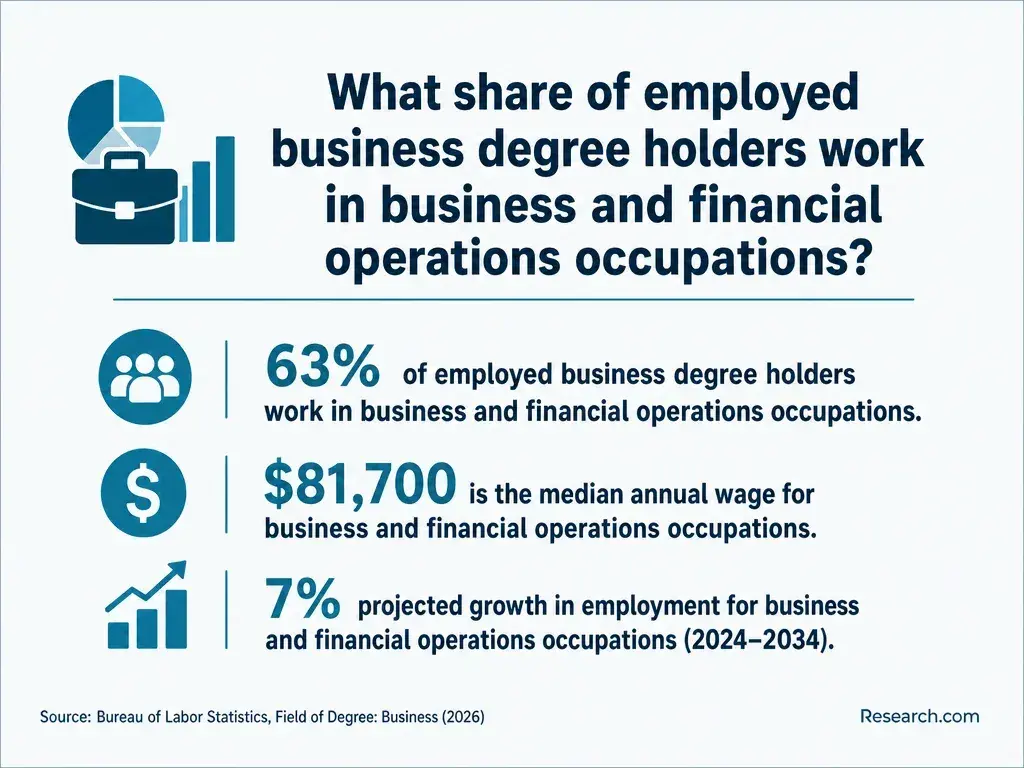
The degree can support applications for business roles, but employers hire for particular tasks and experience - not for the pace at which coursework was completed. Graduates may pursue roles in operations coordination, sales support, HR, marketing, or procurement, depending on their skills and work history. Supervisory and specialist positions can require substantial additional experience.
For context, the U.S. Bureau of Labor Statistics reports a May 2025 median annual wage of $75,940 for human resources specialists and projects 6% employment growth for that occupation from 2025 to 2035. That is an occupation-wide median, not an expected starting salary for a new business graduate. An applicant interested in HR should pair relevant coursework with evidence of communication, records handling, and workplace judgment.
Match the degree plan to a target role: compare job postings, identify missing technical skills, and seek relevant work or supervised projects. If your goal is organizational leadership rather than a broad business role, accelerated organizational leadership degrees offer another curriculum to compare; neither degree substitutes for demonstrated management experience.
Do business administration graduates need professional licenses or certifications?
There is generally no license required simply to hold a BS in Business Administration or work in many general business roles. Particular occupations are different: regulated accounting or financial-services work may require separate education, examinations, experience, or authorization. Voluntary certifications in areas such as HR or project management have their own eligibility rules.
Check the requirements of the actual role and credential issuer before choosing courses. A project management class, for example, can build useful skills but does not automatically award a professional certification. If you are considering a separate project management degree instead of a general business degree, compare project management study costs beyond tuition alongside curriculum and credential requirements. Do not add a second degree solely because a job posting mentions a certification.
Other Things You Should Know About Business Administration
Possibly. Ask whether the program permits planned breaks and how one would affect course availability, enrollment status, financial aid, and your graduation plan.
Term length alone does not decide transferability. The receiving college evaluates the institution, course content, credit value, grades, and how the credit applies to its degree requirements.
Withdrawal and refund deadlines may arrive quickly in a compressed term. Check the school's calendar and ask the financial-aid office about consequences before dropping a course.
That depends on whether the school offers both formats and permits a change within your degree. Confirm which completed courses will apply, when remaining courses are offered, and whether tuition or aid rules will change.
- Semester Course Load and Student Performance - PMC - NIH https://pmc.ncbi.nlm.nih.gov/articles/PMC7568764/
- Receiving Financial Aid | studentaid.gov https://studentaid.gov/complete-aid-process/receive-aid
- Recommended Course Sequence | Texas Higher Education Coordinating Board https://www.highered.texas.gov/data-submission-reporting/recommended-course-sequence/
- Cost of Attendance (Budget) | 2025-2026 Federal Student Aid Handbook https://fsapartners.ed.gov/knowledge-center/fsa-handbook/2025-2026/vol3/ch2-cost-attendance-budget
- Study on Best Practices in Credit Transfer | texas.gov https://reportcenter.highered.texas.gov/reports/data/board-x-m-transfer-of-course-credit-between-public-institutions-of-higher-education-10-18/
- Undergraduate Retention and Graduation Rates - COE https://nces.ed.gov/programs/coe/indicator/ctr/undergrad-retention-graduation
- How Do Transfer Credits Work When You Go Back to School? | Whitworth Online https://online.whitworth.edu/news-articles/how-do-transfer-credits-work-when-you-go-back-to-school/
- How to Transfer College Credits and Finish Your Degree Faster | Park University https://www.park.edu/blog/transfer-college-credits-finish-degree-faster/
- Explanation of Tuition and Fees - UIC Office of the Registrar https://registrar.uic.edu/financial-matters/tuition-explanation/
- Optimizing Course Availability and Delivery for On-Time Completion | Community College Research Center https://ccrc.tc.columbia.edu/research-project/optimizing-course-availability.html