2027 BS in Business Administration Math Planning: Asking About Quantitative Course Success Support
Audited and Verified:
Our Editorial and Data Verification Process
Research.com uses government datasets, official education statistics and primary institutional information to support its career and degree guides. Our review process checks factual accuracy, occupational definitions, source dates and the requirements associated with the credentials discussed.
How This Article Was Fact-Checked
Our editorial team verifies salary estimates, employment projections, education requirements and program information against original data providers and official organizations. Salary figures are checked against the relevant occupational definitions and reporting periods. Information about licensure, accreditation and required in-person training is reviewed separately.
Fact-checked and verified on:

Co-Founder and Chief Data Scientist
A BS in Business Administration may require statistics, accounting, finance, and other courses that use math - even if you do not plan to work in analytics. For students choosing a program or returning to school, the important issue is not just whether tutoring exists, but whether help is available when a difficult course requires it.
This guide shows how to identify quantitative requirements, plan their sequence, and ask specific questions about instruction, feedback, and support before you enroll.
Key Things You Should Know
- Check the degree plan and course prerequisites: business programs commonly use algebra, statistics, accounting, and applied quantitative reasoning, but requirements differ by school and concentration.
- Ask who helps with each required course, when help is available, and whether online students can use it; a general promise of "tutoring" is not enough.
- Plan for practical data skills as well as passing grades: U.S. employment of market research analysts is projected to grow 7% from 2025 to 2035, but that occupation has requirements beyond a business degree.
What Math Courses Are Required for a BS in Business Administration?
There is no universal math-course list for a BS in Business Administration. A school may require college algebra, applied calculus, statistics, or a quantitative-reasoning course through general education, then require students to use those skills in accounting, finance, economics, or analytics. A concentration can add prerequisites that are not part of the general business core.
Read the current catalog and a sample degree plan together. The catalog identifies requirements; the plan shows when courses are intended to be taken. If you have prior coursework, ask whether it satisfies the specific math requirement or merely transfers as elective credit. To identify formal entry requirements before making a study plan, check prerequisites before applying to business administration programs.
How Can Students Succeed in Quantitative Business Courses?
Quantitative-course success usually depends on preparation, timely feedback, and practice with business problems - not simply on taking more math beforehand. Start by identifying the first required course in which your current skills may be a barrier. A student comfortable with algebra but new to spreadsheets needs a different preparation plan from someone who struggles to interpret percentages or graphs.
Use these questions to turn a program's support claims into a workable plan:
- Ask for a syllabus or course description and identify the calculations, software, and prerequisite skills assessed.
- Ask whether tutoring covers that specific course and whether tutors can help with accounting, statistics, or spreadsheets - not only general math.
- Check appointment hours, response times, instructor office hours, and support during major assignments or exams.
- Schedule practice before the first graded assessment; use incorrect answers to identify the concept you need to revisit.
If you will study while employed, protect recurring study and tutoring time before choosing a course load. Compare that commitment with career advancement study options in business administration; an online format still requires time for problem sets and feedback.
Do Business Administration Degrees Require Advanced Mathematics?
Not necessarily. Many business degrees emphasize applying algebra, statistics, and financial calculations to decisions rather than studying advanced mathematics for its own sake. However, "no calculus required" does not mean "little quantitative work": students may still need to interpret statistical evidence, build spreadsheet models, and explain assumptions behind a budget or forecast.
Requirements may become more demanding in finance, analytics, economics, or quantitatively focused electives. If you are considering a different major because of a calculus requirement, compare the actual catalogs first. For example, budget-friendly online project management programs offer another degree path to investigate, but their math requirements and costs also vary. Choose based on the work you want to learn, not an assumption that another program will be math-free.
Course names alone can hide the kind of help a student will need. This table distinguishes common quantitative subjects by the work they ask students to do; it is not a universal list of required courses.
| Subject | Typical quantitative work | Preparation to check |
| Statistics or business analytics | Summarizing data, interpreting variation, and assessing evidence | Graphs, percentages, spreadsheets, and stated prerequisites |
| Accounting | Recording transactions and interpreting financial statements | Arithmetic accuracy and comfort with structured rules |
| Finance | Comparing cash flows, costs, and investment assumptions | Algebra, accounting concepts, and spreadsheet formulas |
| Operations or economics | Analyzing capacity, costs, trade-offs, or trends | Graphs, basic modeling, and relevant course prerequisites |
Sequence matters: a finance course may assume accounting knowledge, while an analytics elective may require statistics. Students moving between programs should request a written evaluation rather than assume similar course titles are interchangeable. The same caution applies when you compare project management bachelor's credit transfer rules: accepted credits may not satisfy a new program's quantitative core.
Both formats can offer strong quantitative support, but access depends on the course and the hours available to you. A campus tutoring center is less useful if its appointments conflict with work; an online program's recorded lessons may be helpful for review but may not provide timely feedback on a stalled assignment.
Compare support at the level of the required courses, not the program's general services page. Ask whether online students can meet tutors live, share a spreadsheet screen, attend instructor office hours, and receive feedback before the next assessment. For campus study, check tutoring hours, travel time, and whether help is available outside class. In either format, confirm exam arrangements and deadlines. If speed is a priority, review accelerated study formats for bachelor's students alongside course sequencing: a shorter term can leave less time to recover from an early misunderstanding.

Admission requirements vary by institution and by whether you enter as a first-year or transfer student. Schools may review prior transcripts and academic standing, while some business majors have separate entry requirements or courses that must be completed before upper-level work. Admission to a university does not establish that you have met every prerequisite for its business curriculum.
If a past math grade concerns you, ask admissions which requirement applies, then ask a business adviser when the next quantitative course must be taken. Bring course descriptions as well as transcripts if you want prior work evaluated. Students comparing an HR-focused route should also check how to apply prior credits to an HR bachelor's degree; different majors can classify the same credits differently.
A traditional full-time bachelor's path often takes about four years, but your remaining time depends on accepted credits that actually apply to requirements, course availability, and enrollment pace. Quantitative prerequisites can extend the schedule if a required course is offered infrequently or must be repeated before the next course.
For a meaningful cost comparison, request a degree audit and estimate tuition and mandatory fees for the remaining required courses, not just an advertised annual rate. Add likely books, software, exam costs, and any extra terms caused by course sequencing. You can find inexpensive online business administration colleges as a starting point, but confirm each school's current charges and your own credit evaluation before treating one as the lowest-cost option.
First verify recognized institutional accreditation and the exact degree you would earn. If a school advertises AACSB, ACBSP, or IACBE accreditation, check what that accreditation covers; it is distinct from institutional accreditation and does not, by itself, establish the quality of a particular tutoring service.
For this decision, request evidence that connects the curriculum to support: the required quantitative-course sequence, tutoring coverage for those courses, instructor access, and the policy for repeating or withdrawing from a course. Ask a current student-services representative what an online or part-time student can actually use. When comparing price as well, find accredited affordable business administration colleges with aid options, then verify current eligibility, net cost, and support directly with each institution.
Business graduates may pursue entry-level work in operations, marketing support, HR, sales, or project coordination, depending on their experience and skills. Quantitative coursework is useful when those jobs involve tracking budgets, checking reports, interpreting customer data, or explaining a process measure. Coursework alone does not make a new graduate a manager, financial specialist, or certified project professional.
Match the courses you choose to tasks in actual job postings. For project coordination, for instance, spreadsheet work, schedules, and clear status reporting may be more relevant than an advanced finance elective. If a specialized project management degree is also under consideration, include tuition and aid questions for project management students in the comparison; a more specialized title is not automatically a better value for your target role.
What Salaries and Job Outlook Can Business Graduates Expect?
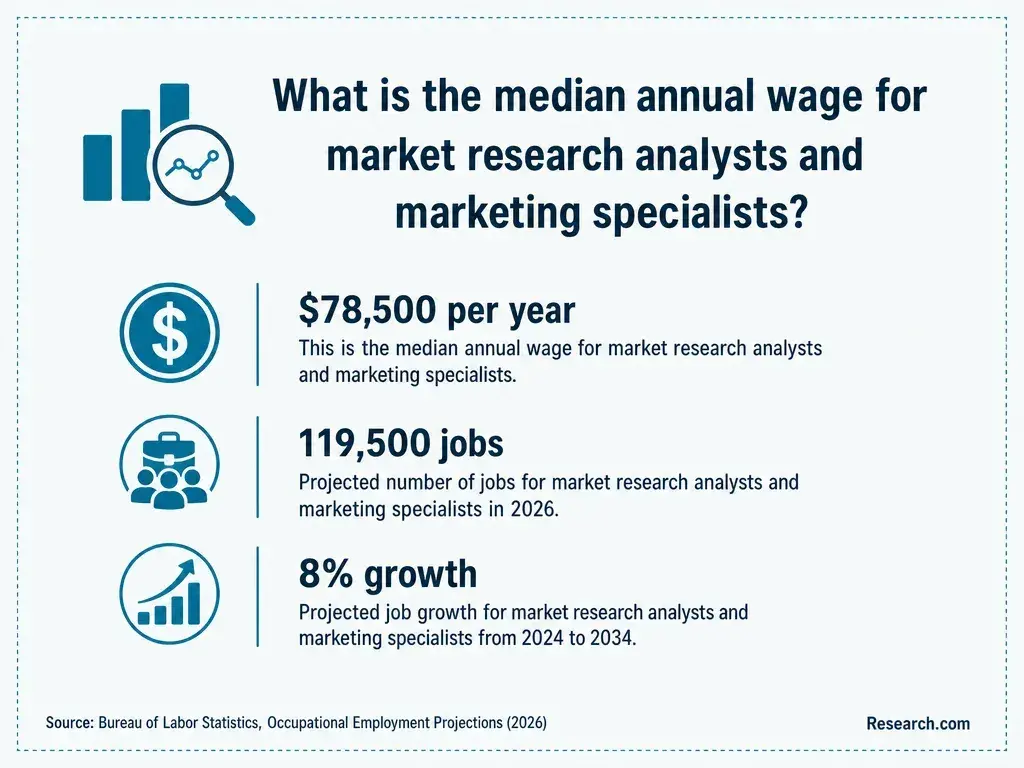
There is no single salary or employment projection for everyone with a BS in Business Administration. The U.S. Bureau of Labor Statistics reports a May 2025 median annual wage of $78,760 for market research analysts and projects 7% employment growth for that occupation from 2025 to 2035. Those are occupation-wide figures, not starting pay or a job-placement forecast for business graduates; qualifications and opportunities vary by role and employer.
Use occupation data to test whether a target function interests you, then compare local job requirements with your planned courses and experience. Consider net education cost separately from potential earnings. If you are weighing a project management degree against business administration, FAFSA grants and scholarships for project management students may affect the cost side of that comparison, but aid and future earnings must each be verified rather than assumed.
Other Things You Should Know About Business Administration
That depends on the course and assessment. Check the syllabus or ask the instructor which calculators, spreadsheet tools, and formula sheets are permitted before an exam.
Contact the institution's accessibility or disability-services office early. It can explain the documentation process and approved accommodations; a tutor cannot authorize them.
Usually not. Tutoring is intended to help you understand a method and correct your own work. Ask about the school's academic-integrity and tutoring policies.
Possibly, but get written approval before enrolling. Confirm the exact course equivalency, minimum grade, transfer policy, and whether the course will meet the business degree requirement.
- Full article: How Much Math Do Students Need to Succeed in Business and Economics Statistics? An Ordered Probit Analysis https://www.tandfonline.com/doi/full/10.1080/10691898.2009.11889532
- Business Administration Pathway, A.S. | Perimeter College https://admissions.gsu.edu/program/business-administration-as/
- How Much Math Do You Need to get a Degree in Business Administration? | Southern Nazarene University https://www.snu.edu/blog/how-much-math-do-you-need-to-get-a-degree-in-business-administration
- Business Administration (B.S.) - Northern Illinois University https://catalog.niu.edu/preview_program.php
- Supplemental Instruction (SI) | University at Albany https://www.albany.edu/tutoring/access-tutoring-resources/supplemental-instruction-si
- Online Teaching and Learning | Academic Programs and Planning https://academicprograms.calpoly.edu/online-teaching-and-learning
- Bachelor of Science in Business Administration - General Management | Georgia Tech Catalog https://catalog.gatech.edu/programs/business-administration-general-management-bs/
- Academic Support Resources - Romeoville https://www.lewisu.edu/case/academicresources.htm
- Quantitative Support - Washington, DC | American University https://www.american.edu/provost/eagle-learning-center/quantitative.cfm