2027 Choosing a BS in Business Administration for Business Roles in Engineering Firms
Audited and Verified:
Our Editorial and Data Verification Process
Research.com uses government datasets, official education statistics and primary institutional information to support its career and degree guides. Our review process checks factual accuracy, occupational definitions, source dates and the requirements associated with the credentials discussed.
How This Article Was Fact-Checked
Our editorial team verifies salary estimates, employment projections, education requirements and program information against original data providers and official organizations. Salary figures are checked against the relevant occupational definitions and reporting periods. Information about licensure, accreditation and required in-person training is reviewed separately.
Fact-checked and verified on:

Co-Founder and Chief Data Scientist
Engineering firms need people who can turn technical work into viable proposals, controlled budgets, reliable schedules, and strong client relationships. If you want to contribute on the business side, a BS in Business Administration can be useful - but its value depends on the role you want and the experience you can build alongside it.
This guide shows which jobs the degree may support, what to look for in a program, and where a specialized degree or direct work experience may be the better choice.
Key Things You Should Know
- A BS in Business Administration can prepare you for project coordination, procurement, finance, HR, and client-facing work in engineering firms; it does not qualify you to practice engineering or automatically manage projects.
- Prioritize accounting, operations, analytics, contracts, and applied work with technical teams over an industry-themed program name alone.
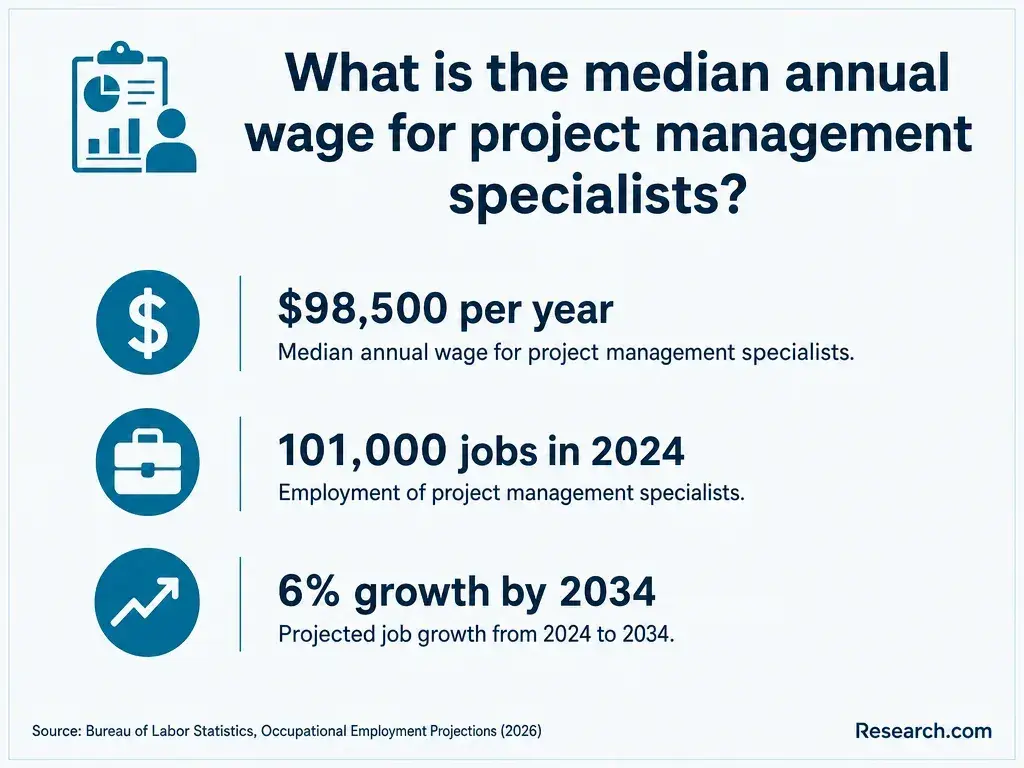
- The May 2025 national median wage for project management specialists was $102,320, but that occupation-wide figure is not a starting salary for business graduates or a figure specific to engineering firms.
What is a BS in Business Administration for engineering firm careers?
A BS in Business Administration is an undergraduate business degree, not an engineering credential. Its core typically develops knowledge of accounting, finance, management, marketing, and quantitative decision-making. In an engineering firm, those subjects matter because technical projects also require staffing plans, purchasing, contract administration, cash-flow awareness, and communication with clients.
The strongest fit is usually a student seeking a business function within a technical organization, rather than responsibility for engineering design or approval. A BS, BBA, or specialized business bachelor's may serve that goal; compare their actual courses and applied opportunities rather than assuming the degree titles establish different hiring rights.
If purchasing and distribution are your clear target, compare accelerated supply chain bachelor's degrees with general business programs for functional depth and time to completion.
Engineering firms vary, too. A consulting design practice, construction-focused engineering company, and manufacturer with an engineering division may assign very different work to similarly titled business employees. Use the job descriptions of your target employers to define what the degree needs to help you do.
What business roles can you pursue in an engineering firm with this degree?
Start with the responsibilities, not the title. The following paths show where broad business preparation can help and what additional evidence an employer may expect.
| Business path | Typical contribution in an engineering firm | Evidence beyond the degree |
| Project or operations coordinator | Track schedules, documentation, budgets, and handoffs | Accurate spreadsheets, scheduling work, and cross-team communication |
| Procurement or supply chain assistant | Support vendor comparisons, purchase orders, and delivery tracking | Purchasing processes, cost analysis, and familiarity with technical specifications |
| Proposal or business development coordinator | Assemble qualifications, deadlines, pricing inputs, and client materials | Writing samples, document control, and coordination with engineers |
| HR or finance support | Help administer staffing processes or project financial records | Relevant functional coursework and careful handling of confidential information |
A graduate may enter through a coordinator or assistant role and gain responsibility as their work warrants. Financial analyst, HR specialist, and project management specialist positions can demand more specific skills or experience; engineering project manager roles often require substantial technical and project history. For an HR-focused path, HR education costs and career planning can help you compare a general business degree with more focused study.
What courses should a business administration degree include for engineering industries?
Look for courses that connect decisions to the economics and execution of technical projects. Managerial accounting and finance help you interpret project costs and margins; operations and project management address schedules, capacity, and handoffs; statistics and information systems support reporting and forecasting. Business law, procurement, and professional writing are valuable where contracts, vendors, and proposals shape the work.
Read the catalog closely: an introductory project management class is not the same as a substantial sequence with scheduling, risk, and cost-control assignments. Check whether an operations, supply chain, finance, or analytics concentration is formally awarded, which electives are actually offered, and whether prerequisites add time.
If you need foundational coursework before entering a degree, short-term classes toward a bachelor's degree may be worth exploring, but ask the receiving school how each course would apply.
An especially useful assignment is a proposal budget or project dashboard built from permitted, clearly labeled information. It should show assumptions and limitations - not claim access to a firm's proprietary estimates or present a classroom forecast as a completed business result.
Business employees must communicate effectively with people who own technical decisions without pretending to make those decisions themselves. That means asking clear questions about scope and deadlines, translating requirements into accurate business documents, spotting discrepancies, and escalating issues to the responsible engineer or manager.
Useful evidence includes a well-documented cost model, a concise proposal excerpt, or a process map that explains who approves a purchase. Spreadsheet competence, version control, sound judgment with confidential client information, and follow-through across teams often matter more than listing software names without examples.
If you are considering online leadership bachelor's programs with compressed schedules, check that their applied assignments build these operational skills as well as general leadership concepts.
Existing experience counts when you can describe what you actually did. Customer service may demonstrate client communication; military logistics or administrative work may demonstrate coordination. Neither replaces knowledge of the target firm's projects, contracting practices, and approval boundaries.
First, confirm that the institution holds recognized institutional accreditation and that the BS in Business Administration is offered in the format you intend to attend. Then check whether any advertised AACSB, ACBSP, or IACBE business accreditation covers the school or program in question. Institutional and business accreditation have different scopes; neither proves that graduates secure engineering-firm jobs.
Compare the current catalog, elective rotation, transfer-credit evaluation, advising, internship rules, and career connections. Ask career services for examples of employers recruiting for project support, procurement, proposals, or other relevant functions - and how any placement figures were defined. US business college rankings for online learners can help you identify candidates, but verify these role-specific details directly before choosing one.
If you already have credits, request a degree audit that separates credits accepted from credits satisfying the business core, concentration, and residency requirements. The institution makes the final applicability decision.
Neither format is inherently better. An online program may let you keep a relevant job while studying; a campus program may offer easier access to local employer events, team projects, and internships. The deciding factor is whether you can gain credible, supervised experience in the function you want.
Ask online programs about live meetings, group assignments, exam arrangements, software access, and whether internships or capstones can be completed near you. Ask campus programs how often required courses run and whether work placements fit your schedule. You can compare fast-paced online business degrees, but a shorter calendar is not an advantage if it leaves too little room for relevant work or requires an unsustainable course load.
Requirements vary by school and entry route. First-year applicants generally provide secondary-school records; transfer applicants provide college transcripts. Some institutions admit students directly to the business major, while others require later admission or completion of specified courses. Check the program's rules for mathematics, accounting, economics, GPA, and application materials rather than assuming one standard applies everywhere.
If you have prior coursework, ask admissions about entry eligibility and an academic adviser or transfer office about how credits would apply to graduation. Those are separate decisions. A school appearing among FAFSA-accepting colleges for business administration students still requires its own admission decision; federal aid eligibility is assessed separately and is not established simply by applying.
A traditional full-time bachelor's path commonly spans four academic years, while transfer credit, part-time enrollment, prerequisite sequencing, and course availability can change the time remaining. Do not rely on an accelerated completion claim until the school applies your credits to an official degree plan.
Compare total cost to finish, not tuition alone: remaining required credits, mandatory fees, books or software, internship travel, and any earnings you would forgo all matter. A lower per-credit price can lose its advantage if more courses are required. Use each school's written estimate and aid offer to compare equivalent completion plans; compare tuition for online business colleges as a starting point, not as a substitute for your individual cost calculation.
There is no reliable single salary for this degree in engineering firms. Pay depends on the occupation, location, firm, and responsibilities. The U.S. Bureau of Labor Statistics reports a $102,320 median annual wage for project management specialists in May 2025. That is a national, occupation-wide midpoint across industries and experience levels - not the expected pay for a new business graduate or a project coordinator.
For a useful comparison, search postings for your intended entry role and location, then assess the duties and experience required alongside the pay range. If you are weighing a quicker program against a lower-cost one, compare cost-to-finish for shorter business administration programs; do not assume faster graduation will produce a particular salary increase.
What is the job outlook for business roles in engineering firms?
Outlook depends on the business function, not the degree title. BLS projects 18% U.S. employment growth for logisticians from 2025 to 2035, a national occupation-wide projection. It signals demand for logistics work generally, but it does not measure openings in engineering firms or guarantee a job for a new graduate.
Check local postings to see whether your target firms seek procurement support, proposal coordination, project controls, or another function - and which tools and experience they specify. If you want to enter sooner, ranked programs for finishing a business bachelor's sooner may help you shortlist schools. Compare their opportunities to build relevant experience before treating speed as a career advantage.
Other Things You Should Know About Business Administration
Not for many business positions. Technical design, engineering sign-off, and some project leadership responsibilities have different qualification requirements; check the duties of the specific job.
Possibly, if your goal is construction-site operations or construction project controls. For business work across different types of engineering firms, compare the curricula and target job postings before specializing.
Only if a specific credential fits your experience and its issuer's eligibility rules. A course or business degree does not automatically qualify you for certification.
Possibly. Obtain academic approval, confirm supervision and learning requirements, and get employer permission before using workplace information or presenting a project publicly.
- Licensing Frequently Asked Questions (FAQs) | maryland.gov https://www.labor.maryland.gov/license/pe/pefaqsgenl.shtml
- Types of Business Degrees: Your Complete Guide | UWA Online https://online.uwa.edu/news/types-business-degrees/
- CAPM vs. PMP Certification | Purdue Project Management https://www.purdue.edu/projectmanagementcertification/news/capm-vs-pmp-certification/
- What's Important to your First Employer | Engineering Career Center https://ecc.ku.edu/index.php/whats-important-your-first-employer
- 11 Types of Business Degrees You Can Pursue in 2026 | University of North Dakota https://und.edu/blog/types-of-business-degrees.html
- Top Jobs in Business Administration & Career Paths | CityU of Seattle https://cityu.edu/what-can-you-do-with-a-business-administration-degree/
- Areas of Business BBA Grads Can Work In | North Carolina Central University https://online.nccu.edu/blog/areas-of-business/
- What's the Difference Between Business Administration and Business Management? | Husson University https://www.husson.edu/online/blog/2022/02/business-administration-vs-business-management
- Business Administration vs Business Management Explained | American College of Education https://ace.edu/blog/business-administration-vs-business-management/
- The Importance of Internships for Business Students | The Citadel Today http://today.citadel.edu/importance-internships-for-business-students/