2027 BS in Business Administration Math Planning: Evaluating a Program Advertised as Having Less Math
Audited and Verified:
Our Editorial and Data Verification Process
Research.com uses government datasets, official education statistics and primary institutional information to support its career and degree guides. Our review process checks factual accuracy, occupational definitions, source dates and the requirements associated with the credentials discussed.
How This Article Was Fact-Checked
Our editorial team verifies salary estimates, employment projections, education requirements and program information against original data providers and official organizations. Salary figures are checked against the relevant occupational definitions and reporting periods. Information about licensure, accreditation and required in-person training is reviewed separately.
Fact-checked and verified on:

Co-Founder and Chief Data Scientist
A BS in Business Administration advertised as having "less math" may still require statistics, accounting, finance, and spreadsheet work. That distinction matters if you are choosing a program around your math preparation or returning with credits you hope will satisfy a requirement.
This guide shows where quantitative work appears, how to compare programs without relying on marketing language, and what to confirm before enrolling. The goal is to find a manageable curriculum that still prepares you for the business work you want to do.
Key Things You Should Know
- "Less math" usually means fewer standalone math courses - not an absence of calculations in accounting, finance, economics, or business analytics.
- Compare each program's catalog and degree audit: a typical bachelor's degree requires about 120 credits, but the number and type of quantitative courses vary by school and concentration.
- Choose the lowest-math path that still fits your goal; avoiding statistics or financial analysis altogether can leave a preparation gap for data-heavy roles.
What math courses does a BS in Business Administration typically require?
Many programs require a general education math course - often college algebra, quantitative reasoning, or another approved option - and a statistics or business statistics course. Some specify calculus or business calculus, while others do not. A course's title alone is insufficient: its prerequisites, topics, and transfer equivalencies determine what you will actually study.
For a returning student, distinguish credit accepted by the college from credit that satisfies the business degree's math requirement. Send the transfer office the original course description and syllabus if an equivalency is unclear, and request an updated degree audit before registering for a replacement course. If you are also considering a specialized degree, transfer-friendly project management bachelor's degrees provide a comparison point - but their transfer and math rules must be checked separately.
Is a BS in Business Administration really a low-math degree?
It can be lower in advanced mathematics than some finance, economics, or analytics programs. It is not usually math-free. The practical test is whether you can interpret a percentage change, read a financial statement, use spreadsheet formulas, and assess what data does - or does not - support.
Programs may count statistics or quantitative reasoning outside the math department, making a simple count of "MATH" courses misleading. Ask for syllabi in accounting, finance, economics, operations, and the capstone, then check whether assessments involve calculations, spreadsheets, or data interpretation. Working learners comparing business administration degrees for working learners should also ask when these courses are offered; a manageable requirement is less useful if it conflicts with work.
Which business administration programs have the fewest math requirements?
There is no dependable school-by-school answer without comparing current catalogs for the same enrollment term. A program with quantitative reasoning instead of calculus may appear lighter, but its business core could include statistics, analytics, and demanding finance assignments. BS, BBA, and BA titles do not establish a consistent math ranking.
Use the following comparison to identify the curriculum features most likely to affect your workload. These are patterns to investigate, not guarantees about any particular school.
| Program feature | What it may mean for math | What to verify |
| Quantitative reasoning option | May replace college algebra or calculus as a general education requirement | Whether business statistics has a separate algebra prerequisite |
| General business or management concentration | May have fewer advanced quantitative electives than finance or analytics | The required core, not just concentration electives |
| Statistics or analytics requirement | May involve substantial calculations and software outside a math department | Syllabus, assignments, and prerequisites |
| Transfer or exam-credit policy | May eliminate a repeated course, but not a required skill | Written equivalency and the official degree audit |
Shortlist programs by their total required quantitative coursework, including prerequisites and business-core assignments, then compare cost. Directories of colleges offering economical online business study can help you find candidates, but price does not establish which curriculum has less math.
The degree requirement may be the same across formats at one institution, while the learning conditions differ. An online statistics class might use recorded explanations and scheduled deadlines; a campus class might provide regular in-person problem-solving. Neither format is inherently easier, and a fully online course is not necessarily self-paced.
Before choosing, ask about live sessions, timed or proctored exams, calculator and spreadsheet rules, tutoring hours, instructor response times, and how group assignments are scheduled. If shorter terms appeal to you, online business study with accelerated terms is worth examining alongside the actual pace of its quantitative courses: fewer calendar weeks can mean more work each week.
Accounting uses calculations to interpret transactions, costs, and financial statements. Finance applies rates, cash-flow estimates, and spreadsheet models. Statistics and analytics use data to describe patterns and evaluate uncertainty. Economics, operations, and marketing courses may also involve graphs, forecasts, budgets, or performance measures.
Match this work to your intended role. Someone interested in project coordination may need budgets and schedules more often than advanced statistical modeling; someone targeting financial analysis will need substantially stronger quantitative preparation than a minimal business core provides. If project work is your main interest, compare the curricula - not just the prices - of cost-conscious project management college options with a business administration program. Avoiding an unnecessary calculus course is reasonable; avoiding skills central to your target work is not.
First-year applicants generally submit evidence of secondary-school completion; transfer applicants submit prior college transcripts. Schools set their own GPA, application, and placement policies, and admission to the institution may be separate from entry into the business major. A math placement result may determine your starting course without deciding whether you are admitted.
Ask admissions which documents are required, then ask a business adviser whether algebra, statistics, or other prerequisites must be finished before specific core courses. If an application charge affects your shortlist, accredited colleges offering free online applications may be worth checking; confirm the current fee and business-program requirements directly with each college.
A bachelor's curriculum commonly totals about 120 credits and takes four years of full-time study, but your remaining time depends on approved transfer credit, course sequencing, and enrollment pace. A prerequisite taken before statistics or finance can extend completion even if it does not add many credits. Part-time study changes the calendar, not necessarily the total coursework.
Compare schools using the tuition and fees for your remaining required courses, plus books, software, exam charges, and any extra terms caused by course availability. Ask financial aid how your enrollment level and added prerequisites affect eligibility; do not assume a transfer estimate is a final cost estimate. If you are comparing a project-management major, FAFSA planning for project management bachelor's students can help frame aid questions, but your business program's award and costs require their own review.
Check the college's current institutional accreditation with the accreditor and confirm that the accreditor is recognized by the U.S. Department of Education or the Council for Higher Education Accreditation. Then check separately whether AACSB, ACBSP, or IACBE lists the business school or program and whether the named BS is within its stated scope. Institutional accreditation and business-specific accreditation are different claims.
Accreditation does not establish that a degree has fewer math courses or produces particular job outcomes. Even when a listing describes lower-priced accredited business administration study options, verify the current institution, exact degree, accreditation scope, and catalog requirements yourself before applying.
A general business degree can support applications for coordinator and specialist work in operations, marketing, HR, purchasing, or projects. Hiring depends on the role, relevant experience, and evidence that you can use spreadsheets, communicate findings, and handle the function's routine work. A degree does not confer a management position.
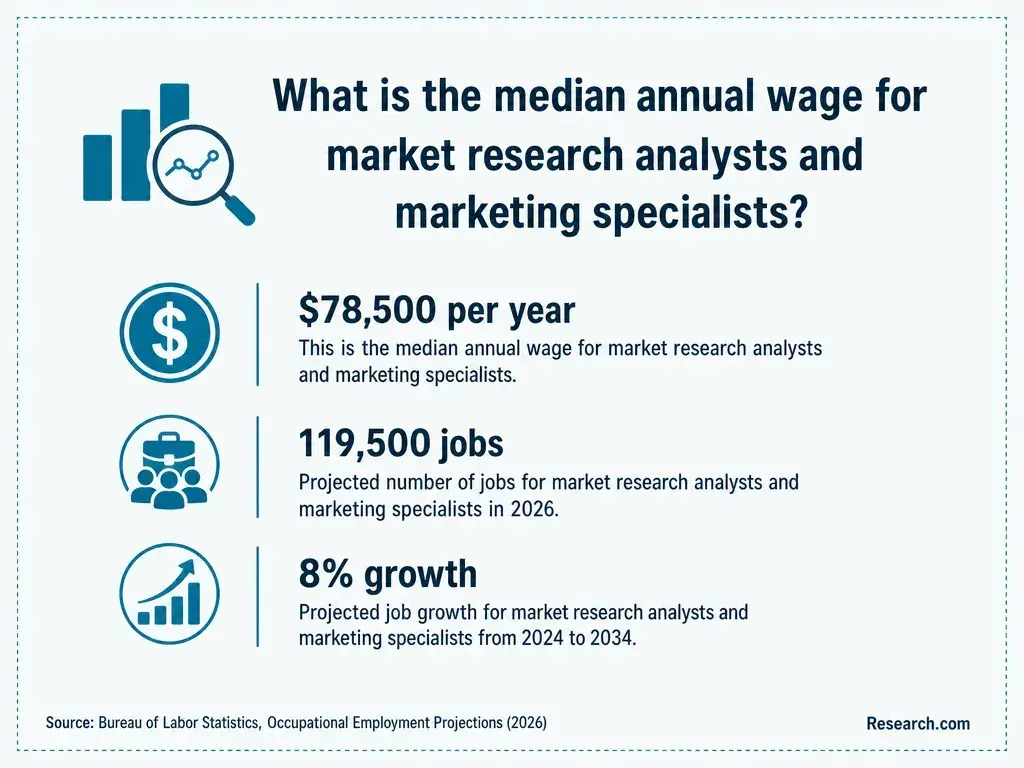
For context, the U.S. Bureau of Labor Statistics reports a $78,760 median annual wage for market research analysts in May 2025, with employment projected to grow 7% from 2025 to 2035. Those are occupation-wide figures, not expected earnings or hiring odds for a new business graduate; research and data skills matter for that role. If supply chain is your specific goal, explore fast-track supply chain bachelor's programs and compare their quantitative preparation with the general business degree.
Do business administration graduates need certifications or licenses?
No universal license is required simply to hold a BS in Business Administration or pursue general business roles. Particular jobs may have separate requirements: accounting licensure, financial-services licenses, and some employer-preferred professional certifications have their own education, examination, or experience rules. A concentration or elective does not automatically meet them.
If a credential is your goal, check its issuing organization's eligibility rules before selecting the lightest-math degree. Compare the cost of a degree with targeted training where appropriate; budgeting for online project management college study is one example of how to examine a specialized degree's tuition and fees rather than assuming it is required for project work.
Other Things You Should Know About Business Administration
Review algebra, percentages, graphs, and spreadsheet formulas before your first quantitative course. Ask the college about placement, refresher options, and tutoring rather than assuming you must repeat a course.
Often, but permitted tools vary by instructor and assessment. Check the syllabus and exam rules, especially for proctored online tests.
Contact the instructor and tutoring service early, and ask an adviser whether withdrawing or repeating it would affect course sequencing, academic standing, or financial aid.
No. Consider both the work you want to do and the support available to learn its required skills. A manageable course plan may serve you better than a concentration chosen solely to avoid calculations.
- Mathematics Graduation Requirements for Students | NC DPI https://www.dpi.nc.gov/documents/course-information/mathcreditoptions-policy-323171/open
- Semester Course Load and Student Performance - PMC - NIH https://pmc.ncbi.nlm.nih.gov/articles/PMC7568764/
- Complete Courses and Requirements | ohio.gov https://education.ohio.gov/Topics/Ohio-s-Graduation-Requirements/Ohio%E2%80%99s-Graduation-Requirements/Complete-Courses-Classes
- What Is the Difference between a BS and a BA Degree? | American InterContinental University https://www.aiuniv.edu/degrees/business/articles/bs-vs-ba-degree
- AACSB Global Standards for Business Education https://www.aacsb.edu/educators/global-standards
- Math Course Prerequisites | MSU Denver https://www.msudenver.edu/math/math-course-prerequisites/
- Does Business Administration Require Math? | MVNU https://mvnu.edu/blogs/does-business-administration-require-math/
- Mathematics Courses (MATH) | Columbus State Community College https://explore.cscc.edu/subjects/MATH/mathematics
- How Much Math Do You Need to get a Degree in Business Administration? | Southern Nazarene University https://www.snu.edu/blog/how-much-math-do-you-need-to-get-a-degree-in-business-administration
- Degree Requirements | Paul Merage School of Business https://merage.uci.edu/programs/undergraduate/degree-requirements.html