Careers After an Online MBA in Leadership for Military Veterans

Co-Founder and Chief Data Scientist
Military leadership experience can open doors in civilian organizations, but employers may not immediately understand the scope of a veteran's responsibilities. An online MBA in leadership can add business knowledge and help translate that experience into management roles - if the program fits the target job.
This guide examines realistic career paths, the gaps an MBA can and cannot close, and the costs and benefits veterans should weigh before enrolling.
Key Things You Should Know
- Veterans may be well positioned for operations, project, logistics, and people-management roles; the strongest match depends on their actual military duties and civilian industry experience.
- The U.S. Bureau of Labor Statistics reports a $126,520 median annual wage for management occupations in May 2025, but that is not an MBA-graduate salary or an expected starting salary.
- Compare the target role, total program cost, career support, and confirmed VA benefit coverage before choosing an online leadership MBA.
What careers can veterans pursue after earning an online MBA in leadership?
An online MBA in leadership combines a broad business degree with additional study of leading people and organizations. For veterans, the most realistic next role usually builds on work they have already done - not on the degree alone. A former logistics officer, for example, has a different starting point from a veteran whose primary experience was training personnel.
The table connects common military responsibilities with civilian paths. Its final column matters because employers may still require industry knowledge, technical skills, or a track record in the specific function.
| Civilian path | Relevant military experience | Likely gap to address |
| Operations manager | Resource allocation, process improvement, team supervision | Commercial budgets, customer measures, or industry-specific operations |
| Project or program manager | Coordinating missions, schedules, risks, and stakeholders | Civilian project methods and evidence of delivering comparable projects |
| Supply chain or logistics manager | Procurement, distribution, inventory, and readiness planning | Commercial systems, vendor relationships, and sector requirements |
| Training or people-operations manager | Developing personnel and managing teams | Employment law, civilian HR practices, and relevant functional experience |
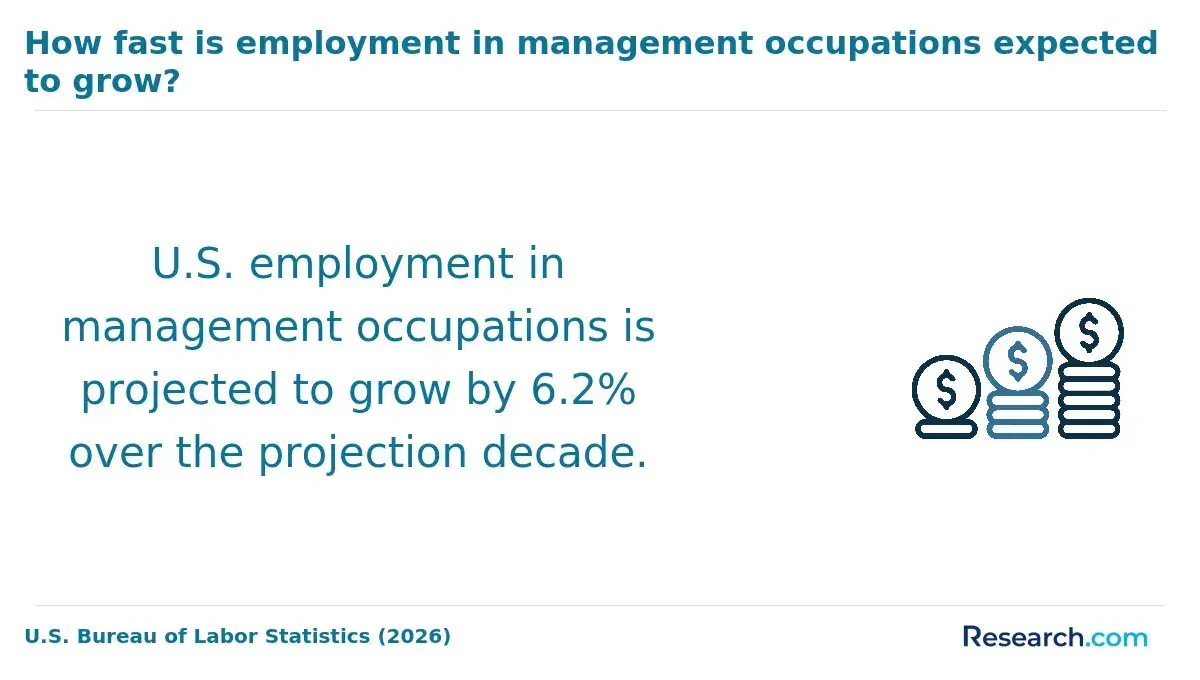
Progression might mean moving from a military specialty into a related civilian management job, then taking on a larger team or budget. A substantial switch - such as moving from logistics into marketing - usually calls for projects or work experience in the new function. Veterans considering that route can compare management programs for marketing professionals rather than assuming a leadership concentration provides marketing depth. Across management occupations, the Bureau of Labor Statistics projects growth faster than the average for all occupations from 2025 to 2035; opportunities will still vary considerably by occupation and location.
How does an online MBA in leadership benefit military veterans transitioning to civilian careers?
The principal benefit is a bridge between proven leadership and civilian business expectations. MBA coursework can give a veteran the language to discuss budgets, profit, customers, organizational change, and measurable results. Group projects can also provide examples of working with peers who do not share a military chain of command.
That bridge works best when paired with deliberate career preparation. Translate a military accomplishment into its business equivalent - such as the size of a team managed, a process improved, or resources overseen - without relying on rank or unexplained acronyms. Ask career services whether they support experienced online students, arrange introductions to employers, and help veterans target roles at the right level. A degree can strengthen a candidacy, but it cannot replace a civilian employer's required technical or industry experience.
What leadership skills do veterans gain from an online MBA program?
Veterans often arrive with experience making decisions under pressure and leading teams. An MBA can extend those strengths into financial decision-making, such as evaluating a proposed investment; organizational change, such as gaining support across departments; and stakeholder communication, such as presenting a recommendation to executives with competing priorities.
The distinction is important: commanding a unit and influencing colleagues in a civilian organization are not identical. Look for assignments that require negotiation, feedback, ethical judgment, and decisions based on financial or market evidence - not just courses that repeat general leadership theory.
Most MBA programs have a management core, which may cover accounting, finance, marketing, operations, strategy, and analytics. A formal leadership concentration may add courses in organizational behavior, change management, negotiation, or leading teams. Schools determine their own course names and requirements; a single leadership elective does not necessarily constitute a concentration.
For career purposes, compare the actual assignments as well as the catalog. A logistics veteran seeking an operations role may gain more from a supply chain project than another general leadership seminar. A veteran pursuing people management should look for work involving performance, conflict, and organizational design. An applied project with a civilian organization may also produce a useful interview example, but its availability must be confirmed with the program.
Requirements vary by school. Common application components include a bachelor's degree, transcripts, a résumé, and written statements or recommendations. Programs differ on professional-experience expectations, GMAT or GRE policies, interviews, and whether applicants need business foundation courses. Military service can provide strong management examples, but it does not automatically satisfy every school's experience requirement.
Before applying, ask an admissions adviser how the program evaluates military responsibilities and whether quantitative preparation is recommended. On the résumé, describe decisions and outcomes in terms a civilian reviewer can assess. Veterans comparing test policies and other entry criteria can use a list of online MBA programs with accessible admissions as a starting point, then verify each school's current requirements directly.
Completion time depends on the program's credits, course sequence, transfer or waiver policies, and whether a veteran studies part time or at an accelerated pace. Online delivery does not necessarily mean self-paced study: scheduled classes, team assignments, or a required visit can affect how the degree fits work and family commitments.
Published tuition is only one part of the price. Compare required credits multiplied by the applicable per-credit tuition, then add mandatory fees, materials, and any travel. Ask whether tuition changes during enrollment and whether a slower pace adds term-based fees. If using VA benefits, compare the amount the benefit is expected to cover with the amount still payable; do not treat a school's advertised price as a personal net cost.
For an initial budget screen, a low-cost online MBA comparison can help identify programs to investigate. Verify current prices, required fees, the availability of leadership coursework, and the complete cost before applying. A less expensive MBA with weak connections to the target occupation may offer less value than a better-fitting program - or a shorter credential.
An online MBA may let a veteran keep working or remain near family while studying. A campus-based MBA may offer more regular face-to-face contact and, in some cases, a recruiting structure better suited to a major career change. Neither format guarantees access to internships, employer events, or the same career services as a school's other MBA formats.
Compare the specific program, not just the delivery label. Ask whether live sessions conflict with work, whether online students can attend employer events, and how group projects are scheduled. Veterans considering regional employment should also assess where alumni and employer connections are concentrated; lists of online MBA business-school options can help start a location-specific comparison. A required campus visit may change both scheduling and travel costs.
Eligible veterans may be able to use Post-9/11 GI Bill benefits for an approved online MBA, but eligibility, payment amounts, and remaining entitlement are individual matters. VA approval applies to the school and program; institutional accreditation alone does not establish benefit eligibility. The housing allowance for exclusively online enrollment is generally calculated differently from the allowance for qualifying in-person enrollment, and enrollment intensity also matters.
Before committing to a school, confirm the program's approval through VA resources and its school certifying official. Ask the official to review how tuition and fees would be certified, whether the planned course load affects payments, and whether any campus-based courses meet VA rules for in-person study. For a private-school program, ask whether the applicable tuition cap could leave a balance and, if so, whether the school participates in Yellow Ribbon for your eligibility level. Do not assume that veteran status alone qualifies you for every benefit or for Yellow Ribbon funding.
There is no reliable single salary for veterans who earn this degree. The U.S. Bureau of Labor Statistics reports that the median annual wage across all management occupations was $126,520 in May 2025, compared with $50,980 across all occupations. The management figure describes workers in those jobs - not online MBA graduates, new managers, or veterans specifically - so it should not be used as a personal earnings forecast.
Expected pay depends more directly on the occupation, location, industry, scope of responsibility, and prior experience. To assess a particular move, compare local postings for roles you could credibly hold now with postings for the next role you want. Note the required skills and experience, then consider whether the MBA would help close those gaps enough to justify its net cost. The Bureau of Labor Statistics projects about 1.1 million management-occupation openings annually, on average, from 2025 to 2035, but that broad total does not establish demand for a particular MBA concentration.
How do veterans choose an accredited online MBA in leadership?
Start by confirming that the institution holds recognized institutional accreditation and that the degree is an online MBA with a formally available leadership concentration, if that designation matters to you. AACSB accreditation is a separate, specialized distinction for a business school; it is not the same as institutional accreditation or VA program approval. Veterans who want to compare one group of business schools can review AACSB-accredited affordable online MBA programs, while checking each program's current curriculum and costs.
Then work backward from the intended job: examine relevant courses and projects, ask what career support online veterans actually receive, and confirm the live-session schedule and total cost. Speak with the school certifying official before relying on an estimate of GI Bill coverage. If the job primarily requires a specific technical skill or credential, a targeted course, certification, or direct work experience may be a more efficient next step than a full MBA.
Other Things You Should Know About MBA
Possibly, but graduate-credit and waiver policies vary. Ask the school to evaluate your records before assuming prior training will shorten the MBA.
No. A clearance is handled through the applicable government process and sponsoring organization, not awarded through a degree program.
No. Veterans' preference is governed by federal eligibility rules, not MBA completion. Check the requirements for the specific federal vacancy and your eligibility documentation.
It can, if you clearly label it "in progress" and give an accurate expected completion date. Emphasize relevant completed coursework only when it supports the role.
- Credentialing Basics - Overview | osd.mil https://www.cool.osd.mil/dciv/credential_basics/index.html
- Translate your military skills to a civilian career - VA Careers https://vacareers.va.gov/job-news-advice/translate-your-military-skills-to-a-civilian-career/
- Veterans to workplace: Keys to successful transition - PMC https://pmc.ncbi.nlm.nih.gov/articles/PMC10013406/
- GI Bill And Other Education Benefit Eligibility | Veterans Affairs https://www.va.gov/education/eligibility/
- Education Benefits and Financial Aid for Military Members and Spouses | Purdue Global https://www.purdueglobal.edu/military/education-benefits-financial-aid/
- What Makes a Top-Ranked MBA Program? | Quantic School of Business and Technology https://quantic.edu/blog/2024/06/06/what-makes-a-top-ranked-mba-program/
- Is an Online MBA Worth It? Knowing If It's Right for You | American Public University https://www.apu.apus.edu/area-of-study/business-and-management/resources/is-an-online-mba-worth-it/
- The Benefits of Getting an Online MBA for Veterans | Gary W. Rollins College of Business https://blog.utc.edu/business/2023/11/09/benefits-of-an-mba-for-veterans/
- Jobs That Require an MBA: Career Paths and Salaries | Touro University Worldwide https://www.tuw.edu/business/21-jobs-require-mba/
- Why veterans should get an MBA | UF Warrington College of Business https://warrington.ufl.edu/news/veterans-should-get-mba/