2027 BS in Business Administration Math Planning: Choosing a Realistic First-Term Quantitative Workload
Audited and Verified:
Our Editorial and Data Verification Process
Research.com uses government datasets, official education statistics and primary institutional information to support its career and degree guides. Our review process checks factual accuracy, occupational definitions, source dates and the requirements associated with the credentials discussed.
How This Article Was Fact-Checked
Our editorial team verifies salary estimates, employment projections, education requirements and program information against original data providers and official organizations. Salary figures are checked against the relevant occupational definitions and reporting periods. Information about licensure, accreditation and required in-person training is reviewed separately.
Fact-checked and verified on:

Co-Founder and Chief Data Scientist
Your first business-school schedule may offer several quantitative courses, but taking them together can make the term harder than it needs to be. College algebra, statistics, accounting, and economics build different skills, and the right starting point depends on your placement results, degree requirements, and time outside class.
This guide is for prospective and newly admitted BS in Business Administration students who want to make progress without overloading their first term. You'll learn how to identify the course that unlocks later requirements, choose a manageable combination, and verify the plan before registering.
Key Things You Should Know
- Start with the prerequisite chain: Choose the required math or statistics course that unlocks later business classes, rather than assuming calculus is necessary for every BS in Business Administration.
- Budget for one demanding quantitative gateway first: Add accounting or economics only if your preparation and weekly study time make the combination realistic; course credits alone do not show the workload.
- Check the official degree audit: A transferred or completed math course may earn credit without satisfying the business major's specific quantitative requirement.
What math courses are required for a BS in Business Administration?
Requirements vary by institution and catalog year. A BS in Business Administration may require college algebra, quantitative reasoning, finite mathematics, business calculus, statistics, or some combination. Some schools also specify a minimum grade before students can enter upper-level business courses. The degree label alone cannot tell you which courses apply.
Read the catalog and your official degree audit together. Identify the general-education math requirement, any separate business-core requirement, and prerequisites for accounting, finance, analytics, or your intended concentration. If you have prior credit, ask the registrar or transfer office whether it satisfies the named requirement, not merely whether the school accepts it as an elective. That distinction also matters when students use prior college credits in a project management bachelor's or another specialized business-related degree.
How much math is involved in a BS in Business Administration?
The workload extends beyond courses labeled "math." Accounting uses arithmetic and financial relationships; economics uses graphs and models; finance uses rates, time value of money, and spreadsheet calculations; statistics asks students to interpret variation and uncertainty. These subjects generally emphasize choosing and explaining a method as well as obtaining an answer.
A useful planning distinction is math-intensive versus quantitative in application. A statistics course may introduce unfamiliar concepts and regular problem sets, while an introductory accounting course may demand sustained practice even if its arithmetic feels familiar. If you work full-time, compare assignment deadlines and live sessions - not just credit totals - before pairing them. Students considering online business administration pathways alongside an existing career should ask for sample syllabi from the actual first-term courses.
How should you plan your first-term business math courses?
Choose a schedule that clears a prerequisite while leaving enough time to learn the material. The examples below are planning patterns, not universal course requirements; your placement, catalog, and course availability control the final schedule.
| Starting position | Potential first-term combination | Main trade-off |
| Returning to math after a long break | Required algebra or preparatory math with writing and an introductory business course | Builds a foundation, but may postpone statistics or finance |
| Comfortable with algebra and eligible for statistics | Statistics with writing or management; add accounting only after reviewing both syllabi | Moves toward analytics prerequisites without assuming two problem-heavy courses are manageable |
| Strong recent math preparation and a calculus requirement | Required calculus with less quantitative companion courses | Preserves time for practice while advancing the prerequisite chain |
Before registering, compare the course sequence with your actual week. This short check catches scheduling problems that a degree audit may not show:
- Mark which course is required first and which later courses depend on it.
- Review placement results, recent grades, and any prerequisite expiration or retake rules.
- Check sample syllabi for homework frequency, exam dates, software, and required attendance.
- Reserve recurring practice and tutoring time, then keep a less quantitative course as a backup if the schedule is too crowded.
An accelerated calendar does not remove the work in a course; it concentrates deadlines. If speed is the goal, use a guide to accelerated bachelor's study to compare calendar formats, then check whether your chosen math sequence is actually offered when you need it.
Most business curricula apply quantitative reasoning in several settings, but depth depends on the school and concentration. Accounting focuses on recording and interpreting financial information. Finance introduces valuation and funding decisions. Statistics examines data and uncertainty. Operations may cover capacity, inventory, or process measures; analytics courses may add spreadsheet models or other tools. A project schedule or dashboard is practice in applying these ideas, not proof of professional expertise.
Check where these subjects sit in the sequence. For example, a finance course may require accounting, while an analytics elective may require statistics. If project scheduling and budgeting are your main interests, compare the relevant courses with a specialized pathway and its added cost; project management degree tuition comparisons are one starting point. Neither a business elective nor a project management course automatically awards a separate credential.
Take the earliest unmet prerequisite that your preparation supports. College algebra is often the sensible starting point when placement or the catalog makes it a gateway. Start with statistics if you are eligible, it satisfies the requirement, and later courses depend on it. Take calculus first only when your program or intended concentration calls for it and you have the necessary preparation; choosing it for its perceived prestige can add difficulty without advancing your degree.
Ask an adviser whether a statistics course has its own algebra prerequisite and whether business calculus differs from a general calculus sequence. If comparing business administration with undergraduate leadership programs with shorter timelines, compare their actual quantitative requirements rather than assuming a shorter advertised timeline means less math. The better first course is the one that counts toward your chosen degree and positions you for the next required class.
Schools commonly review secondary-school or prior college records, but admission to the institution, admission to the business major, and eligibility for a particular math course can be separate decisions. A program may admit you before you complete a business prerequisite, or require placement before registration. GPA rules, testing policies, deadlines, and conditional admission vary; confirm them with the admissions office and business department.
Submit transcripts early enough for an official evaluation, then ask which math and statistics requirements prior courses satisfy. If you are applying to several online schools, fee-free applications for online college may reduce the cost of exploring options, but an application-fee policy says nothing about prerequisite fit or credit applicability.
Campus programs may offer in-person tutoring, study groups, and instructor office hours. Online programs may provide virtual tutoring, recorded explanations, discussion boards, and screen-sharing appointments. Neither format guarantees timely help: check whether support is available when you study and whether tutors cover your specific math or statistics course.
Ask how exams are administered, whether sessions are live, how quickly instructors answer questions, and whether required software works on your device. An asynchronous course can still have fixed weekly deadlines. When comparing online business administration options balancing price and duration, treat accessible quantitative-course support as part of the value - not an optional extra to investigate after enrollment.
First, confirm the institution's current accreditation and whether its accreditor is recognized by the US Department of Education. Then check whether the business school or the specific program holds any claimed AACSB, ACBSP, or IACBE accreditation; those claims have different scopes and should not be inferred from an institution-wide status.
For this decision, quality also means a workable course sequence. Request the current catalog, a sample degree plan, math placement rules, course rotation, and tutoring details. Ask whether a required statistics or calculus class is offered in your preferred format each term. If aid eligibility affects your choices, financial aid planning for low-cost business administration degrees can help frame the questions, but confirm the school's current eligibility and your own award directly.
Completion time depends on remaining credits, prerequisites, course availability, and how many courses you can manage each term. A slower first term may be worthwhile if it helps you pass a gateway course and prevents a repeat or a delayed sequence. Transfer credit can shorten a plan only when it applies to requirements in the official audit.
Compare the full cost of the schedule - not tuition alone - including required fees, books or software, possible repeat courses, and any earnings affected by study time. Check whether tuition is charged per credit or term and whether changing enrollment intensity affects aid. You can use low-cost online business administration pathways to identify programs to investigate, then request an individualized cost and completion estimate based on your evaluated credits and proposed first-term workload.
What careers, salaries, and job outlook follow a business administration degree?
A BS in Business Administration can support applications for business roles, but coursework and a concentration are not substitutes for role-specific experience. An early-career student might use accounting, statistics, and spreadsheet work to demonstrate readiness for coordinator or analyst-support tasks. More specialized analyst positions may require stronger technical skills, relevant projects, or experience; management positions generally involve responsibilities a degree alone does not establish.
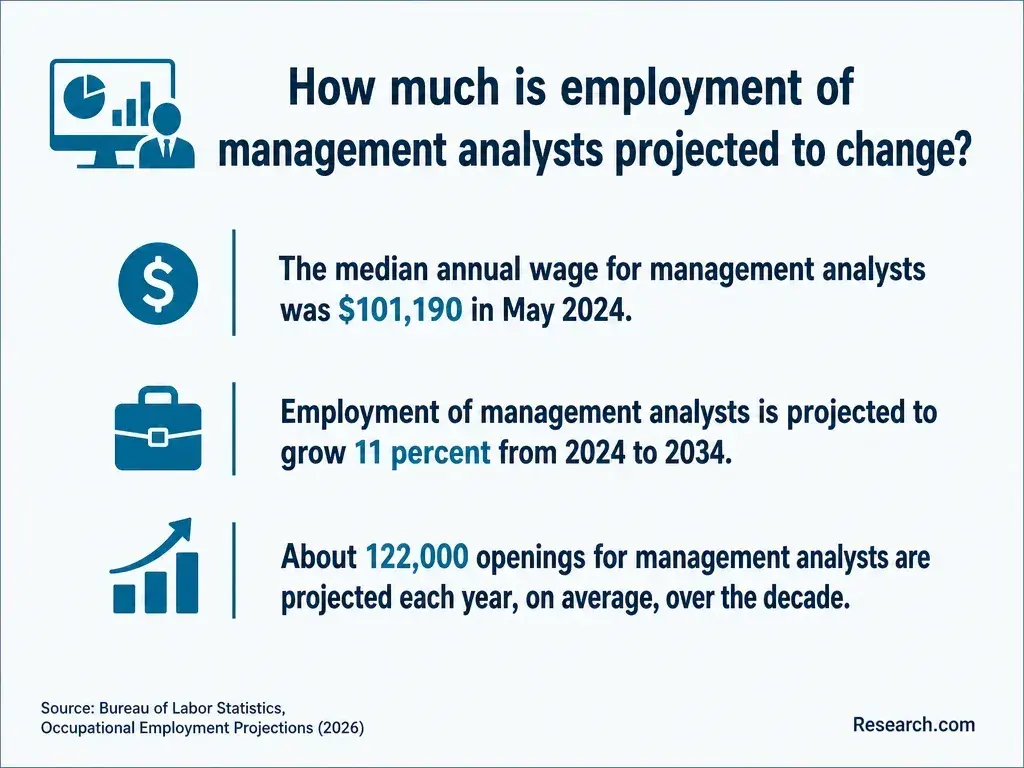
For context, the US Bureau of Labor Statistics reports a $78,760 median annual wage for market research analysts in May 2025 and projects 7% employment growth from 2025 to 2035. Those are occupation-wide figures, not expected pay or a job guarantee for a new business graduate. If your goal is project work instead, compare the skills and hiring requirements of the target role before choosing a specialized degree or investigating paying for project management bachelor's study with grants. Let the job tasks inform your later electives; let prerequisites and capacity govern your first term.
Other Things You Should Know About Business Administration
Often, but permitted tools vary by course and exam. Read the syllabus before relying on a calculator, spreadsheet, or AI tool; some assessments require you to show work without them.
Ask the testing or advising office about retesting, alternative placement evidence, and deadlines before registering. Do not skip a required prerequisite without written approval.
It depends on the school's grading and major policies. Ask the registrar or adviser to confirm in writing whether the course satisfies the specific requirement and any prerequisite-grade rule.
Contact the instructor and tutoring service promptly, review where errors occur, and check withdrawal and aid deadlines before changing your schedule. A structured practice plan is more useful than waiting for the next exam.
- Semester Course Load and Student Performance - PMC - NIH https://pmc.ncbi.nlm.nih.gov/articles/PMC7568764/
- School-Determined Requirements | 2024-2025 Federal Student Aid Handbook https://fsapartners.ed.gov/knowledge-center/fsa-handbook/2024-2025/vol1/ch1-school-determined-requirements
- How many classes should I take? - Stanford Academic Advising https://advising.stanford.edu/current-students/advising-student-handbook/how-many-classes
- Math Advising Tips - Department of Mathematics https://csm.fresnostate.edu/math/students/advising.html
- Degree Requirements - myRBS - Rutgers University https://myrbs.business.rutgers.edu/undergraduate-new-brunswick/degree-requirements
- high school math & first year of college critical to completion | Utah System of Higher Education https://ushe.edu/high-school-math-critical-to-completion/
- Academic Credit and Placement | 2026-2027 University Bulletin https://bulletin.loyno.edu/regulations/academic-credit-and-placement
- Placement Exams and Credit by Examination | sandiego.edu https://usdkb.sandiego.edu/s/article/Placement-Exams-and-Credit-by-Examination
- Mathematics (MATH) - Cuyahoga Community College Catalog - Tri-C https://catalog.tri-c.edu/course-descriptions/math/
- Mathematics (MATH) - UNC Catalog https://catalog.unc.edu/courses/math/