2027 BS in Business Administration and Finance: Choosing a Focus Without Direct Experience in the Field
Audited and Verified:
Our Editorial and Data Verification Process
Research.com uses government datasets, official education statistics and primary institutional information to support its career and degree guides. Our review process checks factual accuracy, occupational definitions, source dates and the requirements associated with the credentials discussed.
How This Article Was Fact-Checked
Our editorial team verifies salary estimates, employment projections, education requirements and program information against original data providers and official organizations. Salary figures are checked against the relevant occupational definitions and reporting periods. Information about licensure, accreditation and required in-person training is reviewed separately.
Fact-checked and verified on:

Co-Founder and Chief Data Scientist
Choosing finance without having worked in the field can feel like committing to a career you have not tested. A BS in Business Administration with a finance focus can give you room to explore, but programs differ in depth, applied opportunities, and cost.
This guide is for prospective and returning students deciding whether finance fits their goals. It explains what the focus involves, how to gain credible experience while studying, and when a broader business degree or another specialty may be the better choice.
Key Things You Should Know
- You do not need prior finance employment to choose the focus, but you should test your interest through accounting, spreadsheets, and a supervised project before committing to advanced electives.
- The U.S. Bureau of Labor Statistics reports a $102,740 May 2025 median wage for financial and investment analysts; that occupation-wide figure is not a starting salary for new graduates.
- Compare the finance courses you would actually take, the experience you can gain, and your remaining cost, not just whether a program advertises a finance concentration.
What Is a Business Administration and Finance Bachelor's Degree?
Usually, this means a BS in Business Administration with a formal finance concentration or a planned set of finance electives. The business core introduces accounting, economics, management, and other organizational functions; finance courses examine how organizations raise, allocate, and manage money.
Check the catalog for the exact award: an informal elective focus is not the same as a concentration recorded on a transcript.
If you have no direct experience, the broader degree can be useful because introductory courses let you compare finance with other functions before specializing. For example, someone more interested in hiring and employee development than financial decisions might explore a guide to studying human resources.
A specialized finance bachelor's may offer more finance depth, while a general business degree may preserve more elective flexibility; neither distinction can be assumed from the degree title alone.
What Careers Can You Pursue With a Finance-Focused Business Degree?
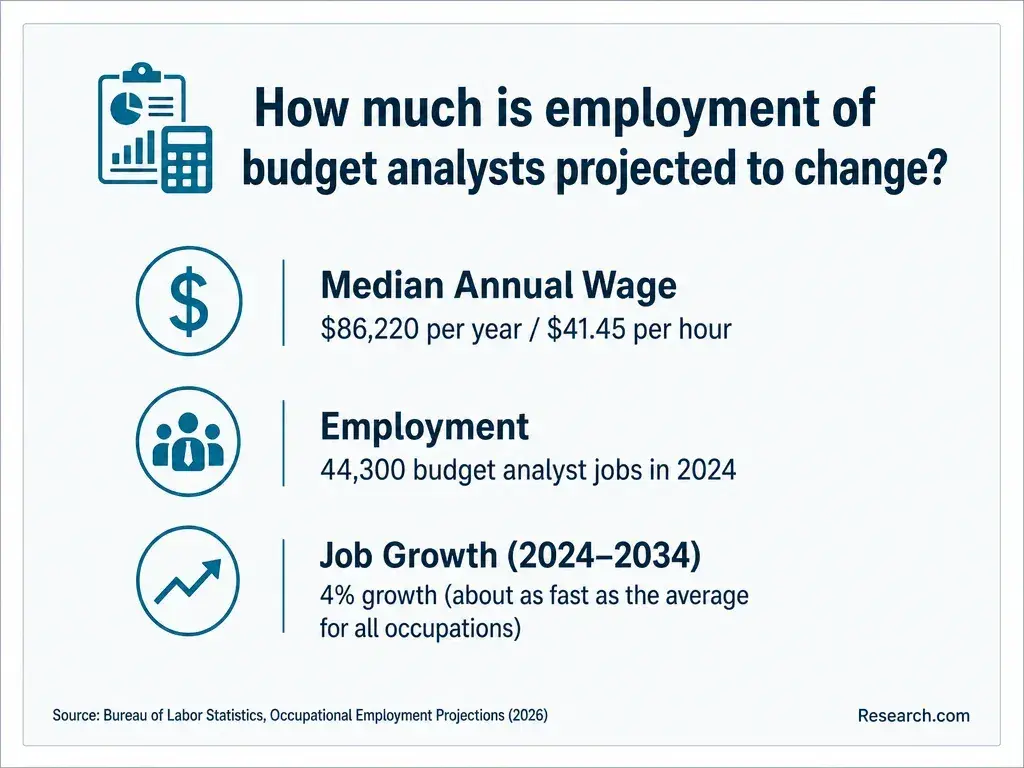
Start with the work you want to do, not the most impressive-sounding title. Financial analyst roles involve evaluating performance, investments, or financial decisions; budget analyst roles focus on developing and monitoring budgets.
Employers may also hire graduates into finance assistant, credit support, banking operations, or business analyst positions, with responsibilities and qualifications varying substantially.
Without finance experience, an adjacent role can provide a more credible entry route than applying only to analyst openings. An operations employee who has tracked spending, for instance, can document that work and seek budget-support assignments.
Someone drawn primarily to schedules, vendors, and project budgets may find project coordination a better initial target; in that case, compare project management study costs beyond tuition before assuming additional finance coursework is the most direct preparation. A degree does not itself qualify a graduate to manage investments for clients or hold a supervisory position.
Is a Business Administration and Finance Degree Worth It Without Experience?
It can be, if the degree meets a real hiring or advancement requirement and you can build evidence of finance skills while enrolled. Prior work in retail, healthcare, trades, or another field may already demonstrate accuracy, customer communication, or responsibility for resources.
It does not necessarily demonstrate financial modeling or analysis; coursework and applied work should close that gap.
Compare the degree's remaining cost with its likely value for your target role. A student who already has a bachelor's degree and needs only spreadsheet and accounting skills may be better served by targeted courses, mentorship, and relevant work assignments.
Someone who lacks a bachelor's required for desired roles may benefit more from completion, particularly if existing credits apply. Shorter affordable business administration degree pathways can be a useful comparison, but obtain an official credit evaluation before treating an advertised timeline or price as yours.
Before committing to finance, try one introductory accounting or finance course and one small, lawful project using public or instructor-provided data. If you enjoy explaining assumptions and trade-offs, not merely producing spreadsheet answers, the focus is more likely to fit.
The business core commonly covers financial and managerial accounting, economics, statistics, business law, management, and communication. A finance focus may add corporate finance, investments, financial statement analysis, or financial modeling.
Titles alone do not show depth: inspect prerequisites, required versus optional courses, spreadsheet work, and whether assignments require you to defend a recommendation under uncertainty.
For a newcomer, sequencing matters. Accounting helps you read statements; statistics helps you assess evidence; introductory finance builds on both before more specialized analysis.
Ask whether a capstone, internship, or supervised project lets you turn those foundations into a work sample. If comparing a people-management path instead, accelerated online organizational leadership school choices illustrate a different curriculum emphasis, not a substitute for finance training.
Both formats can teach financial concepts, but access to feedback and practical experience may differ. The useful comparison is not simply location: ask how you will practice modeling, present analyses, meet instructors, and connect with employers.
The following distinctions can help you investigate programs without assuming every online or campus course works the same way:
| Consideration | Online program | Campus-based program |
| Schedule | May allow remote study, but live sessions and fixed deadlines can still apply | Usually requires travel and scheduled attendance |
| Applied learning | May use remote teams, simulations, or locally arranged placements | May offer in-person teams and nearby employer events |
| Finance tools | Requires reliable access to specified software and technical support | May provide campus labs; access outside class can vary |
Request sample course schedules and internship rules, especially if you need to work while studying. You can compare ranked online business schools in America, then verify each school's current finance course availability and student support directly.
Check that the institution holds recognized institutional accreditation. Then determine whether any advertised business accreditation, such as AACSB, ACBSP, or IACBE, covers the relevant business school or program.
These are different checks: accreditation of a university does not establish that its finance concentration has separate programmatic accreditation, and business accreditation alone does not establish job-placement results.
When comparing economical online college programs in business, verify accreditation through the institution and accreditor, then read the catalog for the exact degree and concentration. Ask the school to confirm the applicable accreditation scope and catalog rules for your intended enrollment term.
Requirements depend on the institution and whether you are applying as a first-year, transfer, or returning student. Schools may require secondary-school records or prior college transcripts; admission to the university and declaration of a finance concentration may occur at different stages. Some upper-level finance courses also have accounting, economics, mathematics, or statistics prerequisites.
Prior finance work is generally not the question to resolve first. Ask admissions which credentials establish eligibility, and ask an academic adviser which completed courses satisfy the business core and finance prerequisites.
Accepted transfer credit may count only as an elective. If your previous coursework points toward a different function, you can also evaluate transfer-friendly online HR colleges; have each institution assess where your credits actually apply before choosing between focuses.
A bachelor's degree commonly takes four academic years of full-time study from the beginning, but your timeline depends on applied transfer credit, prerequisite order, course availability, and enrollment pace. An accelerated calendar may shorten elapsed time without reducing the work required.
Compare low-tuition business administration schools accepting FAFSA only after checking whether the finance coursework you want is available in the degree.
No single tuition figure reliably describes these programs. Request a written estimate covering the credits you still need, tuition, mandatory fees, books or software, possible travel or proctoring, and the effect of studying part time.
Confirm financial-aid eligibility and any employer reimbursement conditions with the responsible offices. For a returning student, the least expensive published tuition rate may not produce the lowest completion cost if more courses remain.
The most useful labor-market comparison is between occupations you might eventually enter, not between degree labels. The U.S. Bureau of Labor Statistics reports the following national occupation-wide figures; medians include experienced workers and are not forecasts of a new graduate's pay:
| Occupation | Median annual wage, May 2025 | Projected U.S. employment change, 2025-2035 |
| Financial and investment analysts | $102,740 | +7% |
| Budget analysts | $91,640 | +2% |
The different growth projections are one reason to choose courses around tasks and employers rather than a salary figure alone. Local opportunities, internships, prior experience, and industry will affect your entry route.
If finishing sooner would let you pursue relevant work earlier, compare fastest bachelor's-level business study options against their actual finance requirements and total cost, not just their advertised pace.
Which Certifications Improve Finance Career Opportunities After Graduation?
Choose a credential only after identifying the work you want to perform. The Chartered Financial Analyst designation is associated with investment analysis, but its examinations and experience requirements are substantial; the Certified Financial Planner certification serves a different, client-planning pathway and has its own education, examination, experience, and ethics requirements.
Neither follows automatically from a business degree. Financial-services activities can also involve separate licenses, depending on the role and employer.
For someone without direct experience, an internship, supervised analysis, or strong spreadsheet work sample may be a better immediate investment than an advanced credential.
Check the credentialing organization's current eligibility rules before paying for preparation. If you have not completed a bachelor's and your target roles require one, consider undergraduate programs with faster pacing before committing money to a certification that does not address that hiring requirement.
Other Things You Should Know About Business Administration
Describe a specific course assignment or approved project: the decision, data source, assumptions, analysis, and what you would check before acting. Be clear that academic work was not professional employment.
You need to be willing to practice quantitative reasoning and interpret results accurately. Review the program's math and statistics prerequisites, and use tutoring or preparatory coursework if your foundation is weak.
Yes, if you can identify relevant responsibilities such as reconciling records, tracking costs, explaining figures, or improving a process. Describe what you actually did rather than relabeling unrelated work as finance experience.
Only if you have permission to share it. Otherwise, create a separate sample with public or fictional data, label its assumptions, and omit confidential, personal, and proprietary information.
- The Employability and Career Development of Finance... - PMC https://pmc.ncbi.nlm.nih.gov/articles/PMC8784401/
- Majoring in Finance: What to Expect | CTU Online https://www.coloradotech.edu/degrees/studies/business-and-management/articles/majoring-in-finance
- Finance and Accounting: Choosing Your Career Path | Michigan Technological University https://www.mtu.edu/business/accounting-finance-path/
- Soft Skills Needed for Careers in Finance | Baker College https://www.baker.edu/about/get-to-know-us/blog/soft-skills-needed-for-careers-in-finance/
- Finance Internships for College & High School Students (2026) - Career and Personal Development | Alma College https://career.alma.edu/blog/2026/01/20/finance-internships-for-college-high-school-students-2026/
- What Can You Do With a Business Degree? | snhu.edu https://www.snhu.edu/about-us/newsroom/business/what-can-you-do-with-a-business-degree
- 10 Key Subjects Taught in a Bachelor of Business Administration Program | Carson-Newman University https://www.cn.edu/cps-blog/10-key-subjects-taught-in-a-bachelor-of-business-administration-program/
- Occupational Outlook - Finance | Gannon University https://www.gannon.edu/academic-offerings/engineering-and-business/undergraduate/finance/occupational-outlook/
- What Are the Most Common Careers in Finance? | Herzing University https://www.herzing.edu/blog/what-are-most-common-careers-finance
- 3 Career Paths in Finance With a B.S. in Business Administration - Voices Digital | Pacific Oaks College https://www.pacificoaks.edu/voices/business/business-administration-degree-finance-career-paths/