2027 BS in Business Administration Decision Guide: A Required Minor or Enough Electives to Use Existing Credits
Audited and Verified:
Our Editorial and Data Verification Process
Research.com uses government datasets, official education statistics and primary institutional information to support its career and degree guides. Our review process checks factual accuracy, occupational definitions, source dates and the requirements associated with the credentials discussed.
How This Article Was Fact-Checked
Our editorial team verifies salary estimates, employment projections, education requirements and program information against original data providers and official organizations. Salary figures are checked against the relevant occupational definitions and reporting periods. Information about licensure, accreditation and required in-person training is reviewed separately.
Fact-checked and verified on:

Co-Founder and Chief Data Scientist
A minor can give your BS in Business Administration a clear academic focus - or add courses you do not need to graduate. For transfer and returning students, the difference matters because previously earned credits may already fill open electives but may not satisfy a minor's specific requirements.
This guide explains how to read those requirements, compare the value of a minor with flexible electives, and get a reliable degree audit before committing time and tuition.
Key Things You Should Know
- A BS in Business Administration requires a minor only if the school's curriculum or your applicable catalog says it does; many programs allow electives instead.
- Accepted transfer credits do not necessarily satisfy a minor, business-core course, or graduation requirement. Their placement in the official degree audit controls their usefulness.
- Choose the route with the fewest remaining required courses, not simply the one that accepts the most credits; a minor is worthwhile when its documented value justifies any added time or cost.
Does a BS in Business Administration Require a Minor or Just Electives?
There is no universal minor requirement for a BS in Business Administration. The answer depends on the institution's degree rules and the catalog that applies to you. One program may require a minor or concentration; another may provide room for unrestricted electives after general education and business requirements are met. A minor is a formally defined set of courses in another subject. Electives are courses used to reach degree requirements without necessarily earning a named credential.
Check whether the rule belongs to the university, the business school, or your particular major. Also check whether you can choose among a minor, concentration, certificate, or electives: these are not interchangeable, even when they include similar courses. If a minor adds courses that cannot be covered by existing credits, compare that extra expense with lower-tuition online business administration programs rather than assuming the cheapest advertised program will be cheapest to finish.
What Does a BS in Business Administration Include?
A typical degree plan combines general education, a business core, any major-specific or concentration courses, and remaining electives. The core builds breadth across business functions; the elective space is where prior credits may be most useful. Some programs also require a capstone or another applied assignment. Exact requirements vary, including between programs that award a BS and those that award a BBA.
For a returning student, the useful question is not "How many credits will you accept?" but "Which requirement will each accepted course satisfy?" A school might accept a prior communications course for general education while classifying several other courses as open electives. Compare budget-friendly online business schools using their actual degree maps and your evaluated credits, not tuition alone.
How Do You Choose Between a Minor and Business Electives?
Start with the job function or skill you want to develop. A minor can make sense when its prescribed courses fill a meaningful gap, fit your schedule, and are recognized on your academic record. Flexible electives often make more sense when you already have substantial usable credits, need room for a few targeted business courses, or would have to extend enrollment to complete the minor.
This comparison separates the credential's possible benefit from its completion cost. It does not assume that a minor improves hiring outcomes by itself.
| Option | Potential advantage | Main constraint to check |
| Formal minor | Defined sequence and documented secondary field | Specified courses, prerequisites, and limits on using transfer work |
| Flexible electives | More opportunities to apply varied existing credits | May provide less depth or no named focus on the transcript |
| Business concentration | Focused study within the major, if offered | Its own required courses and potentially limited course availability |
If your goal is specifically supply chain work, compare a minor with relevant electives and a dedicated degree, including shorter online supply chain degree pathways. The best route depends on which program applies your existing credits and teaches the function you actually want to enter.
Verify the institution's accreditation with the accreditor and the school before relying on a degree plan or transfer estimate. Then check whether any advertised business accreditation - such as AACSB, ACBSP, or IACBE - covers the relevant business school or program. Institutional accreditation and business-specific accreditation have different scopes; neither tells you whether a particular old course will satisfy your minor.
Accreditation is one screening factor, not evidence that credits will apply or that graduates obtain particular jobs. If you are comparing schools before requesting formal evaluations, online college options without an application fee may reduce the cost of applying, but still confirm accreditation, transfer policy, and the catalog rules that govern your degree.
Business cores commonly include accounting, economics, finance, marketing, management, operations, statistics or quantitative reasoning, and business law or ethics. Programs differ in course titles, mathematics prerequisites, and whether a capstone is required. Electives cannot normally replace a required core course merely because both carry business credit.
Course sequence can matter as much as course count: a finance class may depend on accounting, while a capstone may require completion of most core courses. Ask an adviser which missing requirements have prerequisites and when they are offered. This is particularly important when assessing accelerated business education for working adults; a faster calendar does not eliminate prerequisite chains or make an unavailable course appear sooner.
Transfer credits can often fill elective space, but they replace a minor's courses only when the receiving institution approves the required equivalencies and permits transferred work in that minor. Acceptance, application to a requirement, and eligibility to graduate are separate decisions. A course recorded as an open elective has not necessarily satisfied accounting, a concentration, or a minor requirement.
Request a course-by-course evaluation and an official degree audit. Then use this sequence to identify the path that actually gets you to graduation:
- Match each accepted credit to general education, business core, minor or concentration, open electives, or unused credit on the audit.
- Ask the registrar or transfer office about missing equivalencies and submit syllabi for any appeal or substitution the school permits.
- Ask the business adviser to compare a minor and an electives-only plan, including prerequisites, residency rules, course availability, and your likely final term.
- Ask financial aid whether either plan changes aid eligibility before dropping or adding courses.
Do not treat an advertised completion period as a transfer guarantee. Even three-year supply chain undergraduate degree routes are useful comparisons only after the receiving school evaluates how your particular courses apply.
Your remaining time depends on required courses still open on the audit, prerequisite order, course availability, enrollment pace, and any in-residence coursework. The cost comparison should include tuition and mandatory fees for those remaining courses, plus books, software, travel or proctoring where applicable. A minor that uses existing credits might add little coursework; one that requires new upper-level classes could delay completion.
Calculate both routes from written degree plans rather than multiplying an advertised per-credit price by all credits the school accepts. Ask for a term-by-term plan and a financial-aid review, especially if changing enrollment intensity or using employer reimbursement. When screening cheaper business administration study with FAFSA-based aid, verify the school's aid eligibility and your own award rather than treating possible aid as a guaranteed discount.
Delivery format alone does not establish a degree's value. Compare the institution's accreditation, required curriculum, faculty access, career support, and opportunities to demonstrate business skills. For a student finishing around work or caregiving, the decisive difference may be whether required courses are offered when they are needed.
Online does not always mean self-paced. Ask about live sessions, group presentations, exam proctoring, campus visits, and capstone scheduling before assuming the format fits your week. Business administration programs for studying around work commitments are most useful to compare against your actual schedule and remaining degree requirements.
A broad business degree can support applications for roles in operations, sales support, human resources, marketing, and project coordination. The better route depends on your previous work and evidence of relevant skills. For example, electives in spreadsheets and operations paired with a supervised process-improvement project may be more useful for an operations role than an unrelated minor; an HR-focused minor may be worthwhile if you lack that subject knowledge and can complete it without delaying graduation.
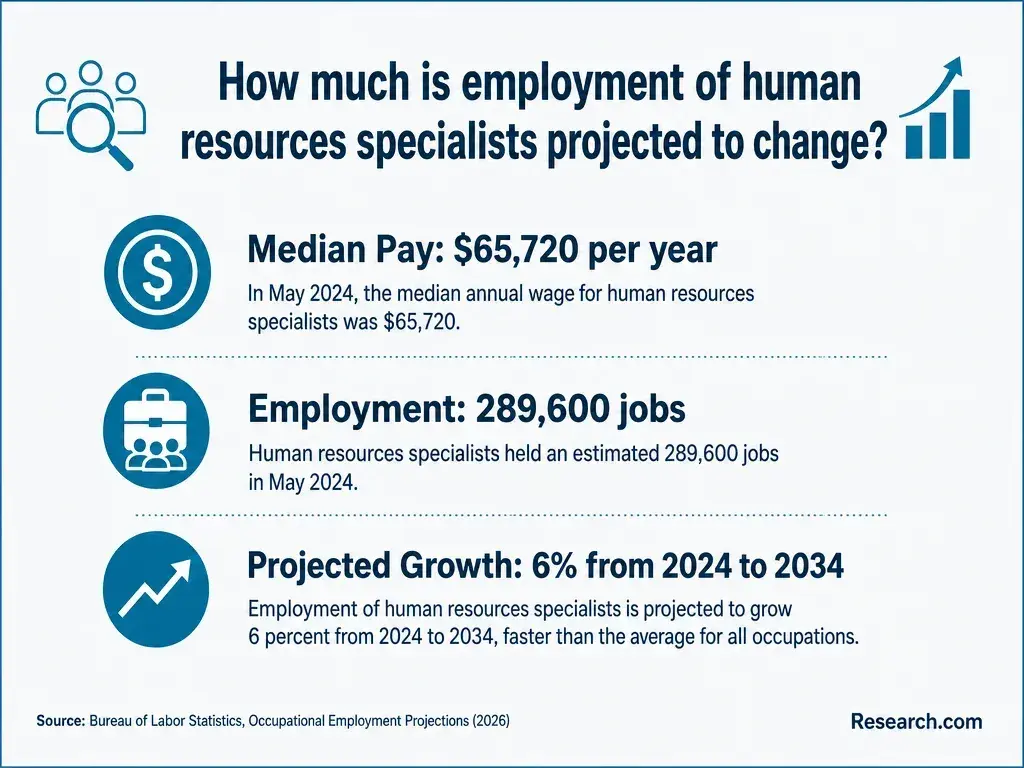
For salary context, the U.S. Bureau of Labor Statistics reports a $75,940 median annual wage for human resources specialists in May 2025. That occupation-wide figure includes experienced workers and is not an expected starting salary for business administration graduates. Compare target job postings, required experience, and the additional coursework cost before attributing career value to a minor. An business administration degree affordability duration and value guide can help frame that broader investment decision, but your evaluated completion plan remains the basis for your own calculation.
Do Business Administration Careers Require Licenses or Certifications?
Most general business roles do not have a single license attached to the BS in Business Administration. Particular occupations, regulated activities, employers, and voluntary certifications may have separate requirements. A business minor, concentration, or elective cluster does not itself confer a professional credential or establish eligibility for accounting licensure, financial-services licenses, or an HR certification.
Check the requirements of your target role before paying for extra coursework. If you intend to work specifically in HR, for example, compare the content and credential requirements of an HR-focused business plan with using existing credits in a human resources degree. A specialized degree may be a better academic fit, but only a formal transfer evaluation can show whether switching would help you finish.
Other Things You Should Know About Business Administration
Sometimes, but schools set their own double-counting limits. Ask for the rule in writing and check how the course appears in your degree audit.
Not necessarily. Schools may record a completed minor on the transcript rather than the diploma. Confirm the institution's documentation policy if that distinction matters to you.
It depends on the minor's grading rules and how the receiving school records transferred work. Check before relying on a pass/fail course for a required subject.
Ask your adviser and registrar to rerun the audit and confirm any declaration deadline. A change may alter required courses or postpone clearance for graduation.
- Rule 3341-3-33 | Baccalaureate degree programs https://codes.ohio.gov/ohio-administrative-code/rule-3341-3-33
- Transfer credit policies - Office of Admissions https://admit.washington.edu/apply/transfer/policies/
- General Requirements for a Baccalaureate Degree | uh.edu https://publications.uh.edu/content.php
- Transfer Credit Policy on the Evaluation of Previous Training and Education | Truckee Meadows Community College Catalog https://catalog.tmcc.edu/rules-regulations/transfer-credit-policy-evaluation-previous-training-education/
- Bachelor's Degree Requirements | University of Oregon Academic Catalog https://catalog.uoregon.edu/admissiontograduation/bachelorrequirements/
- Undergraduate Student Transfer Policy Policy Number 5-03 | Commonwealth University https://www.commonwealthu.edu/documents/cu-policy-5-03-undergraduate-student-transfer-policy
- Academic Regulations | University of Connecticut Academic Catalog https://catalog.uconn.edu/undergraduate/academic-regulations/
- FAQs | Economics and Business Management - UC Merced https://economics.ucmerced.edu/undergraduate-programs/faqs
- Double-Counting of Credit in Undergraduate Programs | Stanford University Bulletin https://bulletin.stanford.edu/academic-polices/degree-requirements/ug-double-counting
- The Norm Brodsky College of Business Core Requirements | Rider University Academic Catalog https://catalog.rider.edu/undergraduate/colleges-schools/business-administration/core-requirements/