2027 BS in Business Administration: An Embedded Professional Certificate
Audited and Verified:
Our Editorial and Data Verification Process
Research.com uses government datasets, official education statistics and primary institutional information to support its career and degree guides. Our review process checks factual accuracy, occupational definitions, source dates and the requirements associated with the credentials discussed.
How This Article Was Fact-Checked
Our editorial team verifies salary estimates, employment projections, education requirements and program information against original data providers and official organizations. Salary figures are checked against the relevant occupational definitions and reporting periods. Information about licensure, accreditation and required in-person training is reviewed separately.
Fact-checked and verified on:

Co-Founder and Chief Data Scientist
A BS in Business Administration with an embedded professional certificate can offer both a broad degree and a focused credential. But "embedded" does not always mean the certificate is separately awarded, included at no extra cost, or recognized by an outside certifying body.
This guide is for prospective and returning students comparing that option with a concentration, a standalone certificate, or a specialized degree. It explains what the certificate should add, how to check its requirements, and how to judge whether the combined pathway fits your career goal and budget.
Key Things You Should Know
- An embedded certificate is valuable when its required courses build a relevant skill, count toward the BS, and result in a credential the school actually awards; confirm all three in writing.
- Compare the combined pathway with a concentration or standalone certificate on remaining credits, scheduling, total cost, and evidence of practical work - not the credential's name alone.
- The U.S. Bureau of Labor Statistics reports a May 2025 median annual wage of $75,940 for human resources specialists, but that occupation-wide figure is not an expected starting salary for business graduates.
What is a BS in Business Administration with an embedded professional certificate?
It is a bachelor's degree in broad business subjects paired with a defined certificate curriculum that students complete during the degree. Courses may count toward both credentials, but the arrangement depends on the institution. At one school, the certificate may be a separate academic award shown on a transcript; at another, the phrase may describe a course sequence without a separately issued credential.
Professional certificate is not a universal designation. Ask who awards it - the university, an external organization, or both - and whether completing the courses earns the certificate automatically or requires an application, examination, fee, or other approval. Neither version should be confused with an occupational license or a voluntary certification issued by a professional body.
The best starting point is the current catalog and a written degree plan, not the program name. A national guide to ranked online business colleges can help identify schools to investigate, but each school must confirm its own credential rules and curriculum.
What careers can you pursue with a BS in Business Administration?
The degree can support applications for roles in operations, sales support, marketing coordination, procurement, and HR. The embedded certificate is most useful when its subject matches the tasks in a target job: an analytics sequence might support reporting work, while an HR sequence might help with recruiting or employee-record processes. Employers will still assess relevant experience, software skills, judgment, and communication.
For an early-career applicant, the strongest evidence is often a combination of coursework and a supervised project, internship, or relevant job. Someone already working in an organization may instead use the degree to qualify for positions requiring a bachelor's credential while documenting responsibility they have already held. A management title is not an automatic next step after graduation.
If HR is the specific goal, compare the embedded option with a dedicated HR bachelor's and its HR bachelor's transfer credit evaluation. A specialized degree may offer more HR coursework; the broader BS may leave more room to change functions later.
How much does a BS in Business Administration cost and how long does it take?
There is no reliable single price or completion time for this pathway. Both depend on tuition rules, aid, applicable transfer credits, course availability, and whether certificate requirements fit inside the degree's remaining electives. A traditional full-time bachelor's plan is commonly organized around four academic years; a transfer student's remaining time depends on an official degree audit, not simply the number of credits a school accepts.
Compare schools using the same proposed course load and ask for an itemized estimate of tuition, mandatory fees, books, software, any certificate or examination charge, and travel or proctoring costs. Then check whether certificate courses replace electives or add credits. An "included" certificate can still delay graduation if a required course is offered infrequently or has a prerequisite.
Financial aid eligibility and net cost require school-specific confirmation. When comparing cheaper business administration study with FAFSA-based aid, ask the financial-aid office how your enrollment intensity and combined course plan affect aid, and compare borrowing as well as advertised tuition.
A BS in Business Administration generally combines general education with business foundations such as accounting, finance, marketing, economics, management, operations, and quantitative analysis. The exact balance varies: "BS" does not guarantee a particular amount of mathematics or analytics, and a BBA is not automatically broader or narrower.
The certificate should add coherent depth beyond that foundation. For example, a supply chain sequence might connect purchasing, inventory, and logistics assignments; an analytics sequence might require spreadsheet models and interpretation of imperfect data. Compare required courses and assessed work with the responsibilities you want, rather than treating one introductory class as specialist preparation.
If supply chain is already your clear target, compare the certificate's actual coursework with budget-friendly supply chain degrees with shorter schedules. A specialized degree may be the better fit when its additional functional depth matters more than flexibility across business fields.
Its potential advantage is efficient specialization: carefully chosen courses can satisfy bachelor's requirements while producing a recognizable record of focused study. That advantage disappears if the certificate adds substantial coursework without improving preparation for the role you want.
The table distinguishes credentials that can look similar in a program description. Use it to identify what a school needs to document before you count on an additional award.
| Pathway | What it establishes | What to verify |
| Embedded academic certificate | Completion of a defined certificate curriculum, if separately awarded | Awarding authority, transcript notation, course overlap, and extra requirements |
| Concentration | An official focus within the bachelor's degree | Whether it appears on the transcript and requires different courses or credits |
| External professional certification | A credential governed by a certifying organization | Separate exam, experience, eligibility, and renewal rules |
For a project-focused career, also compare the embedded curriculum with project management undergraduate transfer pathways. Neither an academic project management certificate nor a related bachelor's automatically grants an external project management certification.
They can lead to the same institutionally awarded degree and certificate, but do not assume their learning arrangements or available certificate courses are identical. Confirm that the online track includes every required course, applied assignment, and assessment, and ask whether the credential has the same official designation in both formats.
Delivery affects feasibility. An online program may still require live meetings, group presentations, timed exams, or a campus visit. A campus program may offer easier access to local internships or in-person recruiting. Before choosing either, map required activities against work and caregiving commitments and ask how missed or canceled certificate courses affect progression.
Online business degrees with compressed terms may shorten the calendar schedule for some students, but compressed courses can intensify weekly work and do not necessarily reduce total tuition or certificate requirements.
Requirements vary by institution and applicant type. First-year applicants commonly submit secondary-school records; transfer applicants submit prior college transcripts. A school may also distinguish admission to the university from entry into the business major or certificate. Ask whether the certificate has its own application, prerequisites, minimum grades, or enrollment limit.
Returning students should request an official evaluation showing where accepted credits apply: general education, business core, certificate courses, or electives. Credit accepted by the institution does not necessarily replace a required accounting, statistics, or certificate course. A written degree audit is especially important before assuming the embedded pathway will save time.
For applicants balancing employment with study, business administration programs for advancement while working offer a useful comparison point. Check admission rules alongside actual course schedules; being eligible to enroll does not mean a particular certificate sequence will fit your work calendar.
Verify the institution's current accreditation with its accreditor and confirm that the accreditor is recognized by the U.S. Department of Education or the Council for Higher Education Accreditation. Then check any claimed business accreditation - such as AACSB, ACBSP, or IACBE - with the relevant accreditor. Institutional accreditation and business-school accreditation have different scopes, and a claim about the business school should not be assumed to cover every certificate.
Quality for this decision also means reliable access to the promised pathway. Request the current catalog, sample course rotation, certificate award policy, transfer rules, and evidence of advising and career support. Ask for the certificate's learning outcomes and examples of assessed work, not just its name. Economical online college programs in business can supply comparison candidates, but price alone cannot establish accreditation scope or certificate availability.
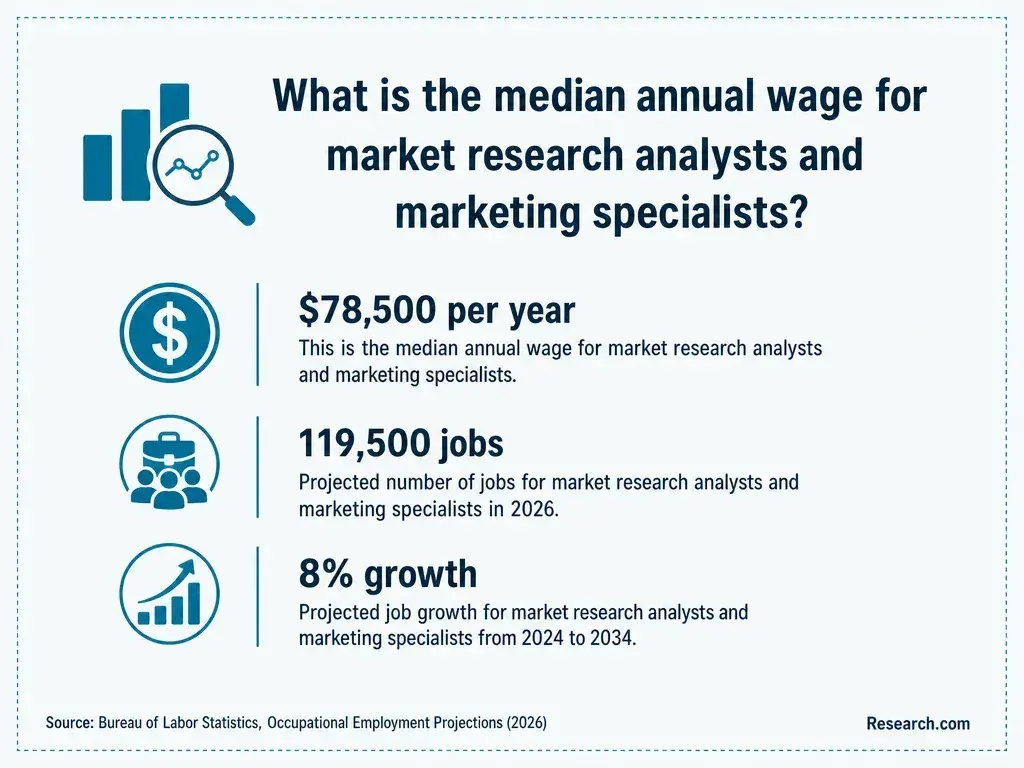
Pay follows occupation, experience, location, and employer - not the degree title or the presence of an embedded certificate. For example, the U.S. Bureau of Labor Statistics reports that market research analysts earned a median annual wage of $78,760 in May 2025, with employment projected to grow 7% from 2025 to 2035. Those are occupation-wide figures, not earnings or placement predictions for new business graduates.
Use a target occupation to evaluate return on education: identify its typical duties, compare local job postings with the certificate's courses, and assess whether you can produce relevant work samples or gain experience. Do not use managers' median wages to estimate your first salary in a coordination or assistant role. For a broader comparison of business administration program length and salary context, keep program costs separate from occupation-wide wage data.
Do business administration careers require licenses or additional certifications?
Many general business support roles have no universal occupational license, though employers can require particular qualifications. Regulated activities and some specialist paths are different. A BS with an accounting certificate, for example, does not by itself establish eligibility for CPA licensure; state accountancy boards determine those requirements. Financial-services roles may have separate licensing rules, while voluntary HR or project management certifications have their own eligibility standards.
Before treating an embedded certificate as a route to a named credential, check the issuer's requirements directly. Ask whether the curriculum merely prepares students to apply or sit for an exam, and account for any separate experience, fees, or continuing requirements. If your goal is primarily supervisory development rather than a broad business degree, compare the curriculum and remaining time with undergraduate leadership programs with shorter timelines; neither pathway substitutes for demonstrated responsibility at work.
Other Things You Should Know About Business Administration
List it as "in progress" only if you are formally pursuing it and can name the awarding institution accurately. Do not present it as earned until the school confirms the award.
Possibly. Ask an adviser to compare the new requirements with courses already completed, prerequisites, and the next available offerings before making the change.
Usually, if you have the right to share them. Remove confidential organizational data, identify hypothetical assumptions, and describe your own contribution to group work.
Employer education benefits vary. Get written confirmation that the degree courses and any separate certificate or exam charges qualify before relying on reimbursement.
- Accreditation in the U.S. | ed.gov http://www.ed.gov/laws-and-policy/higher-education-laws-and-policy/college-accreditation/accreditation-in-the-us
- Cost of Attendance (Budget) | 2025-2026 Federal Student Aid Handbook https://fsapartners.ed.gov/knowledge-center/fsa-handbook/2025-2026/vol3/ch2-cost-attendance-budget
- Estimate your college cost | usa.gov https://www.usa.gov/estimate-college-cost
- Department Expectations: Curriculum | New York State Education Department https://www.nysed.gov/college-university-evaluation/department-expectations-curriculum
- .14 Evaluation and Review Process for Transfer of Courses and Credits. | Library of Maryland Regulations https://regs.maryland.gov/us/md/exec/comar/13B.06.02.14
- Business Administration Major | Towson University https://www.towson.edu/cbe/departments/management/undergrad/business-administration-major/
- Certificate vs. Degree: Which Is Right for You? | UC San Diego Division of Extended Studies https://extendedstudies.ucsd.edu/news-events/extended-studies-blog/certificate-vs-degree-making-the-right-education-decision
- Degrees vs. Certificate Programs: What's the Difference? | snhu.edu https://www.snhu.edu/about-us/newsroom/education/certificates-vs-degrees
- BS in Business Administration | Online Bachelor's Degree | Capella University https://www.capella.edu/online-business-degrees/bs-business-program/bachelors-business-administration/
- Undergraduate Admission | CUNY SPS https://sps.cuny.edu/admissions/undergraduate-admission