2027 BS in Business Administration: A Final Business Plan Project
Audited and Verified:
Our Editorial and Data Verification Process
Research.com uses government datasets, official education statistics and primary institutional information to support its career and degree guides. Our review process checks factual accuracy, occupational definitions, source dates and the requirements associated with the credentials discussed.
How This Article Was Fact-Checked
Our editorial team verifies salary estimates, employment projections, education requirements and program information against original data providers and official organizations. Salary figures are checked against the relevant occupational definitions and reporting periods. Information about licensure, accreditation and required in-person training is reviewed separately.
Fact-checked and verified on:

Co-Founder and Chief Data Scientist
A final business plan can turn years of business coursework into a decision-ready proposal, or become a collection of unsupported forecasts. If you are choosing a BS in Business Administration program or preparing for its capstone, the difference matters.
This guide explains what a credible plan contains, how to scope the research and financial model, and which program requirements to check before enrolling. It also puts accreditation, cost, and career claims in perspective so you can judge the degree by the work you will actually produce.
Key Things You Should Know
- A strong final business plan identifies a decision-maker, a specific business opportunity, evidence for its assumptions, a financial model, and conditions under which the proposal should change.
- Many U.S. bachelor's programs are designed around approximately 120 semester credits, but capstone prerequisites, course availability, and approved project formats determine when you can finish.
- A plan is an academic deliverable, not proof that a business will succeed; verify data permissions and portfolio rights before using employer or customer information.
What is a BS in Business Administration and what does the final business plan project involve?
A BS in Business Administration is an undergraduate degree that combines general education with business subjects such as accounting, marketing, finance, operations, management, and quantitative analysis. The exact mix varies by institution. A final business plan project is one possible capstone: a structured proposal for starting, expanding, or changing an organization. Some programs instead require a case analysis, simulation, consulting project, or strategic report.
Begin with the decision the plan should inform: for example, whether a small business should add a service or whether a proposed venture has a plausible path to covering its costs. A useful plan connects customer evidence and operating capacity to financial assumptions. It does not treat projected sales as observed results.
Faculty rubrics differ, but the following sequence gives most business-plan projects a workable structure:
- Define the proposal: Name the intended customer or beneficiary, the offering, the decision-maker, and the time horizon.
- Test the market case: Identify competitors and substitutes, describe credible demand evidence, and separate research findings from assumptions.
- Explain execution: Show staffing, suppliers, delivery processes, legal or operational constraints, and major milestones.
- Build the financial case: Estimate startup needs, revenue drivers, costs, cash requirements, and what changes if demand is lower than expected.
- Recommend a decision: State the proposal's risks, unresolved questions, and evidence needed before anyone commits resources.
Use public information, permissioned organizational data, or clearly labeled hypothetical inputs. Check the rubric before committing to a topic: a plan for your employer may require faculty approval and separate employer permission. If you are comparing accelerated study schedules for business majors, ask whether the capstone leaves enough time for research, feedback, and revision.
What accreditation should you look for in a BS in Business Administration program?
First, confirm that the institution holds accreditation from an accreditor recognized by the U.S. Department of Education. Then check whether the business school or relevant program has additional accreditation from AACSB, ACBSP, or IACBE. These are different checks: institutional accreditation does not establish business-specific accreditation, and an accreditor's recognition of a school does not necessarily cover every degree it offers.
Ask the institution to identify the accrediting body, the precise scope of any business accreditation, and whether the BS in Business Administration is included. Business-specific accreditation can be useful evidence of academic review, but it does not establish that a particular capstone offers access to clients, proprietary data, or job placement. When comparing lower-priced accredited business administration study options, weigh the capstone rubric and faculty support alongside accreditation and price.
What careers can you pursue with a BS in Business Administration?
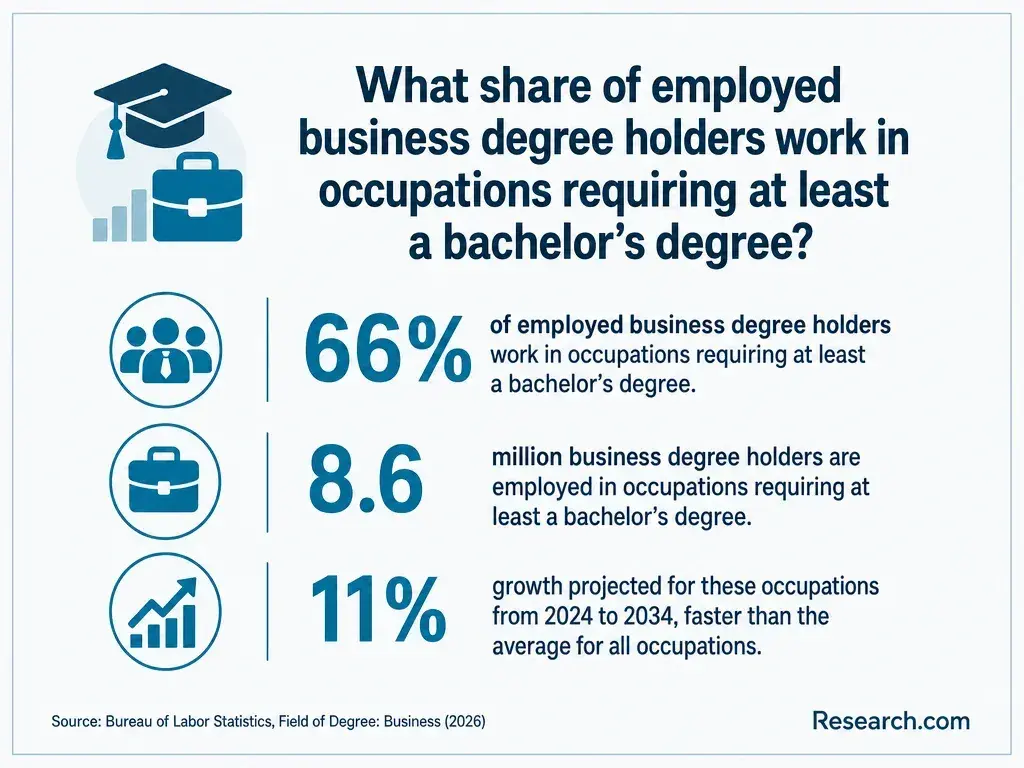
The degree can support applications for business functions, but the final plan is most valuable when it demonstrates skills relevant to a target role. An operations coordinator might discuss capacity and supplier choices, a marketing coordinator might show how customer research shaped a proposal, a project coordinator might explain milestones, dependencies, and risks. Employers will still assess work experience, software skills, communication, and industry knowledge.
For students interested in logistics or procurement, a business plan can show how inventory and fulfillment assumptions affect cash needs. That is different from specialist preparation in supply chain management; explore fast-track supply chain bachelor's programs if that function, rather than general business planning, is the goal. A capstone is a work sample, not evidence that its author has managed a company or qualifies automatically for a management job.
A typical curriculum includes general education, a business core, electives or an official concentration, and sometimes an applied capstone. For a business plan, accounting helps distinguish profit from cash; marketing and research courses inform customer assumptions; operations courses test whether delivery is feasible; and statistics or analytics courses support interpretation of imperfect evidence. Finance may inform funding and cash-flow decisions, while business law and ethics help identify constraints.
Review prerequisite chains rather than the course list alone. If the plan requires a financial model, find out whether accounting, finance, and spreadsheet-based analysis precede the capstone. A project-management elective may improve a plan's implementation schedule without creating a project-management credential. Students who want a more specialized project-management degree, including a transfer pathway, can compare project management degrees with prior-credit pathways. In either case, ask to see the actual capstone learning outcomes and assessment criteria.
Requirements vary by school and by entry route. First-year applicants generally need an accepted secondary-school credential and application materials; transfer applicants usually submit previous college transcripts. A school may also have separate entry requirements for its business major or prerequisites for upper-level courses. Admission to the university does not by itself confirm admission to the major or eligibility to begin the capstone.
If you have previous credits, request an official evaluation showing which courses satisfy general education, business-core, elective, and residency requirements. Pay particular attention to accounting, mathematics, economics, and statistics equivalencies. The receiving institution has final authority over how credits apply. Review prior education requirements for business administration applicants, then ask an adviser which prerequisites must be completed before your proposed project term.
Many U.S. bachelor's degrees are structured around approximately 120 semester credits and four years of full-time study. Your remaining time depends on credits that apply to this degree, enrollment pace, prerequisite order, and when required courses run. A final business plan may span one course or follow earlier research and strategy courses; the catalog and degree audit, not the project title, determine the schedule.
For cost, request a written estimate based on your remaining requirements. Include tuition and mandatory fees, books or software, any proctoring or campus travel, and the cost of an additional term if a required course is unavailable. Compare that estimate with aid and employer benefits you are actually eligible to receive; reimbursement may arrive after you pay the bill. Lower-priced college options for business majors are worth examining, but a lower advertised tuition rate does not establish the lowest total completion cost.
Choose the format that gives you reliable time and access to complete the plan, not simply the most convenient course delivery label. Online study can reduce travel, but a capstone may still require live presentations, group meetings, fixed deadlines, or remotely proctored assessments. Campus study may make faculty consultation and team work easier while adding commuting and scheduled attendance.
If you work or have caregiving responsibilities, ask for a recent capstone syllabus and identify its weekly deadlines, required meetings, presentation format, and revision window. Confirm whether a solo project is allowed and whether students can use public data instead of arranging access to a workplace. Accelerated degree options for working adults may shorten the calendar, but compressed terms do not remove the research and modeling the final plan requires.
There is no single salary or growth rate for a BS in Business Administration: labor-market figures describe occupations, not everyone holding a degree. As one relevant example, the U.S. Bureau of Labor Statistics reports a $78,760 median annual wage for market research analysts in May 2025 and projects 7% employment growth from 2025 to 2035. That occupation is a potential direction for someone who develops research and analytical skills, not an expected starting salary for a new graduate or a reward for completing a business plan.
Evaluate the return on your degree against roles you can realistically pursue with your experience. Compare job postings' research, spreadsheet, presentation, and industry requirements with your coursework and work samples. A discussion of business administration degree cost versus career outlook can inform that comparison, but occupation-wide medians should not be used as a personal earnings forecast.
No general license is required simply to hold a BS in Business Administration or write a capstone business plan. Requirements arise from a specific occupation or activity. Accounting licensure, some financial-services work, and particular professional designations have rules separate from the degree; voluntary certifications may also require experience or examinations.
If a target role names a credential, check its issuing board or organization before choosing courses. An undergraduate plan can demonstrate planning and analysis, but it does not substitute for supervised professional experience or confer certification. For a working adult comparing a shorter credential with a full bachelor's degree, US rankings for accelerated business bachelor's degrees can help identify programs to investigate - not determine whether their graduates meet a separate licensing or certification rule.
How can you choose a reputable BS in Business Administration program?
For this particular goal, examine the final project as closely as the degree name. A reputable program should be able to explain what students produce, how faculty assess evidence and financial assumptions, and what happens if a proposed workplace project cannot be approved. Request a current catalog, sample capstone rubric, official degree audit if you are transferring, and a personalized cost estimate.
Before enrolling, put these questions to an adviser or capstone coordinator:
- Is a business plan an approved capstone option, and may it address a proposed venture rather than an operating company?
- Which courses must be completed first, when is the capstone offered, and how often can students obtain faculty feedback?
- What permissions are needed for workplace data, interviews, team projects, and later portfolio use?
- What research, financial modeling, presentation, and revision work does the grading rubric require?
An application fee is only a small part of the decision. If you compare fee-free applications for online college, still check accreditation, the applicable catalog, project support, and total cost before committing. After choosing a program, settle the project scope with faculty early, document every assumption and source, and obtain permission before using nonpublic information. A portfolio version should remove confidential details and clearly distinguish your proposal from any implemented result.
Other Things You Should Know About Business Administration
Follow your course's AI policy. If use is permitted, verify every claim, calculation, and citation yourself, disclose assistance as required, and never enter confidential business or personal data into a tool without authorization.
Agree on responsibilities at the start and keep a record of research, modeling, writing, and revisions. Follow the instructor's rules for contribution statements and individual assessment.
Report the result honestly. A defensible recommendation to revise, delay, or reject a proposal can show stronger judgment than an optimistic forecast that ignores its assumptions.
Only if the assignment requires them and you can collect them appropriately. Credible public research and clearly labeled assumptions may support an academic plan; do not invent responses or present secondary research as firsthand evidence.
- Feasibility analysis for new businesses https://www.business.qld.gov.au/starting-business/starting-buying/planning/feasibility-analysis
- Market research and competitive analysis - legacy SBA.gov https://legacy.sba.gov/business-guide/plan-your-business/market-research-competitive-analysis
- Plan your business - Small Business Administration https://www.sba.gov/counseling/plan-your-business/
- How to evaluate group work | Center for Teaching Innovation https://teaching.cornell.edu/teaching-resources/active-collaborative-learning/collaborative-learning/how-evaluate-group-work
- What Is Market Research? Key Types, Methods, and Examples - Leavey School of Business - SCU https://www.scu.edu/business/blog/business-concepts/what-is-market-research/
- Business Plan & Pitch Presentation | usf.edu https://guides.lib.usf.edu/business-plan/how-to-pitch
- Financial Statements and Startup Financial Model | Propel Business New Venture & Innovation Program https://propel.smeal.psu.edu/digital-resources/financial-statements-and-startup-financial-model/
- Startup Business Plan: Structure, Steps and Financials | skema.edu https://www.skema.edu/en/news/startup-business-plan-structure-steps-and-financials
- How can I assess group work? - Eberly Center | Carnegie Mellon University https://www.cmu.edu/teaching/designteach/design/instructionalstrategies/groupprojects/assess.html
- How Do You Define the Scope of a Project? | UPI Study https://www.upistudy.com/blog/advanced-technical-writing/how-do-you-define-the-scope-of-a-project