2027 BS in Business Administration and Construction Management: Choosing a Focus Without Direct Experience in the Field
Audited and Verified:
Our Editorial and Data Verification Process
Research.com uses government datasets, official education statistics and primary institutional information to support its career and degree guides. Our review process checks factual accuracy, occupational definitions, source dates and the requirements associated with the credentials discussed.
How This Article Was Fact-Checked
Our editorial team verifies salary estimates, employment projections, education requirements and program information against original data providers and official organizations. Salary figures are checked against the relevant occupational definitions and reporting periods. Information about licensure, accreditation and required in-person training is reviewed separately.
Fact-checked and verified on:

Co-Founder and Chief Data Scientist
You can study construction management without having worked on a jobsite, but the degree you choose will shape how much technical preparation you receive. A BS in Business Administration with construction-focused coursework may suit someone interested in budgets, contracts, and operations; a dedicated construction management degree may offer more practice with estimating, scheduling, and building methods.
This guide is for students and career changers choosing between those paths. It explains what to verify in a program, how to gain field exposure, and what roles are realistic before you have construction experience.
Key Things You Should Know
- Construction experience is not necessarily required for admission, but check whether internships or field-based courses are required to graduate.
- A business administration degree with construction electives is not automatically a dedicated construction management degree or a formal concentration; compare the required courses and credential shown on the transcript.
- The US median for project management specialists was $102,320 in May 2025, but that occupation-wide figure is not an expected starting salary for a new construction graduate.
What is a BS in Business Administration and Construction Management?
The phrase can describe different credentials. One school might award a BS in Business Administration with a formal construction management concentration; another might award a dedicated BS in Construction Management. A third might offer only construction-related electives within a general business degree. Check the catalog and ask what degree and concentration, if any, appear on the transcript.
Business administration emphasizes organizational decisions such as accounting, finance, contracts, management, and operations. Construction management applies those decisions to building projects, where schedules, estimates, drawings, subcontractors, site conditions, and safety affect execution. A business-focused route can fit someone aiming for commercial or administrative project work, but it may leave technical gaps that a dedicated program addresses more directly.
If your stronger interest is staffing and workplace policy rather than building projects, examine human resources degree costs and options as an alternative before paying for construction-specific courses.
Can you earn this degree without construction experience?
Often, yes. Prior construction employment is not a universal condition for entering an undergraduate business or construction management program. Admission without experience and graduation without field exposure are different questions, however. A program may require an internship, supervised work, laboratory activity, site visit, or applied capstone. Ask whether students without industry contacts receive placement help and whether they must secure their own site.
Start with skills you already have. Retail scheduling, military logistics, bookkeeping, customer service, or trade-adjacent work can support project communication and cost awareness, but none replaces learning to read construction documents or understand jobsite safety. Seek an introductory field experience early enough to test your interest: a contractor's office, supplier, estimating team, or approved internship can reveal whether you prefer the commercial side or daily site coordination. Get faculty approval before assuming any work will earn academic credit.
If you are transferring from another business subject, ask for a written degree audit showing where each course applies. Students considering an HR route alongside construction should compare HR bachelor's transfer policies rather than assume the same credits will satisfy construction requirements.
What careers can this degree prepare you for?
For someone without direct experience, the most plausible first step is usually a supporting role, not sole responsibility for a construction project. The table separates roles that can build relevant evidence from responsibilities that employers commonly expect candidates to have practiced.
| Potential role | Typical work | What a new entrant must demonstrate |
| Project coordinator or assistant project manager | Track schedules, documents, purchase orders, and communications | Organization, spreadsheets, clear reporting, and familiarity with construction workflows |
| Estimating assistant | Help review drawings, quantities, supplier quotes, and bid records | Numeracy and introductory estimating skills, usually with supervision |
| Construction operations or procurement assistant | Support purchasing, vendor communication, records, and cost tracking | Accounting basics and dependable coordination across teams |
| Construction manager | Oversee project delivery, contractors, schedules, budgets, and site issues | Substantial project and field judgment beyond a degree alone |
A construction management degree can support advancement, but employers assess actual project responsibility and knowledge of their building sector. If you mainly want to coordinate projects across industries, compare lower-priced project management degrees against the construction-specific preparation you would give up.
Expect a business core that may include accounting, finance, economics, management, operations, statistics, and business law. The deciding issue is what comes after that core. Construction-focused study may cover drawings and specifications, materials and methods, estimating, scheduling, contracts, safety, and project controls. Names and depth vary by school; an elective in project management is not evidence of a complete construction concentration.
Compare course descriptions and required assignments, not just titles. Can you practice quantity takeoffs, build a schedule, explain a cost variance, or review a contract scenario? Ask which prerequisites control access to these courses and whether they run regularly enough for your intended graduation date. If the courses you want sit in a separate project-management program, resolve tuition and aid questions for project management students before changing majors to reach them.
Neither format is automatically better. Online study can make business and planning courses accessible around work, while campus-based study may make scheduled labs, faculty interaction, and local employer visits easier. What matters for a newcomer is whether the format provides credible opportunities to practice construction tasks and meet people who can supervise them.
Ask how students complete drawing-based assignments, team projects, site visits, internships, and any required in-person assessments. Confirm live-session times, software access, and whether an online student outside the school's area can use its employer network. Business programs with accelerated online classes may shorten the calendar, but condensed courses do not remove field requirements or make technical material easier to learn.
First, verify the institution's accreditation and its current standing with the accreditor. Then determine whether a claimed programmatic accreditation actually covers the degree you would enter. Business-school accreditation from AACSB, ACBSP, or IACBE and construction-focused programmatic accreditation have different scopes; neither should be inferred from a school-wide marketing statement.
Ask the school for the accreditor's name, the covered program, and a catalog or directory entry you can check. Accreditation is a quality-screening tool, not proof of an internship placement or job offer. When using a national guide to ranked online business colleges, verify the particular construction pathway and its accreditation separately.
Requirements depend on the school and whether you apply as a first-year or transfer student. Institutions commonly review prior education and transcripts; some business majors also have separate entry rules or prerequisites. Do not assume a lack of construction employment disqualifies you, or that admission to the university automatically places you in the desired concentration.
Before applying, request the current admission criteria, any mathematics or business prerequisites, the policy for transfer-course evaluation, and the deadline for entering the construction pathway. If you have prior college work, ask for an official evaluation showing credits applied to the business core and construction requirements - not merely credits accepted by the institution. You can explore fee-free online university applications, but confirm that any school you choose offers the specific coursework you need.
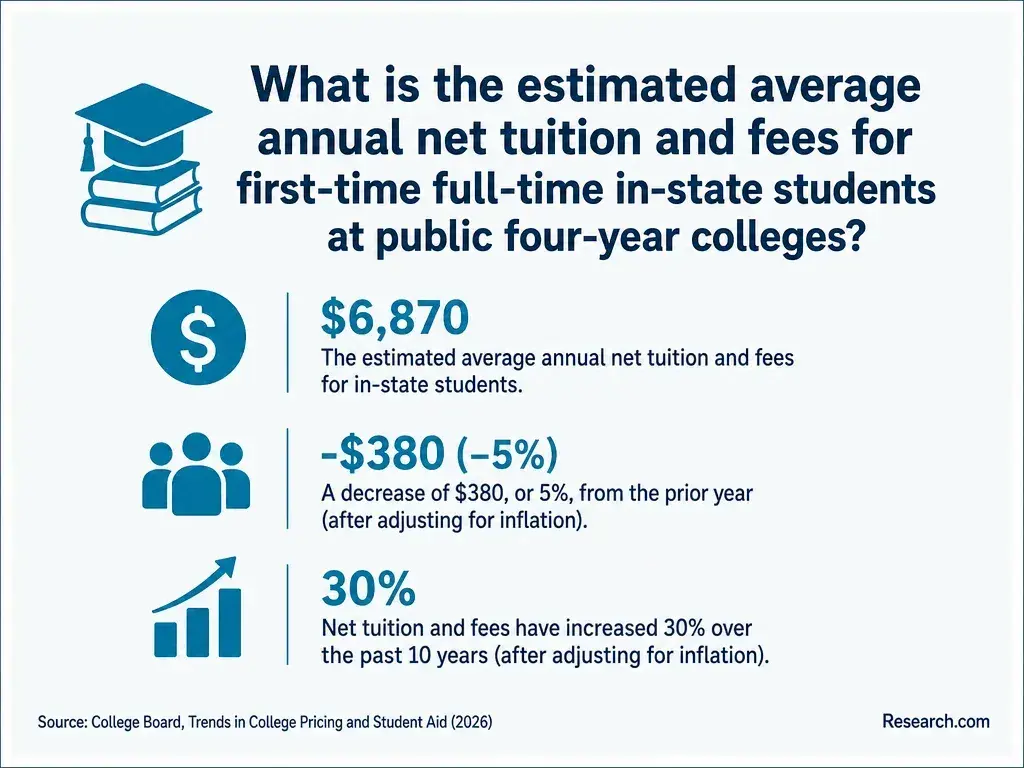
A first-time, full-time student should plan around a conventional multi-year bachelor's pathway; transfer credit, part-time attendance, course sequencing, and internship availability can change the finish date. Price likewise depends on credits still required, tuition and mandatory fees, books and software, travel for field activities, and any reduced work hours. Without a school-specific degree audit and cost estimate, a single total would be misleading.
Request a term-by-term plan and an itemized estimate for the courses you would actually take. Compare that with aid eligibility and the timing of any employer reimbursement. Online business degrees with lower tuition can be useful benchmarks, but a cheaper general business program may not supply the construction courses or field access you need.
There is no reliable single salary for graduates of this degree. Pay depends on the job performed, location, employer, sector, and prior experience. For context, the US Bureau of Labor Statistics reports a May 2025 median annual wage of $102,320 for project management specialists and projects 7% employment growth from 2025 to 2035. This is an occupation-wide figure across industries and experience levels - not a construction-specific graduate starting wage.
For a useful personal estimate, examine local postings for coordinator, estimating assistant, or procurement roles you could qualify for now, then compare their stated pay and requirements with the degree's net cost. To frame that longer-term trade-off, evaluate price duration and outcomes of business administration degrees; do not use a manager's median wage as a promised return.
Are licenses or certifications required for construction management careers?
There is no single license that every US construction manager must hold. Requirements depend on the work and jurisdiction: a state or locality may license a contractor or particular trade, while an employer may require specific safety training or prefer a voluntary construction or project-management certification. A business or construction management bachelor's degree does not itself grant a contractor's license, and certification bodies may impose separate education and experience rules.
Check the requirements attached to your target job, who will hold legal contracting responsibility, and the relevant state or local licensing authority before paying for a credential. If you are considering another bachelor's degree mainly to pursue project-management credentials, compare its curriculum and financial aid packages for online project management bachelor's students with the experience those credentials actually require.
Other Things You Should Know About Business Administration
Choose based on the work you want to learn. A construction management major may provide more technical depth; a business concentration may better fit commercial operations. Compare required assignments and field opportunities, not the names alone.
Yes. Approved community building projects may offer a view of site coordination and teamwork. Follow the organization's safety rules, and do not assume volunteer hours qualify for academic credit.
No. Trade knowledge can help you understand site decisions, but it is not a universal prerequisite. Look for introductory instruction in building methods and opportunities to learn from experienced field staff.
Ask which tasks you may observe or perform, who will supervise you, what safety preparation is required, and whether your schedule permits meaningful participation. Confirm academic eligibility with your program separately.
- Types of Financial Aid: Grants, Work-Study, and Loans | studentaid.gov https://studentaid.gov/understand-aid/types
- Cost of Attendance (Budget) | 2026-2027 Federal Student Aid Handbook https://fsapartners.ed.gov/knowledge-center/fsa-handbook/2026-2027/vol3/ch2-cost-attendance-budget
- Accreditation in the U.S. | ed.gov http://www.ed.gov/laws-and-policy/higher-education-laws-and-policy/college-accreditation/accreditation-in-the-us
- College Degree vs Major vs Concentration | Colorado Technical University https://www.coloradotech.edu/blog/college-degree-vs-major-vs-concentration-what-s-the-difference
- A review of employability skills for graduates in the construction sector - ScienceDirect https://www.sciencedirect.com/org/science/article/pii/S2042389625000356
- Major vs. Minor vs. Concentration: What's the Difference? | snhu.edu https://www.snhu.edu/about-us/newsroom/education/major-vs-minor-vs-concentration
- Bachelor of Science in Construction Management - Degree Plan | UH Department of Civil and Environmental Engineering https://www.cee.uh.edu/construction-management/programs/bachelor-science-construction-management/degree-plan
- College Degree Requirements | K-State https://artsci.k-state.edu/academics/degree_requirements/
- Academic Licensure and Programmatic Accreditation Notification | Tennessee Board of Regents https://www.tbr.edu/academics/academic-licensure-and-programmatic-accreditation-notification
- Major in Construction Management - University of Washington https://cm.be.uw.edu/students/undergraduate-programs/major-in-construction-management/