2027 BS in Business Administration Program Choice: A Construction Business Cost Review as a Capstone Option
Audited and Verified:
Our Editorial and Data Verification Process
Research.com uses government datasets, official education statistics and primary institutional information to support its career and degree guides. Our review process checks factual accuracy, occupational definitions, source dates and the requirements associated with the credentials discussed.
How This Article Was Fact-Checked
Our editorial team verifies salary estimates, employment projections, education requirements and program information against original data providers and official organizations. Salary figures are checked against the relevant occupational definitions and reporting periods. Information about licensure, accreditation and required in-person training is reviewed separately.
Fact-checked and verified on:

Co-Founder and Chief Data Scientist
A construction cost review can make a business administration capstone relevant to real decisions about budgets, purchasing, and project risk. But a useful review needs more than a spreadsheet: the program must permit the project, and the student needs suitable data and a manageable question.
This guide is for prospective and current BS in Business Administration students weighing that capstone option. It explains what the deliverable should contain, how to assess programs and career fit, and when a different project or more specialized degree would serve the goal better.
Key Things You Should Know
- A construction cost review is a defensible analysis of a defined project budget—not a professional cost estimate or proof that money was saved.
- Choose a program only after confirming that its capstone rules permit the project and that you can use authorized, sufficiently detailed cost data.
- The U.S. Bureau of Labor Statistics reports a May 2025 median annual wage of $102,320 for project management specialists; that occupation-wide figure is not a starting salary for business graduates.
What Is a BS in Business Administration With a Construction Business Capstone?
A BS in Business Administration is a broad undergraduate business degree. A construction business capstone applies that education to a construction-related decision, such as whether a proposed purchasing plan fits a project budget. Unless a school formally awards a construction concentration, the capstone is a project choice—not a separate degree, credential, or construction management qualification.
For a cost review, the strongest scope is narrow enough to assess with available evidence: one project phase, purchasing category, or budget-versus-actual question. The intended reader might be a small contractor's owner, a project administrator, or a faculty evaluator. A student without employer access can instead use a clearly labeled hypothetical case and public pricing assumptions; the resulting work should not be presented as an actual company review.
Before selecting a school, ask its business department whether students may propose an industry-specific capstone, who approves the scope, and what evidence the final submission requires. Students comparing ranked US colleges for faster business degree completion should check capstone approval separately: a shorter route to graduation does not establish that this project option is available.
How Does a Construction Cost Review Fit a Business Administration Degree?
The project connects managerial accounting, procurement, operations, and decision-making. Its central question should be explicit—for example, which documented cost differences warrant further review before a purchasing decision. It should not claim to certify an estimate, determine contractual liability, or replace the judgment of a construction estimator or project manager.
A compact capstone structure makes the analysis testable. The following steps move from an approved question to a recommendation that a decision-maker can evaluate:
- Define the project phase, decision-maker, review period, cost categories, and whether the figures represent an estimate, approved budget, commitment, or actual expenditure.
- Identify permitted sources, such as an approved budget, redacted purchase orders, invoices, or a documented hypothetical case; record their dates, units, and gaps.
- Compare like with like: separate quantity changes from unit-price changes, and flag scope changes, allowances, taxes, and timing differences.
- Test how uncertain prices or quantities affect the conclusion, then recommend specific items for investigation rather than asserting unverified savings.
- Submit a concise report with assumptions, calculations, source descriptions, limitations, and a version safe to share outside the organization.
Employer data requires permission under workplace and school rules; removing names alone may not protect commercially sensitive prices. If the real goal is to learn construction procurement in depth rather than complete a broad business degree, compare the curriculum and project access of supply chain undergraduate programs with shorter terms before deciding.
What Careers Can a Business Administration Graduate Pursue in Construction?
A cost review can help an early-career applicant demonstrate spreadsheet work, financial communication, and attention to purchasing controls. Those skills are relevant to project coordination, purchasing support, contract administration, and operations support. Employers may still require construction experience, estimating software, knowledge of drawings, or responsibility for actual projects.
The distinction between supporting a project and directing one matters. A graduate might track commitments and prepare variance reports under supervision; a construction manager typically carries broader responsibility for schedules, budgets, subcontractors, and delivery. Someone already working in construction may be able to pair a business degree with field knowledge to pursue greater responsibility, but the degree alone does not establish readiness to manage a build.
If personnel administration is the target instead, compare the construction cost review with a people-operations project and consider whether choosing a degree in human resources would provide more relevant preparation. Choose the capstone that produces evidence for the tasks you actually want to perform.
Course titles and requirements vary. For this capstone, managerial accounting helps distinguish budgeted and actual costs; finance supports cash-flow reasoning; operations and supply chain courses address purchasing and delivery; and statistics or business analytics helps students interpret differences without overstating what the data proves. Business communication is important because the final recommendation must make sense to a nonacademic decision-maker.
Ask whether relevant courses are required, offered as electives, or part of an official concentration. An elective cluster in operations is not automatically a construction specialization. Check sequencing as well: a capstone may require prior completion of accounting or analytics coursework, and an elective offered too late may not help the project.
A specialized supply chain degree may offer more purchasing depth, but it can also change which prior credits apply. Students weighing that alternative can use tuition and time comparisons for supply chain students as a starting point, then request degree audits from the schools under consideration.
Either format can support a construction cost review. Online delivery may reduce travel, while campus study may make scheduled faculty meetings or local industry contacts easier. Neither format guarantees access to a contractor, usable records, or an individually chosen capstone.
For this project, compare the practical obligations: live meetings, group assignments, software access, presentation requirements, faculty feedback, and deadlines for approving a project proposal. An online course can still require fixed-time participation. If the project depends on a workplace supervisor, ask how that person's role differs from the faculty member's responsibility for grading.
When using online business degree school rankings in America to identify options, obtain the current capstone syllabus or written policy from each school. That is more useful for this decision than a general description of online flexibility.
Verify the institution's recognized accreditation first. Then check whether the business school or specific program holds applicable AACSB, ACBSP, or IACBE accreditation; these designations have different scopes and should not be assumed from a school-wide claim. Accreditation does not itself confirm that a construction cost review is an approved capstone or that graduates obtain construction jobs.
Compare accreditation alongside project supervision, course availability, and price. For example, lower-priced college options for business majors may warrant a closer look, but each institution still needs an individual check of its accreditation, degree requirements, and capstone policy.
Admission requirements depend on the school and whether the applicant enters as a first-year or transfer student. Schools commonly evaluate prior education and transcripts; some business majors have separate entry standards or prerequisites in mathematics, accounting, or economics. Confirm the rules for the intended enrollment term rather than assuming that admission to the university also means admission to the business major.
For this capstone choice, request an official degree audit showing where prior coursework applies and when the capstone becomes available. Accepted transfer credits may count only as electives, leaving accounting or other required courses unfinished. The school—not a preliminary credit estimate—decides equivalencies and graduation requirements. A guide to prerequisites for a business administration degree can help frame questions for admissions and an academic adviser.
A bachelor's degree is commonly planned around four years of full-time study, but the remaining time for a transfer or returning student depends on applied credits, prerequisite sequences, course availability, and enrollment pace. A capstone can add a scheduling constraint if proposal approval, data permissions, or a required presentation must happen in a particular term.
Compare schools using the cost to finish, not just advertised tuition. Ask for an audit and a term-by-term plan, then account for tuition, required fees, software, books, travel, financing costs, and any income affected by study time. If a real workplace review is impossible, determine whether a permitted case-based alternative avoids a delay without weakening the learning objective.
Listings of economical business administration degrees with quicker study routes can narrow a search. Only the school's current charges and evaluation of your remaining requirements can establish a credible personal cost and completion estimate.
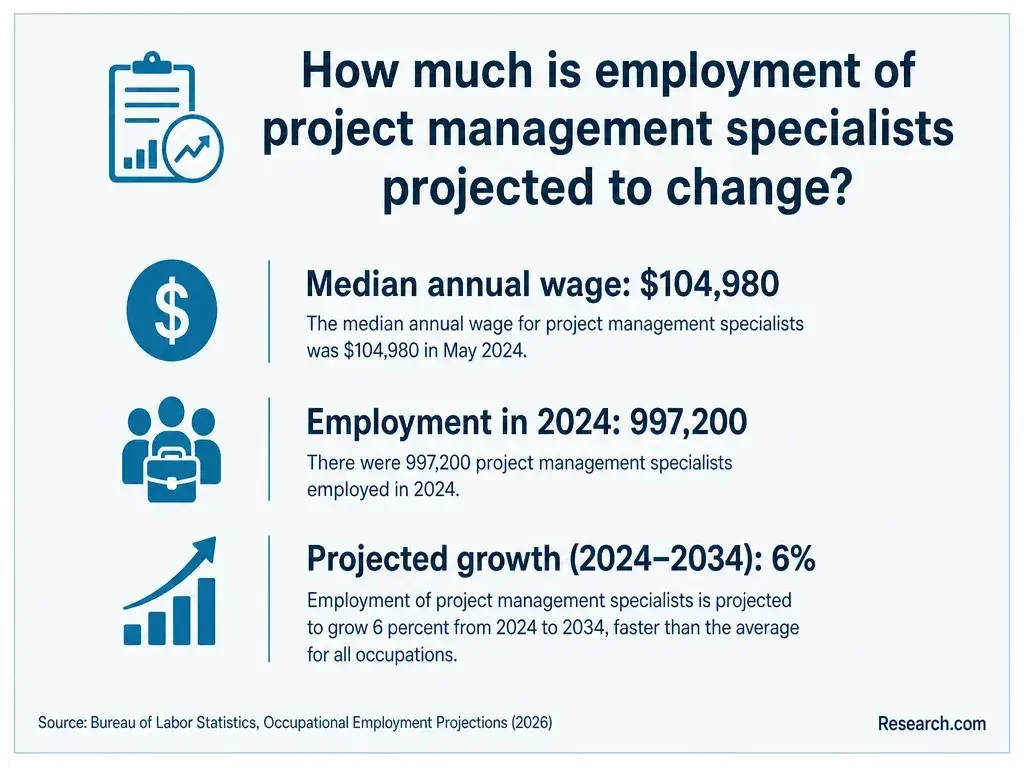
There is no single salary or employment projection for graduates of a construction-focused business capstone. Outcomes depend on the occupation, location, employer, and prior construction experience. The U.S. Bureau of Labor Statistics reports that project management specialists earned a median annual wage of $102,320 in May 2025, with employment projected to grow 7% from 2025 to 2035. Those figures cover the occupation across industries and experience levels; they are not construction-only figures or an expected offer for a new graduate.
Use occupation data to identify a direction, then read local job postings for the actual entry route. Compare required construction knowledge, software, and project responsibility with the evidence your courses and capstone can provide. An aspiring supervisor considering accelerated organizational leadership college programs should make the same comparison: neither degree title substitutes for demonstrated responsibility on construction projects.
Do Construction Business Graduates Need Licenses or Certifications?
A BS in Business Administration and its capstone do not award a construction license or professional certification. Requirements for contractors and particular trades vary by state, locality, and activity; employers set additional qualifications for estimating, purchasing, and project roles. Check the rules for the specific work you intend to perform before paying for a credential.
Voluntary training in estimating tools, project management, or construction safety may be useful when it addresses a documented job requirement, but eligibility and value differ. The more immediate test for a student is whether the capstone shows careful analysis without implying professional authority. If the intended move is into HR rather than construction cost work, transfer pathways into online human resources programs may be worth comparing before committing to a credential or project that does not match the target role.
Before enrolling or proposing the review, confirm the school's capstone rules, identify a lawful data source, and ask a faculty adviser to approve a scope that fits the available time. Revise the deliverable when the evidence cannot support the original question.
Other Things You Should Know About Business Administration
Possibly. Check the bid documents' permitted use and whether they contain enough detail for the question. A posted bid is not necessarily an approved budget, a final contract price, or an actual cost.
Include them when the project question and records support it. Track them separately from the original scope so a scope increase is not misreported as a purchasing overrun.
Not necessarily. A documented spreadsheet may suit a limited review. Use specialized software only if the assignment requires it and you can explain and verify its inputs.
Follow its restrictions. Ask the school whether you can present a redacted methodology or a separate hypothetical example; do not publish confidential figures merely because they appeared in graded coursework.
- Part 31 - Contract Cost Principles and Procedures | Acquisition. GOV https://www.acquisition.gov/far/part-31
- Data Ownership | The Office of Research Integrity https://ori.hhs.gov/education/products/n_illinois_u/datamanagement/dotopic.html
- Business Administration - Craig School of Business | California State University, Fresno https://craig.fresnostate.edu/advising/degprog/businessadminmajor.html
- Program: Management B.S., with Project Management Concentration | usf.edu https://cloud.usf.edu/catalog/undergrad/management-bs-with-project-management-concentration
- Project Management for Construction: Cost Estimation | Carnegie Mellon University https://www.cmu.edu/cee/projects/PMbook/05_Cost_Estimation.html
- What Is a Capstone Project? | National University https://www.nu.edu/blog/what-is-a-capstone-project/
- Risks and challenges of data access and sharing | oecd.org https://www.oecd.org/en/publications/enhancing-access-to-and-sharing-of-data_276aaca8-en/full-report/risks-and-challenges-of-data-access-and-sharing_5274577c.html
- Online Project Management Bachelor's Degree | usnews.com https://www.usnews.com/education/online-education/project-management-bachelors-degree
- Criteria for Accrediting Engineering Programs, 2025 - 2026 | ABET https://www.abet.org/accreditation/accreditation-criteria/criteria-for-accrediting-engineering-programs-2025-2026/
- Project Success Criteria Evaluation for a Project-Based Organization and Its Stakeholders - A Q-Methodology Approach https://www.mdpi.com/2076-3417/12/21/11090