2027 Best Short Certificate Programs for Low Student Debt

Co-Founder and Chief Data Scientist
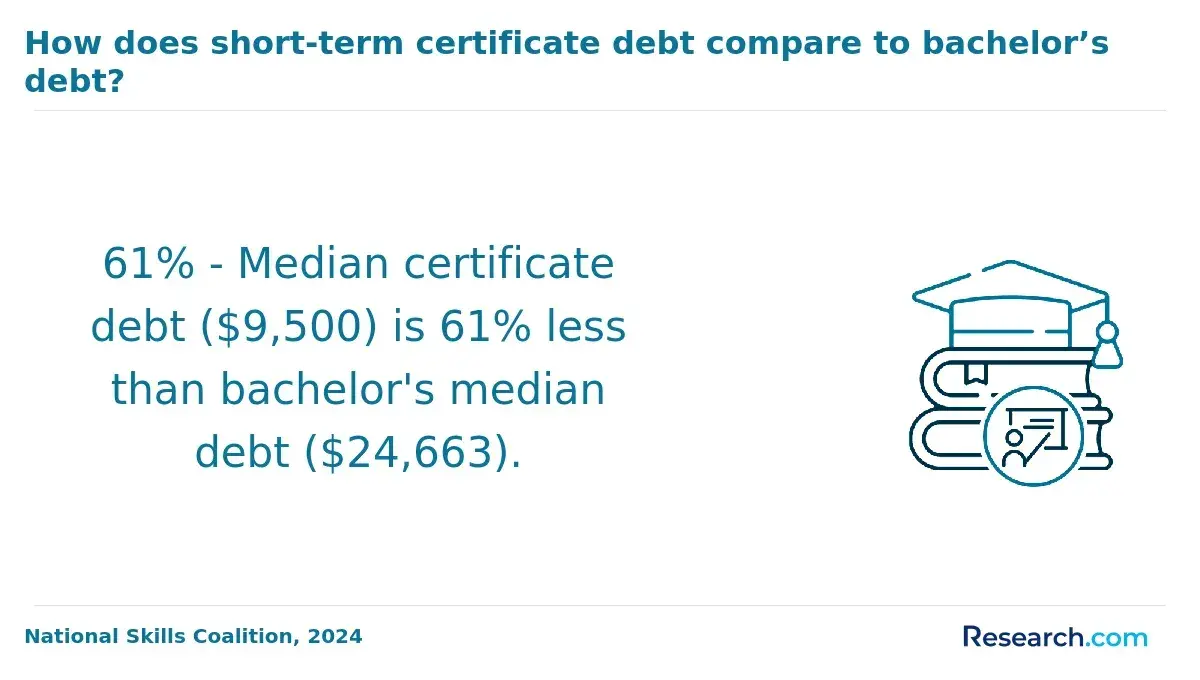
A short certificate can reduce the time, and potentially the borrowing, needed to enter a new field, but the cheapest program is not automatically the best value. Public two-year colleges charged average published tuition and fees of $4,050 for 2024-25, according to College Board, though certificate prices vary widely by program and location.
This guide helps career changers, recent graduates, and working adults compare short, job-focused programs by total cost, licensing fit, delivery format, and realistic career outcomes before enrolling.
Key Things You Should Know
- Low-debt certificate choices usually pair short completion times with public-community-college pricing, employer support, apprenticeships, or workforce grants, not simply low advertised tuition.
- Healthcare and skilled-trade certificates can lead to entry-level work relatively quickly, but regulated roles may require state-approved training, clinical hours, an exam, or licensure beyond the certificate.
- BLS projects medical-assistant employment to grow 15% from 2023 to 2033, while electricians and HVAC mechanics/installers are each projected to grow 9%. Demand does not remove the need to compare total cost and local hiring requirements.
Top 10 Best Short Certificate Programs for Low Student Debt
Popular Trade School Programs
Trade certificates are practical, equipment-based programs commonly offered by community colleges, technical schools, unions, and private career schools. HVAC, welding, electrical technology, industrial maintenance, CDL, and automotive service are common options.
A short certificate may help with entry-level technician or helper roles, while electrician and plumbing careers often require a paid apprenticeship and state or local licensing. Choose campus or hybrid training when labs are essential. A credit-bearing certificate can be useful if it stacks into an associate degree; a noncredit program may be faster but may not transfer.
Healthcare Programs
Medical assisting, dental assisting, pharmacy technician, phlebotomy, medical billing and coding, and nursing aide training are common short healthcare pathways. They suit students comfortable with patient contact, compliance rules, and supervised practice. Medical-assistant and dental-assistant programs often include labs and externships; fully online study alone is usually insufficient for hands-on preparation.
A school certificate is not the same as national certification, and state rules differ for pharmacy technicians, nursing aides, and dental assistants. Verify whether the program prepares students for the required exam, registry, clinical requirement, or employer preference.
Criminal Justice / Law Programs
Short programs in legal assisting, paralegal studies, court reporting support, corrections, and security can introduce legal systems and administrative work. A paralegal certificate is most valuable when it includes legal research, writing, technology, and supervised practical work; employers may prefer a bachelor's degree or a certificate earned after prior college study.
Security roles can require state licensing, fingerprinting, background checks, and firearms training where applicable. Students with a record should review occupation-specific restrictions and explore the best degree for felons before paying for a program.
Arts & Design Programs
Certificates in graphic design, UX/UI design, digital media, photography, web production, and animation can build focused technical skills. These programs work best for learners who can leave with a portfolio containing original, job-relevant projects. Software access, portfolio review, and instructor feedback often matter more than the certificate title alone.
Online programs can be cost-effective for software-based work, but students should confirm current tools, project ownership, and career support. For broader exploration before specializing, compare these options with the best majors that align with longer-term goals.
What are short certificate programs and how do they minimize student debt?
Short certificate programs are focused courses of study designed to teach a defined occupational skill set, often in a few weeks to about a year. They may be offered for academic credit by colleges or as noncredit workforce training by colleges, employers, trade organizations, and private providers.
A certificate documents program completion; it is different from a professional certification awarded by an independent organization after meeting its standards, often through an exam.
They can minimize debt because students generally pay for fewer terms, spend less time away from paid work, and can target a narrower job goal. That advantage disappears when a program has high private-school tuition, requires large financing charges, or does not meet licensing or employer requirements.
A short program is strongest when its curriculum directly matches a local entry-level role and its total cost can be covered without excessive private borrowing.
A certificate is usually a sensible fit for a learner seeking a specific entry point, such as medical assisting or HVAC service. Consider an associate degree, apprenticeship, or longer program instead when the target occupation requires one, when advancement depends on broader coursework, or when the certificate offers no credible pathway to further study.
How much do short certificate programs cost and what funding options exist?
Cost is more than tuition. Compare the amount due through completion, including required tools, books, uniforms, lab fees, examination fees, background checks, transportation, and lost work hours. Community colleges may be lower-cost options, but published price is not the same as your net price after grants.
The comparison below shows the cost categories that can change the debt calculation most. Obtain each figure in writing before accepting enrollment or financing.
| Cost or funding factor | Why it changes value | What to verify |
| Tuition and mandatory fees | Creates the base amount to pay or finance | Total charges for every required term |
| Supplies and clinical or lab costs | Can be substantial in hands-on programs | Tools, uniforms, vaccinations, insurance, and testing fees |
| Federal aid eligibility | Not every nondegree or noncredit program qualifies | Whether the specific program is eligible, not just the school |
| Workforce grants and employer aid | May reduce upfront borrowing | Eligibility, repayment obligations, and deadlines |
| Payment plan or private loan | May add fees or interest | Total financed amount, APR, and cancellation terms |
Start with the FAFSA when the school and eligible program participate in federal aid. Also ask about state workforce agencies, Workforce Innovation and Opportunity Act funding, union sponsorships, Veterans Affairs education benefits where eligible, employer tuition assistance, and institutional grants. Do not assume aid applies to a noncredit program simply because it is delivered by a college.
To keep borrowing controlled, follow a simple sequence:
- Price the complete credential, including every required non-tuition expense.
- Subtract grants, employer support, savings, and realistic earnings from work during training.
- Compare the remaining amount with the entry-level jobs the program actually prepares you to pursue.
- Use federal aid before private financing when eligible, and read withdrawal and refund policies before signing.
How can students compare online vs campus certificate programs for value and flexibility?
Online delivery can lower commuting and scheduling costs, while campus training may be necessary for equipment, clinical practice, and employer-recognized hands-on hours. The better option is the one that meets the occupation's training rules and lets you finish without extending the program or sacrificing required practice.
This comparison clarifies when each format tends to provide better value. Confirm the exact format of labs, externships, exams, and student support rather than relying on an "online" label.
| Decision factor | Online or mostly online | Campus, hybrid, or employer site |
| Best fit | Software, administrative, coding, and theory-based skills | Clinical, shop, driving, or equipment-intensive training |
| Potential savings | Commuting, parking, and schedule flexibility | Access to included equipment and in-person instruction |
| Main risk | Weak hands-on practice or unclear local placement support | Higher travel and scheduling burden |
| Credential check | Confirm remote coursework meets employer or board expectations | Confirm lab hours, site approval, and instructor qualifications |
Online study is often appropriate for bookkeeping, IT support preparation, medical billing, legal research, and digital design when the provider offers current software and substantive feedback. It is less suitable as a fully remote substitute for training that must document clinical competency or supervised physical skills.
Applicants with a lower academic record who want flexible degree pathways can also review online colleges that accept 2.0 GPA, while remembering that admissions rules differ from certificate to certificate.
What accreditation and state licensing requirements should certificate programs meet?
Accreditation matters most when it affects federal aid, transfer credit, employer confidence, or eligibility for a certification or license. For a credit-bearing college certificate, check institutional accreditation through the U.S. Department of Education or the Council for Higher Education Accreditation databases. For career schools, also confirm state authorization to operate.
Programmatic approval is especially important in regulated fields. For example, a healthcare board, nursing aide registry, pharmacy board, dental board, or state workforce agency may require an approved curriculum, documented clinical hours, or an approved exam pathway. A school can be institutionally accredited while a particular program still fails to meet a state licensing rule.
Before enrolling, ask the program to identify the exact credential earned, whether it is credit-bearing, the licensing or certification exam it prepares students for, and the states where its training is accepted. Get answers in writing. If staff use vague phrases such as "nationally recognized" but cannot name the approving body or exam, treat that as a red flag.
Which short certificate fields offer the strongest career outcomes and entry-level roles?
The strongest short-certificate fields generally have a clear entry role, a defined skill standard, and employers that routinely hire trainees or new completers. Growth data helps identify demand, but it does not measure openings in a specific city, shift availability, physical requirements, or the quality of one provider.
The following roles illustrate how a certificate may fit into an entry pathway. BLS figures are occupation-wide data, not salaries promised to certificate completers.
| Field | Possible entry-level role | Typical certificate relevance | Important limitation |
| HVAC | Installer helper or service technician trainee | Technical fundamentals and refrigerant-handling preparation | EPA Section 608 certification is commonly needed for refrigerant work |
| Electrical | Electrical helper or apprentice | Safety and foundational electrical coursework | Licensure typically follows apprenticeship and supervised experience |
| Medical assisting | Medical assistant | Clinical and administrative preparation | Employer preferences and state scope-of-practice rules vary |
| Dental assisting | Dental assistant | Chairside and office preparation | Expanded duties may require state-specific authorization |
| IT support | Help desk or support specialist trainee | Operating systems, networking, and troubleshooting foundations | Portfolio, customer-service skill, and certifications may matter |
For students choosing between a short program and a broader degree, the deciding question is whether the first job requires narrowly defined skills or a deeper academic foundation. Compare certificate pathways with the most lucrative college majors if your target field has advancement roles that commonly require a bachelor's degree.
What are typical admission requirements and timelines for short certificate programs?
Admission requirements depend on the provider and credential type. Many community-college workforce certificates use open or rolling admission, while selective clinical programs may require prerequisites, placement testing, immunizations, drug screening, criminal-background checks, CPR training, or minimum grades in prerequisite courses. Industry-provider certificates may only require payment and basic technology access.
Apply early when a program has limited lab seats, clinical placements, or cohort starts. A practical timeline is to spend several weeks comparing programs and aid options, then allow additional time for transcripts, background checks, health documentation, financial-aid processing, and any prerequisite course. Do not confuse general college admission with admission to a capacity-limited healthcare or technical cohort.
Ask whether previous college coursework, military training, prior credentials, or work experience can satisfy prerequisites. If transfer credit is important, obtain a written evaluation policy; noncredit training often does not transfer as academic credit.
How long do short certificate programs take and what does the coursework include?
Short certificate length ranges from a few weeks for tightly focused training to roughly one year for programs with substantial labs, clinical experience, or multiple technical courses. Clock-hour programs measure instructional time differently from credit-bearing programs, so compare required hours and course sequence rather than relying only on a marketing claim such as "fast track."
Coursework typically combines foundational theory with job-specific practice. Trade programs may include safety, tools, measurement, diagnostics, and supervised lab work.
Healthcare programs can include anatomy, terminology, documentation, infection control, patient interaction, and an externship. Legal and design programs may emphasize writing, research, software, project work, and portfolio development.
Accelerated schedules can reduce time out of the labor market, but they require consistent study time and may make it harder to work full time. Part-time evening, weekend, and hybrid formats can be better debt-reduction choices when they allow students to keep income, even if completion takes longer.
What salary ranges and job outlook can graduates expect from leading certificate fields?
Salary information is useful for judging a program's possible return, but it should be read as a labor-market benchmark rather than a graduate guarantee. Pay varies by location, experience, shift, employer, union coverage, and whether the occupation requires additional licensing or apprenticeship training.
The BLS reported the following national median annual wages for 2024. Its projected employment growth figures cover 2023 to 2033.
| Occupation | 2024 national median annual wage | Projected growth, 2023-33 | Certificate-only caution |
| Electricians | $62,350 | 9% | Most enter through apprenticeship; a certificate alone generally does not confer licensure. |
| HVAC mechanics and installers | $59,810 | 9% | Employers may expect refrigerant certification and hands-on competence. |
| Paralegals and legal assistants | $61,010 | 1% | Some employers prefer an associate or bachelor's degree plus paralegal training. |
| Graphic designers | $61,300 | 2% | A portfolio and software capability are central; a certificate alone may not be sufficient. |
| Medical assistants | $44,200 | 15% | Requirements and certification preferences differ by employer and state. |
| Dental assistants | $47,300 | 8% | State rules can affect permitted duties and required credentials. |
Use these figures to set a borrowing ceiling, not to forecast your personal income. Ask local employers what they pay new hires and whether they hire graduates from the program you are considering. A program with modest tuition and clear employer connections can be a better low-debt choice than a higher-priced program advertising a broad salary range.
How can prospective students evaluate and choose reputable, low-debt certificate programs?
A reputable low-debt program is one that is affordable for your circumstances, recognized for the job you want, and transparent about requirements and outcomes.
Start with public community colleges, union or registered apprenticeship options, employer-sponsored training, and state-approved providers before considering high-cost private career schools.
Use these checks to compare finalists before submitting a deposit:
- Match the curriculum to actual local job postings and ask employers whether they recognize the credential.
- Request an itemized total-cost estimate that includes required equipment, exams, clinical fees, and repeat-course charges.
- Verify institutional accreditation, state authorization, and program approval when the field is regulated.
- Confirm whether the program is credit-bearing, transferable, stackable into an associate degree, or purely noncredit workforce training.
- Ask for completion, withdrawal, job-placement, and licensure-exam information, including how each outcome is calculated.
- Read the refund policy and avoid pressure to sign financing documents before comparing alternatives.
Common mistakes include choosing a school based only on speed, treating a certificate as a license, accepting private loans without calculating the full repayment amount, and assuming "online" means accepted in every state.
The best next step is to compare two or three programs using the same checklist, then choose the least expensive option that still satisfies the training, approval, and scheduling requirements for your target role.
Other Things You Should Know About the Best Short Certificate Programs
They can be worth it when they prepare you for a clearly defined entry-level role, meet applicable licensing or employer requirements, and can be completed with limited borrowing. They are less valuable when the occupation requires a degree, apprenticeship, or additional credential that the program does not provide.
The fastest option depends on local hiring and required training. Short programs in nursing aide work, phlebotomy, CDL training, IT support preparation, and some administrative healthcare roles may be relatively quick, but required exams, background checks, clinical hours, or licensing can extend the timeline.
Possibly. Federal aid generally depends on both the institution and the specific eligible program. Credit-bearing programs at participating schools are more likely to qualify than standalone noncredit courses, but students should verify eligibility directly with the financial-aid office.
A certificate may cost less and take less time, but an associate degree can offer broader career options and transferable credits. Choose the certificate when it meets the exact entry requirement for your goal; choose the associate degree when employers, licensing rules, or advancement paths consistently require more education.
References
- Scholarships for Students Pursuing Career Education https://career.org/web/web/Multimedia/CER/Articles/Scholarships-for-Students-Pursuing-Career-Education.aspx
- What is the typical debt load for graduates of four-year public universities - APLU https://www.aplu.org/our-work/4-policy-and-advocacy/publicuvalues/student-debt/
- Career Training and Trade School Loans https://www.salliemae.com/student-loans/career-training-loan/
- Dept. of Education's College Scorecard shows where student loans pay off... and where they don't | Brookings https://www.brookings.edu/articles/ed-depts-college-scorecard-shows-where-student-loans-pay-off-and-where-they-dont/
- Advanced Career Training Programs Overview - /info/landing/online-career-training-program https://commed.smc.edu/info/landing/online-career-training-program
- Student Loans for Certificate Programs: Paying for Career Training https://www.credible.com/student-loans/student-loans-for-certificate-programs
- How to Graduate from College with Zero Student Loan Debt https://www.fastweb.com/financial-aid/articles/psst-want-to-graduate-from-college-with-an-undergraduate-degree-and-no-debt
- Average Student Loan Debt [2025]: by Year, Age & More https://educationdata.org/average-student-loan-debt
- Short-term credentials and the labor market: Who stands to benefit? https://fedcommunities.org/short-term-credentials-labor-market-who-stands-benefit/