2027 Best Online Short Certificate Programs for Career Changers

Co-Founder and Chief Data Scientist
Changing careers quickly is appealing, but the wrong online certificate can cost time and money without meeting employer or licensing requirements. Short programs can build targeted skills in weeks or months, while longer credit-bearing certificates may create a path into an associate degree. The U.S. Bureau of Labor Statistics projects about 19 million job openings per year from 2024 to 2034, largely from replacement needs. This guide helps career changers compare program types, verify recognition, estimate costs, and choose training that matches a specific job goal.
Key Things You Should Know
- Choose a short online certificate only after identifying the exact job, required license or industry certification, and whether employers accept online training for that role.
- Short certificates commonly take weeks to under one year; credit-bearing college certificates may take longer but can be stackable toward an associate degree.
- BLS projects about 19 million annual U.S. job openings from 2024 to 2034, but openings do not mean every field accepts a certificate alone; experience, exams, clinical hours, or licensing may still be required.
Top 10 Best Online Short Certificate Programs for Career Changers
Popular Trade School Programs
Online trade certificates work best for theory-heavy preparation, not hands-on licensure training. Common options include HVAC fundamentals, electrical theory, construction estimating, welding technology theory, CAD drafting, logistics, and automotive service preparation. Many skilled trades require supervised lab work, apprenticeships, or state-approved instruction before a learner can work independently. Choose an online program when it clearly identifies required in-person components and prepares you for an employer-recognized exam. Choose a hybrid technical college or apprenticeship instead when the occupation requires tools, safety demonstrations, clinical-style practice, or state licensing.
Healthcare Programs
Short online healthcare certificates may cover medical billing and coding, pharmacy technician preparation, medical assisting coursework, patient access, electronic health records, or community health support. Fully online study is usually more suitable for administrative roles than direct patient-care jobs. Medical assisting, phlebotomy, nursing aide, and similar patient-facing paths often require supervised clinical practice and may be regulated by state rules. Confirm whether the program qualifies you for a certification exam, includes placement support for required externships, and meets your state's eligibility standards before paying tuition.
Criminal Justice / Law Programs
Online short programs in criminal justice, paralegal studies, legal research, court reporting support, homeland security, and cybersecurity can help career changers develop foundational knowledge. A certificate is not a law degree and does not authorize legal practice. Paralegal employers may prefer graduates of programs approved by the American Bar Association, although approval is not legally required in every setting. For corrections, policing, or security careers, agencies commonly impose separate background, fitness, academy, and state requirements. Review those requirements before choosing a general criminal justice certificate.
Arts & Design Programs
Online certificates in graphic design, UX design, digital marketing design, photography, animation, web design, and video editing can suit career changers who need portfolio-ready skills. The strongest programs require project critiques, current software workflows, and several finished work samples rather than only recorded lectures. Employers in many creative fields evaluate portfolios more heavily than the certificate name. A short program is a sensible starting point for entry-level freelance or production work; a longer degree or sustained portfolio development may be better for art direction, advanced UX research, or highly competitive studio roles.
What is an online short certificate program and who is it best suited for?
An online short certificate program is a focused course of study that awards an educational certificate after completion. It may be offered by a community college, university, technical school, employer-training provider, or online learning company. It is different from a professional certification, which is typically awarded by an independent certifying body after an exam and sometimes verified work experience.
It is best suited for a career changer with a defined target role, a skills gap that can be addressed in a short timeframe, and a realistic understanding of local employer requirements. It is less suitable when a role requires a degree, a state license, extensive supervised practice, or a long portfolio-building period. Learners considering eventual graduate study should compare the certificate route with most useful masters degrees when the target occupation typically expects advanced education.
Before enrolling, clarify the credential type and its practical value:
- Credit-bearing college certificate: May use academic credits that can sometimes apply toward a degree, subject to the receiving institution's policies.
- Noncredit workforce certificate: Focuses on job skills and typically does not transfer as college credit.
- Professional certificate: Usually signals completion of provider-designed coursework and may be useful for portfolios or skill development.
- Certification preparation program: Teaches material for a separate industry examination but does not itself award the professional certification.
How do online short certificate programs compare to campus-based options for career changers?
This comparison highlights the trade-off to assess before choosing a format.
| Decision factor | Online short certificate | Campus or hybrid option |
| Schedule | Often asynchronous and easier to combine with work | Usually fixed meeting times, with some evening options |
| Hands-on learning | Best for software, theory, administration, and business skills | Better for labs, equipment, clinical practice, and demonstrations |
| Networking | May require proactive use of virtual events and career services | Can provide more direct instructor and employer contact |
| Licensure fit | Must be verified carefully; online coursework alone may be insufficient | May more easily include required labs or supervised hours |
For career changers attracted to creative work, compare the program's portfolio expectations with fun majors in college that pay well to decide whether a short credential or a broader degree path better fits the long-term goal.
How can you verify that an online certificate program is properly accredited and recognized?
Accreditation matters most when a certificate is issued by a college, uses federal financial aid, transfers for academic credit, or supports a regulated career. Institutional accreditation applies to the school as a whole; programmatic accreditation applies to certain professional programs. A noncredit provider may not be accredited, but it should still be transparent about its curriculum, instructors, assessment, employer relationships, and the credential awarded.
Use these checks before committing:
- Confirm the institution's accreditation directly through the U.S. Department of Education or Council for Higher Education Accreditation databases when the provider claims institutional accreditation.
- Check the relevant state licensing board or certifying organization to see whether the program meets exam or training eligibility rules.
- Ask whether the certificate is credit-bearing, how many credits it carries, and whether credits can transfer or stack into a degree.
- Request total cost, refund terms, required software or equipment costs, completion requirements, and career-services details in writing.
- Search job postings in your target area to confirm that employers recognize the skills, software, or certification preparation offered.
Red flags include vague claims that a program is "accredited" without naming an accreditor, promises of guaranteed employment, unclear total charges, or statements that imply a certificate automatically grants a license. Accreditation does not guarantee a job, and employer recognition can vary by region and occupation.
What admission requirements and prior experience do online short certificate programs typically expect?
Admission requirements depend on the provider and credential type. Noncredit professional certificates may require only an account, payment, and basic computer access. Community-college certificates commonly require an application and may require placement testing or prerequisite courses. Programs in healthcare, information technology, legal studies, and advanced trades can require prior coursework, background checks, immunizations, drug screening, or technical skills.
Career changers should distinguish admission from job eligibility. A program may admit a beginner while the occupation requires a separate exam, supervised experience, a clean background check, physical capability, or a degree. People rebuilding a career after justice involvement should review best degrees for felons alongside local licensing and employer policies, since restrictions vary substantially by occupation and state.
Ask the admissions team whether previous college coursework, military training, industry experience, or employer training can satisfy prerequisites. Do not assume transfer credit applies to a noncredit program, or that a certificate will transfer into a degree without written confirmation from the receiving school.
How long do online short certificate programs take and what do they usually cost?
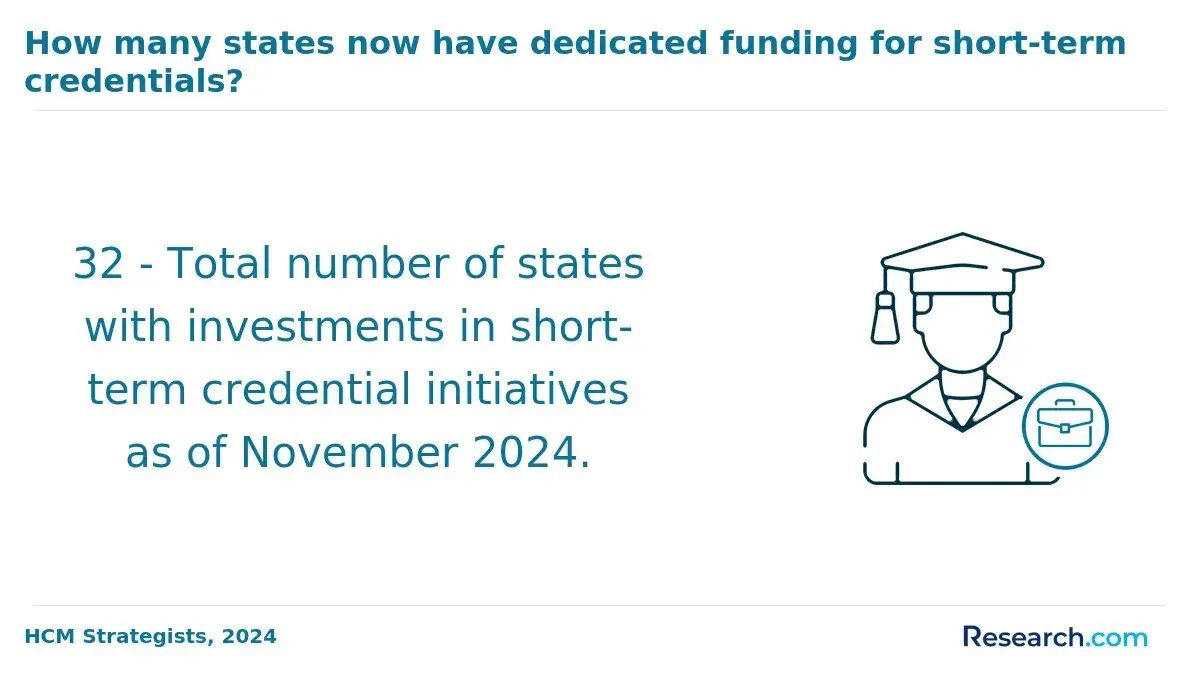
Most online short certificate programs run from a few weeks to less than one year, but the label "short" does not establish quality or total workload. Self-paced programs can be faster for experienced learners; instructor-led college certificates commonly follow academic terms. Programs with clinicals, labs, externships, or licensing requirements may take longer than their online coursework suggests.
Cost varies sharply by provider, academic credit, subject, and included services. The comparison below separates typical cost drivers rather than implying a universal price.
| Program type | Typical timeline | Major cost factors | Best use case |
| Noncredit online certificate | Weeks to several months | Course fee, subscription, exam preparation, software | Building a defined skill quickly |
| College credit certificate | One or more academic terms | Per-credit tuition, fees, books, technology | Stacking credits toward a degree |
| Hybrid career training | Several months to about a year | Tuition, labs, supplies, background checks, clinical costs | Fields requiring supervised practice |
| Certification-exam preparation | Weeks to months | Training, exam fee, retake fee, renewal costs | Meeting an industry credential goal |
Calculate total cost by adding tuition, required exams, equipment, software, proctoring, travel for labs, and lost work time. Federal aid may be available for eligible programs at eligible institutions, but many short noncredit offerings do not qualify. If your plan eventually requires doctoral study, compare long-term borrowing carefully with most affordable doctoral programs rather than treating a low-cost first certificate as the full education cost.
What coursework and skills do the best online short certificate programs commonly include?
The best online short certificate programs teach job-relevant skills, assess whether students can use them, and explain how the work maps to a target role. Strong curricula combine foundational knowledge with practical assignments, feedback, and current tools. Merely watching videos or earning a completion badge is usually weaker evidence of readiness than completing assessed projects.
Common coursework themes include:
- Industry vocabulary, regulations, ethics, safety, privacy, or compliance requirements relevant to the field.
- Technical tools such as spreadsheets, design software, coding environments, customer relationship systems, electronic records, or drafting platforms.
- Applied problem-solving through case studies, simulations, projects, labs, or portfolio assignments.
- Communication skills, documentation, client interaction, teamwork, and basic project management.
- Career preparation such as résumé revisions, interview practice, job-search strategy, and guidance on certification exams when applicable.
AI is changing entry-level work in areas such as marketing, design, customer support, data analysis, and software development. Prefer programs that teach responsible use of AI tools, verification of outputs, privacy awareness, and the underlying skill - not just prompt-writing. Employers still need people who can judge quality, communicate decisions, and complete work when automated output is wrong.
What career outcomes and job roles can online short certificate programs lead to?
A short certificate can support entry-level transitions, but its value depends on the occupation and prior experience. It may help a former retail manager move toward project coordination, an administrative worker learn medical billing, or a technically inclined learner prepare for entry-level IT support. It usually cannot replace required degrees, licensing, apprenticeships, or professional experience for regulated and advanced roles.
The following examples show realistic ways certificate learning can connect to work, while clarifying where additional requirements are common.
| Certificate focus | Potential entry-level direction | Important limitation |
| IT support or cybersecurity fundamentals | Help desk, technical support, junior IT operations | Employers may expect a separate certification, troubleshooting experience, or a portfolio. |
| Medical billing and coding | Billing support, claims processing, coding trainee roles | Some employers prefer recognized coding certification or prior healthcare experience. |
| Bookkeeping | Accounts payable, accounts receivable, bookkeeping assistant | Higher-level accounting roles often require a degree and substantial experience. |
| Digital design | Production design, content creation, freelance project work | A portfolio and software proficiency often matter more than the certificate alone. |
| Construction or HVAC theory | Apprentice or helper pathways | Hands-on training, supervised hours, and licensing rules may apply. |
Use local job postings as the final test: note repeated requirements, preferred software, licenses, certifications, and degree expectations. Then select a program that addresses the largest gap between your current experience and the actual postings.
What salary ranges and advancement opportunities are realistic after completing a short certificate?
Salary outcomes should be evaluated by occupation, location, experience, and employer - not by a certificate's marketing claims. For context, the BLS reported a 2024 median annual wage of $61,550 for computer user support specialists and $49,210 for medical records specialists. Those figures describe workers in the occupations, not the earnings of certificate completers, and entry-level pay can be lower.
A short certificate has the strongest return when it leads to a specific, attainable next step: qualifying for an interview, preparing for a recognized exam, gaining a portfolio, or moving into an adjacent role that uses existing experience. Advancement commonly requires performance, employer-specific training, added certifications, supervised hours, or a degree. Be cautious of providers that cite broad occupational salaries without explaining whether graduates are eligible for those jobs.
Compare your projected investment against a conservative scenario: likely entry-level pay in your region, time out of work, exam and renewal costs, and the probability that the credential alone meets job-posting requirements. This approach is more useful than relying on a single national salary figure.
How do online short certificates align with licensing, industry certifications, and employer expectations?
Online short certificates can align with employer expectations when they teach a recognized skill set and, where needed, prepare learners for a separate certification or license. They do not automatically create professional certification status. For example, a course may prepare a learner for an IT, coding, or project-management exam, but the certifying organization sets the exam, eligibility, renewal, and experience rules.
Licensure is more restrictive. Healthcare, skilled trades, education, legal practice, and other regulated fields may require state-approved education, in-person training, supervised hours, examinations, and background checks. Requirements can change by state. Before enrolling, verify the exact credential pathway with the state board - not only with the school.
To align training with hiring expectations, review recent postings, ask employers whether they value the certificate, and confirm whether the program includes the tools used locally. A stackable, credit-bearing certificate can be a prudent option when you may need an associate or bachelor's degree later; a low-cost noncredit program can be better when a targeted skill is the only gap.
Other Things You Should Know About
They can be worthwhile when they address a clearly identified requirement for an attainable role. They are less valuable when the target job requires a degree, state license, extensive supervised training, or experience the program cannot provide.
Sometimes, particularly in support, administrative, technical, or portfolio-based roles. However, employers may also expect experience, a separate professional certification, a portfolio, or an internship. Review local postings before choosing a program.
A certificate is awarded for completing an educational program. A certification is a professional credential awarded by a certifying organization after meeting its standards, often including an exam and renewal requirements.
Verify the provider, total cost, curriculum, instructor access, assessment methods, refund policy, licensing relevance, and employer recognition. Avoid programs that promise guaranteed jobs, hide fees, or make unclear accreditation claims.
References
- CourseCareers https://coursecareers.com/
- Choosing the optimal length for an online course | TrainerCentral https://www.trainercentral.com/blog/choosing-the-optimal-length-for-an-online-course.html
- The Top 5 Certificate Programs for Jobs With Growth Potential | CourseStorm https://www.coursestorm.com/blog/top-certificate-programs-for-jobs
- How Long Do eLearning Courses Take to Complete? https://www.elearningcollege.com/elearning-blog/how-long-do-elearning-courses-take-to-complete
- Tech Training Programs for Career Transition - Merit America https://meritamerica.org/career-track/
- Fast Track Job Training https://ccitraining.edu/fast-track-careers/
- Explore Online Certificate Programs Approved by FAFSA https://www.edumed.org/online-schools/fafsa-approved-certificate-programs/
- What You Should Know About Short-Term Certification Programs https://www.learnhowtobecome.org/career-resource-center/short-term-certifications/
- 7 Short Courses for a Rewarding Career Change - Unmudl https://unmudl.com/blog/career-change-short-courses
- Short-term credentials and the labor market: Who stands to benefit? https://fedcommunities.org/short-term-credentials-labor-market-who-stands-benefit/