2027 Best Online Career Training Programs With Credit for Military Experience

Co-Founder and Chief Data Scientist
Military learners often face a costly question: which online program will recognize their prior training without sending them through classes they have effectively completed already? ACE credit recommendations, Joint Services Transcripts, and school-specific evaluations can shorten credit-bearing certificate or associate pathways, but they do not guarantee credit.
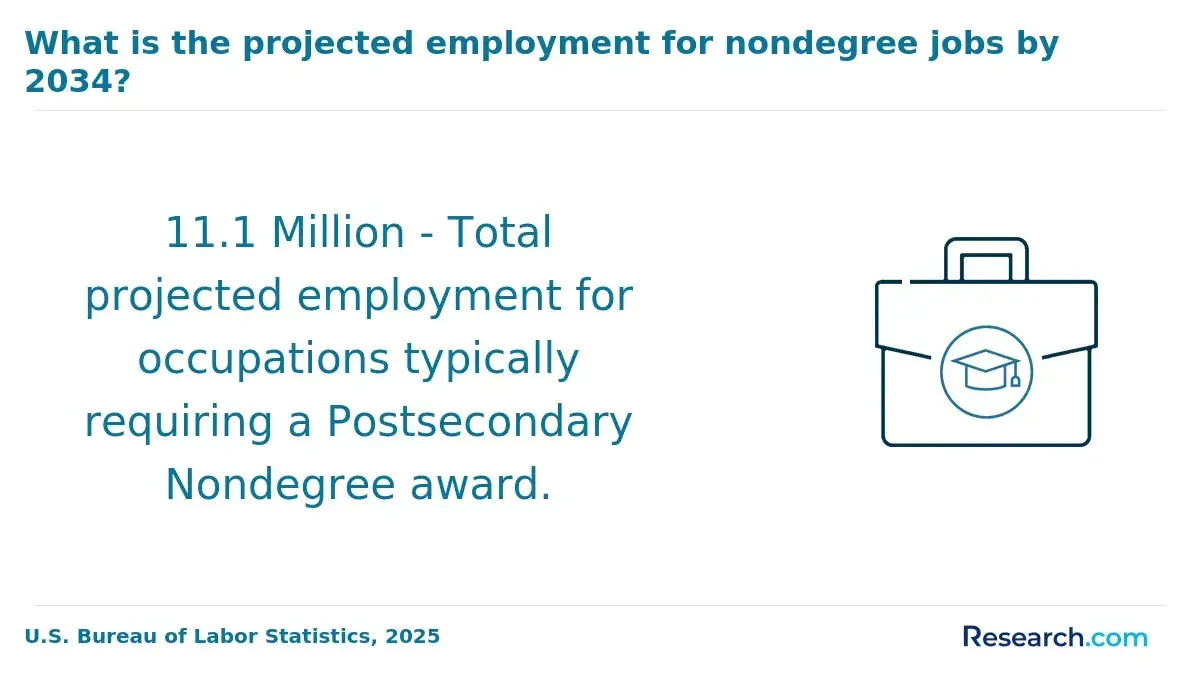
BLS employment projections for 2024-34 show continued demand across healthcare, skilled trades, technology, and public-service occupations. This guide compares practical online career training options, explains funding and quality checks, and helps active-duty members, veterans, reservists, and spouses choose training aligned with a real job target.
Key Things You Should Know
- Military experience can translate into academic credit through a school's review of a Joint Services Transcript, Community College of the Air Force transcript, ACE recommendations, challenge exams, or prior-learning assessment; the receiving school makes the final decision.
- Credit-bearing certificates and associate degrees are usually the strongest fit when you need transferable college credit or GI Bill eligibility, while noncredit career training may be faster but often cannot award transfer credit or support the same aid options.
- Compare the total remaining credits, required hands-on training, state licensing rules, and program approval before enrolling; occupational outcomes vary widely, even where BLS projects growth through 2034.
Top 10 Best Online Career Training Programs With Credit for Military Experience
Popular Trade School Programs
Online trade programs commonly cover electrical technology, HVAC/R, welding theory, construction management, diesel technology, logistics, and industrial maintenance. Military maintenance, engineering, transportation, and safety roles may support credit review, especially in credit-bearing certificates or associate degrees.
Fully online study generally suits theory, codes, estimating, and diagnostics; welding, electrical labs, and HVAC refrigerant work still require supervised practical training. Choose a program with local employer connections if you need an apprenticeship or lab placement. BLS reports a 2024 median annual wage of $62,350 for electricians, though licensure requirements vary by state.
Healthcare Programs
Online healthcare options include medical billing and coding certificates, health information technology, medical assisting coursework, pharmacy technician preparation, medical administrative support, and associate degrees in health sciences. Combat medic, corpsman, laboratory, pharmacy, and medical administration experience can be relevant, but civilian licensing boards - not schools alone - determine clinical eligibility.
Programs requiring patient care, externships, or labs are usually hybrid. A certificate may prepare learners for an industry certification exam but does not itself confer professional certification. Confirm whether clinical placement is available in your state before paying a deposit.
Criminal Justice / Law Programs
Military police, security, intelligence, corrections, investigations, and administrative experience may align with online criminal justice certificates, homeland security programs, emergency management training, paralegal studies, and associate degrees.
Academic credit may reduce general education or elective requirements, but it rarely replaces state peace-officer academy standards, bar-related requirements, or paralegal employer preferences. A paralegal certificate can be useful for learners who already hold a degree; an associate program may better suit first-time college students. Ask whether the curriculum covers legal research, writing, ethics, and jurisdiction-specific law.
Arts & Design Programs
Online arts and design training includes graphic design certificates, digital media, UX/UI fundamentals, photography, animation, web design, and video production. Military public affairs, audiovisual production, mapping, technical illustration, and communications work can strengthen a portfolio and may earn elective credit at some colleges.
Employers commonly evaluate demonstrated work, so a program should produce portfolio-ready projects rather than only software tutorials. Certificates can build targeted skills quickly; an associate degree offers broader design foundations and transferable credits. Verify software costs, computer specifications, and ownership of student work before enrolling.
How do online career training programs convert military experience into academic credit?
Online career training programs convert military learning into academic credit through an individualized evaluation, not an automatic conversion. ACE evaluates many military courses and occupations and publishes credit recommendations, while colleges decide whether those recommendations fit their own courses and degree rules. The Army, Marine Corps, Navy, and Coast Guard commonly use the Joint Services Transcript; Air Force learners may also have Community College of the Air Force records.
A typical evaluation follows these steps:
- Request official military transcripts and collect training certificates, occupational specialty records, and DD Form 214 if separated.
- Apply to a credit-bearing institution and submit documents by its prior-learning or transfer-credit deadline.
- Ask for a written evaluation showing credits accepted, course equivalents, elective credit, and credits still required.
- Compare that evaluation with your target credential, licensing rules, and any employer-required certification exams.
Credit can apply to general education, electives, technical coursework, or occasionally required courses. It may not replace residency requirements, upper-level coursework, clinical hours, apprenticeships, or state-mandated training. Noncredit bootcamps and vendor courses generally do not award academic transfer credit, even when they value military experience for admission.
What accreditation and quality standards should military learners look for in online programs?
For a credit-bearing certificate or associate degree, prioritize institutional accreditation recognized by the U.S. Department of Education and the Council for Higher Education Accreditation. Accreditation matters because it affects transferability, federal student aid eligibility, and institutional oversight. Programmatic accreditation is additionally important in regulated fields such as nursing, medical imaging, and some technical programs.
Quality checks should match the credential type. A college certificate should publish credit hours, faculty qualifications, completion requirements, and transfer policies. A noncredit provider should clearly identify the employer-recognized certification, exam preparation, refund terms, instructor support, and whether the credential is a certificate of completion rather than college credit.
If prior military credit is part of your plan, obtain the policy in writing before enrollment. Learners considering longer academic routes can also compare easiest master's programs to get into, but graduate admission and transfer policies are separate from military-credit evaluation.
How do online career training programs compare to campus options for military students?
Online programs can be a strong option for service members with deployments, shifts, or frequent moves because asynchronous coursework reduces location constraints. Campus or hybrid programs are often better when a field requires labs, equipment, clinical practice, apprenticeship networking, or immediate instructor supervision. The most practical choice is usually the format that meets the occupation's training requirements while minimizing repeated coursework.
This comparison highlights where each format tends to fit military learners.
| Decision factor | Online or hybrid advantage | Campus advantage |
| Schedule | Recorded or asynchronous coursework can accommodate duty schedules. | Fixed meeting times create routine but may conflict with orders. |
| Hands-on learning | Hybrid models combine online theory with local labs or placements. | Direct access to equipment, labs, and supervised practice. |
| Military credit review | May be efficient when transcript evaluators work remotely. | Face-to-face advising can help resolve complex evaluations. |
| Networking | Useful for national or remote-friendly fields. | Often stronger for local employers, unions, and clinical sites. |
Do not assume "online" means self-paced. Many programs have weekly deadlines, proctored exams, group work, live sessions, or local placement obligations. Ask how absences caused by orders are handled before committing.
What admission requirements and documentation are needed to apply military training toward credit?
Requirements depend on whether the program is a college credential, a noncredit training course, or a regulated clinical program. Many undergraduate certificates and associate degrees require an application, proof of high school completion or equivalent, official transcripts, and placement information. Some career-training providers use simpler enrollment forms and may not require a GPA.
Prepare these documents early because transcript evaluation can take time:
- Official Joint Services Transcript or Community College of the Air Force transcript.
- Official college transcripts from prior institutions, including courses funded through military education benefits.
- DD Form 214, military training records, course completion certificates, and occupational documentation when requested.
- Identification, residency information, and clinical or background-check documents for programs with placements.
Do not confuse flexible admission with automatic credit. Schools may admit an applicant while awarding few military credits. If prior academic performance is a concern for a graduate pathway, review options for online graduate programs that accept 2.0 GPA; each program still sets its own standards.
Which career fields best recognize military experience in online certificate and training programs?
Fields that use standardized military occupational training and documented technical competencies often offer the clearest alignment for credit review. Logistics, information technology, cybersecurity, engineering support, emergency management, healthcare administration, aviation maintenance, and public safety are frequent examples. Alignment improves the chance of relevant elective or technical credit, but civilian credentials may still require separate exams, supervised hours, or licenses.
The following comparison can help match your service background to a civilian training route.
| Military-experience area | Potential online credential route | Important limitation |
| IT, communications, cyber operations | Information technology or cybersecurity certificate; industry certification preparation | Employers may require current vendor or security certifications in addition to college credit. |
| Logistics and transportation | Supply chain, business operations, or logistics certificate | Credit may apply as electives rather than replacing all specialized coursework. |
| Medical administration or clinical support | Health information, coding, or health sciences certificate | Clinical occupations may require state approval, exams, and placements. |
| Security and investigations | Criminal justice, emergency management, or homeland security certificate | Law-enforcement hiring and academy requirements remain separate. |
For learners weighing a degree rather than short training, most lucrative degrees can provide broader context on earnings-oriented academic choices. Occupational pay depends on role, location, experience, clearance eligibility, and employer - not on a certificate alone.
How long do online career training programs take when military credits are applied?
Completion time is determined by remaining requirements, not simply by how many military credits a transcript contains. A short noncredit career course may take weeks or months, while a credit-bearing certificate commonly requires multiple college courses and an associate degree generally requires about two academic years of full-time study before approved transfer or prior-learning credit is applied.
Military credit can shorten the timeline when it satisfies required courses, but elective credit may reduce total credits without reducing the sequence of prerequisite classes. Healthcare clinical rotations, trade labs, capstones, and licensing requirements often set a minimum timeline that transcript credit cannot eliminate.
Before enrolling, ask for a degree audit that identifies the earliest realistic completion term under your intended pace. Compare full-time and part-time plans, then account for deployments, family obligations, and the availability of required courses. A program advertising an accelerated timeline is not necessarily faster for every military specialty.
What are typical tuition costs, funding options, and GI Bill benefits for these programs?
Costs vary sharply by provider, residency status, delivery format, required equipment, and the number of credits accepted. Tuition is only one part of the decision: trade programs may add tools and lab fees, healthcare programs may add uniforms, immunizations, background checks, and exam fees, while design programs can require specialized hardware and software.
Use this cost-and-funding framework to compare offers rather than relying on a headline tuition figure.
| Cost or funding item | What to verify | Why it matters |
| Tuition and mandatory fees | Price per credit or total program price, including online and technology fees | A low tuition rate can exclude required charges. |
| Military credit award | Accepted credits and remaining billable credits in writing | Credit only saves time or money when it reduces required coursework. |
| GI Bill benefits | Program approval, enrollment status, covered charges, and benefit entitlement remaining | VA education benefits depend on the approved program and individual eligibility. |
| Tuition Assistance and aid | Service branch rules, school deadlines, FAFSA eligibility, and scholarships | Funding sources can have different limits and repayment implications. |
| Required external expenses | Licensing exams, certification tests, tools, software, travel, and clinical costs | These expenses may not be included in advertised tuition. |
Ask the school's certifying official whether the exact online program is VA-approved before using GI Bill benefits. Tuition Assistance rules are set by each service branch, and federal aid typically applies only to eligible students enrolled in qualifying, credit-bearing programs.
What jobs, certifications, and licenses can these programs lead to for military learners?
These programs can lead to entry-level roles, advancement in a related field, or preparation for an external certification or license. The outcome depends on the curriculum, your previous experience, state rules, and employer hiring standards. A school-issued certificate demonstrates program completion; an industry certification usually requires a separate assessment administered by a certifying body.
Examples of realistic pathways include the following:
- IT or cybersecurity certificates may support help desk, network support, or junior security roles and can prepare learners for vendor or industry certification exams.
- HVAC, electrical, and industrial maintenance programs may support apprenticeship or technician pathways, but state or local licensing and supervised experience can still be required.
- Medical coding and health-information programs may prepare learners for administrative healthcare roles and optional professional certification exams.
- Criminal justice and emergency management credentials may support civilian security, dispatch, corrections, compliance, or preparedness roles, subject to employer screening requirements.
- Design certificates can support junior creative work when paired with a strong portfolio, software proficiency, and relevant project experience.
Use BLS occupational profiles to understand pay and projected openings for a target occupation, then verify the actual entry requirements in job postings. A credential is more valuable when it clearly fills a requirement employers list.
How can veterans and active-duty service members choose a reputable online program?
Choose a reputable program by starting with the job, license, or certification you need - not with a vague promise of "military-friendly" education. A school can support veterans well and still offer a program that does not meet your career requirement. Get a written credit evaluation and compare your remaining cost and time across at least two appropriate providers.
Before submitting an enrollment agreement, take these practical steps:
- Identify the exact job target and review local job postings, state licensing board rules, or certification-body eligibility requirements.
- Confirm whether the credential is credit-bearing, noncredit, stackable into a degree, or preparation for a separate certification exam.
- Verify institutional accreditation and any required programmatic accreditation for your field.
- Request a written breakdown of accepted military credit, remaining courses, total charges, required in-person components, and estimated completion sequence.
- Confirm VA approval and speak with the school certifying official before relying on GI Bill funding.
- Read withdrawal, refund, deployment leave, and transfer-credit policies before paying.
Red flags include guaranteed employment claims, pressure to sign immediately, vague statements about transferable credit, missing licensure disclosures, and costs that omit equipment or exam fees. Applicants with a record should also know that access policies vary; resources on online colleges that accept felons may help identify institutions to investigate, but occupational licensing and employer background rules remain separate questions.
Other Things You Should Know About
No. ACE recommendations and military transcripts can support an evaluation, but the college decides what it will accept and where the credit applies in your program.
Possibly. The specific program generally must be VA-approved, and your benefit amount depends on eligibility, enrollment status, and the type of training. Confirm details with the school certifying official before enrolling.
No. An online certificate is usually awarded by an educational provider after completing coursework. A professional certification is awarded by a certifying organization after meeting its standards, which may include an exam or experience requirement.
Submit official military and college transcripts before enrollment, request a written evaluation, and select a program where accepted credit satisfies required courses rather than only electives. Also confirm that labs, clinicals, and licensing steps will not delay completion.
References
- Skills-Based Fellowships Prioritize Military Experience Over Education https://www.hiringourheroes.org/stories/skills-based-fellowships-for-veterans-without-degrees/
- Skills Training for Veterans https://www.knowavet.org/skills-training-for-veterans/
- Best Online Universities for Military Veterans: Tuition Benefits and Support https://lakewood.edu/best-online-universities-for-military-veterans-tuition-benefits-and-support/
- College Credit for Military Training & Experiences https://www.dantes.mil/credit4training/
- Choosing Accredited Online Programs for Military Education: What You Need to Know - New Odyssey https://newodyssey.org/choosing-accredited-online-programs-for-military-education-what-you-need-to-know/
- Job Training Programs for Veterans - Hire Heroes USA https://www.hireheroesusa.org/training-partners/
- Military College Credit | Leverage Your Military Service at TUW https://www.tuw.edu/school-news/military-college-credit/
- Best Practices for Facilitating Credentialing https://www.credentialingexcellence.org/Resources/Military-and-Veterans/Best-Practices
- Military Service Members | DEAC https://www.deac.org/student-center/military-service-members/
- 2025 Best Military-Friendly Online Colleges https://www.onlineu.com/online-schools/military-friendly