2027 Best Online Career Training Programs for Working Adults

Co-Founder and Chief Data Scientist
Choosing online career training while keeping a job means balancing schedule flexibility against employer recognition, hands-on requirements, and cost. U.S. Bureau of Labor Statistics projections published in 2025 show healthcare support occupations are projected to grow 15% from 2024 to 2034, much faster than average.
This guide helps working adults compare certificate, associate degree, and industry-certification pathways; identify programs that fit real schedules; and verify whether training supports the job, exam, or license they want.
Key Things You Should Know
- Choose the credential backward from the target job: an online certificate can build job skills, but regulated careers often also require supervised clinical hours, an exam, or a state license.
- For working adults, asynchronous coursework is valuable, but confirm required live sessions, lab intensives, internships, externships, and weekly workload before enrolling.
- Compare total cost and outcomes rather than advertised tuition alone; College Board reported average 2024-25 published in-district tuition and fees of $4,050 at public two-year colleges, while noncredit and private-provider training varies widely.
Top 10 Best Online Career Training Programs for Working Adults
Popular Trade School Programs
Online trade training works best for theory-heavy preparation paired with local hands-on practice. Common options include HVAC technician certificates, electrical technology certificates, welding certificates, construction management certificates, and associate degrees in industrial maintenance. HVAC and electrical programs may prepare learners for entry-level work and relevant exams, but apprenticeship hours and state or local licensing rules can still apply. Choose a hybrid program when equipment practice, safety demonstrations, or supervised lab work is essential. A credit-bearing community-college certificate may stack into an associate degree; a private career-school certificate may not transfer.
Healthcare Programs
Healthcare options include medical billing and coding certificates, pharmacy technician certificates, medical assisting certificates, health information technology certificates, and associate degrees in nursing. Billing, coding, and health-information coursework can often be completed online, though employers may prefer certification such as CPC or RHIT eligibility. Clinical careers require more caution: medical assisting and nursing generally include in-person clinical training, and nursing licensure depends on a state-approved program and passing the NCLEX-RN. Confirm clinical placement responsibility, background-check costs, immunization requirements, and whether the curriculum meets your state board's rules before paying a deposit.
Criminal Justice / Law Programs
Working adults can pursue criminal justice certificates, associate degrees in criminal justice, paralegal certificates, legal studies certificates, and cybersecurity or emergency-management training. A criminal justice credential can support administrative, corrections, security, or public-service pathways, but it does not automatically qualify someone as a police officer; agencies set their own hiring, fitness, background, and academy requirements. For paralegal work, favor programs with practical legal research, writing, and document-management training. Some employers prefer American Bar Association-approved paralegal programs, although approval is not universally required and many approved programs include campus-based coursework.
Arts & Design Programs
Online arts and design training commonly includes graphic design certificates, web design certificates, UX/UI certificates, digital marketing certificates, animation certificates, and associate degrees in visual communication. Portfolio quality usually matters more to hiring managers than the name of a short course, so select programs with critique, project briefs, current software instruction, and ownership of completed work. A noncredit certificate can be a fast way to build a portfolio; a credit-bearing associate degree may offer broader foundations and transfer options. Ask whether software subscriptions, hardware, or portfolio hosting create additional costs.
How do online career training programs work for busy working adults?
Online career training usually combines a learning platform, recorded lessons, assignments, assessments, instructor support, and career resources. Working adults should distinguish asynchronous programs, which let learners complete work by deadlines, from synchronous programs with scheduled classes. "Online" does not always mean fully remote: clinicals, labs, proctored exams, internships, and licensing preparation may occur locally.
A realistic schedule depends on the program's pace and your outside obligations. Before applying, map these operational details against your work calendar:
- Required weekly study hours, including reading, projects, and exam preparation
- Whether assignments can be completed on nights and weekends or require daytime participation
- Dates and locations for mandatory labs, clinicals, externships, or residencies
- Access to tutoring, technical support, recorded sessions, deadline extensions, and career coaching
Programs with frequent starts can reduce the time spent waiting to begin, but accelerated terms compress deadlines. Compare online universities with multiple start dates if flexibility matters, then confirm that the pace is sustainable rather than simply fast.
What accreditation should online career training programs have to be recognized by employers?
Employer recognition depends on the type of provider and the target occupation. For a college certificate or associate degree, verify institutional accreditation through the U.S. Department of Education's database and confirm that the school is authorized to enroll students where you live. Institutional accreditation matters most for academic credit, federal aid eligibility where applicable, and potential transferability; it does not by itself prove that a specialized program meets licensing requirements.
For nondegree training, assess the credential that employers actually recognize. A certificate documents completion of a provider's curriculum. A professional certification is awarded by an independent certifying body after meeting its requirements, which may include an exam, education, or work experience. In healthcare, IT, and skilled trades, ask whether the training prepares you for a named certification exam and whether exam fees are included.
Use the following distinction to avoid a common enrollment mistake: accreditation evaluates an institution or program, while certification validates an individual professional's competency against defined standards.
| Career goal | Recognition to verify | Why it matters |
| College certificate or associate degree | Institutional accreditation and credit status | Affects transfer options and may affect financial-aid eligibility |
| Licensed healthcare career | State board approval and clinical requirements | May determine eligibility for licensure examination |
| Industry certification path | Named certifying organization's eligibility rules | Confirms training aligns with the intended exam or credential |
| Trade apprenticeship path | State or local rules and employer/apprenticeship acceptance | Determines whether training counts toward required experience or schooling |
How do online career training programs compare with campus programs for quality and outcomes?
Quality is determined less by delivery mode than by curriculum, instruction, practice opportunities, and learner support. A strong online program has clear learning outcomes, qualified instructors, timely feedback, reliable technology, and assessments that require learners to demonstrate skills. Campus programs can be better when frequent access to equipment, studios, clinics, or face-to-face mentoring is central to learning.
Online study is often the better fit for adults who need location flexibility and can manage independent deadlines. Campus or hybrid study may be the safer choice for learners who need structured meeting times, immediate access to labs, or a school-arranged clinical environment. For either format, ask for completion, job-placement, and licensure-exam information where relevant, and ask how the school defines each measure. Outcomes can vary by student background, local labor market, and whether graduates complete required experience after training.
The comparison below highlights the trade-off that matters most: convenience should not remove the supervised practice needed for the occupation.
| Factor | Online or hybrid advantage | Campus advantage |
| Schedule | More flexibility for shift workers and caregivers | Fixed routine can improve accountability |
| Hands-on learning | Can combine online theory with local placements | Regular access to equipment and in-person demonstrations |
| Networking | May connect learners across regions | Often stronger local employer and peer contact |
| Travel and housing | Can reduce commuting or relocation needs | May be necessary for program-specific facilities |
What admission requirements do online career training programs typically have for adult learners?
Admission requirements depend on whether the provider offers a college credential, a workforce certificate, or an industry training course. Many short noncredit programs require only that learners meet age, identity, technology, and payment requirements. Credit-bearing certificates and associate degrees commonly require an application and high school completion or an equivalent; selective health programs may add prerequisite courses, placement testing, immunization records, drug screening, or background checks.
Do not assume that a lower GPA closes every door, but do read program-level requirements rather than relying on a school's general admission policy. Adults rebuilding an academic record can compare online colleges that accept low GPA and then verify whether the specific career program has higher standards.
Before you apply, confirm these requirements in writing because they affect both timing and eligibility:
- Whether the credential is credit-bearing, noncredit, or preparation for an external certification exam
- Any prerequisites in math, anatomy, writing, computer skills, or prior work experience
- Technology, identity-verification, proctoring, and residency requirements
- Clinical, internship, licensing, background-check, or physical-capacity requirements
- Whether prior college credits, military training, or employer training can reduce coursework
How long do online career training programs take and what do they cost?
Completion time ranges from a few weeks for a focused vendor course to roughly one to two years for many associate degrees. A short program can be appropriate for a narrow skill or certification exam, while a longer credit-bearing program may provide general education, deeper technical training, and a path to further study. Part-time enrollment protects work income but extends the timeline; accelerated formats require more hours each week.
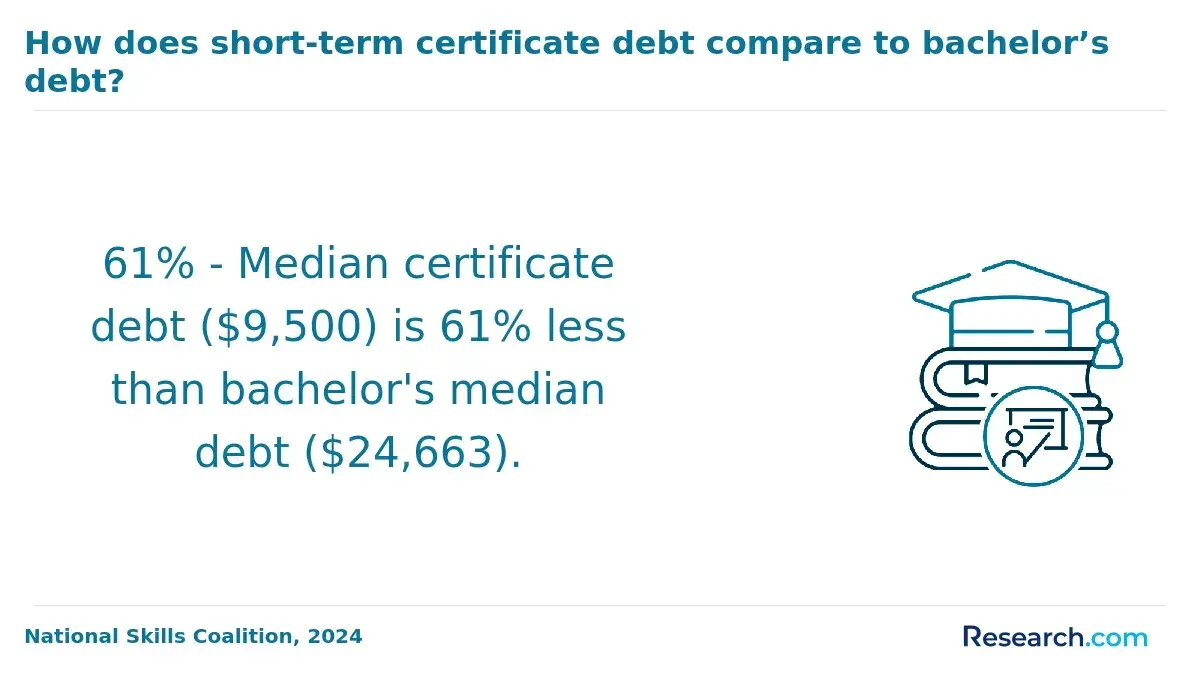
Cost should include more than tuition. College Board reported average published in-district tuition and fees of $4,050 for public two-year colleges in 2024-25. That benchmark is useful for comparing credit-bearing associate pathways, but it does not represent private career schools, bootcamps, or noncredit certificates, whose pricing and aid rules differ.
Build a total-cost estimate before comparing programs:
- Tuition, registration charges, and mandatory technology or distance-learning fees
- Books, software licenses, equipment, tools, uniforms, and professional supplies
- Exam, background-check, immunization, clinical, licensing, or certification fees where required
- Lost work time, travel, childcare, and any required in-person residency costs
Federal student aid generally applies only to eligible programs at eligible schools, not every short course. Ask the provider whether the program qualifies, whether employer tuition assistance can be used, and whether credits transfer. Adults seeking a lower-cost degree route can also review options for the easiest associate degree, while still prioritizing job relevance over perceived ease.
What careers can online training programs prepare working adults for in high-demand fields?
The best career target combines realistic entry requirements with local demand and a schedule-compatible training route. The U.S. Bureau of Labor Statistics projects healthcare support occupations to grow 15% from 2024 to 2034, while computer and information technology occupations are projected to grow faster than average over the same period. Growth is not a hiring guarantee, but it signals fields worth investigating alongside local job postings.
High-demand possibilities for working adults include medical coding, pharmacy support, health information work, IT support, cybersecurity support, bookkeeping, project coordination, logistics, HVAC support, and digital design. Entry requirements differ substantially: some roles value a portfolio or certification, while others require a degree, supervised experience, apprenticeship, or license.
Use this comparison to match the training level to the role rather than enrolling in the shortest available course.
| Field | Potential online starting point | Important limitation |
| IT support | Certificate or certification-prep training | Employers may also expect hands-on troubleshooting experience |
| Medical coding | Career certificate or coding coursework | Certification eligibility and employer preferences vary |
| Skilled trades | Online theory plus hybrid lab training | Apprenticeship and licensing requirements can apply |
| Graphic or web design | Portfolio-focused certificate | Portfolio quality and current tools matter heavily |
| Paralegal support | Legal studies or paralegal certificate | Requirements and employer preferences vary by market |
For broader degree-based options, explore top degrees in demand for the future and compare each path's credential, licensing, and time commitment with your target role.
What salary ranges and advancement opportunities follow from completing online career training?
Salary information should be used as labor-market context, not as a promise from a training provider. The Bureau of Labor Statistics reported a May 2024 median annual wage of $61,990 for HVAC mechanics and installers and $48,780 for medical records specialists. Those figures describe workers in the occupations nationwide; they do not show what certificate completers earn, and pay varies by region, experience, employer, shift, and credentials.
Advancement usually follows demonstrated skills and additional responsibility rather than completion alone. A medical coding learner may progress through experience and specialty certification; an IT support worker may add vendor or security credentials; a trade worker may move through apprenticeship and licensing stages. If the occupation requires a degree or license, short online training may be a first step rather than a complete qualification.
Ask providers for transparent outcome definitions and compare them with job ads in your location. Be wary of schools that use vague claims such as "high earning potential" without explaining the job title, time frame, sample size, or whether wages are verified.
How do licensing and certification requirements affect choosing an online career training program?
Licensing and certification can determine whether an online program is useful. Licensing is a legal authorization issued by a government entity, often after approved education, examinations, and supervised practice. Certification is commonly a voluntary or employer-preferred credential issued by a professional organization. A training certificate may prepare you for either one, but it is not automatically equivalent to one.
Regulated fields demand the closest review. Nursing, many allied-health occupations, electrical work, and other trades may require state-specific approval, clinical or apprenticeship hours, examinations, and continuing education. If you plan to work in a different state from the school, contact the destination state board before enrollment; authorization and curriculum alignment can change.
Protect your investment by completing these steps before signing an enrollment agreement:
- Identify the exact job title and the state or national credential it requires
- Read the licensing board or certifying organization's eligibility rules directly
- Ask the school whether its program meets those rules for your state and request a written response
- Confirm who arranges required clinicals, labs, fieldwork, or supervised experience
- Budget for exams, applications, background checks, renewals, and continuing education
How can working adults evaluate and choose a reputable online career training provider?
A reputable provider makes the credential, costs, schedule, support, and limitations easy to verify before you pay. Start with the job you want, then compare at least three programs against the same criteria. Do not choose solely because a program is short, heavily advertised, or promises employment.
The questions below help expose differences that marketing pages often obscure.
| Question to ask | What a useful answer includes |
| What credential will I receive? | Its exact name, issuer, credit status, and whether it is a certificate or certification preparation |
| What is the full cost? | Tuition, fees, tools, software, exams, and required in-person expenses |
| What must be completed in person? | Lab, clinical, externship, residency, proctoring, and placement details |
| Will this meet my licensing or exam goal? | State-specific eligibility information and the source used to verify it |
| What outcomes are reported? | Definitions, reporting period, number of graduates, and whether outcomes are independently verified |
Red flags include pressure to enroll immediately, unclear refund policies, unverified accreditation claims, vague placement statistics, and statements that a certificate "guarantees" a license or job. Keep copies of the catalog, enrollment agreement, cost sheet, and written statements about eligibility. A provider that cannot clearly explain its training model is rarely the right fit for a working adult making a significant time and financial commitment.
Other Things You Should Know About
Often, yes, especially when coursework is asynchronous. First confirm the weekly workload and any fixed clinical, lab, internship, or live-class requirements. Programs with required daytime placements may be difficult to combine with a standard full-time schedule.
Recognition depends on the employer, field, provider, and credential. Employers may value a college certificate, an industry certification, a portfolio, or documented hands-on experience differently. Review local job postings and ask whether the program prepares learners for a recognized exam or credential.
A certificate is usually better for a focused, faster skill goal. An associate degree may be better when the occupation requires broader coursework, academic credit, or a pathway to a bachelor's degree. Neither option is automatically better without considering the target job.
Some eligible credit-bearing programs at eligible institutions may qualify for federal aid, but many short noncredit courses do not. Ask the provider about aid eligibility, payment plans, scholarships, employer tuition assistance, and the full cost before enrolling.
References
- Graduate Employment Outcomes: How to Measure & Improve https://gosprout.app/graduate-employment-outcomes/
- Best Online Degrees for Working Adults in 2026 https://www.straighterline.com/blog/degreecompletion-best-online-degrees-for-working-adults-in-2026
- Tuition Assistance for Job Training Programs https://www.fastweb.com/financial-aid/articles/tuition-assistance-for-job-training-programs
- Paying for Career Training: Cost of Career Training and Trade Schools | Climb Credit https://climbcredit.com/resources/data/pay-for-trade-school-career-training/
- How Online Career Training Helps Working Adults Upskill Faster https://ccitraining.edu/blog/how-online-career-training-helps-working-adults-upskill-faster/
- College Graduate Skills Study - Workplace Intelligence https://workplaceintelligence.com/college-graduate-skills-study/
- How Career Training Programs Help You Land a Job Faster | Year Up United https://www.yearup.org/about/resources/how-career-training-programs-help-you-land-a-job-faster
- 5 career services to support your professional and adult learners | EAB https://eab.com/resources/blog/adult-education-blog/5-career-services-to-support-your-professional-and-adult-learners/
- Why Employment Outcome Rates Matter | ACI Learning https://www.acitechacademy.com/blog/why-employment-outcome-rates-matter-a-guide-for-students-and-employers/
- How Mentorship and Support Can Help Opportunity Youth Reach their Goals - National Mentoring Resource Center https://nationalmentoringresourcecenter.org/blog/how-mentorship-and-support-can-help-opportunity-youth-reach-their-goals/