2027 A Water Advisory Message Readability Review: A Graduate Public Health Portfolio Project

Co-Founder and Chief Data Scientist
A water advisory can be technically correct yet leave residents unsure whether they may drink, cook with, or bathe in their tap water. For a graduate public health student, reviewing that gap makes a focused portfolio project: one that demonstrates health communication skills without pretending a readability score proves a message is safe or effective.
This guide shows how to select an advisory, assess its wording and instructions, propose revisions, and document the work responsibly. It also helps you decide whether the project fits your course, field placement, or career goals.
Key Things You Should Know
- Review the actual advisory type first: boil-water, do-not-drink, and do-not-use notices call for different actions, and a readability edit must never change the issuing authority's safety instructions.
- Use at least 2 kinds of evidence—a text readability measure and a separate check of whether readers can find and understand the required actions. A grade-level score alone cannot establish comprehension.
- A credible portfolio artifact includes the source and date, a documented review method, a clearly labeled proposed revision, limitations, and permission or redaction decisions; it is not an official replacement advisory.
What Is a Graduate Public Health Portfolio Project?
A graduate public health portfolio project is a documented piece of applied work that shows what a student can do, how they made decisions, and where their conclusions stop. For a water advisory readability review, the intended decision-maker might be a health department communicator or utility staff member deciding whether a draft notice needs clearer language before their own review and approval.
Keep the scope manageable: evaluate one publicly available advisory, its accompanying web page, or a draft supplied with permission. Record the issuing authority, publication date, intended audience, and the version reviewed. A student's proposed rewrite is an academic artifact, not an authorized notice. Students building foundational skills before graduate study may also consider reviewing online public health BS programs, but this particular project should be judged on its methods and judgment, not its degree label.
How Does a Readability Review Strengthen Public Health Communication Skills?
The exercise forces students to translate a complex exposure-related instruction into language people can act on under uncertainty. It develops audience analysis, plain-language editing, environmental health literacy, and the ability to explain why a proposed change preserves—or risks altering—the original meaning.
Compare "avoid ingestion" with an instruction that names the affected activity, but do not assume the shorter wording is sufficient. A resident may still need to know which water source is affected, when the restriction begins, what to use instead, and where updates will appear.
If your previous degree was outside public health, this kind of supervised work can demonstrate transferable writing or community-service skills; public health graduate bridge and entry pathways may help you evaluate any remaining academic preparation needs. Neither prior writing experience nor a strong readability score substitutes for technical review by the issuing authority.
What Does a Public Health Portfolio Project Include?
The most useful submission lets a reviewer reproduce the assessment and see which decisions require official approval. These components form a compact project brief rather than a claim that an advisory has been field-tested:
- Project scope: Identify the advisory type, intended audience, source, date, format, and decision the review is meant to inform.
- Original-text record: Retain a permitted copy or citation and document which text was included in each calculation.
- Assessment: Report formula outputs, action-step findings, accessibility observations, and the limits of each method.
- Proposed revision: Show a labeled draft or annotated edits, with a rationale and a check against the original safety instructions.
- Review and sharing plan: Name the technical and community reviewers still needed, and redact contact details or restricted material before public display.
A short reflection can explain what feedback would change your draft and what you could not establish without resident testing. Keep the artifact distinct from a larger doctoral leadership project: students considering that route should examine online doctoral public health entry pathways separately rather than treating a portfolio review as evidence of doctoral project approval.
Flesch Reading Ease, Flesch-Kincaid Grade Level, and SMOG are common text-based measures. Flesch Reading Ease produces a score associated with ease of reading; Flesch-Kincaid and SMOG express results as approximate school grade levels. They use features such as sentence length and word complexity, not whether an instruction is accurate, visible, translated well, or understood.
For a brief advisory, note that results can shift substantially with a headline, address, technical contaminant name, or very short sample; SMOG is particularly ill-suited to an undersized sentence sample. Record the tool, formula, text boundaries, and any exclusions rather than presenting a score without context. Pair formula results with a plain-language and action check, using resources such as the CDC Clear Communication Index to structure questions about the main message and recommended behavior.
A readability review is not exposure modeling or epidemiologic research. If the student's actual goal is advanced quantitative investigation rather than message improvement, comparing epidemiology doctoral tuition support addresses a different educational decision; it will not make a formula score a valid measure of resident understanding.
Obtain faculty and, if applicable, site approval before beginning. Use a public advisory or a draft you are authorized to access, and agree on whether the output is a private exercise or something the partner may consider. The sequence below separates mechanical scoring from the safety-critical review:
- Define the notice. Record whether it is a boil-water, do-not-drink, or do-not-use advisory, who issued it, the affected area, and the version and date. Do not transfer instructions from one advisory type to another.
- Mark essential information. Identify the affected water and uses, required actions, start time, update source, and any authority-provided instructions for groups with specific needs. Flag absent details rather than inventing them.
- Measure and inspect. Run a documented readability calculation on the same defined text each time. Separately check headings, reading order, unfamiliar terms, links, images, and whether the main action is easy to find on a phone or printed notice.
- Draft and verify. Rewrite for direct, concrete instructions while retaining the authority's meaning. Ask an environmental health or utility subject-matter reviewer to check technical accuracy before anyone considers using the text.
- Test appropriately and report. If permitted, ask intended readers to locate and explain the requested actions; document the task, recruitment, and limits. Otherwise, label the work a desk review, summarize unresolved questions, and keep the draft separate from the official notice.
If the work involves collecting responses from people, check faculty, site, and institutional requirements for consent, privacy, and any applicable research review before recruitment. An independent project can demonstrate useful skills without requiring a doctorate; budget-friendly online public health PhD options are relevant only if your longer-term aim is research training, not simply publishing this review.
Effective public health communication requires more than simplifying technical language; messages must remain accurate, accessible, and appropriate for the communities receiving them. Students should understand how environmental health principles, health equity, and evaluation methods shape responsible communication decisions. These considerations also help prospective students determine whether a public health degree is necessary for their career goals or whether targeted training would be sufficient:
Environmental health anchors the review: the wording must match the authority's stated hazard and permitted water uses. Boiling is not a universal remedy; a message about a chemical hazard cannot be treated as if it were a microbiological boil-water notice. The student's job is to flag ambiguity, not independently determine that water is safe.
Health equity and community engagement change what counts as a usable message. Consider residents who rely on printed notices, screen readers, languages other than English, or limited internet access. Do not infer a community's preferred language or level of understanding from demographics alone; ask the responsible partner how audiences and distribution channels are identified.
Evaluation requires a modest claim. Formula output describes text features; a task-based check can show what particular participants found or missed; neither proves population-wide behavior change. For someone choosing education chiefly to improve routine communications work, a supervised project or targeted training may be more direct than another degree. Compare public health degrees by price and completion time only if a credential is needed for a broader role.
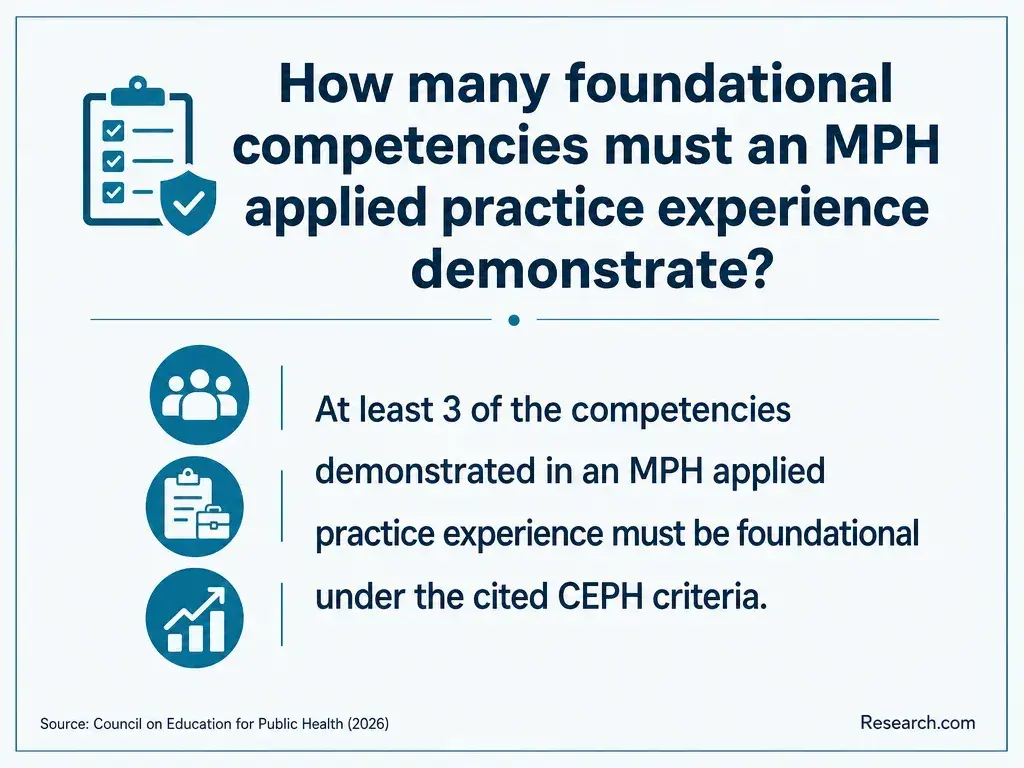
Requirements vary by program and entry term. A professional MPH commonly includes supervised applied practice and an integrative learning requirement, but a school may assess those through different approved experiences and products. A personal portfolio is not automatically a required capstone, and a class review does not automatically satisfy fieldwork hours, competencies, or partner-supervision rules.
Before proposing the advisory review for credit, ask the program coordinator which learning objectives it must meet, whether a host organization and supervisor are required, who approves the site and deliverable, and whether a publicly available advisory is acceptable. A comparison of selectivity across online MPH options addresses admission, not whether this specific project will fulfill an enrolled student's academic requirements.
For this project, the decisive difference is access to feedback, not the location of lectures. An online student may review a public notice remotely but still need scheduled meetings, approved supervision, and a local or remote partner willing to evaluate the work. A campus student may find it easier to collaborate in person, but proximity does not grant access to agency drafts or residents.
Ask each program whether methods courses cover health communication, whether faculty can supervise an environmental health message review, and how students arrange partner feedback and any required applied practice experience. Compare the full cost of attendance and project logistics—not tuition alone—when considering budget-friendly online public health degrees. Online delivery does not ensure asynchronous work or a flexible field placement.
An MPH application generally requires evidence of prior college study and program-specific application materials; individual schools determine their own GPA policies, prerequisites, references, essays, tests, and deadlines. A background in communication, environmental science, community work, or another field may be relevant, but applicants should verify whether a particular program requires statistics or other preparation. Readers concerned about their record can use public health master's admissions beyond GPA to frame questions for admissions staff rather than assuming a universal cutoff.
Compare tuition using the school's published per-credit or program charges, then account for required credits, fees, books, travel, and time spent on supervised work. Ask whether the advisory project could be completed within an existing course or approved placement; paying for an additional degree solely to create one communication sample may not be worthwhile. Confirm the institution's accreditation and the exact scope of any Council on Education for Public Health accreditation before treating a program's advertised status as covering your intended degree.
Which Careers and Certifications Can Follow a Public Health Graduate Degree?
A carefully documented advisory review can support applications for health communication, health education, environmental health outreach, or public information work by showing an employer how the applicant edits, checks, and explains a consequential message. It is evidence of a skill, not proof of qualification to issue advisories or independently assess water safety. Those responsibilities depend on the agency, position, experience, and applicable rules.
An MPH may be useful when the target role also calls for broader population-health practice, evaluation, or coordination. Some health education roles value credentials such as CHES, while CPH is a separate public health certification; eligibility must be checked with the certifying body. Neither follows automatically from earning an MPH. When comparing the investment, distinguish occupation-wide job prospects from outcomes promised to graduates of a particular program; online public health master's tuition and job prospects can inform that broader cost discussion without replacing a check of actual job postings.
Other Things You Should Know About Public Health
No. A student can submit recommendations, but the issuing authority controls its notices and must approve any operational change.
It may help produce a preliminary draft if the site permits it, but a qualified human reviewer should check meaning, local usage, and safety instructions before publication. Do not upload restricted drafts or personal information without authorization.
Assess whether its text can be selected, read in order by assistive technology, and accessed on a phone. Note any extraction errors before calculating readability; an automated score from faulty text is not reliable.
Label the reviewed version and retrieval date prominently. If the authority changes its instructions, do not present an older proposed rewrite as current public guidance.
- Risk Communications/Emergency Public Information and Warning | ASPR TRACIE https://asprtracie.hhs.gov/technical-resources/79/risk-communications-emncy-public-information-and-warning/77
- Enrollment and Access Barriers for People with Limited English Proficiency - MACPAC https://www.macpac.gov/publication/enrollment-and-access-barriers-for-people-with-limited-english-proficiency/
- Drinking Water Advisories: An Overview | cdc.gov https://www.cdc.gov/water-emergency/about/drinking-water-advisories-an-overview.html
- Drinking Water Health Advisories (HAs) | US EPA https://www.epa.gov/sdwa/drinking-water-health-advisories-has
- Tip 6. Use Caution With Readability Formulas for Quality Reports | Agency for Healthcare Research and Quality https://www.ahrq.gov/talkingquality/resources/writing/tip6.html
- Understanding Boil Water Notices - TCEQ - Texas.gov https://www.tceq.texas.gov/drinkingwater/notices/bwn/understanding-bwns
- Plain language guide series - Digital.gov https://digital.gov/guides/plain-language
- Boil Water Notices - Fact Sheet and Templates for Public Drinking Water Suppliers https://www.health.ny.gov/environmental/water/drinking/boilwater/boil_water_fact_sheet.htm
- Language and Literacy - Healthy People 2030 https://odphp.health.gov/healthypeople/priority-areas/social-determinants-health/literature-summaries/language-and-literacy
- Assessing Readability of Patient Education Materials - PMC https://pmc.ncbi.nlm.nih.gov/articles/PMC3049622/