2027 Choosing MPH Coursework for Health Policy Evaluation

Co-Founder and Chief Data Scientist
An MPH concentration labeled "health policy" may teach how policies are developed without giving you enough practice to evaluate whether they work. That distinction matters if you hope to assess insurance changes, public health regulations, or access-to-care initiatives. This guide is for prospective MPH students choosing courses and programs for evaluation work. It explains which methods to prioritize, how to judge applied opportunities, and when a more specialized or less expensive path may fit better.
Key Things You Should Know
- Prioritize a sequence combining policy analysis, epidemiology, biostatistics, evaluation design, and an applied project - not a concentration name alone.
- Check whether advanced electives run during your enrollment and whether you can obtain supervised, approved access to a feasible policy question and suitable data.
- Compare the full cost and time needed to build evaluation skills; an MPH is not automatically necessary if targeted methods training meets your goal.
What is health policy evaluation in an MPH program?
Health policy evaluation examines what happened after a policy was adopted, for whom, and under what conditions. A policy could change Medicaid eligibility, require a reporting practice, or fund a local prevention service. Evaluation might examine implementation, access, spending, or health outcomes. It is different from policy analysis, which often compares proposed options before a decision, although a strong curriculum teaches both.
For example, a student evaluating an expanded screening benefit would need to define the eligible population, the policy's start date, a meaningful outcome, and a credible comparison. A rise in screening afterward would not, by itself, show that the policy caused the change: other initiatives and changing population characteristics might also matter.
An MPH usually approaches this work as population-health practice. Students seeking to lead original methods research may instead want a research-intensive MS or PhD; comparing affordable public health PhD pathways is relevant only if that longer research trajectory fits the intended work.
Which MPH courses prepare students for health policy evaluation?
Look for a connected course sequence rather than a long elective catalog. The comparison below shows what each course area should enable you to do; titles vary by school.
| Course area | Contribution to policy evaluation | What to check in the syllabus |
| Health policy and public health law | Identify who has authority, what the policy changes, and whom it affects | Actual policy documents, implementation, and equity implications |
| Epidemiology and biostatistics | Define populations and outcomes; interpret estimates and uncertainty | Study design, regression, missing data, and appropriate software practice |
| Program or policy evaluation | Build evaluation questions, measures, and a usable plan | Logic models, process measures, comparison strategies, and limitations |
| Qualitative or mixed methods | Understand implementation and experiences that administrative data miss | Sampling, interviewing, interpretation, and ethical practice |
| Economics or health services research | Assess costs, utilization, and system-level trade-offs | Whether the course matches your intended employer or policy setting |
Take introductory statistics before an advanced evaluation elective if the latter assumes regression knowledge. Applicants still completing a bachelor's degree can use online public health bachelor's programs with accelerated courses to explore preparation options, but should ask the MPH program which prior statistics or methods coursework it actually expects.
How do you choose an accredited MPH program for health policy analysis?
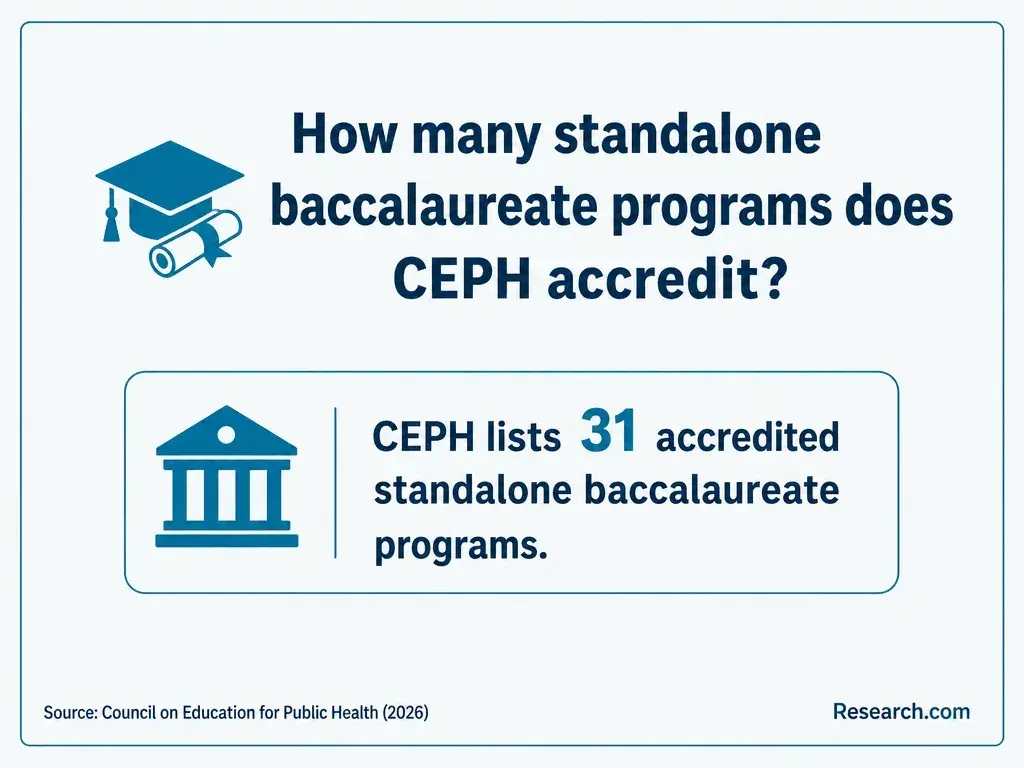
First, verify the institution's recognized accreditation and check the Council on Education for Public Health (CEPH) listing for the specific school, unit, or program offering the MPH. Institutional accreditation alone does not establish CEPH coverage, and an advertised health policy elective does not establish a formal concentration.
Then request a current degree plan and recent course schedules. Ask whether evaluation, advanced statistics, and qualitative methods are open to MPH students; how often they run; who supervises policy-related applied work; and what happens if an elective is canceled. A program with fewer advertised choices may be stronger for your goal if it reliably offers the courses and partnerships you need.
Admissions fit and curriculum fit are separate decisions. If grades are a concern, guidance on public health master's admission workarounds for GPA gaps can help you prepare an application; it cannot substitute for checking the program's current requirements or quantitative course access.
Employers need more than the ability to run a model. A useful evaluation explains the policy, chooses defensible evidence, and communicates what decision-makers can - and cannot - conclude. Use coursework and supervised projects to build these linked skills:
- Frame the decision: Specify the affected population, implementation period, outcomes, and what finding would inform a policy choice.
- Assess evidence: Examine data quality, comparison groups, confounding, missing records, uncertainty, and whether an association supports a causal claim.
- Understand implementation: Combine administrative measures with appropriate interviews or document review when the question requires them.
- Protect people and data: Confirm permissions, confidentiality rules, and whether institutional review or other oversight is needed before using restricted information.
- Communicate limits: Write a concise brief that separates findings, assumptions, limitations, and recommendations.
Build a portfolio around an approved, carefully scoped deliverable rather than claiming an unevaluated policy had an impact. If you already have a relevant degree and supervised evaluation experience, compare targeted methods training against a full program's time and cost; public health program speed and career value is one part of that decision, not a substitute for course-level scrutiny.
Neither format is inherently better. Online study can suit a working analyst who can use an existing policy setting for approved applied work; campus study may make it easier to attend research meetings, meet local partners, or take methods courses across departments. In either format, the decisive questions are whether you can take the needed courses and complete a supervised evaluation project.
Check live-session times, group-work expectations, campus visits, software access, and whether the school helps arrange placements outside its home region. "Online" does not mean asynchronous, and a remote placement still needs program approval and appropriate supervision. When reviewing lower-cost Master of Public Health study online, compare the actual evaluation curriculum and fieldwork support alongside tuition.
Programs generally ask applicants to document prior undergraduate study and explain their public health interests, but specific GPA policies, prerequisites, tests, recommendations, and application systems vary. A public health major is not universally required. Experience in government, clinical care, nonprofits, research, business, or data analysis may be relevant if you can connect it to a concrete policy question.
For evaluation-focused study, inspect any published statistics or quantitative prerequisites and distinguish required for admission from recommended before advanced coursework. If you have not completed a bachelor's degree, compare lower-tuition undergraduate public health pathways before budgeting for an MPH; ask each prospective graduate program which prior degree and preparation it accepts.
Completion time depends on credit requirements, full-time or part-time enrollment, course rotation, and the time needed for applied work. The relevant cost is not just advertised tuition: include mandatory fees, travel or campus visits, software, potential unpaid fieldwork, and earnings you may forgo.
Request a term-by-term plan and an itemized estimate for your residency status and expected pace; no single price or duration applies across MPH programs.
Ask when financial support is awarded, whether it continues during part-time terms, and whether a placement affects your ability to keep working. A public health graduate scholarship eligibility guide can help identify questions to ask, but only the school can confirm an award and its conditions. Compare the resulting total with targeted methods courses if you already have the policy knowledge and job access you need.
Possible work includes policy analyst, program evaluation analyst, health services research associate, or public health agency analyst. Responsibilities may include defining measures, analyzing claims or survey data, interviewing implementation partners, preparing briefs, and explaining limitations to decision-makers.
Job titles overlap: read postings for the actual methods, policy area, data access, and experience required. An MPH plus a supervised project can help an early-career applicant demonstrate readiness for analyst work; it does not automatically qualify someone to lead a research unit or direct policy.
Government, nonprofit, health system, and consulting employers may value different evidence. Compare the positions you want with online public health master's tuition and job prospects, then use current job descriptions to test whether the proposed coursework closes your particular gaps.
There is no single reliable salary for "an MPH in health policy evaluation." Policy analyst titles span sectors and levels, and occupational wage data describe jobs - not the earnings caused by a degree. The US Bureau of Labor Statistics' occupation-specific wage information can provide context when a posting maps clearly to an occupation, but it should not be presented as an MPH graduate salary.
For a useful estimate, collect salary ranges from current postings that match your location, sector, methods responsibilities, and experience level. Public-sector pay grades, research funding, and consulting seniority can change the comparison substantially. Treat broad MPH degree salary expectations as background, then calculate whether the roles realistically available to you justify the program's total cost.
Do MPH health policy careers require licenses or certifications?
Policy evaluation roles generally do not have a universal professional license. An MPH does not confer clinical licensure, and optional public health credentials have separate eligibility and examination rules. Some jobs may prefer a credential, require a clinical license because of additional duties, or specify particular data-security training; verify the individual posting and the responsible certifying or licensing body.
Further degrees are not certifications either. If your eventual goal is senior practice leadership, review doctoral public health program features separately from credential requirements. For an immediate evaluation role, evidence of sound methods, supervised work, and clear policy writing is usually the more relevant question.
Other Things You Should Know About Public Health
Check that you can define the policy, affected population, timeframe, and measurable outcome - and obtain permitted data within the course deadline. A narrower implementation question may be more feasible than estimating causal impact.
Sometimes. Confirm that the data cover the relevant population and period and support your intended comparison. Public availability does not remove the need to check data quality, disclosure rules, or project oversight.
No. A credible project may find mixed evidence or insufficient data. Clearly explaining those limits is more valuable than overstating an effect.
Ask the program and data owner what you may share. A redacted methods memo, blank evaluation framework, or independently created example can demonstrate your reasoning without exposing restricted information.
- Step 4 - Gather Credible Evidence | Program Evaluation https://www.cdc.gov/evaluation/php/evaluation-framework-action-guide/step-4-gather-credible-evidence.html
- Development of a Core Competency Model for the Master of Public Health Degree | nih.gov https://pmc.ncbi.nlm.nih.gov/articles/PMC2509588/
- Training package for cost analyses and economic evaluation | who.int https://www.emro.who.int/ar/evidence-data-to-policy/training-package/cost-analyses-and-economic-evaluation.html
- Certificate in Implementation Science | University of Miami https://uonline.miami.edu/online-certificates/implementation-science/
- CEPH D2: MPH Foundational Competencies | tulane.edu https://sph.tulane.edu/academic-affairs/ceph-d2-mph-foundational-competencies
- Fundamentals of Implementation Science | Global Health E-Learning Program https://edgh.washington.edu/courses/fundamentals-of-implementation-science/
- Foundational Competencies | School of Public Health | The University of Alabama at Birmingham https://www.uab.edu/soph/home/graduate/foundational-competencies
- Competencies | Master of Public Health - Brown MPH program https://mph.sph.brown.edu/about/competencies
- Study Designs for Intervention Research in Real-World Settings | ucsf.edu https://epibiostat.ucsf.edu/study-designs-intervention-research-real-world-settings
- Concentration in Implementation Science | Johns Hopkins https://publichealth.jhu.edu/academics/drph/curriculum/concentration-in-implementation-science