2027 A Financial Consultation Scheduling Process: An Undergraduate Healthcare Administration Case Study

Co-Founder and Chief Data Scientist
A patient may need to understand an expected medical bill before a scheduled procedure, but arranging that conversation requires more than finding an open appointment. Staff must coordinate coverage information, an appropriate counselor, privacy safeguards, and the patient's timing.
This illustrative case study shows how an undergraduate healthcare administration student can analyze that workflow. It also helps prospective students decide whether a bachelor's program offers the right preparation for patient access and financial operations, or whether a shorter training route would be more direct.
Key Things You Should Know
- A sound scheduling process connects an eligible patient with a financial counselor before a planned service while keeping estimates, privacy, and access to care distinct.
- A healthcare administration bachelor's degree can build the finance, operations, and compliance knowledge behind the workflow, but supervised experience is still important for patient-facing work.
- The Bureau of Labor Statistics reports a $126,520 median annual wage for the broad management-occupations group in May 2025, that figure is not an entry-level patient access salary or a promised graduate outcome.
What Is a Financial Consultation Scheduling Process in Healthcare Administration?
It is the workflow for identifying a patient who may benefit from a conversation about expected charges, coverage, payment options, or financial assistance; arranging that conversation; and recording the appropriate follow-up. Scheduling the consultation is an administrative task. Explaining insurance benefits or financial assistance may require a trained specialist.
Consider an illustrative case. A patient has an upcoming nonemergency procedure and asks about a potentially high out-of-pocket cost. A patient access employee needs to connect the patient with a financial counselor before the procedure without presenting an estimate as a final bill. An undergraduate case analysis could trace the process as follows:
- Record the patient's request and preferred contact method using the organization's approved system.
- Confirm that registration and available coverage information are ready for review, flagging unresolved questions rather than assuming a benefit is guaranteed.
- Offer an accessible appointment with a qualified counselor at a time that leaves room for the patient to consider available options.
- Send only the information needed for the consultation through approved channels, then document scheduling and any necessary follow-up.
The distinction matters academically: a student evaluating this case studies handoffs, delays, and controls, not just calendar management. Students more interested in coding, data governance, or health records than patient-facing financial operations can compare CAHIIM-accredited HIM degree programs online as a different educational path.
Why Is Financial Consultation Scheduling Important in Healthcare Organizations?
Timely scheduling gives patients an opportunity to ask about costs before a planned service and gives counselors time to review questions about coverage or assistance. For the organization, a clear handoff can reduce avoidable confusion between registration, clinical scheduling, billing, and patient financial services. It cannot make an estimate exact: benefits, claims processing, and the care ultimately delivered may change the amount owed.
The process also has an ethical boundary. Staff should not treat a financial consultation as permission to delay emergency evaluation or imply that payment is a condition for receiving emergency care. For planned services, students should examine whether appointment timing, language access, and contact methods allow patients a meaningful chance to participate. Those responsibilities make patient access a substantive operations function, not merely a clerical one; health services administration jobs and career progression can provide context for where operational experience may lead.
What Does an Undergraduate Healthcare Administration Degree Teach About Financial Consultations?
A bachelor's program typically approaches consultations from the perspective of managing services rather than providing clinical care or issuing definitive insurance determinations. Healthcare finance helps students understand charges, reimbursement, and budgets. Operations courses address capacity and handoffs. Ethics and compliance courses help them recognize when a workflow protects - or burdens - a patient.
Applied to the case, a useful student question is not simply whether the counselor's calendar has space. It is whether the patient receives the right expertise early enough, whether an incomplete coverage record creates rework, and whether staff know when to escalate a question they cannot answer. Those are transferable management questions, but the degree alone does not establish competence to interpret every payer contract or financial-assistance policy.
A bachelor's degree is also not necessarily the only route to later graduate study: MHA programs open to applicants with other professional backgrounds illustrate why students should choose an undergraduate major for its immediate learning and career value, rather than assume it is a universal MHA prerequisite.
Preparation is strongest when students can apply classroom concepts to a real or realistic process. A case assignment might ask them to map the patient's route from referral to consultation, identify who owns each handoff, and explain what happens when coverage information is missing. A supervised internship or project may then show how an organization's actual scheduling system, escalation rules, and patient communication standards work.
Before enrolling, ask whether the program offers healthcare-specific projects, support for arranging fieldwork, and opportunities to practice communicating with patients or cross-functional teams. An online program can teach process analysis well, but a student seeking patient access work should check how they will obtain supervised local experience. After building workplace experience, someone seeking broader operational leadership could consider online MHA programs for advancing healthcare administration education; graduate management study is not a substitute for learning the frontline workflow.
Course titles vary, so compare syllabi and learning outcomes rather than expecting a class named "financial consultation scheduling." Healthcare finance or accounting can explain how payment flows affect organizational decisions. Operations or quality improvement can cover queues, staffing, process mapping, and measures of delay. Health law, ethics, and information management can address privacy, documentation, and appropriate handling of patient information. Patient access topics may appear within revenue cycle or healthcare management courses rather than as a standalone subject.
For this case, the most useful course combination lets a student distinguish an estimate from a final patient balance, analyze an appointment bottleneck, and explain why a counselor, not an untrained scheduler, should handle complex financial questions. If a school offers little applied healthcare content, a student should ask how its general business courses connect to patient services. Those comparing later graduate options can also review healthcare management master's duration and program choices, while remembering that a shorter graduate program does not replace foundational workplace training.
Requirements depend on the institution and whether the applicant is entering as a first-year or transfer student. Schools commonly request prior academic transcripts and an application; some have separate requirements for admission to the major, an internship, or an upper-division sequence. Applicants should verify the current policy rather than assume that healthcare employment is required - or that admission to the university automatically means admission to every course in the major.
Transfer students should request a written evaluation showing which credits meet general education and major requirements. Anyone comparing accredited U.S. universities offering healthcare administration bachelor's degrees should also verify institutional accreditation, transfer rules, internship eligibility, and whether the advertised format is available in their state. Institutional accreditation and specialized accreditation are different questions; do not assume a bachelor's program has a particular specialized credential merely because its university is accredited.
The better format depends less on the word "online" than on how classes, projects, and field experience fit a student's life. This comparison highlights the questions most relevant to someone preparing for a patient-facing operations role.
| Consideration | Online program | Campus program |
| Class schedule | May offer recorded work, but live sessions and deadlines can still be required | Often has fixed meeting times and commuting requirements |
| Workplace practice | May require the student to arrange an approved local placement | May offer nearby placement connections; availability still varies |
| Interaction | Often relies on virtual discussions and group work | Offers in-person contact, with opportunities depending on the program |
Ask each school who secures field placements, when any live meetings occur, and whether working students can complete required experiences. If planning for an eventual MHA, evaluate that degree separately: online CAHME-accredited MHA programs concern graduate-level program accreditation, not an accreditation automatically held by an undergraduate degree.
A full-time bachelor's path is commonly planned around four academic years, but transfer credit, part-time enrollment, course sequencing, and required fieldwork can change the completion date. A student with prior college credit needs a degree audit - not a marketing claim about transfer-friendly enrollment - to estimate time remaining.
Compare the total cost to finish, tuition for remaining credits, mandatory fees, books or software, transportation or placement costs, and the effect of any reduced work hours. Then subtract only grants, scholarships, or employer assistance for which the student is actually eligible. Published per-credit tuition is not a complete cost estimate, and borrowing adds repayment costs. A healthcare administration bachelor's tuition comparison can help identify schools to investigate, but request a personalized cost estimate before committing.
For someone already employed in patient access, employer training, a relevant certificate, or selected college courses may be less costly if the immediate goal is to improve scheduling performance rather than earn a bachelor's credential.
Patient access representative, financial counseling support, insurance verification, revenue cycle analyst, and scheduling or registration team roles are possible starting points, depending on the employer and the applicant's experience. A graduate who has practiced explaining processes, reviewing data, and coordinating handoffs may be better prepared for these functions than one whose coursework remained entirely theoretical. Financial counselor positions can require additional payer, billing, or assistance-program experience.
Progression toward supervisor or manager roles generally depends on demonstrated results, people-management ability, and knowledge of the organization - not simply possession of a degree. Someone aiming eventually for broader management may compare the cost of further graduate study using tuition comparisons for MHA and related master's programs. For the immediate goal of scheduling consultations effectively, however, supervised operational experience is usually the more direct next step.
What Salary and Job Outlook Can Healthcare Administration Graduates Expect?
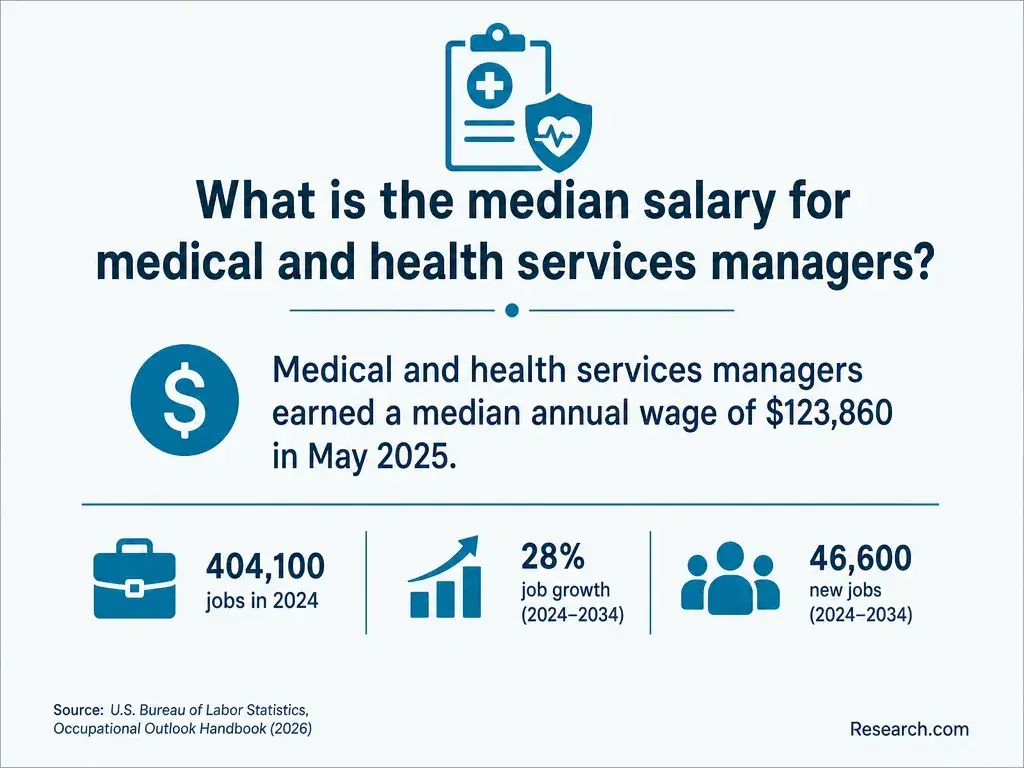
Pay depends heavily on the specific job, location, employer, and experience level. The Bureau of Labor Statistics reports that the management-occupations group had a median annual wage of $126,520 in May 2025. That broad figure includes many established managers outside healthcare; it should not be used as an expected salary for a new graduate entering patient access or financial counseling support.
BLS projects management occupations overall to grow faster than the average for all occupations from 2025 to 2035. That describes a broad labor market, not a forecast for financial consultation scheduling jobs. Before paying for a degree, compare local postings for the roles you can realistically pursue now with postings for your intended next role. Note which require a bachelor's degree, which prioritize revenue cycle experience, and which ask for supervisory responsibility.
A doctorate is not a routine requirement for this workflow or for entry-level patient financial operations. Someone considering one for a later research or executive goal should separately assess comparing tuition and duration for healthcare administration doctorates rather than treating a broad management salary as evidence that further study will pay for itself.
Other Things You Should Know About Healthcare Administration
No. A counselor can explain an available estimate and its assumptions, but coverage decisions, services delivered, and claims processing may affect the final amount.
No. Schedulers should follow their organization's training and escalation rules, directing complex benefits or assistance questions to qualified staff.
Do not assume so. Use the organization's approved communication methods and privacy procedures, including its rules for verifying the recipient.
Ask where consultation requests originate, which handoffs cause delays, how staff escalate uncertain estimates, and what training new hires receive.
- Summary of the HIPAA Privacy Rule | hhs.gov https://www.hhs.gov/hipaa/for-professionals/privacy/laws-regulations/index.html
- How health systems facilitate patient-centered care and... - PMC https://pmc.ncbi.nlm.nih.gov/articles/PMC9710067/
- Electronic Health Records | cms.gov https://www.cms.gov/priorities/key-initiatives/e-health/records
- CDC Approach to Program Evaluation https://www.cdc.gov/evaluation/php/about/index.html
- Obtaining Data From Electronic Health Records - - NCBI - NIH https://www.ncbi.nlm.nih.gov/books/NBK551878/
- Ways to Approach the Quality Improvement Process | Agency for Healthcare Research and Quality https://www.ahrq.gov/cahps/quality-improvement/improvement-guide/4-approach-qi-process/index.html
- Benefits Counselor | Department of Administration - SC Admin https://admin.sc.gov/ohr_heeapa_class/ag55
- Bachelor of Science in Healthcare Administration Online | Mount saint vincent https://online.mountsaintvincent.edu/degrees/undergraduate/bachelor-healthcare-administration/
- Job Descriptions - Duke HR https://forms.hr.duke.edu/descriptions/duhs/printer.php
- Setting a Course for Growth Through Optimal Service-Line Performance | HFMA https://www.hfma.org/operations-management/service-line-management/60248/