2027 How to Transfer Into an Online Degree Program

Co-Founder and Chief Data Scientist
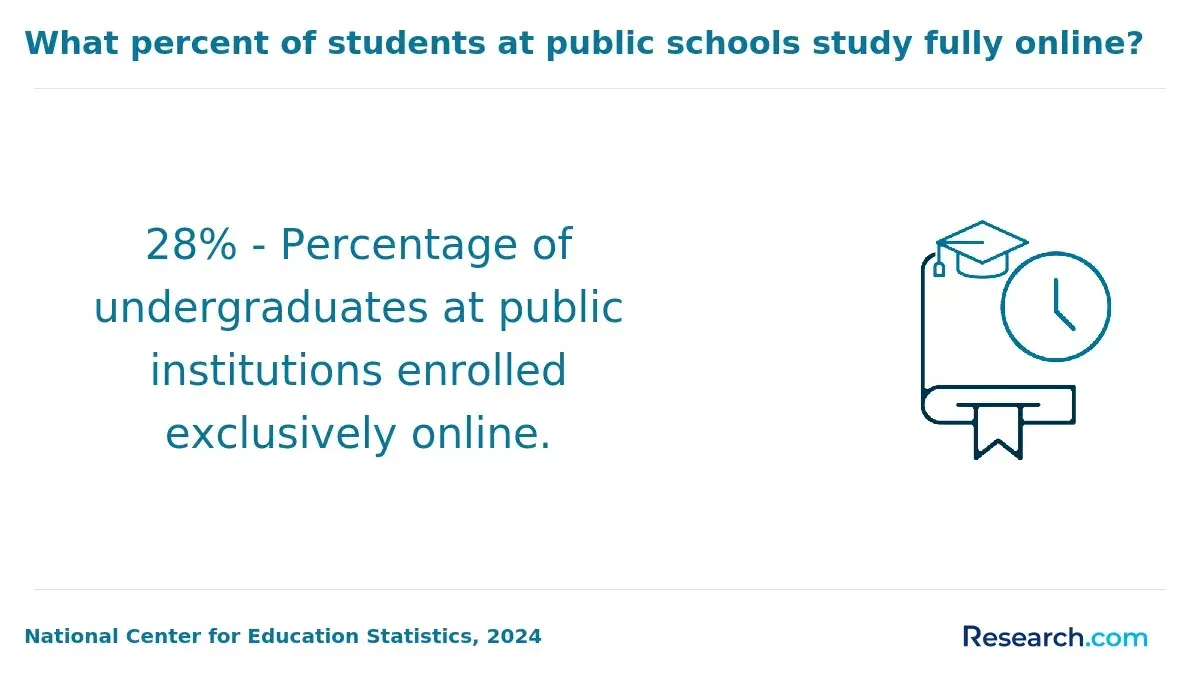
Transferring into an online degree program can save time, reduce cost, and help you finish a credential without starting over. NCES reported in its 2024 Condition of Education that more than half of U. S. undergraduates took at least one distance education course in fall 2022, showing that online learning is now a mainstream pathway.
This guide is for students with prior college, military, workplace, or exam-based learning who want to understand transfer credits, admissions, accreditation, cost, timeline, and career outcomes before choosing a program.
Key Things You Should Know
- Most online bachelor's programs accept transfer credits, but schools usually cap how many credits can apply; many require at least 25% to 30% of the degree to be completed through the awarding institution.
- College Board's 2024 pricing data lists average published tuition and fees at $11,610 for in-state public four-year colleges and $43,350 for private nonprofit four-year colleges, so transferring credits can materially affect total cost.
- Accreditation matters: credits from institutionally accredited colleges are usually easier to transfer, while credits from unaccredited schools may be rejected even if the coursework looks similar.
How do you transfer into an online degree program?
To transfer into an online degree program, you apply as a transfer student, submit official transcripts, wait for a credit evaluation, and then choose whether the remaining courses, cost, and graduation timeline make sense. The process is similar to campus transfer admissions, but online programs often serve working adults, military learners, and students returning after a break, so they may have more flexible start dates and credit review options.
The most important step is to get a written credit evaluation before enrolling. A verbal estimate from an admissions counselor can be useful early on, but it should not be treated as a final decision because departments, registrars, and program chairs often make the official ruling.
Use this sequence to reduce surprises and compare schools fairly:
- Collect official transcripts from every college you attended, including schools where you completed only one or two courses.
- Identify your intended major and degree level because a course may transfer as elective credit but not satisfy a major requirement.
- Ask each online school for its transfer credit policy, residency requirement, minimum grade rule, and maximum transferable credit limit.
- Submit transcripts for an official or preliminary transfer evaluation before you commit to enrollment.
- Compare the remaining credits, total tuition, fees, textbook costs, required technology, and projected graduation date.
- Confirm whether financial aid, employer tuition benefits, military benefits, or scholarships apply to the remaining program.
- Enroll only after you understand which credits count, which do not, and what courses you still need to finish.
If your goal is to finish quickly, compare standard transfer pathways with an accelerated bachelor's degree online. Accelerated formats can be efficient, but they work best for students who can handle shorter terms, heavier weekly workloads, and fewer schedule breaks.
What credits will an online college accept?
Online colleges may accept several types of credit, but acceptance depends on the school, the major, the age of the course, the grade earned, and whether the content matches current degree requirements. "Transfer credit" means the receiving institution agrees to count prior learning toward your new degree; it does not always mean every previous class will reduce your remaining major requirements.
The table below summarizes common credit sources and how they are usually reviewed. Use it to understand what to ask for during a credit evaluation rather than assuming all prior learning will apply automatically.
| Credit source | How schools commonly evaluate it | What to watch for |
| College courses | Reviewed through official transcripts, course descriptions, and equivalency databases | Courses may transfer as electives if they do not match the new major |
| Community college credits | Often accepted for general education and lower-division requirements | Upper-division major requirements may still need to be completed at the new school |
| Military training | May be evaluated through Joint Services Transcript recommendations and institutional policy | Not all military training maps cleanly to academic requirements |
| Credit by exam | May include AP, CLEP, DSST, or IB scores if they meet school thresholds | Minimum scores and credit awards vary widely by institution |
| Professional certifications | Some adult-focused programs review industry credentials for credit | Credit may be limited to electives or workforce-focused programs |
| Prior learning assessment | Students may submit portfolios or documented learning for faculty review | Fees, documentation standards, and credit limits can reduce the value |
A common mistake is assuming that "accepted by the university" means "applies to my major." For example, an online business program may accept 60 credits from a prior school, but only 45 may satisfy required general education or business courses; the rest may sit as unused electives if the degree plan has no room for them.
How does accreditation affect transfer credits?
Accreditation is one of the biggest factors in transfer credit decisions because it signals whether a college has met recognized academic and operational standards. In the United States, institutionally accredited colleges are generally the safest choice for transfer students because their credits are more likely to be reviewed seriously by other accredited institutions.
Programmatic accreditation can also matter when the degree leads to licensure or specialized employment. Nursing, teaching, social work, counseling, engineering, and some business programs may have additional accreditation expectations beyond institutional accreditation.
Before transferring, check accreditation at three levels:
- Institutional accreditation: Confirm that the school itself is accredited by an agency recognized by the U.S. Department of Education or CHEA.
- Programmatic accreditation: For regulated or specialized fields, confirm whether the specific online program holds the accreditation expected by employers, licensing boards, or graduate schools.
- State authorization and licensure fit: If you live outside the school's home state, ask whether the online program is authorized for your state and whether it meets licensure requirements where you plan to work.
The biggest red flag is a school that avoids clear answers about accreditation or uses similar-sounding terms such as "licensed," "approved," or "internationally recognized" without recognized U.S. accreditation. Those labels may not protect your ability to transfer credits, receive federal financial aid, qualify for licensure, or enter graduate school.
What admission requirements do transfer students need?
Transfer admission requirements vary, but most online colleges want evidence that you can succeed in college-level work and that your prior credits can be documented. Selective programs may review your GPA, completed prerequisites, and available seats in the major, while open-access or adult-focused institutions may emphasize transcript completion and placement into the right degree plan.
Most transfer applicants should prepare the following materials before they apply:
- Official transcripts from every college previously attended, even if credits were earned many years ago or grades were low.
- High school transcript or GED documentation if you have completed only a small number of college credits.
- Minimum college GPA, often around 2.0 for general admission, though competitive majors may require higher grades.
- Program-specific prerequisites, such as anatomy for nursing, calculus for engineering, accounting courses for business, or statistics for psychology.
- Personal statement, resume, or employment history if the program uses holistic review or evaluates adult learning experience.
- English proficiency documentation if required by the institution for applicants educated in another language system.
If your GPA is below the published requirement, do not assume you are automatically out. Some online programs offer conditional admission, academic renewal, provisional enrollment, or a pathway through a non-degree term where you can demonstrate readiness before full admission.
How many transfer credits can count toward a degree?
The number of credits that can count toward a degree depends on the credential level and the school's residency rule. A residency rule is not about where you live; it means the minimum amount of coursework you must complete through the institution that will award your degree.
The table below gives a practical view of common transfer-credit patterns. Exact limits vary, so use this as a comparison tool when speaking with online admissions and registrar offices.
| Degree level | Typical total credits | Common transfer pattern | Decision point |
| Associate degree | About 60 credits | Many schools allow a substantial share to transfer, but may require a final block of credits in residence | Best for students close to finishing or building toward a bachelor's transfer pathway |
| Bachelor's degree | About 120 credits | Many programs accept up to roughly 60 to 90 transfer credits, depending on level and fit | Best value when prior credits meet general education and major requirements, not just electives |
| Master's degree | Often 30 to 45 credits | Transfer limits are usually lower, often because graduate programs require current, program-specific coursework | Best for students with recent graduate credits that closely match the new curriculum |
For bachelor's students, the practical question is not simply "How many credits will you take?" but "How many required credits remain?" A school that accepts fewer total credits may still be better if it applies more of them to your major and shortens your actual path to graduation.
How long does an online degree take after transferring?
An online degree after transferring can take a few months to several years, depending on how many credits apply, whether you study full time or part time, and how the program schedules courses. Students with many usable credits may finish faster, while students changing majors may need more time because key prerequisites and upper-division courses still remain.
Use the following timeline estimates as planning ranges, not promises. Course availability, failed or withdrawn classes, clinical placements, and prerequisite sequencing can all extend the finish date.
| Transfer situation | Likely remaining work | Typical planning consideration |
| Student with an associate degree entering a matching bachelor's major | Often about two years full time, sometimes less in accelerated formats | Check whether the associate degree satisfies general education as a block |
| Student with scattered credits and no completed credential | Timeline depends on how many credits apply to the new degree plan | Ask for a course-by-course degree audit before enrolling |
| Student changing majors | May need foundational and upper-division major courses | Expect some credits to transfer as electives rather than major requirements |
| Graduate transfer student | Usually a small number of credits may transfer | Confirm whether prior graduate courses are recent enough and equivalent |
Working adults should be realistic about weekly time. A shorter program is not always easier; accelerated terms compress assignments, discussions, exams, and projects into fewer weeks. If you are balancing work or caregiving, a slightly longer part-time plan may lead to better persistence than overloading your first term.
Students comparing graduate pathways after finishing a bachelor's degree may also look at one-year master's programs. These can be attractive for career changers or promotion-focused students, but transfer credit is often more limited at the graduate level.
How much does transferring into online school cost?
The cost of transferring into online school depends on tuition, accepted credits, fees, books, technology, time to completion, and lost or reduced work hours. The headline tuition rate matters, but the better comparison is total cost to finish after transfer credits are applied.
College Board's 2024 Trends in College Pricing lists average published tuition and fees of $11,610 for in-state students at public four-year institutions and $43,350 at private nonprofit four-year institutions for the 2024-25 academic year. For transfer students, that gap means the same number of remaining credits can lead to very different total bills depending on institution type and aid.
When comparing online programs, ask schools to break down all costs in writing:
- Per-credit tuition for online students, including whether out-of-state online learners pay a different rate.
- Mandatory online, technology, graduation, proctoring, lab, clinical, or student service fees.
- Books, software subscriptions, exam vouchers, background checks, uniforms, or placement-related costs.
- Transfer evaluation, prior learning assessment, transcript, portfolio review, or credit-by-exam fees.
- Financial aid eligibility, employer reimbursement rules, military benefit coverage, and scholarship renewal conditions.
Federal Student Aid has kept the maximum Pell Grant at $7,395 for recent award years, but not every student qualifies and the grant may not cover a large share of tuition at higher-cost institutions. If you plan to borrow, compare the debt you would take on against realistic salary ranges for your target field rather than assuming the degree will automatically pay for itself.
If graduate school is part of your long-term plan, reviewing which master's degrees are worth it can help you avoid stacking credentials without a clear career or salary rationale.
What courses usually transfer into online programs?
The courses most likely to transfer into online programs are lower-division general education courses with clear academic equivalents. English composition, college algebra, introductory psychology, U.S. history, biology, public speaking, and basic economics often transfer more easily than specialized, outdated, remedial, or highly technical courses.
Course age matters most in fast-changing fields. A history or literature course from several years ago may still be acceptable, while older credits in cybersecurity, programming, healthcare, accounting standards, or laboratory science may need review because content changes more quickly.
Here is how transfer evaluators often treat common course categories:
| Course type | Transfer likelihood | Reason |
| General education courses | Often strong | They commonly match broad degree requirements across institutions |
| Major prerequisites | Moderate to strong | They transfer well when content, credits, and lab components match |
| Upper-division major courses | Variable | Departments may require close alignment with their own curriculum |
| Technical or career courses | Variable | Some apply only to applied degrees or electives |
| Developmental or remedial courses | Usually weak | They often do not count toward college-level degree requirements |
| Old technology or healthcare courses | Variable to weak | Programs may require current knowledge for safety, software, or licensure reasons |
A practical strategy is to request a syllabus review for any course that is important to your major. Catalog titles can be misleading, and a syllabus can show topics, assignments, lab hours, textbooks, and learning outcomes that may support a better transfer decision.
Which online degrees lead to the best careers?
The best online degree after transferring is the one that connects your accepted credits to a realistic career goal. Strong choices often combine transferable coursework, clear employer demand, measurable skill development, and a path into roles that do not require excessive additional licensing unless you are prepared for it.
BLS May 2024 wage data shows that computer and mathematical occupations had a median annual wage of $105,990, while business and financial operations occupations had a median annual wage of $82,130. These figures do not guarantee outcomes for degree holders, but they show why transfer students often consider fields with identifiable labor-market demand and portable skills.
The table below compares common online degree areas for transfer students. Use it to match your credits and interests with practical employment considerations.
| Online degree area | Common career direction | Best fit for transfer students who have | Important caution |
| Business administration | Management, operations, sales, project coordination, entrepreneurship | General education, accounting, economics, or communication credits | Choose concentrations carefully because a generic business degree may need experience to stand out |
| Computer science or information technology | Software, systems, cybersecurity, data, cloud support | Math, programming, or technical credits | Portfolio, certifications, and current tools may matter as much as the degree title |
| Healthcare administration | Clinic operations, health services coordination, compliance support | Health science, business, or administrative credits | Clinical careers such as nursing have separate licensure and placement requirements |
| Accounting or finance | Accounting, audit support, financial analysis, payroll, compliance | Business prerequisites and quantitative coursework | CPA eligibility varies by state and often requires specific accounting credits |
| Education | Teaching, instructional support, training, curriculum roles | General education and child development credits | Teacher licensure requirements vary by state and may require supervised field experience |
| Psychology or human services | Case management, social services, HR support, graduate school preparation | Social science and statistics credits | Licensed counseling or clinical roles usually require graduate education |
Current trends also matter. AI and automation are changing entry-level work in business, technology, writing, analytics, and customer operations, so programs that teach data literacy, ethical technology use, communication, and problem-solving may age better than programs focused only on static tools.
If your goal is flexible employment, compare online majors with degrees for remote jobs. Remote-friendly careers still require strong skills, experience, and self-management, but some degree paths align better with distributed work than others.
How do you choose a reputable transfer-friendly online school?
A reputable transfer-friendly online school is accredited, transparent about credit policies, clear about total cost, and willing to give you a degree plan before you enroll. It should also have student support services designed for online learners, not just recorded courses attached to a campus program.
Use these questions when comparing schools. The answers should be specific, written, and easy to verify:
- Is the institution accredited by a recognized accreditor, and does my program need separate programmatic accreditation?
- How many of my credits apply to general education, major requirements, electives, and graduation requirements?
- What is the minimum grade required for transfer credit, and are there time limits for older courses?
- How many credits must I complete at this school to graduate?
- Will I receive a written degree audit before I enroll or before the add-drop deadline?
- Are online students eligible for the same academic advising, tutoring, library access, career services, and disability accommodations as campus students?
- What is the total estimated cost to finish, including fees and required materials?
- Does the program meet licensure or certification requirements in my state if my field requires them?
Be cautious if a school pressures you to enroll before evaluating transcripts, promises that "most credits will transfer" without documentation, hides fee details, or cannot explain how online students complete labs, clinicals, internships, or fieldwork. These issues can lead to longer timelines and higher costs than expected.
Students who want a broad starting point can compare the most popular online colleges, then narrow the list by accreditation, transfer policy, degree fit, cost, and student support rather than relying on popularity alone.
Other Things You Should Know About
Yes, depending on the school. Some programs require a minimum transfer GPA, while others offer conditional admission, academic renewal, or a pathway through a limited number of courses before full acceptance.
Usually, no. Many accredited institutions issue the same diploma for online and campus students, though transcript formats and policies vary by school. Ask the registrar if this matters to you.
Not always. Some schools accept an associate degree as a block for general education, while others evaluate each course separately. Major fit is the key factor.
Transfer now if your current school is too expensive, poorly aligned with your major, or not feasible to attend. Finish first if you are close to completing a credential that will transfer cleanly and strengthen your degree plan.
References
- Top Online Schools That Accept Transfer Credits https://www.edvisorly.com/student-guides/online-schools-that-accept-transfer-credits
- How much is online high school? Costs, fees, and a realistic budget https://mountainpointacademy.com/blog/how-much-is-online-high-school/
- Transfer Access for All? Depends on Where You Start https://www.nists.org/post/transfer-access-for-all-depends-on-where-you-start
- Choosing an Online School as a Transfer Student | OEDb.org https://www.oedb.org/advice/choosing-an-online-school-for-transfer-students/
- 10 Best Online Colleges that Accept Transfer Credits – Rankings https://www.collegeconsensus.com/rankings/best-online-colleges-accepting-transfer-credits/
- How to Choose an Online College in 10 Easy Steps https://www.straighterline.com/blog/choose-accredited-online-college-10-easy-steps
- How Much Does Online School Cost? | K12 https://www.k12.com/tips-support-for-parents/how-much-does-online-school-cost/
- How Much Is Online School? - Connections Academy® https://www.connectionsacademy.com/support/resources/article/how-much-does-online-school-cost/
- New Pathways to a College Degree: How Transfer Credits Save Time https://www.uagrantham.edu/blog/transfer-college-credits-online-pathways-degree/