2027 Can a BS in Business Administration Prepare You for a Program Coordinator Role? Skills and Entry Requirements
Audited and Verified:
Our Editorial and Data Verification Process
Research.com uses government datasets, official education statistics and primary institutional information to support its career and degree guides. Our review process checks factual accuracy, occupational definitions, source dates and the requirements associated with the credentials discussed.
How This Article Was Fact-Checked
Our editorial team verifies salary estimates, employment projections, education requirements and program information against original data providers and official organizations. Salary figures are checked against the relevant occupational definitions and reporting periods. Information about licensure, accreditation and required in-person training is reviewed separately.
Fact-checked and verified on:

Co-Founder and Chief Data Scientist
A program coordinator may track budgets, organize schedules, communicate with partners, and keep an initiative moving - but the job title covers very different work across employers. If you are considering a BS in Business Administration, the useful question is whether its courses and applied experience match the coordinator roles you want.
This guide connects degree content to job tasks, explains common entry requirements, and shows when relevant work experience or a more specialized path may be the better investment.
Key Things You Should Know
- Yes. A BS in Business Administration can build the budgeting, operations, communication, and reporting skills used in program coordination, but the degree alone does not establish job readiness.
- Entry requirements vary by program and employer. Some roles value a bachelor's degree; others place greater weight on scheduling, client service, nonprofit, healthcare, or industry experience.
- There is no single national salary category for "program coordinator." The closest useful labor-market comparison depends on what the position actually does - not its title.
Can a business administration degree prepare you for a program coordinator role?
Yes, particularly when the role involves organizing services or events, tracking spending, coordinating staff and vendors, maintaining records, and reporting progress. A BS in Business Administration provides broad preparation in how organizations allocate resources and make decisions. A program coordinator, however, typically supports the day-to-day delivery of a defined initiative rather than setting organization-wide strategy or automatically managing employees.
The match depends on the setting. A nonprofit coordinator might document grant activities and communicate with community partners; a university coordinator might manage student appointments and events; a healthcare coordinator might need familiarity with patient privacy and clinical workflows. General business coursework helps with the shared administrative tasks, while sector knowledge often comes from work, volunteering, or additional training.
If the jobs you want emphasize project schedules, risks, and deliverables more than broad business operations, compare the curriculum with lower-cost colleges for project management majors. A specialized degree may offer more relevant coursework, but it is not necessary for every coordinator opening. Read actual postings before choosing between the two.
What education and experience do employers require for program coordinators?
There is no universal entry requirement. Employers may accept relevant administrative experience, prefer a bachelor's degree, or require one for a particular program. They may also seek experience with the population served, a funding source, or a regulated work environment. Read each posting for its required qualifications rather than treating "preferred" as an absolute barrier.
For an early-career applicant, evidence of responsibility matters alongside education: maintaining an event calendar, reconciling expenses, answering participant inquiries, preparing a status report, or coordinating volunteers. An internship, campus job, or volunteer position can provide that evidence if the tasks resemble the target role. Experience in customer service, office administration, or operations may transfer even without a coordinator title.
Some postings labeled "program coordinator" are effectively project coordination jobs and may favor specialized study. If that is your target, compare the additional time and expense of changing majors with the employer's actual requirements; project management bachelor's scholarship options can be part of that comparison. Do not assume a different degree is needed when relevant experience would meet the requirement.
What skills does a program coordinator need to succeed?
Coordinators turn plans into repeatable work. They need to notice missed deadlines, clarify who owns a task, keep accurate records, and explain changes to people with different priorities. Spreadsheet and document skills matter, but so do judgment, discretion, and dependable follow-through.
When reviewing a degree or building a résumé, connect each skill to something you can demonstrate:
- Planning: Maintain a schedule, task tracker, or event run sheet that shows dependencies and owners.
- Budget awareness: Compare planned and actual expenses and flag discrepancies without claiming authority you did not have.
- Communication: Draft clear updates for participants, supervisors, vendors, or community partners.
- Measurement: Summarize participation or service data, explain missing information, and protect confidential records.
A shorter degree timeline may help you apply sooner, but it will not replace examples of these skills. If you compare ranked US colleges for faster business degree completion, check whether their schedules still leave room for relevant employment, an internship, or a substantial class project.
Course titles differ by school, so judge the syllabus and assignments rather than the name alone. The strongest combination usually covers operations or project management, managerial accounting or budgeting, business communication, organizational behavior, and introductory statistics or information systems. Together, these subjects support scheduling, resource tracking, stakeholder coordination, and basic reporting.
Choose assignments that produce evidence of those abilities: a project schedule, a budget comparison, a process map, or a concise progress report. A class simulation can demonstrate your reasoning, but label it as academic work - not an implemented workplace result. Obtain permission before using employer data, and remove confidential or personal information from portfolio samples.
Check whether useful courses are required, elective, or part of an official concentration, and whether prerequisites affect when you can take them. In faster-paced business degree study options, course availability and sequencing are especially important: a quick calendar is less useful if you cannot take the most relevant courses before applying for jobs.
Neither format is inherently better for program coordination. An online program may let an employed student keep gaining relevant experience, while campus study may make it easier to access local employers, student organizations, and in-person events. The deciding factor is whether you can complete the coursework and build credible work samples in your circumstances.
Do not equate online with self-paced. Ask about live sessions, group assignments, presentation times, exam proctoring, internship rules, and any required campus visits. Compare those obligations with your work schedule before selecting among work-compatible business administration education options. In either format, confirm that the institution is accredited and that the degree - not just the institution's marketing - includes the courses you need.
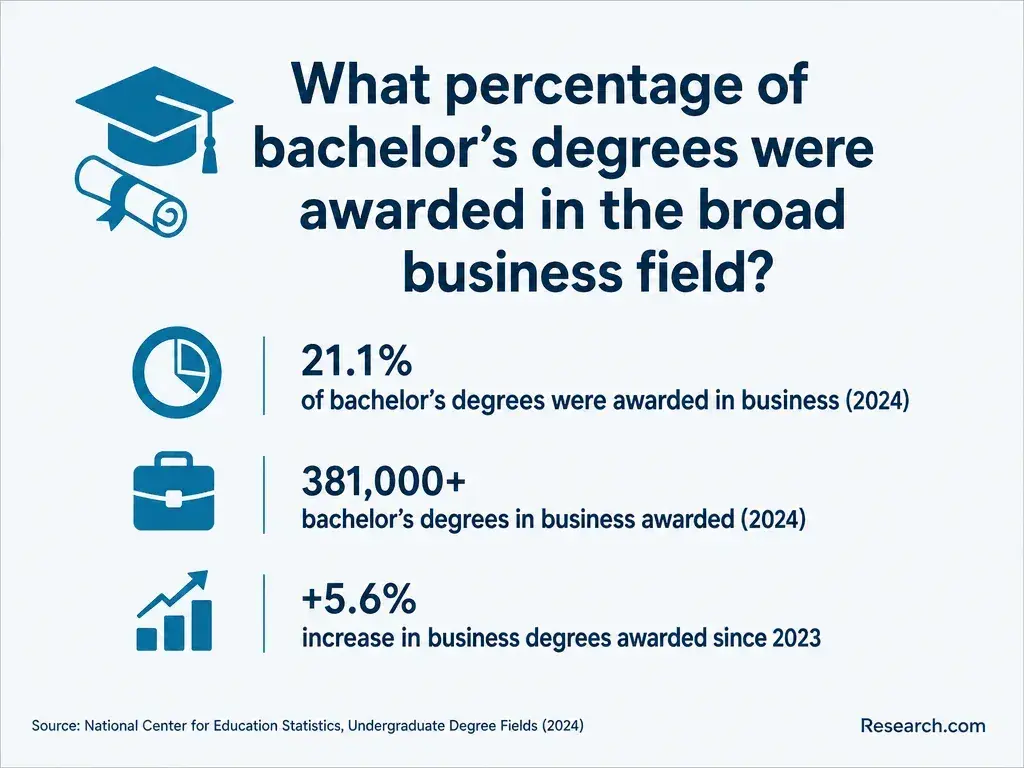
A bachelor's degree commonly requires about four years of full-time study from entry, but your remaining time depends on accepted credits, how those credits apply to degree requirements, course availability, and enrollment pace. Part-time attendance generally extends the calendar. A school's transfer estimate is not a completion plan until its official evaluation shows which general education, business core, and elective requirements remain.
Compare total cost to completion, not tuition alone: remaining courses, mandatory fees, books or software, travel, and the earnings or work hours you might give up. Request a written degree audit and an itemized estimate from each school. Then ask the financial-aid office which charges may be covered and when payment is due. A comparison of FAFSA-accepting colleges for business administration students can help identify schools to investigate, but eligibility and the aid offered depend on the student and institution.
Requirements differ for first-year, transfer, and returning applicants. Schools commonly review prior transcripts and may set GPA, general education, or mathematics requirements; some admit students to the university before they can enter the business major. Accounting or statistics may be an entry prerequisite at one school and a course completed after admission at another.
Before applying, request the current catalog's admission rules and an evaluation of your prior coursework. Ask admissions what establishes eligibility, the business department what its major requires, and the registrar how transfer courses will apply. For a closer look at possible quantitative and introductory-course expectations, use academic preparation for business administration applicants. Admission does not guarantee that previous credits satisfy the business core or shorten the degree by the amount you expect.
Program coordinator is not, by itself, a generally licensed occupation in the United States. Most openings do not require a universal coordinator certification. An employer may nevertheless request training tied to its setting or tools - for example, a specific software platform, safety procedures, or rules governing sensitive information.
Project management certificates can show focused training, but eligibility for professional certifications varies by credential and may involve experience requirements. Likewise, a coordinator position focused on hiring or employee programs may benefit from HR study without making an HR credential mandatory. Compare the actual work and qualifications in those postings with a guide to studying human resources before paying for a separate qualification.
Coordinator experience can lead toward program management, operations, project management, events, HR, or sector-specific administration. Progression depends on what you have actually owned: tracking an initiative is different from being accountable for its budget, staff, and results.
Look for the next role that extends your strongest evidence. If you have managed schedules and dependencies, a project-focused role may fit. If you have handled purchasing, inventory, and vendor communication, operations or supply chain work may be a closer step; supply chain bachelor's options focused on completion speed are worth comparing only if employers in that target function expect more specialized preparation.
For perspective, the US Bureau of Labor Statistics reports a May 2025 median annual wage of $102,320 for project management specialists. That is an occupation-wide figure for a distinct role, not a predicted salary or automatic promotion for a program coordinator. Use its job duties - not its wage alone - to judge whether that path fits your experience.
What are program coordinator salaries and job outlook trends?
"Program coordinator" spans too many functions to support one reliable national wage or growth figure. Compare a posting's duties with a defined occupation before using labor-market data. For example, the Bureau of Labor Statistics reports a May 2025 median annual wage of $61,160 for meeting and event planners and projects 6% employment growth for that occupation from 2025 to 2035. Those figures may inform an events-heavy search, but they do not describe nonprofit services, healthcare, or academic program coordinators as a group.
Use local postings to check pay ranges for your target sector, location, and experience level. If you are weighing a degree primarily for earnings, compare likely entry opportunities and borrowing against the full cost of finishing it; low-cost online business degree programs can broaden the schools you evaluate. No occupation-wide median establishes what a new graduate will earn.
Other Things You Should Know About Business Administration
Yes, if you meet the posting's required qualifications. Relevant work, volunteer tasks, and completed coursework can support an application; state your expected graduation date accurately.
Often, especially when you scheduled people, maintained records, handled communications, or reported results. Describe your responsibilities and outcomes accurately rather than relying on the volunteer title alone.
Include a clearly labeled schedule, budget template, process map, or status report that demonstrates your work. Use fictional data or obtain permission and remove confidential information before sharing workplace material.
Usually not. Choose one only if its courses develop skills repeatedly requested in your target postings and its additional credits, if any, justify the time and cost.
- General Schedule Qualification Policies | U.S. Office of Personnel Management https://www.opm.gov/policy-data-oversight/classification-qualifications/general-schedule-qualification-policies/
- Skills Gaps: A Review of Underlying Concepts and Evidence | congress.gov https://www.congress.gov/crs-product/R47059
- Higher Education Program Coordinator - NC State Online https://online-distance.ncsu.edu/career/program-coordinator-higher-education/
- 10 Key Subjects Taught in a Bachelor of Business Administration Program | Carson-Newman University https://www.cn.edu/cps-blog/10-key-subjects-taught-in-a-bachelor-of-business-administration-program/
- Why Digital Literacy Skills Matter in Business | Northern Virginia Community College https://www.nvcc.edu/discover/why-digital-literacy-skills-matter-in-business.html
- Job Standard for Academic Programs Coordinator | Boise State Online https://www.boisestate.edu/hrs-job-levels-job-standards/job-standard-for-academic-programs-coordinator/
- What does a Clinical Program Coordinator do? Career Overview, Roles, Jobs | AARST https://jobs.aarst-nrpp.com/career/clinical-program-coordinator
- Program Coordinator: What Is It? and How to Become One? | ziprecruiter.com https://www.ziprecruiter.com/career/Program-Coordinator/What-Is-How-to-Become
- Learn About Being a Coordinator | indeed.com https://www.indeed.com/career-advice/careers/what-does-a-coordinator-do
- What is a Project Coordinator? - Career Insights https://www.tealhq.com/career-paths/project-coordinator