# 1 position
Pima Community College - Plumbing Technology/Plumber.
certificate or diploma

Audited and Verified:
Our Editorial and Data Verification Process
Research.com uses government datasets, official education statistics and primary institutional information to support its career and degree guides. Our review process checks factual accuracy, occupational definitions, source dates and the requirements associated with the credentials discussed.
How This Article Was Fact-Checked
Our editorial team verifies salary estimates, employment projections, education requirements and program information against original data providers and official organizations. Salary figures are checked against the relevant occupational definitions and reporting periods. Information about licensure, accreditation and required in-person training is reviewed separately.
Fact-checked and verified on:

Co-Founder and Chief Data Scientist

Reviewed by Karolina Broda
Fact-Checker and Data Verification
Choosing affordable plumbing training means comparing more than tuition: a short course, a college credential, and a paid apprenticeship can lead to different costs and amounts of jobsite experience. The U.S. Bureau of Labor Statistics projects 6.8% national employment growth for plumbers, pipefitters, and steamfitters from 2025 to 2035. This guide explains Arizona training routes, costs, wages, and licensing so you can judge which fits your goal. It also features a Most Affordable Plumber Trade Schools in Arizona for 2027 ranking created by the Research.com team of data scientists to help students make an informed choice about programs worth considering.
Expect instruction in piping systems, tools, measurement, plan reading, safety, and applicable plumbing code, followed by practice assembling, testing, or troubleshooting systems. Classroom knowledge matters, but plumbing also requires supervised physical work. Before enrolling, ask how much instruction takes place in a shop or on a jobsite and who arranges that experience.
The main routes differ in what they award and how quickly they connect training to paid work. The table distinguishes common models, not identical offerings at every Arizona provider.
| Route | What it typically provides | Best fit and principal trade-off |
| Short certificate or pre-apprenticeship | Foundational instruction and, where offered, shop practice; a school credential is not itself a journeyman designation. | Useful for exploring the trade or strengthening an apprenticeship application; confirm that the credential leads to interviews or recognized credit. |
| Community college certificate or associate degree | Technical coursework, potentially with labs and broader general coursework for an associate degree. | Fits learners seeking structured instruction; compare time and cost with the amount of actual field experience included. |
| Registered apprenticeship | Paid, supervised work plus related technical instruction under a registered sponsor. | Fits learners ready for employment-based training; entry may depend on openings, testing, interviews, or an employer. |
| Direct employer entry | Paid helper work and employer-directed training, which may or may not be part of a registered apprenticeship. | Can reduce upfront school costs; ask how skills, raises, and documented experience will progress. |
Do not assume that a quick academic credential is the quickest route to independent plumbing work. Even when comparing options described as a top associate degree in 6 months accredited, verify the plumbing-specific curriculum and practical training rather than relying on a general completion timeline.
Arizona plumbing work spans residential construction and repair, commercial buildings, facilities maintenance, and larger piping projects. An entry-level worker might join a plumbing contractor as a helper or apprentice; other opportunities involve service calls, new construction, or maintenance for an employer. Pipefitting and steamfitting can involve different systems and training, even though federal wage statistics group these occupations together (U.S. Bureau of Labor Statistics, Occupational Outlook Handbook).
Location affects the decision. Phoenix-area opportunities may offer more potential employers and training sponsors, while a rural learner may face longer trips to labs or worksites. Compare the actual commute and availability of supervised work in the area where you intend to live; an inexpensive classroom course far from an apprenticeship or employer may be the costlier route overall.
There is no single reliable wage for every new Arizona plumber. Pay depends on experience, specialty, employer, location, and whether work is performed as an employee or through a licensed contracting business. For a national benchmark, the median annual wage for plumbers, pipefitters, and steamfitters was $63,800 in May 2025 (U.S. Bureau of Labor Statistics, Occupational Outlook Handbook). Because that figure combines occupations and experience levels nationwide, it should not be treated as an Arizona starting offer.
For a local decision, compare current Arizona occupational wage estimates from the U.S. Bureau of Labor Statistics or Arizona labor-market agency with actual apprentice and helper openings in your intended area. Ask a prospective sponsor for its wage progression, benefits, travel expectations, and overtime policy. Those figures are more useful for a personal budget than applying the national median to your first year.
A short school credential may take months, while an associate degree generally takes longer and a registered apprenticeship commonly spans multiple years of related instruction and supervised work. Exact schedules and required hours depend on the provider or registered sponsor; Arizona does not impose one universal plumbing-school clock-hour requirement for every entry-level employee. Confirm whether advertised hours count classroom instruction, labs, or actual work separately.
Faster completion is not the same as faster career progression. An accelerated classroom program can get a learner into the labor market sooner, but it cannot replace jobsite competence an employer expects. If considering a fast associates degree, ask whether its timetable leaves room for plumbing labs and whether prior coursework or documented experience can receive credit. Apprentices should ask sponsors about advanced standing rather than assuming a school certificate automatically shortens the apprenticeship.
Online instruction can suit plumbing theory: terminology, drawings, calculations, safety concepts, and some code study. It cannot by itself demonstrate safe tool use, joining techniques, leak testing, or work in an occupied building. Campus programs may provide a dedicated shop; an apprenticeship provides repeated supervised practice at employer worksites. A hybrid option is credible only if it specifies where practical assessments occur.
For learners balancing work and travel, remote theory can reduce trips, particularly when the nearest shop is far away. Before choosing it, get the in-person schedule, lab location, equipment access, and any required employer placement in writing. An entirely online certificate should not be mistaken for proof of jobsite readiness or eligibility to operate as an Arizona plumbing contractor.
A defensible statewide average would require comparable, current prices for Arizona school programs and apprenticeships; these pathways report costs differently, and no single average should stand in for a quote. Request each finalist's current itemized cost rather than assuming that the lowest advertised tuition is the least expensive route to employment.
A useful comparison includes tuition and mandatory fees, books and materials, tools, safety gear, transportation to labs or worksites, and income forgone during unpaid training. Add any applicable exam or contractor-application expenses only if they belong to your intended next step. Then subtract confirmed grants, scholarships, employer contributions, or wages earned during training. Paid apprenticeships can change the calculation substantially, though pay and covered expenses vary by sponsor (U.S. Department of Labor, Apprenticeship.gov).
Federal aid depends on the specific institution and eligible program, not merely on whether classes are online or the school appears in a ranking (Federal Student Aid). Readers comparing colleges online that accept fafsa should still ask the plumbing provider's financial-aid office whether their particular credential qualifies. Also ask an Arizona workforce office about current training assistance before borrowing.
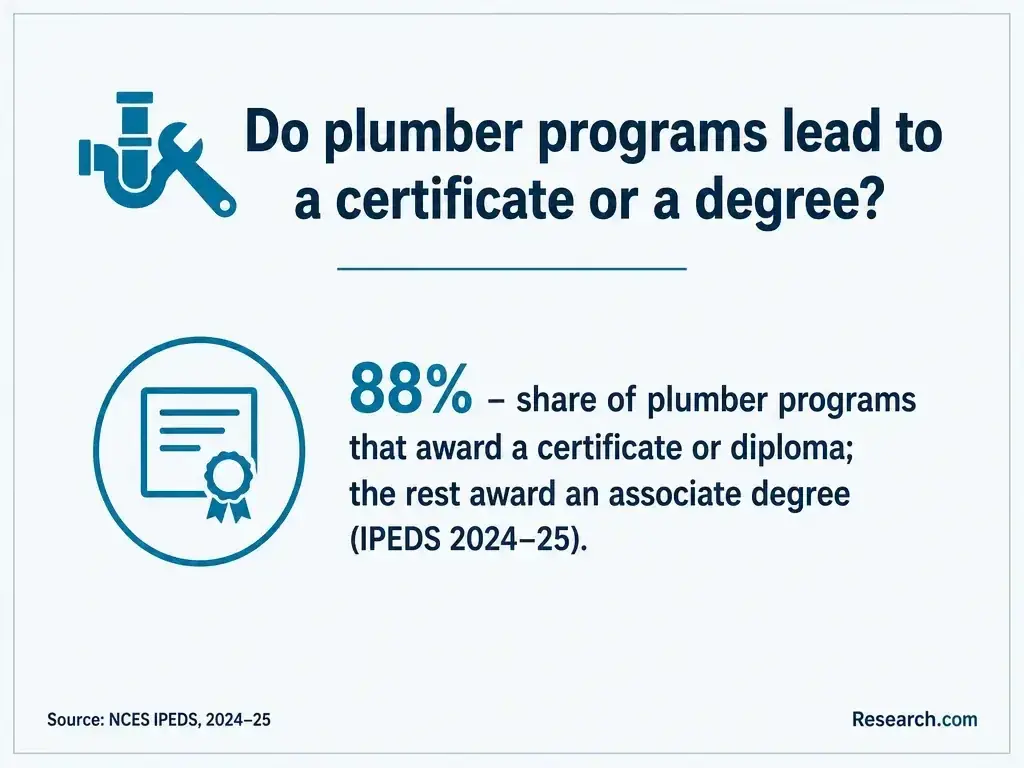
The award depends on the route: a school might issue a completion certificate or an associate degree, while a registered apprenticeship issues an apprenticeship completion credential after its work and instruction requirements are met. An employer may instead document training and experience without awarding an academic credential. These are not interchangeable simply because each includes the word "plumbing."
Ask for the exact credential title, issuing organization, assessed competencies, and any credit arrangements with apprenticeship sponsors. An NCCER-related credential, if offered, is an industry training credential, not an Arizona contractor license (National Center for Construction Education and Research; Arizona Registrar of Contractors). Institutional accreditation addresses a school's standing; it does not certify an individual's plumbing skills or replace required work experience.
Requirements vary by route. A college or career-school program may request an application and placement information, while a registered apprenticeship sponsor may require an application, eligibility documents, an aptitude assessment, an interview, or placement with a participating employer. Worksite assignments can also involve employer safety or driving requirements. Check the current provider or sponsor notice rather than treating another program's rules as statewide rules.
Entry planning is especially important if you need immediate income. A school may admit students on a different schedule from an apprenticeship sponsor's hiring cycle. Ask when hands-on training begins, whether placement is arranged or left to you, and whether you can work while attending. Completing a pre-apprenticeship can strengthen preparation, but it does not guarantee selection into a registered apprenticeship.
Useful instruction connects drawings and calculations to real installations. Learners should practice identifying materials and fittings, measuring and assembling piping, using tools safely, testing systems, and diagnosing faults. They also need to understand water supply, drainage and venting, applicable code, and how to communicate about work performed (U.S. Bureau of Labor Statistics, Occupational Outlook Handbook; O*NET). Arizona work must meet the applicable codes and permit requirements for the jurisdiction and project.
Ask to see the shop equipment and assessment method. A program that demonstrates pipe joining and testing provides different evidence of readiness from one that only assigns readings or videos. For a service-oriented goal, look for troubleshooting and customer-facing practice; for new construction, examine plan-reading and installation opportunities. The best curriculum is the one aligned with the work you want to seek next.
Arizona generally does not issue an individual statewide journeyman-plumber license that every employee must hold before working for a plumbing contractor. Working independently as a contractor is different: the Arizona Registrar of Contractors regulates contractor licensing, including plumbing classifications, and applies qualification, examination, and other requirements to the license applicant and qualifying party. Verify the current classification and rules with the Registrar before paying for training intended to support a contracting goal (Arizona Registrar of Contractors).
Neither a school certificate nor registered-apprenticeship completion automatically grants a contractor license. Industry certifications may document skills, and a registered apprenticeship is a structured training pathway; neither substitutes for occupational licensing where contractor licensing applies. Employers must still follow applicable permits, codes, and worksite rules. If your long-term aim is self-employment, retain records of supervised experience and ask the Registrar what evidence its current application requires.
Start with the job you want - service plumbing, installation, or eventual contracting - then compare school programs with paid apprenticeships and direct employer entry. Affordability rankings can identify candidates, but they cannot tell you whether a particular shop schedule, work placement, or credential fits your goal. General academic shortcuts, including unrelated academic program comparisons, are not substitutes for checking plumbing competencies and supervised work.
Use the following questions with each school or sponsor. Written answers make it easier to spot a low advertised price that hides a longer or less practical route.
For return on investment, weigh your likely completion, time away from paid work, aid and debt, expected starting pay, and how earnings might change over time - not institution type alone. A warning sign is a promise that a brief course or online-only credential makes you a licensed Arizona contractor. Check claims directly with the Arizona Registrar of Contractors and the program's named apprenticeship sponsor.
A common progression begins with helper or apprentice work, moves into more independent installation or service duties as competence grows, and can lead to crew leadership, estimating, specialized piping work, or an appropriately licensed contracting business. Advancement depends on demonstrated experience and employer needs; a new school credential alone does not place someone at a senior level. Pipefitting and steamfitting are related paths but may require different on-the-job preparation (U.S. Bureau of Labor Statistics, Occupational Outlook Handbook).
Work setting matters as much as job title. Service roles can involve customer visits and unpredictable repairs; larger installations may emphasize coordinated crew work and drawings. Someone exploring best introvert jobs should not assume plumbing is either solitary or constantly customer-facing. Ask employers what a normal shift entails before choosing a training emphasis.
The U.S. Bureau of Labor Statistics projects 6.8% employment growth from 2025 to 2035 for plumbers, pipefitters, and steamfitters nationwide. This indicates continued demand across the combined occupation, not a guaranteed opening for an Arizona graduate or a forecast for plumbers alone. Local hiring can differ with construction activity, repair demand, employer staffing, and the availability of apprenticeship places.
Use the national projection to assess the broad field, then test it against current Arizona job postings and sponsor intake in the area where you can travel. An applicant who needs a paid position immediately should confirm an employer or apprenticeship opportunity before spending heavily on a course whose main benefit is classroom preparation.
Education is a consequential investment, so Research.com designed its rankings to help readers compare programs against others serving the same occupation and location. The team checks multiple education and outcomes sources to improve the quality, credibility, and accuracy of those comparisons. Only programs with completions reported to the Integrated Postsecondary Education Data System (IPEDS) are eligible; a registered apprenticeship or other provider absent from IPEDS is not necessarily an inferior option.
The most affordable ranking evaluates costs and debt only: tuition, cost of attendance, median student debt, and federal loan default rate. Weights are assigned through an entropy-based method, which gives more weight to indicators that differ more across eligible programs. Accreditation and other quality measures do not enter this affordability score. A low-cost ranking position therefore does not establish that a program offers the best plumbing labs, apprenticeship connections, or route to a particular job.
Research.com's separate best-programs methodology considers student outcomes, earnings and return on investment, costs and debt, and quality and recognition. Its current weights assign 20% to occupation-relevant programmatic accreditation or industry recognition, 10% to institutional accreditation, 10% to student support, and the remaining 60% to outcomes, earnings, and costs using entropy-based weighting. Those are not the weights for this most affordable ranking. Readers can use the ranking to narrow a cost-conscious shortlist, then verify each finalist's current price and practical training.
The following databases and organizations are among the sources used across Research.com trade-program rankings. Some cover other occupations rather than plumbing specifically; their inclusion does not imply that they accredit Arizona plumbing programs.
For more detail on the ranking approach, see Research.com's methodology.
# 1 position
# 2 position
# 3 position
# 4 position
# 5 position
# 6 position

# 7 position
# 8 position
# 9 position

No single trade-school credential is required for every entry-level plumbing employee. Registered apprenticeships and employer training are alternatives. Contractors face separate Arizona Registrar of Contractors licensing rules.
It can have lower upfront costs and pays wages during training, but sponsors differ in openings, pay, covered tools, and instruction costs. Compare your full expenses and earnings for each route.
You can study some theory online, but safe installation, testing, and troubleshooting require in-person practice and supervised work. Ask where a hybrid program conducts its practical assessments.
No. A school credential documents training; contractor licensing has separate requirements administered by the Arizona Registrar of Contractors.
Only if it also provides the practical preparation and employer connection you need. Compare total cost, time to paid work, shop and field hours, and the exact credential before enrolling.