# 1 position


Audited and Verified:
Our Editorial and Data Verification Process
Research.com uses government datasets, official education statistics and primary institutional information to support its career and degree guides. Our review process checks factual accuracy, occupational definitions, source dates and the requirements associated with the credentials discussed.
How This Article Was Fact-Checked
Our editorial team verifies salary estimates, employment projections, education requirements and program information against original data providers and official organizations. Salary figures are checked against the relevant occupational definitions and reporting periods. Information about licensure, accreditation and required in-person training is reviewed separately.
Fact-checked and verified on:

Co-Founder and Chief Data Scientist

Reviewed by Karolina Broda
Fact-Checker and Data Verification
Choosing an affordable plumbing program means comparing more than tuition: you need training that fits Utah's licensing path and lets you earn while gaining experience. The U.S. Bureau of Labor Statistics projects 6.8% national growth for plumbers, pipefitters, and steamfitters from 2025 to 2035. This guide explains costs, credentials, apprenticeships, and career prospects. It also accompanies the Most Affordable Plumber Trade Schools in Utah for 2027 ranking, created by the Research.com team of data scientists to help you identify plumbing training programs worth considering.
Expect instruction in pipe systems, tools, safety, plan reading, and plumbing calculations, with in-person practice connecting and testing systems. A school-based credential may prepare you to seek an apprenticeship or complement one; it does not replace the supervised work and examinations required for the applicable Utah license (Utah Division of Professional Licensing).
The key distinction is where you gain work experience. A school program concentrates instruction in classrooms and labs. A registered apprenticeship combines related instruction with paid, supervised work over a longer period (U.S. Department of Labor, Apprenticeship.gov). For someone who needs earnings immediately, an apprenticeship may be the better investment if a position is available. For someone who needs foundational practice before approaching employers, a school program may provide a useful start - provided its cost and licensing relevance hold up to scrutiny.
Potential workplaces include residential and commercial construction contractors, building-maintenance departments, and employers that install or service piping systems. The U.S. Bureau of Labor Statistics distinguishes plumbing work from related pipefitting and steamfitting work; a program aimed mainly at one specialty may not prepare you equally well for the others.
Location affects the practical cost of training. In the Wasatch Front, compare the commute to both the classroom and likely jobsites. Elsewhere in Utah, ask whether a provider has accessible lab sessions and whether an employer can offer the supervision your intended licensing route requires. A low-cost program becomes less affordable if travel makes attendance or work placements difficult.
Do not use a national occupational median as a Utah starting-pay quote. The U.S. Bureau of Labor Statistics reports a May 2025 U.S. median annual wage of $63,800 for plumbers, pipefitters, and steamfitters. That figure combines related occupations and workers at different career stages; an apprentice's pay, a licensed plumber's pay, and earnings from self-employment can differ substantially.
For a decision about a particular program, ask prospective Utah apprenticeship sponsors or employers for their current trainee wage progression, typical hours, and benefits. Compare those terms with the school's total cost and the time you would spend training before earning wages. Verify any Utah-specific wage figure you encounter against the Utah Department of Workforce Services or U.S. Bureau of Labor Statistics occupational data, checking the occupation and reference year.
There is no single program length: a short introductory credential, an apprenticeship-related classroom program, and a paid apprenticeship serve different purposes. Completing classroom training sooner does not necessarily shorten the supervised experience needed for a Utah journeyman license (Utah Division of Professional Licensing). Compare the time to the credential with the time to licensing eligibility, not just the advertised graduation date.
Ask each provider for its current clock or contact hours, lab hours, attendance schedule, and documented relationship to an apprenticeship. Then ask the Utah Division of Professional Licensing which education and experience requirements apply to the specific license you intend to pursue. This matters particularly if you are considering accelerated study: a compressed classroom calendar cannot by itself supply months of supervised work.
Online instruction can be useful for theory, calculations, codes, and plan reading. It cannot reproduce the physical practice of measuring, joining, installing, troubleshooting, and testing piping under supervision. For licensing-focused training, confirm where those skills will be practiced and assessed; do not assume an online certificate satisfies Utah's education or experience requirements (Utah Division of Professional Licensing).
A hybrid schedule may help a working apprentice fit classroom instruction around paid work, but only if required labs and attendance are accessible. An on-campus program may suit a beginner who needs frequent instructor feedback. Compare the actual lab schedule and travel burden rather than choosing solely by the program's online or campus label.
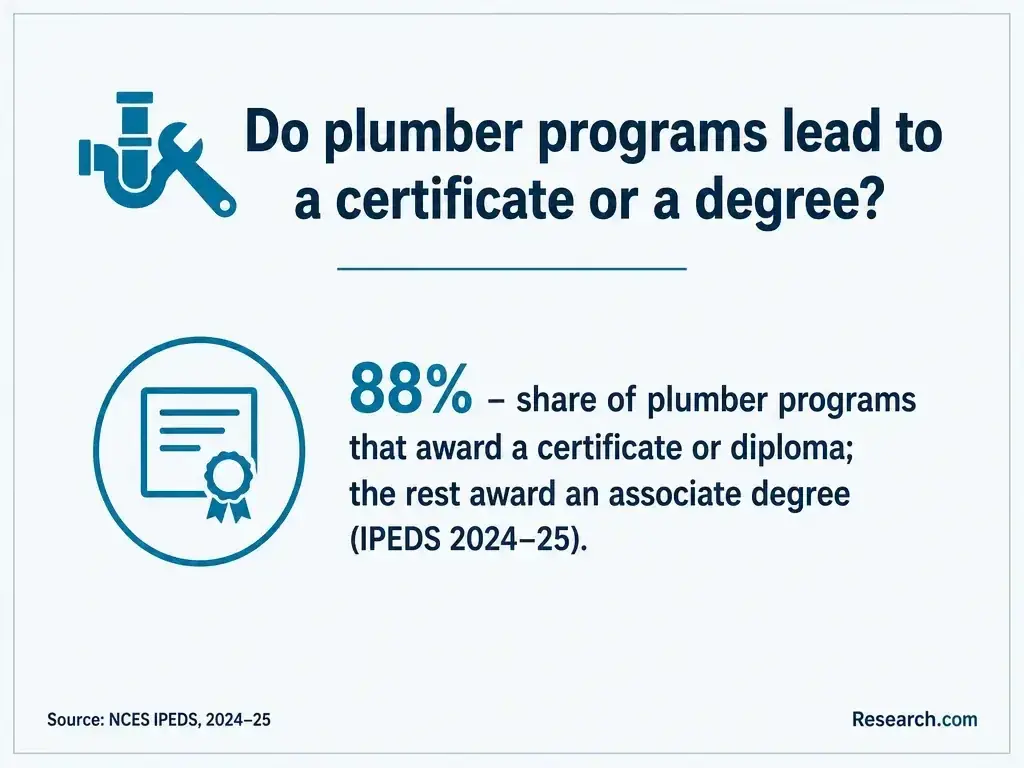
A reliable statewide average is not available from a single comparable set of plumbing-program prices. Published tuition may cover different training lengths and may omit costs that matter to a trainee. Request a written, current quote from each provider instead of treating a ranking position as your final price.
Build your comparison around these costs and offsets:
Ask whether the quoted price is fixed for the whole program, whether residency changes tuition, and whether aid applies to that particular credential. Federal student aid eligibility depends on the student, institution, and program; it should not be assumed for every trade-school or apprenticeship option (Federal Student Aid). For a meaningful return-on-investment comparison, also consider completion likelihood, likely earnings before and after training, debt, and how long it may take for benefits to outweigh costs.
Depending on the provider, you may earn a school certificate or another documented training credential. A registered apprenticeship has a different outcome: completion of an apprenticeship program that combines related instruction and supervised work (U.S. Department of Labor, Apprenticeship.gov). Neither a similarly named certificate nor institutional accreditation should be mistaken for a Utah occupational license.
Before enrolling, get the credential's exact name in writing. Ask whether instruction can be credited toward an apprenticeship, whether prior experience can affect placement, and who makes that determination. An employer or apprenticeship sponsor - not the certificate title alone - can tell you whether the training earns advanced standing in its program; the Utah Division of Professional Licensing determines licensing requirements.
Requirements vary by provider and pathway. A school may set its own entry criteria and placement process; an apprenticeship sponsor may separately assess applicants for available paid positions. School admission therefore does not equal apprenticeship admission, a job offer, or eligibility for a Utah license.
Ask about prerequisite education, placement tests, required tools and safety gear, physical demands, and whether you must first secure an employer. If the program promises apprenticeship placement, request its written placement terms and find out what happens if a position is unavailable. Confirm any apprentice registration and later license requirements with the Utah Division of Professional Licensing rather than relying on admissions language.
Plumbing training should connect classroom knowledge to installation and repair tasks: reading plans, using measurements and calculations, selecting materials and fittings, working safely with tools, and diagnosing system problems. The U.S. Bureau of Labor Statistics identifies installation, maintenance, repair, and interpretation of building plans as central to plumbers' work.
Look past the course titles. Ask what systems students assemble, how instructors assess leak testing and troubleshooting, and how much supervised practice occurs before a trainee works at an employer site. A program with substantial lab access may offer more preparation for a first work assignment than one with the same credential name but mainly recorded lessons. Curriculum should also address the codes and workplace practices relevant to the work you plan to do in Utah.
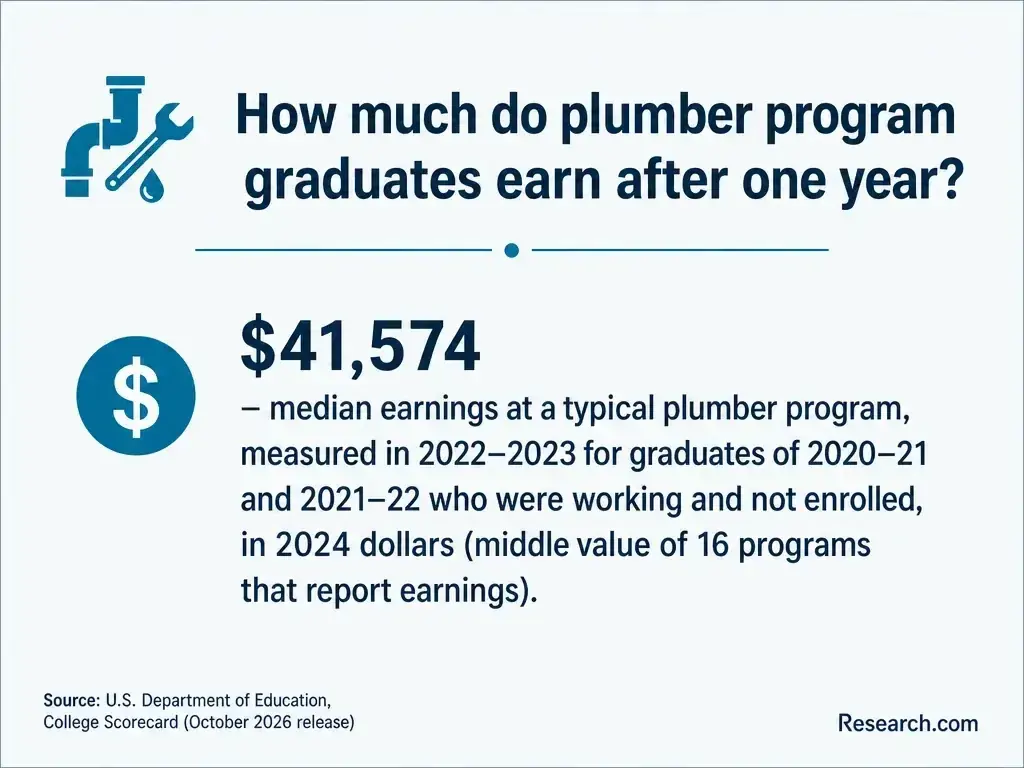
Utah regulates plumbing practice through its state licensing system. Its Division of Professional Licensing distinguishes apprentice and journeyman pathways, including residential license categories, from higher-level master licensing. Requirements depend on the credential sought and can involve documented experience, education or training, and examinations (Utah Division of Professional Licensing). A school-issued certificate and an optional industry credential are not substitutes for the applicable state license.
Before choosing a program, identify the license that fits your intended work and check the Division's current application instructions. Ask how supervised hours will be recorded, whether the program's instruction meets the relevant requirements, and what examinations remain. Institutional accreditation concerns the school; apprenticeship registration concerns the training arrangement; occupational licensure concerns legal authorization to perform regulated work. None automatically confers the others.
Start with the work and license you want, then compare programs on the complete route to that goal. Salt Lake Community College, Bridgerland Technical College, and Davis Technical College are examples of Utah providers to investigate; verify each provider's current plumbing offerings, schedules, and charges directly rather than assuming every campus offers the same route.
Use these checks to turn an affordable-program shortlist into a decision:
A red flag is a promise that a short or fully online certificate alone makes you a licensed plumber. Another is a tuition quote that excludes essential tools or required travel. Choose the cheaper program only when it also provides the practical training and credible route to work you need; a ranking is a starting point, not a licensing or employment guarantee.
A common progression is supervised trainee or apprentice work, followed by eligibility to seek the appropriate journeyman license after meeting Utah's requirements. With additional experience and any applicable requirements, a plumber may pursue master-level licensing, supervision, or business ownership (Utah Division of Professional Licensing). These later steps are not immediate outcomes of a school certificate.
Training can also point toward residential service, commercial installation, or related piping work. Choose a program whose labs and employer connections match that direction: someone aiming for residential service needs relevant troubleshooting practice, while someone targeting commercial construction should ask about exposure to larger projects and jobsites. Verify the licensing scope for the work you intend to perform.
The U.S. Bureau of Labor Statistics projects 6.8% national employment growth for plumbers, pipefitters, and steamfitters from 2025 to 2035. This is a national projection for a combined occupation, not a forecast of Utah plumbing vacancies or a guarantee of an apprenticeship opening.
Use that projection as context, then test your local opportunity: review current Utah Department of Workforce Services information and speak with employers or apprenticeship sponsors in the area where you can realistically travel. A viable training choice depends not just on long-run demand, but on whether you can obtain supervised work, afford the schedule, and complete the requirements for the role you want.
Education is a significant investment, so Research.com compares plumbing programs with other options in the same occupation and location rather than with unrelated trades. Only programs reporting completions to IPEDS qualify for the ranking. That makes the comparison useful for examining listed schools, but it does not mean an unlisted apprenticeship or training provider is unavailable or unsuitable.
The most affordable ranking scores tuition, cost of attendance, median student debt, and federal loan default rates. It uses an entropy-based weighting method, which assigns more weight to cost and debt measures that differ more across programs. Unlike Research.com's best-program rankings, it does not score accreditation, training quality, licensing alignment, or student support. Readers should verify those factors separately before enrolling.
The Research.com team draws on the following sources when creating its trade-program rankings. Some cover occupations other than plumbing and should not be read as plumbing-specific approval bodies:
Use the ranking to narrow your cost comparison, then confirm current prices, practical training, and Utah licensing alignment directly with each provider. Research.com explains its broader ranking approach on its methodology page.
# 1 position
# 2 position
# 3 position
Not necessarily. A paid apprenticeship can combine instruction and supervised work without a separate, upfront school program. Check the Utah Division of Professional Licensing's current requirements for your intended license and confirm how a specific apprenticeship meets them.
No. A school credential documents training; Utah occupational licensure has separate requirements that may include supervised experience and examinations (Utah Division of Professional Licensing).
Theory may be available online, but installation and troubleshooting require in-person practice. Verify how a program delivers and documents its hands-on training before enrolling.
It may cost less upfront and provide wages while you train, but compare required instruction costs, tools, travel, available positions, and your expected earnings. Neither route is automatically the better financial choice.
Ask for its total written cost, exact credential, lab and classroom hours, apprenticeship connection, and explanation of how training relates to the Utah license you want. Verify licensing claims with the Utah Division of Professional Licensing.