# 1 position

Audited and Verified:
Our Editorial and Data Verification Process
Research.com uses government datasets, official education statistics and primary institutional information to support its career and degree guides. Our review process checks factual accuracy, occupational definitions, source dates and the requirements associated with the credentials discussed.
How This Article Was Fact-Checked
Our editorial team verifies salary estimates, employment projections, education requirements and program information against original data providers and official organizations. Salary figures are checked against the relevant occupational definitions and reporting periods. Information about licensure, accreditation and required in-person training is reviewed separately.
Fact-checked and verified on:

Co-Founder and Chief Data Scientist

Reviewed by Karolina Broda
Fact-Checker and Data Verification
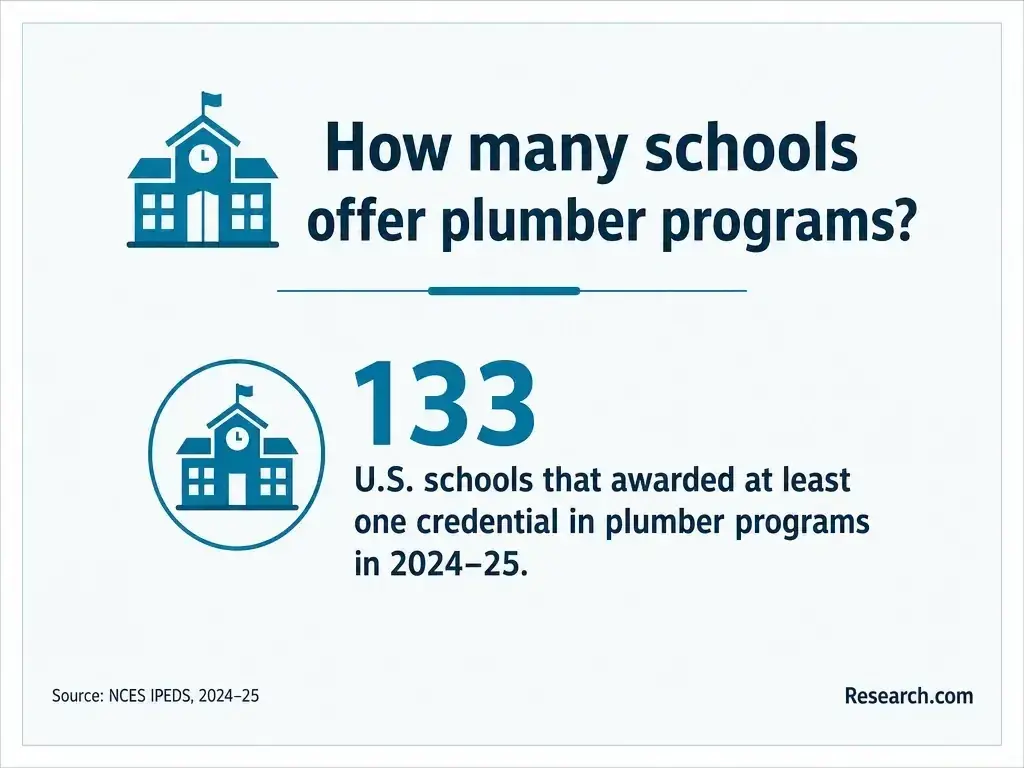
Choosing affordable plumbing training in Pleasant Hill means comparing more than tuition: a short course, a college credential, and a paid apprenticeship lead to different levels of work experience. The U.S. Bureau of Labor Statistics projects 6.8% national growth for plumbers, pipefitters, and steamfitters from 2025 to 2035. This guide helps prospective students and career changers compare costs, practical training, and California contractor rules. It will feature a Most Affordable Plumber Trade Schools in Pleasant Hill for 2027 ranking created by the Research.com team of data scientists to help students make an informed choice about programs worth considering.
Expect instruction in water-supply and drainage systems, fittings, tools, safety, and code interpretation, followed by practice on physical assemblies. The crucial question is whether a program provides enough shop time and a credible route into supervised employment. A classroom-only credential can introduce the trade but cannot replace field experience.
The pathways below differ most in how students obtain practical experience and pay for training. Confirm the actual plumbing offering and its current schedule directly with any provider; proximity alone does not establish that a program is available.
| Pathway | Typical credential or outcome | Best fit and principal limitation |
| Pre-apprenticeship or introductory course | Course completion or training certificate | Helps a newcomer test the trade; may not provide a job placement or apprenticeship credit. |
| College or career-school plumbing program | Certificate or diploma, depending on the offering | Provides structured instruction; compare lab access, fees, and employer connections. |
| Registered apprenticeship | Paid work-based training plus related instruction and a completion credential | Fits someone ready to work while learning; entry depends on sponsor openings and requirements. |
| Direct employer training | Job experience, sometimes with sponsored classes | Can provide an immediate work route; verify the quality and documentation of supervised experience. |
Diablo Valley College is a local college to check for relevant offerings, but readers should verify whether it currently offers plumbing-specific training rather than assuming it does.
Potential workplaces include residential service contractors, commercial construction firms, building-maintenance departments, and employers that install or repair water and drainage systems. Pleasant Hill's position within the East Bay makes commuting to jobs and training sites an important part of the decision: the closest classroom is not necessarily closest to an apprenticeship worksite.
Ask a prospective employer whether the opening is specifically for plumbing, pipefitting, or general maintenance. Those jobs overlap but do not provide identical experience, and the distinction matters if you later seek a California C-36 contractor license. An introductory credential may help you apply for helper roles; it should not be treated as proof that you can work independently.
The U.S. Bureau of Labor Statistics reports a $63,800 national median annual wage in May 2025 for plumbers, pipefitters, and steamfitters. This is the midpoint for employed workers across the combined occupation, not a Pleasant Hill wage or an estimate of what a new trainee will earn.
For a local decision, compare current East Bay apprentice or helper pay offers with the cost of your intended program and commute. Ask whether wages rise at defined apprenticeship stages and whether benefits begin immediately. A higher quoted wage for experienced workers should not be used to justify debt that an entry-level paycheck may not support.
An introductory course may take far less time than an apprenticeship, but completion time alone is a poor measure of readiness. Registered apprenticeships combine related instruction with extensive paid, supervised work over multiple years; a short certificate generally does not include comparable field experience (U.S. Department of Labor, Apprenticeship.gov).
Request the program's current calendar, instructional clock hours, lab hours, and attendance rules. Then ask whether any coursework can count toward a sponsor's requirements; do not assume automatic advanced standing. If speed is your priority, compare the time until you can earn wages in a helper or apprentice position, not just the time until a certificate is issued. A fast associates degree online is not a substitute for supervised plumbing practice.
Online instruction can suit plumbing calculations, drawings, terminology, and some code study. Cutting, joining, testing, troubleshooting, and safe tool use require equipment and observation in a shop or on a supervised worksite. A hybrid option is worthwhile only if its in-person component is accessible from Pleasant Hill and matches the practical skills employers expect.
Before paying for an online course, ask where its labs take place, who assesses hands-on work, and whether an apprenticeship sponsor accepts any coursework. An entirely remote completion certificate should not be mistaken for documented field experience. If schedule flexibility drives your search, even the cheapest online college per credit hour does not answer the more important plumbing question: where will you practice?
There is no defensible single average for Pleasant Hill plumbing training: a short course, a college certificate, and a paid apprenticeship have different charges and wage arrangements. Published tuition also excludes costs that can change which option is genuinely affordable.
Use the same cost categories for every offer you compare. Request an itemized, current quote rather than relying on an advertised starting price.
Federal aid eligibility depends on the institution and program, not simply on being a trade course (U.S. Department of Education, Federal Student Aid). Ask about California workforce assistance and whether a registered apprenticeship pays for related instruction. To judge return on investment, weigh net cost and debt against completion likelihood, time away from paid work, likely starting wages, and the years you expect to work afterward. An "easy" credential is not necessarily a better investment; readers comparing what is an easy associate's degree to get should keep the required plumbing field experience in view.
It depends on the route: a school may award a completion certificate or diploma, while a registered apprenticeship awards its own completion credential after the sponsor's training requirements are met. Some providers also teach toward an industry credential. Ask for the exact credential name and issuer before enrolling; similar-sounding certificates do not necessarily represent equivalent shop or field training.
Institutional accreditation concerns the school. State school authorization concerns permission to operate. Apprenticeship registration concerns a work-based training program. None of these is the same as an individual's occupational qualification or a California contractor license. If you are considering an academic credential rather than a short course, ask whether credits transfer or receive prior-learning recognition; any such arrangement must be confirmed by the receiving program.
Requirements vary by provider and pathway. A school may ask for an application, proof of prior schooling, or a placement assessment. An apprenticeship sponsor may additionally screen for readiness to work safely, travel to jobsites, and meet its stated entry conditions. Check the published requirements for the particular intake rather than assuming that admission to a course also secures an apprenticeship place.
For Pleasant Hill applicants, transportation deserves special attention. Ask where classes, shop sessions, and worksites are located and when they begin. A workable commute can determine whether an otherwise affordable program is realistic to finish. If you already have construction experience, request a written decision on any available prior-learning credit or advanced standing before committing.
Relevant instruction covers reading drawings, measuring and laying out pipe, selecting materials and fittings, assembling supply and drainage systems, testing for leaks, and following jobsite safety practices. Code interpretation matters because installation requirements affect how work is performed and inspected. The U.S. Bureau of Labor Statistics identifies installation, maintenance, and repair as central tasks for plumbers, pipefitters, and steamfitters.
Compare courses by the work students actually perform, not the length of the topic list. Ask to see the shop syllabus: which joints will you make, which systems will you assemble and test, and how will instructors assess faults? Strong communication, documentation, and customer-service skills also matter on occupied residential and commercial sites.
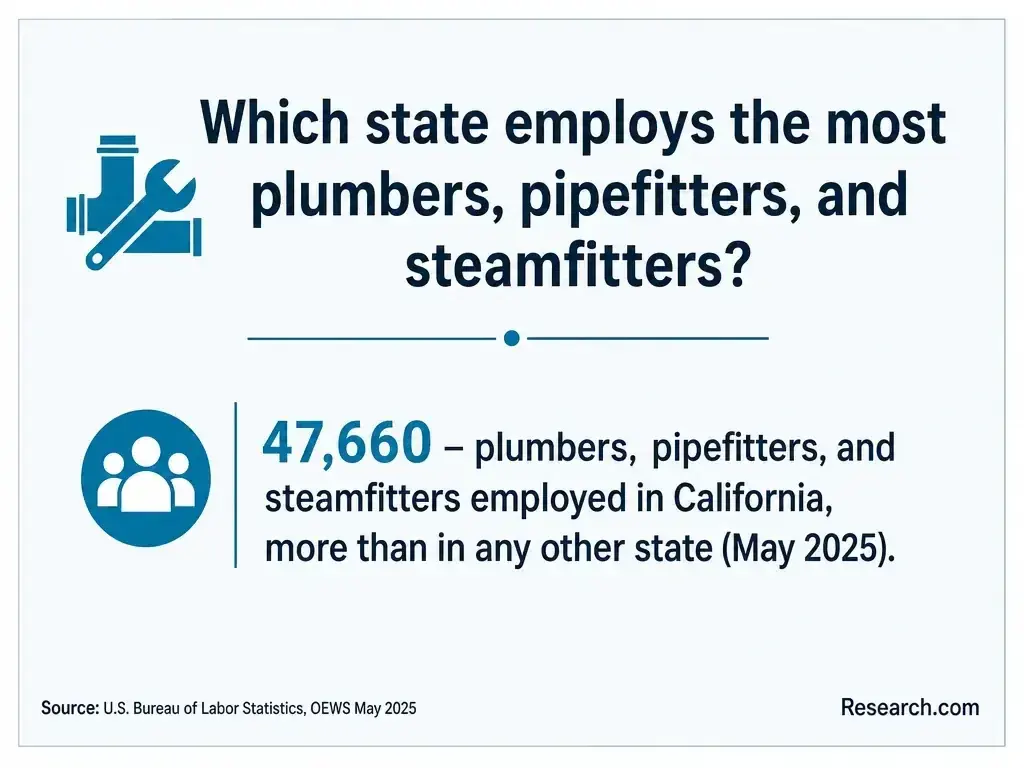
California does not issue a single statewide journeyman plumber license that every plumbing employee must hold. Running a business that contracts for plumbing work is a different matter: the California Contractors State License Board administers the C-36 plumbing contractor classification and requires qualifying experience, examinations, and other licensing conditions. Local rules and employer requirements may also affect particular work, so verify the role you intend to take.
A school certificate does not replace the supervised experience needed for contractor licensing. Before enrolling, ask how the program helps you enter qualifying work and how that work is documented. Check current requirements directly with the Contractors State License Board before planning for independent contracting; do not treat institutional accreditation, an optional industry certificate, or apprenticeship registration as a contractor license.
Start with the job you want: helper, apprentice, experienced employee, or eventually a licensed contractor. Then compare programs on the route they provide to that goal. An affordable course is worthwhile when it develops useful skills and opens a credible next step; it is a weak purchase if its credential has no practical component or recognized connection to employment.
Use these questions with admissions staff and apprenticeship coordinators to uncover differences a ranking cannot show:
Red flags include an unitemized price, a promise that a certificate alone permits independent contracting, or an "online-only" route presented as equivalent to supervised plumbing work. Compare any school-based option with paid apprenticeship or employer training before borrowing.
Training can lead first to a plumbing helper or apprentice position, then to more independent installation and service work as skills and supervised experience grow. Some workers move into commercial systems, maintenance, estimating, supervision, or business ownership. Those steps depend on the work performed and employer needs; owning a plumbing contracting business brings separate California licensing obligations (California Contractors State License Board).
If you are still comparing occupations, best trade school job comparisons can help frame the choice. For plumbing specifically, favor a route that exposes you to the systems you want to work on. Residential service and commercial construction can demand different schedules, troubleshooting skills, and travel.
National employment for plumbers, pipefitters, and steamfitters is projected to grow 6.8% from 2025 to 2035 (U.S. Bureau of Labor Statistics, Employment Projections). That supports exploring the trade, but it does not measure vacancies in Pleasant Hill or guarantee an apprenticeship opening.
Use the national projection as a broad signal, then check current East Bay job postings and registered-apprenticeship intakes for the work you want. Separate entry-level openings from advertisements seeking experienced workers. Because jobsites can extend beyond Pleasant Hill, realistic commute range may matter more to your first opportunity than the city where your classroom is located.
Investing in training is an important decision, so Research.com's team evaluates programs against others in the same occupation and location rather than against unrelated schools nationwide. The Most Affordable ranking scores tuition, cost of attendance, median student debt, and federal loan default rate, with weights assigned through an entropy-based method. Accreditation and other quality indicators are not part of this affordability score; readers should check them separately.
Only programs with completions reported to IPEDS are eligible. That makes the ranking useful for comparing included programs, but it does not capture every apprenticeship, employer-sponsored course, or other training option. The team uses the following data sources in its ranking work, applying occupation-specific sources where relevant:
These checks support a more credible cost comparison, not a promise of admission, employment, or licensing eligibility. Readers can find further detail on Research.com's methodology.
# 1 position
# 2 position
Not necessarily. A registered apprenticeship or supervised employer training may provide an entry route without first completing a separate trade-school program. Compare entry requirements, paid work, instruction, and field experience.
It can reduce upfront costs and provide wages during training, but compare sponsor fees, tools, travel, scheduling, and admission availability. A school course may still be useful preparation if it has a clear next step.
No. A course certificate alone does not satisfy California's C-36 contractor licensing requirements, which include qualifying experience and examinations (California Contractors State License Board).
Check Diablo Valley College's current catalog or admissions office for a plumbing-specific offering, its credential, and its hands-on requirements. Do not assume a nearby college has a current plumbing intake.
You may study some theory remotely, but practical installation, tool use, testing, and supervised fieldwork require in-person participation. Ask where and how those skills will be assessed.