# 1 position


Audited and Verified:
Our Editorial and Data Verification Process
Research.com uses government datasets, official education statistics and primary institutional information to support its career and degree guides. Our review process checks factual accuracy, occupational definitions, source dates and the requirements associated with the credentials discussed.
How This Article Was Fact-Checked
Our editorial team verifies salary estimates, employment projections, education requirements and program information against original data providers and official organizations. Salary figures are checked against the relevant occupational definitions and reporting periods. Information about licensure, accreditation and required in-person training is reviewed separately.
Fact-checked and verified on:

Co-Founder and Chief Data Scientist

Reviewed by Karolina Broda
Fact-Checker and Data Verification
Choosing affordable plumbing training in Mission, South Dakota, means looking beyond tuition: you need supervised practice, a route into paid work, and training that fits the rules where you plan to work. The U.S. Bureau of Labor Statistics projects 6.8% national growth for plumbers, pipefitters, and steamfitters from 2025 to 2035. This guide explains costs, credentials, apprenticeships, and licensing questions. It accompanies the Most Affordable Plumber Trade Schools in Mission for 2027 ranking, created by the Research.com team of data scientists to help students identify programs worth considering.
Expect instruction in measuring and assembling piping, reading plans, using tools safely, and diagnosing water-supply and drainage problems. A useful program also gives you supervised practice on real or simulated installations. Classroom completion alone is not the same as the work experience needed to progress in the trade.
These routes serve different goals. Availability, admission, and the credential awarded must be confirmed with each provider or sponsor:
| Pathway | What it provides | Best fit and trade-off |
| Pre-apprenticeship or short certificate | Foundational instruction and, if specified, shop practice | Useful for exploring the trade or strengthening an apprenticeship application; does not itself establish journeyman status. |
| Trade-school certificate or diploma | Structured coursework and potentially more extensive labs | Fits students who want instruction before applying to employers; verify price and actual hands-on hours. |
| Registered apprenticeship | Paid supervised work paired with related instruction | Fits students ready to earn while training; openings and entry requirements depend on the sponsor. |
| Employer-sponsored entry | Worksite training that may lead to apprenticeship registration | Can minimize upfront school costs; confirm who supervises you and whether experience counts toward advancement. |
For a Mission resident, the decisive difference may be where shop sessions and work placements take place. Ask for the exact location and schedule before treating a distant or hybrid option as affordable.
Plumbing trainees can seek supervised work with residential service firms, construction contractors, facilities-maintenance teams, or public and community infrastructure employers. Pipefitting and steamfitting are related but distinct specialties; a program focused on household plumbing may not prepare you equally for industrial piping. The U.S. Bureau of Labor Statistics describes plumbing work across construction, repair, and maintenance settings.
Mission's rural location makes placement geography important. Ask whether a provider has employers willing to take apprentices near the Rosebud Reservation, where its recent trainees actually worked, and how often you would need to travel. If your goal is work on tribal land, confirm applicable employment and trade rules with the relevant tribal authority rather than assuming a state credential answers every jurisdictional question.
The U.S. Bureau of Labor Statistics reports a $63,800 national median annual wage in May 2025 for the combined occupation of plumbers, pipefitters, and steamfitters. That figure is not a Mission wage, a plumber-only figure, or a promise to a new apprentice. Earnings can change substantially with experience, specialty, employer, and the availability of local work.
For a realistic decision, request the starting wage, scheduled apprentice raises, expected hours, benefits, and travel arrangements from prospective sponsors. Compare an offer with your current earnings and training costs rather than using the national median as your first-year income. Readers comparing trades can use which trade school job pays the most as a starting point, then check local offers for the occupation they actually intend to enter.
Program length depends on the credential and schedule. A short introductory certificate can end well before a worker has enough supervised experience to advance; an apprenticeship combines related instruction with years of paid work. Do not compare a certificate's completion date with an apprenticeship's completion date as though they mark the same level of occupational independence.
Ask each provider for its published calendar, total classroom and lab hours, required attendance, and whether credits or prior work can reduce the training you must repeat. Ask the South Dakota Plumbing Commission separately how qualifying experience is documented for the license you intend to pursue. If you are considering an accelerated option while comparing highest paying 6 month online certifications, check whether its schedule leaves enough time for meaningful plumbing shop practice.
Online or hybrid instruction can cover terminology, drawings, estimating, and portions of code study. Pipe joining, fixture installation, leak testing, tool use, and supervised jobsite work require physical practice. A fully online certificate should therefore not be treated as proof of practical competence or licensing eligibility.
On-campus training is a stronger fit when it provides accessible, well-equipped labs and instructor feedback. Hybrid training can work for someone with reliable access to scheduled labs and an employer worksite - but travel from Mission may erase the convenience of remote lessons. Ask where practical sessions occur, how attendance is verified, and whether those hours meet a sponsor's or regulator's requirements. Even when comparing best online college courses for seniors for flexible learning, judge plumbing training by its required in-person practice.
A reliable Mission-wide average is not available from the ranking's college-oriented datasets: they may omit apprenticeships and other providers, and published institutional prices do not necessarily equal a plumbing trainee's bill. Request a current, itemized quote rather than relying on an unsourced local average.
Compare these cost categories across the same training period. They show why a lower tuition figure may not produce the lower cost to become job-ready:
| Cost or offset | What to verify |
| School charges | Tuition, mandatory fees, materials, and any additional lab charges. |
| Job-readiness expenses | Tools, protective equipment, required exams or applications, and transportation to labs or jobsites. |
| Time and financing | Lost earnings while attending, borrowing costs, and the chance of not completing. |
| Offsets | Paid apprentice wages, employer-provided tools, grants, scholarships, or aid for an eligible program. |
Federal aid depends on both the institution and the specific program's eligibility; a school's accreditation alone does not establish that a short course qualifies. Verify eligibility through the school's aid office and Federal Student Aid. A list of online accredited colleges that accept financial aid is not evidence that a plumbing course or its practical component is aid-eligible. Ask local workforce staff whether training assistance is available before borrowing.
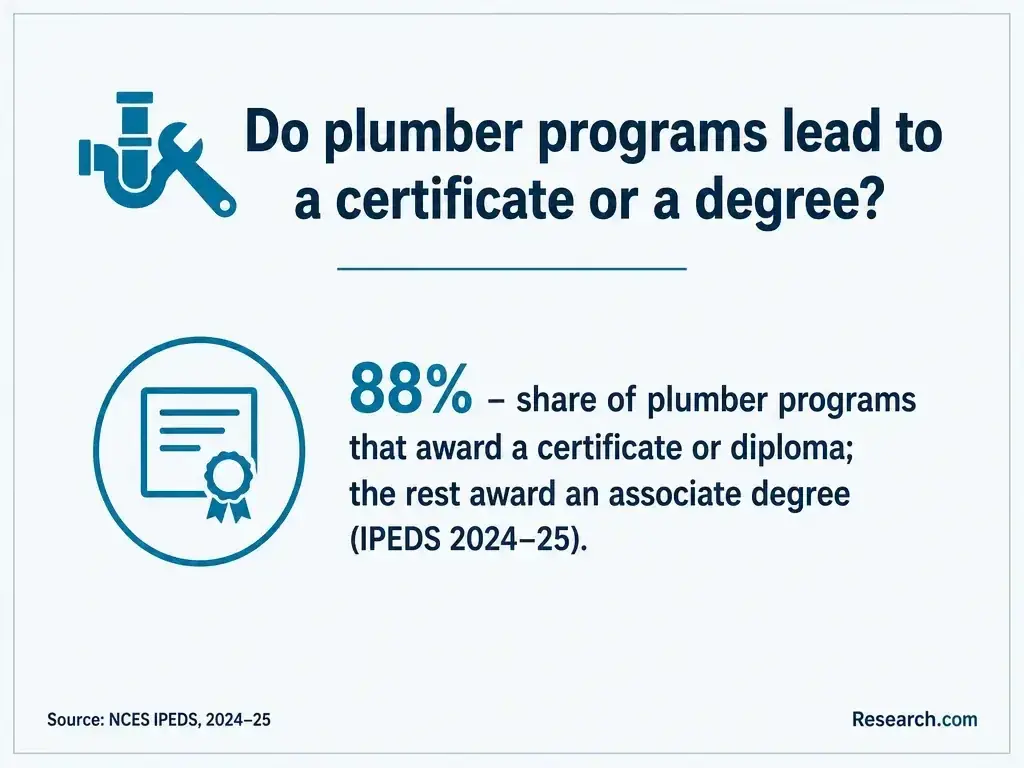
A school may award a completion certificate, diploma, or, where offered, an associate degree. A registered apprenticeship issues its own completion credential through its sponsor and registration system. An industry training certificate, such as one aligned with NCCER, can document specified skills but is not a South Dakota occupational license.
Ask for the exact credential name on the completion document and whether employers or apprenticeship sponsors recognize it for entry or advanced standing. Institutional accreditation concerns the school; state authorization concerns permission to operate; apprenticeship registration concerns a work-based training arrangement. None automatically replaces licensing requirements or guarantees that previously completed hours will count.
Requirements vary by school and sponsor. A provider may ask for an application, evidence of basic reading and math readiness, and the ability to attend scheduled shop sessions. An apprenticeship sponsor may additionally use an interview, skills assessment, employer selection process, or conditions tied to worksite safety. Obtain its current written requirements; do not assume admission to a school includes an apprentice job.
If you are exploring Sinte Gleska University, ask whether it currently offers a plumbing-specific program, where practical instruction occurs, and what credential it awards. Do not enroll in a general construction course without confirming that its content and any documented hours serve your plumbing goal.
Relevant instruction includes water distribution, drainage and venting, pipe materials and joining methods, fixture installation, blueprint reading, measurement, safety, and troubleshooting. Code instruction matters because installation must meet the rules applicable to the worksite. The U.S. Bureau of Labor Statistics identifies plan interpretation, system installation, and repair as core duties for plumbers, pipefitters, and steamfitters.
Look past a course title and inspect the lab plan. Ask what systems students assemble, whether they pressure-test and diagnose faults, who observes their work, and how much practice occurs before employer placement. A program emphasizing demonstrations but offering little individual tool time may be a poor substitute for supervised work.
Do not assume a trade-school certificate permits independent plumbing work. The South Dakota Plumbing Commission oversees state plumbing credentials, including apprentice registration and licensing for qualified practitioners. The appropriate route depends on the work you intend to perform and the experience, examination, and other requirements attached to the applicable credential; verify the current rules directly with the commission before choosing a program.
Mission is on the Rosebud Reservation. For work under tribal jurisdiction, ask the relevant tribal authority whether separate permissions or requirements apply, and ask the state commission when state licensing applies to your proposed work. Professional or industry certification may help demonstrate skills, but it is distinct from required occupational authorization. Keep records of supervised hours and employers from your first day.
Start with the job you want - residential service, construction plumbing, or another piping specialty - then compare programs and apprenticeships against that goal. An affordable course is a good investment only if you can finish it, afford the full route into work, and use its training toward the experience or credential you need.
Before committing, work through these checks with each provider or sponsor:
Red flags include vague answers about supervised practice, promises of automatic licensure, and a price quote that omits tools or travel. A ranking measures specified factors; it cannot decide whether your commute, schedule, or local employer access makes a route viable. Searches for a highest paying 4 year degree answer a different investment question: for plumbing entry, prioritize recognized practical training and the route to qualifying experience.
A common progression is supervised entry work, broader responsibility with documented experience, and - where the work requires it - the appropriate journeyman or contractor-level state credential. Workers may specialize in service repair, new construction, water systems, or related piping work. Moving into supervision or operating a business brings additional responsibilities and may involve different credential requirements; a beginner certificate alone does not confer those roles.
For Mission residents, the best first placement may matter more than the most specialized introductory course. Ask employers what work apprentices actually perform and whether that experience supports the specialty and jurisdiction in which you hope to work later.
The U.S. Bureau of Labor Statistics projects 6.8% employment growth nationwide from 2025 to 2035 for plumbers, pipefitters, and steamfitters combined. This indicates continued national demand, not a forecast of openings in Mission or a guarantee of an apprenticeship offer.
Because the local labor market is smaller than a major metro area, test demand before paying for training: contact prospective employers and apprenticeship sponsors about openings, worksite locations, and the type of plumbing work they expect. If local placements are limited, decide whether regular travel or relocation is acceptable before selecting an in-person program.
Investing in training is an important decision. Research.com built this ranking to help readers compare affordable options against other plumbing programs in the same location, using reported costs and debt rather than tuition alone. The team checks multiple education and occupational sources for credibility and accuracy; readers should still confirm current program details directly before enrolling.
Only programs with completions reported to the Integrated Postsecondary Education Data System (IPEDS) are eligible. The most affordable ranking scores tuition, cost of attendance, median student debt, and federal loan default rate, with weights assigned through an entropy-based method. Accreditation and other quality measures do not enter this affordability score. Consequently, an unranked apprenticeship may still be an excellent option, and a highly ranked program still requires a separate check of its practical training and licensing fit.
The ranking draws on the following data sources. Some cover occupations other than plumbing and should not be mistaken for plumbing-program approval:
IPEDS and College Scorecard do not capture every trade school, union program, or employer apprenticeship. Use the ranking as a cost-focused shortlist, not a complete directory or a judgment of training quality. More detail is available in the Research.com methodology.
# 1 position
# 2 position
Not necessarily. A registered apprenticeship or employer-supported route can combine instruction with supervised, paid work. Verify the applicable registration and licensing rules before choosing between routes.
It can reduce upfront costs because apprentices earn wages, but compare tools, transportation, related-instruction expenses, and the time needed to complete each route. Ask sponsors for their actual pay and cost schedule.
Online lessons can cover theory, but plumbing requires in-person tool use and supervised practical experience. Check where and how a hybrid provider supplies those components.
No. A school certificate documents training, while occupational licensing has separate requirements. Confirm the rules for your intended work with the South Dakota Plumbing Commission and, where applicable, the relevant tribal authority.
Ask for total costs, practical-training hours, lab and worksite locations, the exact credential, and evidence that the route supports apprentice entry or advancement. Get answers in writing before paying a deposit.