# 1 position


Audited and Verified:
Our Editorial and Data Verification Process
Research.com uses government datasets, official education statistics and primary institutional information to support its career and degree guides. Our review process checks factual accuracy, occupational definitions, source dates and the requirements associated with the credentials discussed.
How This Article Was Fact-Checked
Our editorial team verifies salary estimates, employment projections, education requirements and program information against original data providers and official organizations. Salary figures are checked against the relevant occupational definitions and reporting periods. Information about licensure, accreditation and required in-person training is reviewed separately.
Fact-checked and verified on:

Co-Founder and Chief Data Scientist

Reviewed by Karolina Broda
Fact-Checker and Data Verification
The cheapest plumbing program is not necessarily the least expensive route to a license: tools, travel, unpaid training time, and apprenticeship requirements can change the calculation. The Research.com team of data scientists created the Most Affordable Plumber Trade Schools in Saint Cloud for 2027 ranking to help students identify programs worth considering. Nationally, plumbers, pipefitters, and steamfitters had a $63,800 median annual wage in May 2025 (U.S. Bureau of Labor Statistics). This guide helps prospective students compare costs, hands-on training, credentials, and Minnesota licensing requirements before enrolling.
Expect instruction in plumbing systems alongside practice measuring, cutting, joining, installing, and testing pipe. A worthwhile program should give you supervised shop time, safety instruction, and a clear explanation of how graduates move into paid, supervised work. Ask St Cloud Technical and Community College which plumbing-related offerings are available for your intended start term, what credential each awards, and how much instruction takes place in a lab rather than a classroom.
Trade school and apprenticeship solve different problems. A school program can build foundational skills before you seek an employer. A registered apprenticeship combines paid work with related instruction and builds documented job experience over time (U.S. Department of Labor). If you already have access to a suitable supervised plumbing position, compare its training and wages with the cost of school rather than assuming you need both.
Plumbing training can lead toward work with contractors serving homes, commercial buildings, and construction projects, or toward building-maintenance roles that include plumbing tasks. The distinction matters: a maintenance job involving minor repairs is not necessarily a substitute for the supervised plumbing experience Minnesota requires for license progression. Before accepting a position, ask whether the employer can provide appropriately supervised work and documentation of your duties and hours (Minnesota Department of Labor and Industry).
Saint Cloud students should also consider the practical reach of a job search. A training site, employer, or worksite outside the city can add commuting costs, even when its advertised training price is lower.
The latest national figure supplied by the U.S. Bureau of Labor Statistics is a $63,800 median annual wage in May 2025 for plumbers, pipefitters, and steamfitters. It describes workers across experience levels and several related occupations - not new plumbing trainees in Saint Cloud. Do not use it as an expected first-year paycheck.
For a local decision, request the starting wage and scheduled increases from a prospective apprenticeship sponsor or employer. Compare those figures with the hours you can work while studying, commuting expense, and any school debt. A paid route may improve your finances during training even if it takes longer to complete.
There is no single duration: a short introductory credential, a longer diploma, and a registered apprenticeship have different end points. Finishing a school program means completing its curriculum; it does not mean completing Minnesota's supervised-experience requirements or becoming licensed. Registered apprenticeships combine on-the-job learning with related instruction, so compare their full training schedule - not just classroom hours - with a school calendar (U.S. Department of Labor; Minnesota Department of Labor and Industry).
Ask for the current program's credits or clock hours, lab hours, full-time and part-time schedules, and expected completion date. Then ask which hours, if any, an employer or Minnesota regulator will recognize toward your intended license. Get any claimed credit for prior experience or school training confirmed before enrolling.
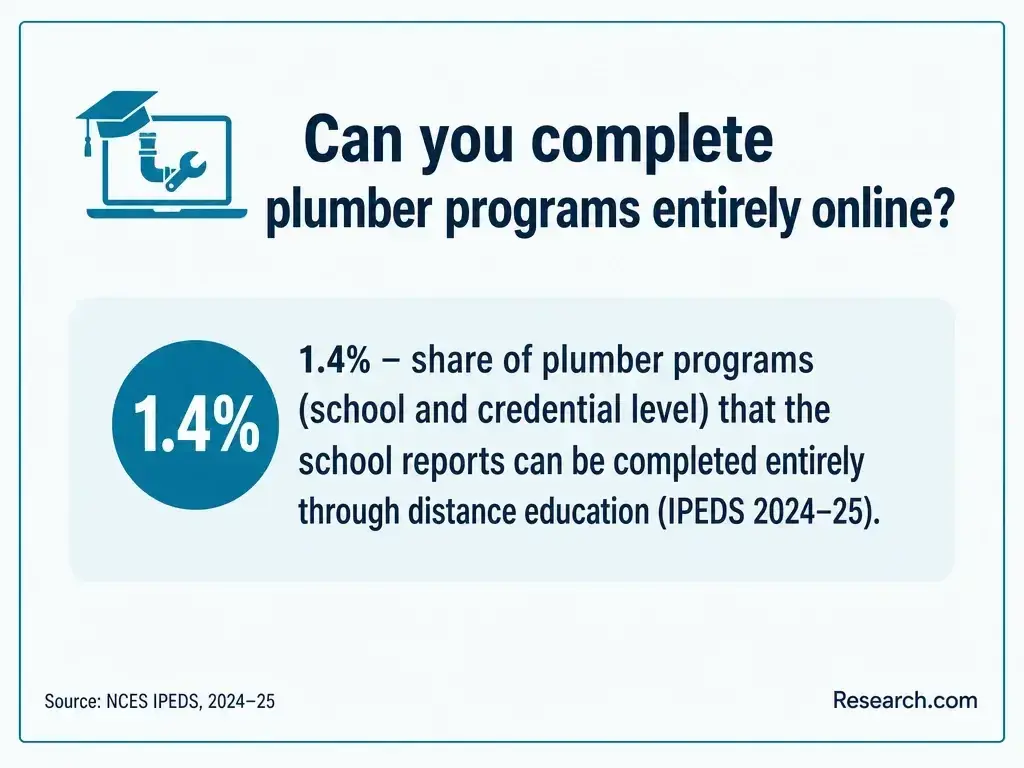
Online instruction can be useful for code reading, calculations, and introductory theory. It cannot by itself demonstrate that you can assemble, install, troubleshoot, and test plumbing systems safely. For that, compare access to an equipped shop, supervised practical assessment, and an employer worksite. A hybrid program makes sense only if its required in-person sessions and placements fit your schedule and travel budget.
Some online certificate programs that pay well train people for other occupations. Do not infer from an online credential's earnings potential that it provides the practical experience or regulatory eligibility needed for Minnesota plumbing work.
A defensible Saint Cloud program average cannot be stated without comparable, current published prices for the relevant offerings. Treat any advertised tuition figure as only one part of the cost to become job-ready. Request a written estimate for your start term and compare it with a paid apprenticeship offer on the same time horizon.
The following cost categories show what to include so a lower sticker price does not hide a more expensive training route.
| Cost or offset | What to confirm |
| School charges | Tuition, mandatory fees, books, materials, and any additional lab charges. |
| Practical preparation | Tools, safety gear, and transportation to labs or worksites. |
| Career entry | Applicable registration, examination, and license-related charges. |
| Time and funding | Lost work hours, apprentice wages, employer support, grants, and eligible aid. |
Ask the school's financial-aid office about eligibility rather than assuming every short program qualifies for federal aid. A longer paid apprenticeship may cost less out of pocket than a shorter unpaid course; completion likelihood, borrowing, and the timing of future earnings also affect the investment decision.
The award depends on the specific offering: it may be a certificate, diploma, or associate degree. A registered apprenticeship has a different structure and can lead to an apprenticeship completion credential. Compare the actual award and curriculum rather than treating similar-sounding program names as equivalent (U.S. Department of Labor).
An fast-track online associates degree is not a shortcut around plumbing practice or Minnesota licensing rules. If a school offers an academic credential, ask what hands-on work accompanies it and whether any training receives recognized credit toward your next occupational step.
School admission and entry into supervised plumbing work are separate decisions. Check the current offering's academic prerequisites, placement requirements, application dates, and equipment list directly with St Cloud Technical and Community College. An apprenticeship sponsor or employer may set additional selection and hiring conditions; acceptance to a school does not secure an apprenticeship position.
Before committing, ask who arranges a work placement, whether you must find your own employer, and what registration is required before performing plumbing work in Minnesota. The Minnesota Department of Labor and Industry is the authority for current state registration and licensing requirements - not a school's admissions decision.
A plumbing-focused curriculum should connect drawings and code concepts to hands-on installation: measuring and laying out runs, selecting materials, joining pipe, working with drainage and water-supply systems, testing, and diagnosing faults. Safety and clear communication matter because plumbers work around occupied buildings and alongside other trades (U.S. Bureau of Labor Statistics, Occupational Outlook Handbook).
Look past a course title and request a syllabus and shop schedule. If two programs award the same credential, the one with better-supervised practice in the tasks you want to perform may be more useful than one relying chiefly on video demonstrations. Ask whether the curriculum addresses Minnesota's applicable plumbing code and how instructors assess practical work.
Minnesota regulates plumbing work. A person entering the trade should verify the appropriate registration and supervision rules with the Minnesota Department of Labor and Industry before doing covered work. Progression toward a journeyworker license involves documented practical experience and an examination; completing a trade-school credential alone does not award that license (Minnesota Department of Labor and Industry).
Keep the distinctions clear: institutional accreditation concerns the school; apprenticeship registration concerns a training arrangement; an optional industry certificate documents particular training; and an occupational license authorizes work under state rules. Ask the regulator and prospective employer how your intended program, experience records, and examination plan fit together. Recheck current requirements before enrollment because they govern whether a program advances your specific goal.
Start with the role you want and work backward from Minnesota's requirements. A low-cost program is a good investment only if you can complete it, afford its full cost, develop practical competence, and reach suitable supervised work. Rankings help narrow a search; they cannot confirm an individual student's licensing pathway.
Use these checks when speaking with a program representative and a prospective apprenticeship sponsor:
A warning sign is a promise that an online course or school certificate alone makes you a licensed plumber. Ask for the regulator's applicable rule instead of relying on advertising. General resources about cheap online bachelor degree programs address a different education decision and should not replace this trade-specific comparison.
A plausible progression is foundational training, supervised entry-level work, documented experience, and - after meeting Minnesota's requirements - a journeyworker license. With further qualifying experience, some plumbers pursue advanced licensure, supervisory work, or contracting. Those later steps are not outcomes automatically awarded by an introductory program (Minnesota Department of Labor and Industry).
If your goal is building maintenance rather than licensed plumbing, ask employers how much plumbing work the role actually involves. If your goal is independent plumbing work, prioritize a route that leads to qualifying experience. Resources about online phd programs no dissertation concern an unrelated pathway and offer no substitute for supervised trade training.
The U.S. Bureau of Labor Statistics projects 6.8% national employment growth from 2025 to 2035 for plumbers, pipefitters, and steamfitters. This is a national projection for a combined occupational group, not a forecast of Saint Cloud apprenticeship vacancies. It supports investigating the trade, but it does not establish that a particular training program will lead to a local job.
Before enrolling, compare current area job postings with sponsor openings and ask which employers take on supervised entrants. That evidence is more useful for planning your first job than a national growth rate alone. Guides to 1 year phd programs online do not speak to this labor market or its licensing requirements.
Investing in training is an important decision, so Research.com designed this ranking to compare programs against other options for the same occupation and location. The most affordable ranking scores tuition, cost of attendance, median student debt, and federal loan default rate; weights are assigned using an entropy-based method. Unlike a best-programs ranking, its score does not include accreditation, student support, completion, or earnings. Readers should check those factors separately before choosing a program.
Only programs with completions reported to the Integrated Postsecondary Education Data System (IPEDS) are eligible. That makes the comparison useful for evaluating reported college programs, but it does not cover every apprenticeship, employer training route, or other provider. The team uses the following sources to check costs, outcomes, institutional information, and relevant occupational recognition:
The health and dental sources do not establish plumbing-program approval; they are part of a broader source set used across trade rankings. For this ranking, affordability is a starting point, not a finding that a program meets Minnesota's requirements for plumbing work. See Research.com's methodology for more information about how rankings are created.
# 1 position
# 2 position
Not necessarily. Supervised work and apprenticeship can provide an entry route. Check Minnesota Department of Labor and Industry requirements and ask a sponsor whether school training would improve your placement or count toward a later step.
Online coursework can cover theory, but plumbing competence requires supervised practical work. Confirm where labs and worksite training occur before enrolling.
No. A school credential and a Minnesota occupational license are different. Registration, documented experience, and an examination may apply to your intended stage of work (Minnesota Department of Labor and Industry).
Compare mandatory fees, tools, safety gear, travel, lost earnings, aid, and any wages earned while training. Also check whether you can realistically complete the program and move into qualifying supervised work.
It depends on your access to a sponsor, need for wages, readiness for work, and desired instruction. Compare the apprenticeship's paid work and classroom training with a school program's practical hours, costs, and connection to employers.