# 1 position


Audited and Verified:
Our Editorial and Data Verification Process
Research.com uses government datasets, official education statistics and primary institutional information to support its career and degree guides. Our review process checks factual accuracy, occupational definitions, source dates and the requirements associated with the credentials discussed.
How This Article Was Fact-Checked
Our editorial team verifies salary estimates, employment projections, education requirements and program information against original data providers and official organizations. Salary figures are checked against the relevant occupational definitions and reporting periods. Information about licensure, accreditation and required in-person training is reviewed separately.
Fact-checked and verified on:

Co-Founder and Chief Data Scientist

Reviewed by Karolina Broda
Fact-Checker and Data Verification
Choosing plumbing training near Mission, South Dakota, means weighing more than tuition: you need a way to develop hands-on skills and meet the rules that apply where you plan to work. The U.S. Bureau of Labor Statistics projects 6.8% national employment growth for plumbers, pipefitters, and steamfitters from 2025 to 2035. This guide compares school and apprenticeship routes, costs, credentials, and career prospects. It also accompanies the Best Plumber Trade Schools in Mission for 2027 ranking, created by the Research.com team of data scientists to help students make an informed choice about programs worth considering.
Expect instruction in piping systems, measurement, drawings, installation, troubleshooting, and jobsite safety - not just lectures. A useful program gives students supervised practice joining pipe, laying out systems, testing for leaks, and using tools safely. Ask for the current share of training conducted in a lab or on a worksite; a credential with little practical instruction may leave you needing substantial additional preparation before an employer will assign field tasks.
In and around Mission, compare the training site with the locations of potential employers. A nearby classroom can still be expensive to attend if required labs or work placements involve long drives across the Rosebud area. If considering Sinte Gleska University, verify that a plumbing-specific program is currently offered, where its practical instruction takes place, and what credential it awards; do not infer those details from an institution's presence in Mission.
A short school program may fit someone seeking basic skills before applying for an apprentice position. Someone who can secure supervised paid work immediately may prefer apprenticeship or employer-sponsored training, which integrates instruction with field experience. General lists of best online certificate programs that pay well cannot establish whether a plumbing course supplies the in-person competencies needed for the job.
Potential work settings include residential service businesses, construction contractors, building maintenance teams, and employers maintaining larger commercial systems. Plumbing and pipefitting overlap in the federal occupational data, but their day-to-day work and employer requirements can differ: a residential service goal calls for different exposure than a project focused on industrial pipe.
Mission's rural location makes worksite geography part of the training decision. Ask prospective employers whether entry-level work is available locally, whether travel to other communities is expected, and who supplies a vehicle or tools. Training can make an applicant more competitive, but it does not by itself secure an apprenticeship, job, or authority to perform regulated work independently.
The U.S. Bureau of Labor Statistics reports a May 2025 national median annual wage of $63,800 for plumbers, pipefitters, and steamfitters. That is a benchmark for an established, combined occupational group - not a published Mission wage or a prediction of a new trainee's pay. Apprentices generally earn less than experienced workers, and offers can differ by employer, duties, travel, and progression arrangements.
For a realistic local comparison, request the starting rate, scheduled increases, expected paid hours, benefits, and travel reimbursement from each prospective sponsor or employer. Compare those terms with the full cost and time of any school program. A higher eventual wage does not automatically justify tuition if a paid route would provide the same relevant experience sooner.
There is no single Mission-wide program length. A preparatory course may be shorter than the years of supervised work needed to progress in the trade; its completion date is not the date a student becomes an independently licensed plumber. The U.S. Bureau of Labor Statistics describes plumbing apprenticeships as typically lasting four or five years, with technical instruction alongside paid on-the-job training.
Apprenticeship.gov describes a common registered-apprenticeship model of roughly 2,000 hours of on-the-job learning and 144 hours of related instruction per year, although sponsor requirements vary. Ask a program for its exact clock hours, lab hours, calendar length, and schedule. Then ask the South Dakota Plumbing Commission and any prospective sponsor which training or experience will count toward the intended licensing step. A faster certificate is worthwhile only if it advances that plan.
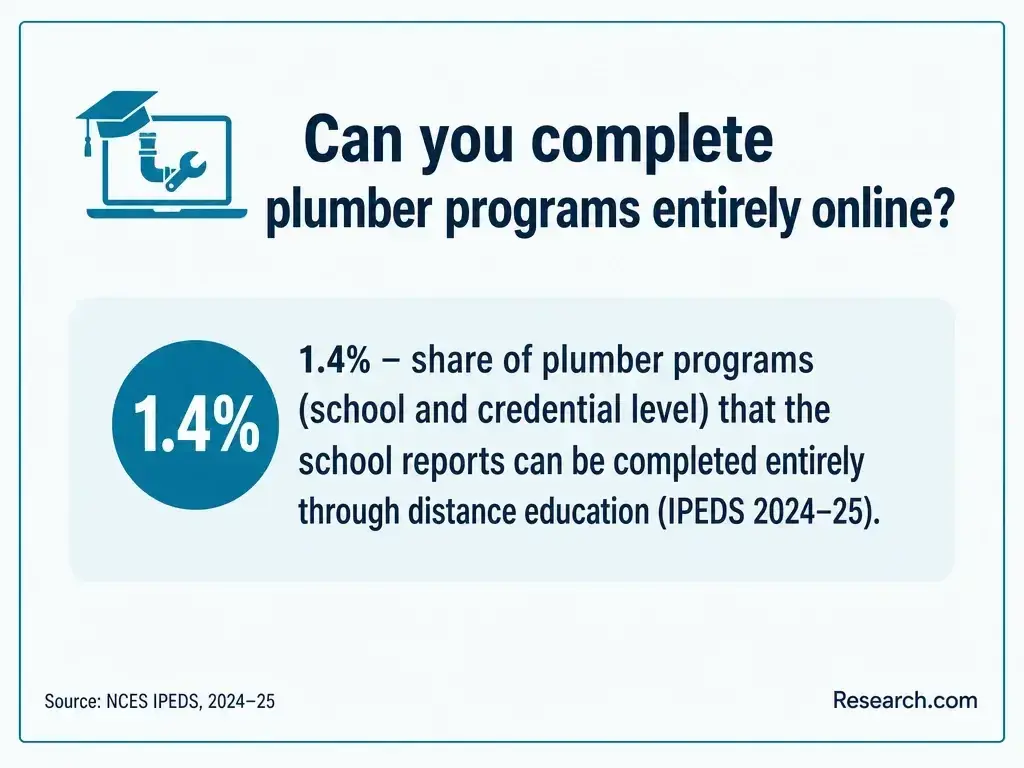
Online delivery can suit code reading, drawings, estimating, and some safety lessons. It cannot replace supervised practice with tools, materials, installation, testing, and worksite conditions. A hybrid program is credible only if it clearly identifies where and when those practical components occur - and whether a prospective employer or apprenticeship sponsor recognizes them.
The distinction matters especially when commuting from Mission: fewer classroom trips may help, but a remote course with distant mandatory labs may cost more in travel and time than a nearby in-person option. Broad guides to online certificate programs that pay well can help frame the format question, but they are not evidence that an online plumbing credential satisfies South Dakota experience or licensing requirements.
A reliable Mission-specific average is not available from the information needed to compare every school, short course, and apprenticeship on equal terms. Published tuition alone would also understate the cost of becoming job-ready. Request an itemized estimate for your actual schedule and worksite arrangements rather than applying a national average to a local decision.
The table separates expenses a student may pay from costs that a sponsor or employer might cover. Confirm each item in writing before comparing offers.
| Cost or offset | What to verify |
| School charges | Tuition, mandatory fees, books, materials, and any separate lab charges |
| Field readiness | Tools, protective equipment, work clothing, and required screening |
| Career entry | Apprenticeship registration, examination, or licensing application charges where applicable |
| Time and travel | Transportation to classes and worksites, plus earnings forgone while attending |
| Offsets | Paid apprentice hours, employer-provided equipment, scholarships, grants, or aid for which the program is eligible |
If a school awards an associate degree, how much it costs to get an associate's degree provides broader cost context, not a substitute for that school's plumbing-specific quote. Check federal aid eligibility with the institution and Federal Student Aid; registered apprenticeships may instead reduce upfront costs through wages and sponsor-paid instruction. Neither funding route is automatic.
Possible outcomes include a school certificate or diploma, an associate degree where offered, an industry training credential, or a registered-apprenticeship completion credential. These document different things. A school award records completion of its curriculum; apprenticeship completion reflects a sponsor's structured instruction and work-based learning. Neither should be described as a South Dakota occupational license.
Ask for the credential's exact name, issuing organization, transcript or completion record, and any evidence of employer recognition. If a student already has relevant experience, ask whether the school or sponsor offers assessed prior-learning credit or advanced standing; do not assume hours transfer. Lists of low cost accredited online colleges may describe institutional cost and accreditation, but those features alone do not establish plumbing field competence or licensing eligibility.
Requirements depend on the route. Schools set their own entry and placement policies; employers and apprenticeship sponsors may also assess math, reading, physical ability to perform job tasks, transportation, and readiness for worksite safety rules. A sponsor may have an application window or hiring process even when a classroom course has open enrollment. Obtain the current written criteria rather than assuming admission to one route grants entry to another.
Before applying, ask whether the program requires a diploma or equivalent, an assessment, tools, screening, or a sponsoring employer. Ask separately whether an apprenticeship position is arranged, merely supported, or entirely the student's responsibility. For someone in a rural service area, the ability to reach a worksite consistently may be as consequential as meeting academic entry requirements.
Strong introductory training connects calculations and drawings to physical installation. Students should encounter pipe sizing and layout, fixture and drainage concepts, water supply, materials and joining methods, leak testing, troubleshooting, and safe tool use. Codes and inspection practices matter because acceptable work is determined by the rules governing the actual jobsite, not by a course title alone. The U.S. Bureau of Labor Statistics describes installation, repair, blueprint reading, and code compliance as core work for the occupation.
Compare syllabi against the job you want. A residential service candidate needs meaningful troubleshooting and customer-facing practice; someone pursuing larger construction projects should ask about plan reading and coordinated work with other trades. Find out whether skills are demonstrated on functioning systems or assessed only through written assignments.
South Dakota regulates plumbing through its Plumbing Commission. The license or registration appropriate to a person's work and stage of training is distinct from a school certificate, industry credential, or registered-apprenticeship record. Experience, supervision, and examinations may be relevant to progression; finishing a course does not automatically confer permission to work independently. Confirm the current category and requirements directly with the South Dakota Plumbing Commission before paying for training.
Because Mission is within the Rosebud area, also check which state, tribal, and local rules apply to the specific worksites where you intend to train or take jobs. Do not assume rules are identical across jurisdictions or that experience will transfer without review. Institutional accreditation concerns a school; apprenticeship registration concerns a training arrangement; occupational licensure governs authorized practice. None substitutes automatically for the others.
Start with your intended first job and work backward. A school option is a sound investment when its practical training, credential, schedule, and total cost improve your route into supervised employment. A paid apprenticeship may be the better choice if it is accessible and provides the instruction you need without delaying work. Do not choose from a ranking alone.
Use these checks when speaking with a school, employer, or apprenticeship coordinator; each resolves a different risk before you commit.
For return on investment, consider completion probability, debt, starting pay, future pay progression, time in training, and how long it may take to recover costs - not institution type alone. An unrelated search for the best accelerated online bachelor's degree for working adults does not answer whether a route supplies the supervised plumbing experience your goal requires.
An entry route may lead to supervised residential installation or service work, followed by broader responsibilities as experience and any required licensing milestones are met. Other possibilities include commercial plumbing, pipefitting, maintenance, estimating, supervision, or eventually operating a business where applicable rules permit. These are potential progressions, not outcomes conferred by a certificate.
Choose training for the work you want next, not just the most advanced title advertised. For example, a program emphasizing new construction may be less useful to someone seeking repair work in dispersed rural communities. Ask prospective employers which competencies they expect of a new hire and which they teach on the job.
The U.S. Bureau of Labor Statistics projects 6.8% U.S. employment growth from 2025 to 2035 for plumbers, pipefitters, and steamfitters. That national projection indicates continuing demand across the combined occupation; it is not a forecast of openings in Mission or a promise that a local employer will hire after graduation.
A smaller local labor market can make a single employer's hiring needs, apprenticeship capacity, and travel expectations more important than the national growth rate. Before enrolling, contact potential sponsors about upcoming intake, the types of projects available, and whether work requires travel beyond Mission. Treat a program's placement claim as useful only when it specifies the plumbing cohort and the period measured.
Investing in training is a consequential decision, especially when a school credential alone may not provide the work experience needed for a plumbing license. Research.com created the accompanying ranking to help readers compare programs against other options in the same occupation and location. The team checks multiple education, outcomes, cost, and recognition sources rather than relying on a single school claim.
Best-program rankings assess student outcomes, earnings and return on investment, costs and debt, and quality and recognition. Programmatic accreditation or relevant industry recognition accounts for 20% of the score, institutional accreditation for 10%, and student support services for 10%. The remaining 60% covers outcomes, earnings, and costs, with weights distributed through an entropy-based method that gives more weight to indicators that vary more across programs. Most-affordable-program rankings instead score tuition, attendance cost, debt, and federal loan default rate using entropy-based weights; accreditation and other quality indicators are not part of that affordability score.
The ranking draws on the following data sources. Some recognition sources cover other trades or health occupations and should not be read as plumbing-specific approvals.
Only programs with completions reported to IPEDS are eligible for the ranking. An unranked apprenticeship, employer training route, or school program is not necessarily unavailable or poor quality; it may simply fall outside that dataset. Use the ranking to shortlist options, then confirm current plumbing instruction, costs, practical training, and licensing relevance directly. Research.com explains the scoring approach further on its methodology page.
# 1 position
# 2 position
Not necessarily. Supervised employer training or a registered apprenticeship may be an alternative. Confirm South Dakota's current requirements for the work and licensing stage you intend to pursue.
Some theory can be taught online, but tool use, installation, testing, and supervised field skills require in-person practice. Verify where a hybrid program provides it.
No. A school certificate and an occupational license are separate. Ask the South Dakota Plumbing Commission how training, experience, and examinations apply to your intended work.
Choose based on access to paid supervised work, the practical instruction offered, total cost, schedule, and licensing relevance. A short school course can prepare you to apply, while an apprenticeship combines paid work with structured instruction.
Ask for its current credential, lab and worksite locations, hands-on hours, itemized costs, employer connections, and evidence that its training fits your intended licensing and job pathway.