# 1 position
Nicolet Area Technical College - Plumbing Technology/Plumber.
certificate or diploma

Audited and Verified:
Our Editorial and Data Verification Process
Research.com uses government datasets, official education statistics and primary institutional information to support its career and degree guides. Our review process checks factual accuracy, occupational definitions, source dates and the requirements associated with the credentials discussed.
How This Article Was Fact-Checked
Our editorial team verifies salary estimates, employment projections, education requirements and program information against original data providers and official organizations. Salary figures are checked against the relevant occupational definitions and reporting periods. Information about licensure, accreditation and required in-person training is reviewed separately.
Fact-checked and verified on:

Co-Founder and Chief Data Scientist

Reviewed by Karolina Broda
Fact-Checker and Data Verification
The cheapest plumbing program is not necessarily the least expensive route to a Wisconsin plumbing license. Tuition is only part of the decision; paid work experience, tools, travel, and the time required for apprenticeship matter too. Nationally, employment of plumbers, pipefitters, and steamfitters is projected to grow 6.8% from 2025 to 2035 (U.S. Bureau of Labor Statistics). This guide helps prospective students and career changers compare those trade-offs. It also accompanies a Most Affordable Plumber Trade Schools in Wisconsin for 2027 ranking created by the Research.com team of data scientists to help students make an informed choice about programs worth considering.
Expect a choice between preparatory training and apprenticeship-related instruction. A stand-alone technical-college certificate or introductory course may teach tools, safety, and basic systems, but it does not replace the supervised work and examinations associated with Wisconsin plumbing licensure. A registered apprenticeship combines paid work under supervision with required related instruction; technical colleges may deliver that classroom portion (Wisconsin Department of Workforce Development; Wisconsin Department of Safety and Professional Services).
Public technical colleges, union-affiliated sponsors, and employers can therefore play different roles in the same pathway. Before enrolling, ask whether the offering is an apprenticeship's required instruction, preparation for applying to one, or a separate credential. Listings of top accredited online trade schools may help identify flexible coursework, but cannot establish that plumbing labs or supervised job experience can be completed remotely.
Plumbing training can lead toward residential service, commercial construction, building maintenance, or work on larger institutional and industrial projects. A new trainee's available tasks depend on supervision and Wisconsin credential rules, not simply the name of a school award (Wisconsin Department of Safety and Professional Services; U.S. Bureau of Labor Statistics).
Location affects access to work-based training. Students near larger construction markets may have more sponsors to contact, while a rural student should calculate travel to both the jobsite and required instruction. Ask sponsors where apprentices are assigned and how often that location changes before accepting an offer.
A current, comparable Wisconsin-specific wage figure is needed to estimate local pay accurately; the national figure should not be relabeled as a state wage. The U.S. Bureau of Labor Statistics reports a May 2025 national median of $63,800 for plumbers, pipefitters, and steamfitters combined. That figure includes experienced workers and related occupations, so it is not a likely first-year apprentice wage.
For a decision about a Wisconsin offer, request the sponsor's apprentice wage progression, expected paid hours, benefits, and any travel or tool obligations. Compare that schedule with what you earn now. An apprenticeship can offset training costs through wages, but the value depends on hours worked and whether the pay fits your household budget.
Length depends on the credential. An introductory course can be much shorter than a registered apprenticeship, but completing the course does not shorten Wisconsin's licensure pathway automatically. The state's plumbing apprenticeship is typically a five-year combination of supervised work and related instruction; confirm the current required hours, schedule, and any credit for prior experience with the Wisconsin Department of Workforce Development and your prospective sponsor.
An accelerated classroom schedule is useful only if it still fits the required practical training. Resources on best accelerated online degrees for working adults address a different type of study: plumbing entrants should compare time to paid apprenticeship placement and eventual license eligibility, not just time to finish classes.
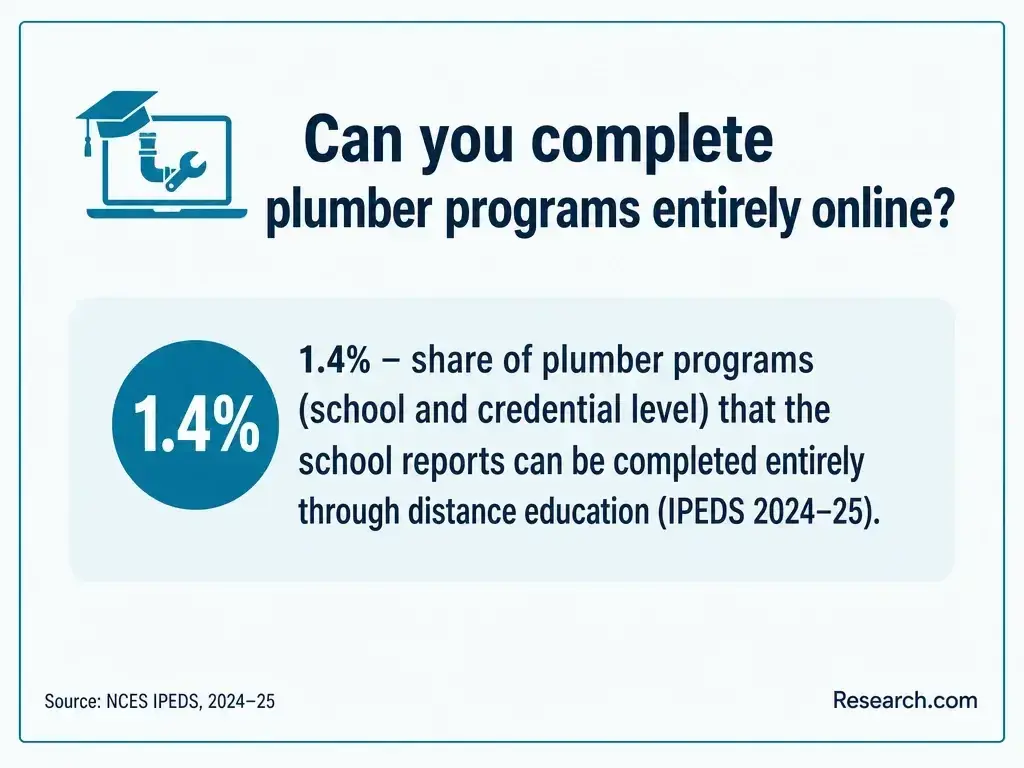
Online delivery can work for some theory, calculations, and code-reading instruction. Pipe assembly, tool use, testing, troubleshooting, and supervised installation require physical practice. A hybrid offering is worthwhile for a working apprentice only when its in-person sessions and job-based training are accessible and accepted by the apprenticeship sponsor (Wisconsin Department of Workforce Development).
Ask where practical assessments happen, who supervises them, and whether the sponsor accepts remote coursework toward related instruction. Unlike the flexible academic formats discussed in guides to the one year online doctoral programs, an online-only plumbing course should never be assumed to satisfy Wisconsin occupational requirements.
There is no single defensible statewide average for all Wisconsin plumbing routes: technical-college offerings, sponsor-paid instruction, and employer-supported apprenticeships have different cost structures, and college datasets do not cover every sponsor. Ask each provider for a written estimate of total cost to become job-ready, not just tuition.
Use the same cost checklist for each option so a low tuition quote does not hide a more expensive commute or required equipment.
Check aid eligibility with the institution and potential workforce funding with Wisconsin's workforce agency; eligibility is not automatic. When comparing return on investment, account for completion probability, debt, current earnings, expected pay progression, and how long it takes to reach independent work - not just the first year's price.
The answer depends on the offering. A stand-alone course may award a certificate of completion; a registered apprenticeship leads to an apprenticeship completion credential after its required work and instruction. Neither should be confused with a Wisconsin occupational license, which has separate state requirements (Wisconsin Department of Workforce Development; Wisconsin Department of Safety and Professional Services).
Short credentials - including some certs that pay well in other fields - can be useful for learning specific skills. In plumbing, verify whether an employer or apprenticeship sponsor recognizes the credential and whether it advances your intended licensing path before paying for it.
A school's admission rules and an apprenticeship sponsor's hiring rules are separate. A preparatory course may have its own basic entry or placement requirements; a sponsor may also assess math, availability for work, transportation, and readiness for physical jobsite tasks. Requirements and selection processes vary, so obtain the current criteria directly from each provider or sponsor.
For registered apprenticeships, check the Wisconsin Department of Workforce Development's current process and the sponsor's stated qualifications. Do not pay for a prerequisite course on the assumption that it guarantees an apprenticeship place. Ask whether the course is required, merely recommended, or unnecessary for that sponsor.
Relevant instruction covers plumbing codes, blueprint reading, measurements, piping materials, installation, drainage, water distribution, safety, and diagnosis of system problems. Apprentices develop these skills further through supervised work; classroom knowledge alone cannot demonstrate competent installation in occupied buildings or on construction sites (U.S. Bureau of Labor Statistics; Wisconsin Department of Workforce Development).
Compare syllabi and practical assessments rather than assuming similarly named programs teach equivalent skills. If considering an associate-degree route, the quickest way to get an associate's degree is not necessarily the quickest way into licensed plumbing work. Ask whether any coursework receives apprenticeship credit and get the sponsor's answer before enrolling.
Wisconsin regulates plumbing work. The Department of Safety and Professional Services administers plumbing credentials, including apprentice and journeyman pathways; the Department of Workforce Development oversees registered apprenticeship. A school completion certificate, institutional accreditation, apprenticeship registration, and a journeyman license serve different purposes. None automatically substitutes for the others (Wisconsin Department of Safety and Professional Services; Wisconsin Department of Workforce Development).
Before committing to training, confirm which credential permits your intended tasks, how to register or work under supervision, and the current apprenticeship, experience, and examination requirements for advancement. If you may work outside Wisconsin later, verify that state's rules separately rather than assuming a Wisconsin credential transfers.
Start with the intended outcome: paid entry into a registered apprenticeship, preparation for applying, or instruction required by an existing sponsor. Then compare programs against the same job-ready standard. The most-affordable ranking is a useful cost shortlist, but it does not score licensure eligibility or guarantee an apprenticeship placement.
Ask each school and sponsor the following questions before you pay a deposit:
Check institutional accreditation or school authorization separately from apprenticeship registration and state licensing requirements. A warning sign is a provider that advertises a quick certificate as a license, cannot explain its hands-on training, or will not give a complete cost estimate.
A practical progression is supervised apprentice work, completion of required training, and pursuit of the applicable journeyman credential. With experience and any further state-required qualifications, a worker may seek advanced licensing, supervision, specialized service work, or business ownership (Wisconsin Department of Safety and Professional Services; Wisconsin Department of Workforce Development).
Choose early training for the work you want to do. Residential service emphasizes diagnosis and customer communication; construction work places greater weight on plans, coordination, and installation schedules. Ask prospective sponsors what work apprentices actually perform, since the credential name alone does not reveal how much exposure you will get to either setting.
The U.S. Bureau of Labor Statistics projects 6.8% national employment growth from 2025 to 2035 for plumbers, pipefitters, and steamfitters combined. That is a broad occupational projection, not a forecast of Wisconsin apprenticeship vacancies or guaranteed work for graduates.
For a local decision, compare current registered sponsors and employer openings within commuting distance, including where related instruction is held. A promising national outlook does little to reduce the cost of training if the available apprenticeship requires travel you cannot sustain.
Investing in training is an important decision. Research.com's most-affordable ranking is designed to help readers compare reported costs among programs in the same occupation and location, rather than assume that a low advertised tuition makes a program affordable overall. The team checks multiple education and training sources to improve the ranking's credibility and accuracy.
Only programs with completions reported to IPEDS are eligible. Most-affordable rankings score tuition, cost of attendance, median student debt, and federal loan default rate; an entropy-based method gives more weight to measures that vary more across eligible programs. Accreditation, recognition, and student outcomes are not part of this affordability score. That differs from Research.com's best-program rankings, which also consider outcomes, earnings, support, accreditation, and relevant industry recognition.
The following sources inform the ranking process. Some cover other trades or healthcare occupations; their inclusion as sources does not make those fields' credentials relevant to plumbing.
IPEDS does not capture every union, employer-sponsored, or other apprenticeship option. Use the ranking to shortlist reported programs, then compare their complete costs and their fit with Wisconsin's apprenticeship and licensing rules. More detail is available on Research.com's methodology page.
# 1 position
# 2 position

# 3 position

# 4 position
# 5 position
Plumbing Technology/Plumber
Delivery mode: On Campus (May Include Online Courses)
81.21
/ 100
Final score
Accreditation
Institutional accreditation from Higher Learning Commission.
Western Technical College earned a Research.com Affordability Score of 81.21/100, with 10% federal loan default rate among the verified supporting factors.
# 6 position
# 7 position
# 8 position

# 9 position
# 10 position
# 11 position

Not necessarily as a separate, upfront program. A registered apprenticeship combines supervised paid work with related instruction, which a technical college may provide. Check the Wisconsin Department of Workforce Development and your prospective sponsor's current entry rules.
No online-only course should be assumed to meet the practical experience and other requirements for Wisconsin plumbing licensure. Confirm accepted instruction and supervised-work requirements with the Wisconsin Department of Safety and Professional Services and your sponsor.
No. A school certificate records completion of that school's program. Wisconsin occupational licensing has separate requirements administered by the Department of Safety and Professional Services.
It may reduce out-of-pocket costs and provide wages while you train, but compare tools, transportation, instruction costs, and the sponsor's pay schedule. A stand-alone course may still be useful if a sponsor recommends it or it addresses an entry-skill gap.
Get written confirmation of total cost, in-person practice, the credential awarded, and whether a Wisconsin apprenticeship sponsor accepts the training. Do not rely on a ranking or an accreditation claim alone to establish license eligibility.