# 1 position
NUC University - Plumbing Technology/Plumber.
certificate or diploma

Audited and Verified:
Our Editorial and Data Verification Process
Research.com uses government datasets, official education statistics and primary institutional information to support its career and degree guides. Our review process checks factual accuracy, occupational definitions, source dates and the requirements associated with the credentials discussed.
How This Article Was Fact-Checked
Our editorial team verifies salary estimates, employment projections, education requirements and program information against original data providers and official organizations. Salary figures are checked against the relevant occupational definitions and reporting periods. Information about licensure, accreditation and required in-person training is reviewed separately.
Fact-checked and verified on:

Co-Founder and Chief Data Scientist

Reviewed by Karolina Broda
Fact-Checker and Data Verification
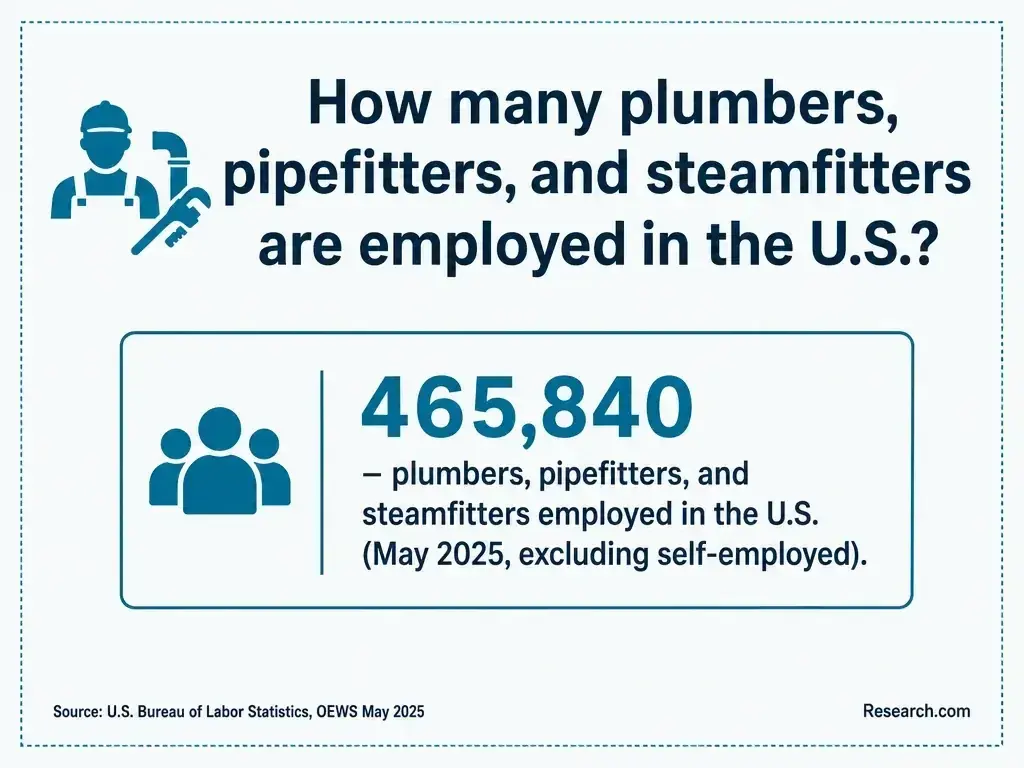
Choosing plumbing training in Puerto Rico means looking beyond a school's name: will its labs, work experience, and credential help you enter the trade? The U.S. Bureau of Labor Statistics reports a May 2025 national median wage of $63,800 for plumbers, pipefitters, and steamfitters, but that is not a starting-pay estimate for Puerto Rico. The Research.com team of data scientists created the Best Plumber Trade Schools in Puerto Rico for 2027 ranking to help students identify programs worth considering. This guide helps you compare routes, costs, and licensing questions before enrolling.
Expect instruction in water supply, drainage, fixtures, piping materials, plan reading, measurement, and safe tool use, followed by practice assembling and testing systems. A useful program lets you perform those tasks in a lab or supervised work setting - not just watch demonstrations. Ask how many contact hours involve hands-on work and whether students practice diagnosing leaks and correcting faulty installations.
Routes serve different goals. A certificate or diploma can suit someone seeking quicker entry to supervised work; an associate degree may add broader technical coursework but takes longer. A registered apprenticeship generally combines related instruction with paid on-the-job training and may better suit someone who can secure a sponsor. Employer training or a direct-entry helper position can also be sensible when a worker can obtain genuine supervision and a documented path forward. According to the U.S. Bureau of Labor Statistics, apprenticeships commonly take four or five years, though a particular Puerto Rico sponsor's terms must be checked directly.
Unlike an accelerated online bachelor's program, plumbing training cannot be judged by coursework speed alone: physical practice and supervised job experience are central to readiness. Ask any provider which tasks graduates can safely perform, what credential they receive, and what experience they still need.
Potential settings include residential service companies, commercial construction contractors, facilities-maintenance teams, and contractors working on water, drainage, or building renovations. The work differs: service calls emphasize troubleshooting in occupied buildings; construction emphasizes layout and installation alongside other trades; facilities jobs may combine plumbing with general maintenance. These are occupational settings described by the U.S. Bureau of Labor Statistics, not promises that a particular employer has vacancies.
Location affects the training decision. A student who must travel to a lab and then to changing worksites should price both commutes, not just the trip to school. Before enrolling, ask where practical sessions and employer placements actually occur and whether the program has accessible opportunities near where you can work.
There is no reliable Puerto Rico starting-wage figure that can be inferred from a national median. The U.S. Bureau of Labor Statistics reports $63,800 as the May 2025 U.S. median annual wage for the combined occupation of plumbers, pipefitters, and steamfitters. It covers experienced workers and related trades as well as plumbers; it is neither a local wage nor a prediction for a new graduate.
For a realistic return-on-investment estimate, request wages from prospective local employers or apprenticeship sponsors and check the latest Puerto Rico occupational figures in the U.S. Bureau of Labor Statistics Occupational Employment and Wage Statistics. Compare an attainable entry wage with what you earn now, then account for training time, debt, paid work during training, and the possibility that you may not complete the program.
There is no single duration for a Puerto Rico plumbing program. Certificates and diplomas vary by provider and schedule; an associate degree generally requires a longer commitment. Registered apprenticeships commonly run four or five years nationally and combine instruction with supervised work, according to the U.S. Bureau of Labor Statistics. Do not treat those typical apprenticeship durations as a Puerto Rico licensing-hour rule.
Ask for the written calendar and a breakdown of classroom, lab, and worksite hours. A shorter schedule can reduce time away from paid work, but it is a poor bargain if it leaves you without enough practical experience for an employer's entry role or without experience required for your intended licensing path.
Online coursework may be practical for terminology, calculations, drawings, and safety theory. Cutting and joining pipe, installing fixtures, testing systems, and troubleshooting physical faults require in-person equipment and feedback. A hybrid program can work if its required lab and field sessions are accessible; a fully online course should not be assumed to provide occupational or licensing eligibility.
Before paying for a remote course, get the lab location, required attendance dates, equipment access, and supervised-work arrangements in writing. Searches for open admission universities may identify flexible entry policies, but open admission says nothing about whether plumbing students receive adequate hands-on training.
A defensible Puerto Rico-wide average is not available here: providers package programs differently, and an apprenticeship's paid training does not have the same cost structure as school enrollment. Request an itemized, current quote from each provider rather than relying on an advertised tuition figure. This comparison shows what belongs in a job-ready budget.
| Cost or offset | What to confirm |
| School charges | Tuition, mandatory fees, books, materials, and any repeated-course charges |
| Practical training | Tools, safety gear, uniforms, and travel to labs or worksites |
| Career entry | Applicable examination, application, and licensing fees |
| Financial offsets | Eligible aid, workforce funding, scholarships, employer support, or apprenticeship wages |
| Time cost | Income forgone or reduced while attending classes and practical sessions |
Ask the school whether its specific program qualifies for federal student aid; institutional accreditation alone does not establish a particular student's eligibility. Options described as inexpensive online colleges that accept financial aid are not automatically cheaper routes into plumbing once required in-person training is included. Compare the net amount you would pay and borrow, not tuition alone.
The award depends on the route: a school may grant a certificate, diploma, or associate degree; a registered apprenticeship provides a completion credential under its registered training arrangement. Industry credentials, such as those associated with NCCER training, can document particular skills if the provider actually offers them. Ask to see the exact credential name and its requirements before enrolling.
These distinctions matter because a school award, institutional accreditation, state authorization to operate, apprenticeship registration, industry certification, and an occupational license answer different questions. None automatically substitutes for the others. Ask employers whether they recognize the credential and Puerto Rico's plumbing licensing authority whether the training and documented experience fit the license you eventually intend to seek.
Requirements vary by provider and route. A school may ask for evidence of prior schooling, an application, and placement information; an apprenticeship sponsor or employer may assess availability for work, practical aptitude, and its own hiring requirements. Confirm prerequisites directly rather than assuming that admission to a school also means acceptance into an apprenticeship or job placement.
Working applicants should ask whether prior construction experience earns documented advanced standing and whether school coursework can count toward a particular apprenticeship's instruction. Get any credit decision in writing before comparing program lengths or costs; an employer or sponsor need not recognize credits merely because a school awards them.
Core skills include reading plans, measuring and cutting materials, assembling supply and drainage lines, installing fixtures, testing for leaks, diagnosing failures, and working safely around tools and occupied buildings. The U.S. Bureau of Labor Statistics identifies installation, maintenance, and repair as central plumbing duties. For local employability, look for practice that matches the service or construction work you want - not merely a course title labeled "plumbing."
Ask to inspect the lab and course outline. The strongest evidence of practical preparation is a clear account of what each student builds, tests, repairs, and documents, plus how an instructor evaluates that work. If a provider cannot explain the practical component, compare a supervised apprenticeship or employer training opportunity instead.
Puerto Rico regulates plumbing through its plumbing examining board and Department of State. The license category and permitted duties matter: enrolling in training, working under supervision, and independently offering regulated plumbing services are not the same activity. Verify current categories, eligibility, experience, examination, and application rules with the Junta Examinadora de Plomeros de Puerto Rico and Puerto Rico Department of State before relying on a school's licensing claims.
Ask the provider precisely which requirement its instruction addresses and how supervised experience is documented. An industry certificate may help demonstrate skills, but it is not a Puerto Rico occupational license; institutional accreditation or state school authorization does not grant one either. If you expect to work outside Puerto Rico, check that jurisdiction's separate rules rather than assuming your training or license transfers.
Start with your intended job: supervised helper, service technician, apprentice, or eventual independent practitioner. Then compare a school program with available paid apprenticeships or employer training on practical access, total cost, schedule, and the steps still required after completion. A ranking is a shortlist, not proof that a program fits your commute or licensing goal.
Use these questions with each school, sponsor, or employer; written answers make similarly named programs easier to compare.
Red flags include an online-only route marketed as sufficient for hands-on work, guaranteed wages, or a claim that accreditation itself grants licensure. Searches such as phd no dissertation concern a different kind of credential; for plumbing, prioritize demonstrated practical skill and verified occupational eligibility.
An entry route may lead to supervised installation or service work, followed by more complex troubleshooting, specialized piping, crew leadership, or business ownership. Progression depends on experience, employer opportunities, and any license required for the work - not simply on collecting additional school certificates. The U.S. Bureau of Labor Statistics describes apprentices and experienced plumbers performing increasingly responsible installation and repair duties.
Service work can involve substantial independent problem-solving, but it also means speaking with customers, coordinating with coworkers, and explaining repairs. Someone exploring best careers introverts should consider the actual work setting rather than assume plumbing is either solitary or constantly customer-facing.
The U.S. Bureau of Labor Statistics projects 6.8% U.S. employment growth for plumbers, pipefitters, and steamfitters over 2025-2035. That is a national projection for a combined occupation, not a Puerto Rico forecast or a placement rate. It suggests continuing demand nationally, but local hiring can differ by employer, project pipeline, and location.
Before committing to training, ask nearby contractors and apprenticeship sponsors whether they currently take beginners and what skills they expect. Compare those answers with the latest Puerto Rico labor-market information from official workforce sources. A program is a stronger investment when its practical training matches openings you can realistically reach.
Education is a consequential investment, so Research.com evaluates plumbing programs against other programs in the same occupation and location rather than treating every trade-school option as interchangeable. The ranking includes only programs with completions reported to IPEDS. That makes the comparison more consistent, but it also means a registered apprenticeship or employer training program may be a worthwhile option without appearing in the ranking.
Best-program scores consider student outcomes; earnings and return on investment; costs and debt; and quality and recognition. Relevant programmatic accreditation or industry recognition accounts for 20% of the score, institutional accreditation for 10%, and student support for 10%. The remaining 60% covers outcomes, earnings, and costs, with weights distributed using an entropy-based method that gives more weight to indicators that vary more across programs. Earnings measures include median earnings one year after completion and earnings relative to annual cost; cost measures include tuition, attendance cost, debt - including debt held by students who withdrew - and federal loan default rates. Full-time and part-time retention and completion are considered. Where a measure is available only at the institution level, readers should not mistake it for a plumbing-program outcome.
Research.com checks the following sources for education data, recognition, and occupation-specific relevance. Some listed health-care credential sources help screen other trade rankings; they do not establish plumbing qualifications.
Most-affordable-program rankings use only tuition, attendance cost, median debt, and federal loan default rate, with entropy-based weights; accreditation and other quality measures are not part of that score. The ranking can narrow a search, but readers should still confirm current program details and licensing eligibility directly. More information about the approach appears on Research.com's methodology page.
# 1 position
# 2 position
Plumbing Technology/Plumber
Delivery mode: On Campus (May Include Online Courses)
16.24
/ 100
Final score
Accreditation
Institutional accreditation from Accrediting Commission of Career Schools and Colleges.
Professional Technical Institution received a Research.com Trade Program Score of 16.24/100.
It can be if its practical training and credential help you reach an attainable job at a manageable total cost. Compare it with paid apprenticeship and employer-training options, including the income you may give up while studying.
Online lessons can cover theory, but pipe installation, testing, and repair require in-person practice. Do not assume an online course satisfies Puerto Rico licensing requirements.
No. A school certificate documents completion of training. Check the Puerto Rico plumbing examining board's current requirements for the license and duties you intend to pursue.
Choose based on access and fit. School may offer a defined classroom-and-lab schedule; a registered apprenticeship combines instruction with paid supervised work but requires a sponsor and typically takes longer.
Get the credential name, practical-training schedule, itemized total cost, refund terms, and any licensing-eligibility claims in writing. Verify regulatory claims with the relevant Puerto Rico authority.