# 1 position


Audited and Verified:
Our Editorial and Data Verification Process
Research.com uses government datasets, official education statistics and primary institutional information to support its career and degree guides. Our review process checks factual accuracy, occupational definitions, source dates and the requirements associated with the credentials discussed.
How This Article Was Fact-Checked
Our editorial team verifies salary estimates, employment projections, education requirements and program information against original data providers and official organizations. Salary figures are checked against the relevant occupational definitions and reporting periods. Information about licensure, accreditation and required in-person training is reviewed separately.
Fact-checked and verified on:

Co-Founder and Chief Data Scientist

Reviewed by Karolina Broda
Fact-Checker and Data Verification
Choosing plumbing training in Cleveland means deciding whether to pay for a school program, seek a paid apprenticeship, or combine the two. The U.S. Bureau of Labor Statistics (BLS) projects 6.8% national growth for plumbers, pipefitters, and steamfitters from 2025 to 2035 - but training routes differ substantially. The Best Plumber Trade Schools in Cleveland for 2027 ranking, created by the Research.com team of data scientists, will help students identify programs worth considering. This guide explains how to compare costs, hands-on experience, credentials, and Ohio licensing rules before committing.
Expect instruction in reading plans, measuring and joining pipe, water supply and drainage systems, fixtures, safety, and code interpretation, followed by supervised work with tools. A useful program lets students practice diagnosing leaks and installing assemblies - not merely watch demonstrations. Ask how many scheduled hours take place in a lab and whether the school arranges a worksite placement; a certificate with limited practical work is not equivalent to an apprenticeship.
Cleveland applicants can compare college or career-school training with registered apprenticeships, including opportunities associated with the area's plumbing trade unions and employers. A school program may suit someone who needs foundational skills before applying to employers. An apprenticeship may suit someone ready for a longer selection and training process who wants wages while learning. Neither route automatically confers an Ohio commercial contractor license (U.S. Department of Labor, Apprenticeship.gov; Ohio Department of Commerce).
Plumbing skills are used by residential service companies, commercial construction contractors, building-maintenance teams, and employers maintaining institutional or industrial facilities. The work varies: a service technician may troubleshoot occupied buildings, while a construction apprentice may install systems from plans alongside other trades. Pipefitting and steamfitting are related occupations, but a plumbing-focused course should not be assumed to prepare someone equally for every type of process piping (BLS, Occupational Outlook Handbook).
That distinction matters in Cleveland's mix of older buildings, new construction, and large facilities: ask where a provider's recent trainees actually completed fieldwork. If the goal is commercial construction, prioritize experience on jobsites and with the relevant code; if it is residential service, look for supervised troubleshooting and customer-facing work.
BLS reports a $63,800 national median annual wage in May 2025 for plumbers, pipefitters, and steamfitters combined. That figure describes workers across experience levels and specialties; it is neither a Cleveland-only estimate nor a likely first-year apprentice wage. Compare Cleveland-area wage postings or current apprenticeship wage schedules for the specific job you want before estimating your return on training (BLS, Occupational Outlook Handbook).
For an investment decision, compare expected earnings after training with what you could earn without it, then account for training length, paid work, fees, possible debt, completion risk, and how long you expect to remain in the trade. Broader trade school jobs salary comparisons can provide context, but they should not substitute for local apprentice and employer pay information.
There is no single Cleveland-wide program length. A short pre-apprenticeship or certificate may concentrate on entry skills; an associate degree includes additional coursework; and a registered apprenticeship usually spans several years of related instruction and supervised paid work. The U.S. Department of Labor describes a common apprenticeship structure as approximately 2,000 hours of on-the-job learning and 144 hours of related instruction per year, although an individual program's standards govern its actual requirements (Apprenticeship.gov).
Request the provider's current schedule in clock or credit hours and separate classroom, lab, and employer-worksite hours. A faster certificate can get you to job applications sooner, but it does not erase the work experience needed for more independent roles or Ohio commercial contractor licensure.
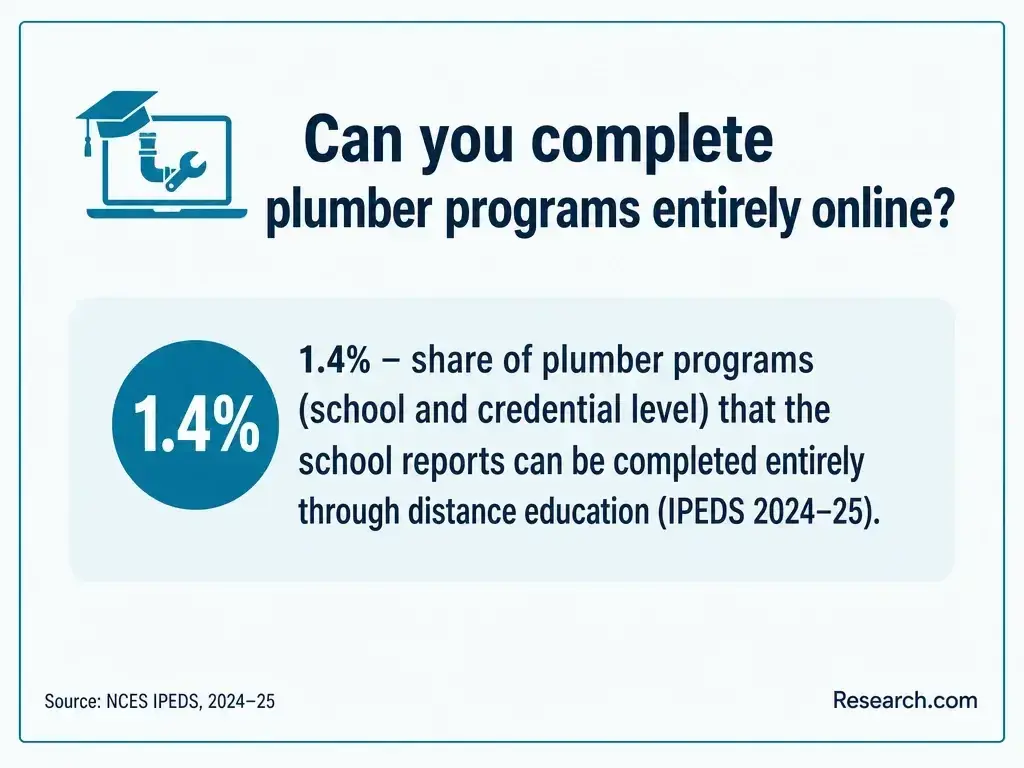
Online delivery can work for terminology, plan reading, math, and some code study. Pipe preparation, joining methods, pressure testing, fixture installation, and safe tool use require supervised practice with equipment. A hybrid program can be worthwhile if its in-person lab schedule is accessible and its practical assessment is substantial; an online-only course should be treated as introductory study, not a substitute for worksite experience (BLS, Occupational Outlook Handbook).
Before enrolling, ask where and when hands-on sessions occur, who evaluates them, and whether the program connects students to apprenticeships or employers. For someone commuting across greater Cleveland, required lab and jobsite travel can determine whether a seemingly convenient online option is workable.
A reliable Cleveland-wide average for all plumbing training routes is not available: college datasets do not fully capture union, employer-sponsored, and other apprenticeships. Use an individual provider's written, current cost estimate instead of treating advertised tuition as the price of becoming job-ready. An apprenticeship can reduce upfront school expense and pay wages during training, though applicants should still check dues, tools, transportation, and any required purchases (IPEDS; U.S. Department of Labor, Apprenticeship.gov).
Compare these cost categories for each offer so that a lower advertised price does not conceal a larger overall commitment.
| Cost or offset | What to verify |
| Instruction and supplies | Tuition, mandatory fees, books, materials, and consumables |
| Job-readiness expenses | Tools, PPE, transportation to labs and worksites, and any required checks |
| Later requirements | Any applicable examination, application, or licensing costs |
| Offsets and time | Grants, eligible student aid, employer-paid training, apprentice wages, and earnings forgone while studying |
Ask whether a particular program qualifies for federal student aid rather than assuming every trade course does; eligibility depends on the institution, program, and student (Federal Student Aid). OhioMeansJobs Cleveland-Cuyahoga County can also help applicants investigate whether workforce-training assistance is available for an eligible program. Compare net cost alongside completion prospects and the amount of paid experience included.
The answer depends on the route. A school may award a completion certificate, diploma, or associate degree; a registered apprenticeship documents completion under its approved training standards. Employer-sponsored training may instead document specific competencies. Ask for the credential's exact title and whether employers recognize it for the positions you intend to seek (U.S. Department of Labor, Apprenticeship.gov).
These credentials serve different purposes. Institutional accreditation concerns a school's educational quality; state authorization concerns its permission to operate; apprenticeship registration concerns a training program's standards. None, by itself, is an Ohio occupational license. If you may later enter an apprenticeship, ask whether prior coursework or documented experience qualifies for credit or advanced standing - get the sponsor's answer in writing before paying for classes.
Requirements vary by provider and pathway. A school may use an application and assess reading or math readiness. Apprenticeship sponsors set their own eligibility and selection rules, which may include an aptitude assessment, interview, ability to reach jobsites, and employer-related requirements. Do not assume that admission to a classroom program reserves an apprenticeship place or a job (U.S. Department of Labor, Apprenticeship.gov).
Ask for the current written requirements before applying, especially if you need evening instruction or must keep working. If considering Cuyahoga Community College District, confirm that the specific offering currently available is plumbing-focused, what credential it awards, and whether it includes practical training; a college's general trades offerings do not establish that any particular plumbing program is open.
Core instruction should connect measurement and trade math to actual pipe layouts; teach tool use and material selection; and cover water distribution, drainage, venting, fixtures, testing, and safe work practices. Code study matters because installations must meet applicable requirements, but reading a rule is different from producing and checking a compliant installation under supervision (BLS, Occupational Outlook Handbook).
Compare the evidence of practice, not just course titles: ask to see lab tasks, equipment lists, assessment methods, and the share of training conducted at employer worksites. A program aimed at commercial jobs should also explain how its instruction connects to that setting; a residential-service applicant should look for fault-finding and repair practice.
Ohio's Construction Industry Licensing Board licenses plumbing contractors for covered commercial contracting work; its pathway involves qualifying experience and an examination, not simply graduation from trade school. Ohio does not use one school-issued plumbing certificate as a universal license for every employee and job. Contractor rules, local registration requirements, and the conditions under which an apprentice or employee works must be checked for the specific work planned (Ohio Department of Commerce, Ohio Construction Industry Licensing Board).
If your long-term goal is to contract independently, ask the board how your intended employment will count toward its experience requirement before choosing training. Also check the City of Cleveland's current contractor requirements for work within city limits. An industry training certificate can show skills, but certification, apprenticeship registration, school accreditation, and government licensure are separate matters.
The best fit is the route that gives you usable practical skills, a recognized credential or documented experience, and a feasible next step toward your intended plumbing job. A ranking can narrow the search, but it cannot establish that an unlisted apprenticeship is weak or that a listed school is right for your schedule and licensing goal.
Use these checks when speaking with a school, employer, or apprenticeship coordinator; request written answers where cost or credit is involved.
A warning sign is a provider that advertises a quick "licensed plumber" outcome without explaining supervised experience or the particular license involved. Another is a tuition quote that omits tools and travel. An accelerated course may be worthwhile for someone with an employer lined up; someone who needs substantial field experience may get better value from a paid apprenticeship.
Entry routes commonly lead to supervised helper or apprentice work, followed by more independent installation or service duties as skills and experience grow. With relevant experience, workers may specialize in particular systems, lead crews, or pursue contracting. A move into pipefitting or steamfitting may require different jobsite skills and employer training despite overlap in tools and methods (BLS, Occupational Outlook Handbook).
Choose training for the first attainable role, not only the eventual one. Someone seeking independent commercial contracting should map the experience and licensing steps with the Ohio Construction Industry Licensing Board; someone seeking employment on a crew should first prioritize strong supervised practice and employer connections.
BLS projects 6.8% U.S. employment growth from 2025 to 2035 for plumbers, pipefitters, and steamfitters combined. That national projection signals continuing opportunities across the occupational group, but it is not a Cleveland forecast, a plumbing-only estimate, or a guarantee of placement after training (BLS, Employment Projections).
Local prospects will depend on the type of work sought, contractors' hiring, and a trainee's ability to reach jobsites throughout the metro area. Before committing, compare current Cleveland-area postings with a program's employer partners and ask whether recent completers entered plumbing jobs specifically - not just any job.
Education is a consequential investment. Research.com created its ranking to help readers compare plumbing programs against other programs serving the same occupation and location, rather than against unrelated schools. The team evaluates reported outcomes, costs, recognition, and student support; only programs with completions reported to the Integrated Postsecondary Education Data System (IPEDS) are eligible. That limit matters: a legitimate union or employer apprenticeship may not appear in the ranking.
Best-program rankings assess student completion and full- and part-time retention; median earnings one year after completion and earnings relative to annual attendance cost; tuition, attendance cost, debt - including debt held by students who withdrew - and federal loan default rates; and accreditation, occupation-relevant recognition, and support services. Occupation-relevant programmatic accreditation or industry recognition carries 20% of the score, institutional accreditation 10%, and student support 10%. Outcomes, earnings, and costs account for the remaining 60%, with entropy-based weighting that gives more weight to indicators that distinguish programs. Most-affordable rankings instead score only costs and debt, using entropy-based weights; accreditation and other quality indicators are not part of that score.
The following sources inform the ranking. Some cover occupations other than plumbing; their inclusion as sources does not mean their credentials endorse a plumbing program.
The ranking is a starting point for a shortlist, not proof that a program meets a particular employer's or licensing authority's requirements. Readers can review the full approach on the Research.com methodology page, then verify current program details directly with each provider.
# 1 position
# 2 position
No single trade-school credential is the required entry route for all plumbing jobs. Paid apprenticeship and employer training are alternatives; the requirements depend on the work and role. Ohio commercial contractor licensure is a separate later consideration (U.S. Department of Labor, Apprenticeship.gov; Ohio Department of Commerce).
Potentially. Sponsors set their own entry and selection requirements. Check current openings and eligibility directly rather than paying for a certificate on the assumption that it is required (U.S. Department of Labor, Apprenticeship.gov).
Do not assume so. Online study cannot replace supervised installation and testing practice, and an Ohio commercial contractor license has requirements beyond a course certificate (Ohio Department of Commerce, Ohio Construction Industry Licensing Board).
It depends on access and goals. An apprenticeship combines wages with extensive worksite learning but takes longer; a short certificate may help build basics before seeking a position. Compare admission prospects, practical hours, net cost, and the next job each route realistically supports.
No. Ranking eligibility requires program completions reported to IPEDS, so union or employer apprenticeships and other training options may be absent. Consider those routes alongside ranked programs.