# 1 position
Mineral Area College - Electrician.
associate

Audited and Verified:
Our Editorial and Data Verification Process
Research.com uses government datasets, official education statistics and primary institutional information to support its career and degree guides. Our review process checks factual accuracy, occupational definitions, source dates and the requirements associated with the credentials discussed.
How This Article Was Fact-Checked
Our editorial team verifies salary estimates, employment projections, education requirements and program information against original data providers and official organizations. Salary figures are checked against the relevant occupational definitions and reporting periods. Information about licensure, accreditation and required in-person training is reviewed separately.
Fact-checked and verified on:

Co-Founder and Chief Data Scientist

Reviewed by Karolina Broda
Fact-Checker and Data Verification
Choosing electrician training in Park Hills means comparing more than tuition: a short school program and a paid apprenticeship can lead to very different costs and work experience. Electricians earned a national median of $63,190 in May 2025, according to the U.S. Bureau of Labor Statistics (BLS), but that is not a starting-pay estimate. This guide explains credentials, practical training, costs, and Missouri licensing considerations. It also features the Most Affordable Electrician Trade Schools in Park Hills for 2027 ranking, created by the Research.com team of data scientists to help students make an informed choice about programs worth considering.
Expect instruction in electrical theory, code use, drawings, installation, testing, and safe work practices - not just preparation for a written exam. The decisive comparison is how much supervised work you will perform on wiring, circuits, and troubleshooting, and whether that experience counts toward an apprenticeship or an employer's entry requirements.
Park Hills students should compare Mineral Area College's current offerings with registered apprenticeships and employer-sponsored training available within a workable commute. A school certificate may help you compete for an entry-level position; a registered apprenticeship combines paid work and related instruction over a longer period. Neither route should be judged by credential name alone.
Short credentials can be useful for specific skills, but lists of best paying 6 month online certifications should not be mistaken for a complete electrician pathway: electrical installation requires in-person practice and substantial supervised experience.
Potential settings include residential and commercial electrical contractors, industrial maintenance operations, and facilities teams. Some jobs involve traveling to construction sites across the surrounding area; others are based at a single plant or building. That distinction matters in Park Hills because the commute to a worksite or training sponsor can materially change the value of an otherwise inexpensive program.
Ask local employers which entry-level tasks they assign to school graduates and whether they sponsor the supervised training needed for advancement. Optional credentials may strengthen a particular application, but when considering what are some certifications that pay well, verify that an employer actually values the credential for electrical work; it is not a substitute for field competence.
BLS reports a U.S. median annual wage of $63,190 for electricians in May 2025. This is the midpoint for employed electricians nationwide, including experienced workers - not a Park Hills wage or an expected offer to a new trainee. Without a comparable, current local electrician-wage estimate, using that national figure as a projected first-year income would overstate what the evidence shows.
For a realistic return-on-investment estimate, request actual apprentice or entry-level pay ranges from prospective employers and sponsors. Compare likely pay progression with program costs, debt, your current earnings, completion prospects, and the time it will take to qualify for better-paid work.
A school program's length depends on its published schedule and credential; an apprenticeship takes longer because it includes extensive paid work as well as classroom instruction. The U.S. Department of Labor describes the common registered-apprenticeship model as approximately 2,000 hours of on-the-job learning and 144 hours of related instruction per year, with exact standards set by the occupation and sponsor. Ask whether a school's hours can be credited by a specific apprenticeship sponsor - do not assume they transfer automatically.
Part-time attendance can preserve current income but may delay entry into supervised electrical work. An accelerated course can shorten classroom time without shortening the experience an employer or licensing authority may require.
Online delivery can work for theory, code reading, and some calculations. Campus labs and employer worksites are where students demonstrate tool use, installation, measurement, and safety under supervision. A hybrid program is useful only if its in-person component is accessible from Park Hills and substantial enough for your intended next step.
Get the lab schedule and location in writing before comparing prices: travel and missed work can erase a remote course's apparent savings. Unlike most affordable online doctoral programs, electrician training cannot be evaluated primarily by what can be delivered through a screen. An entirely online course should not be assumed to meet apprenticeship or local work requirements.
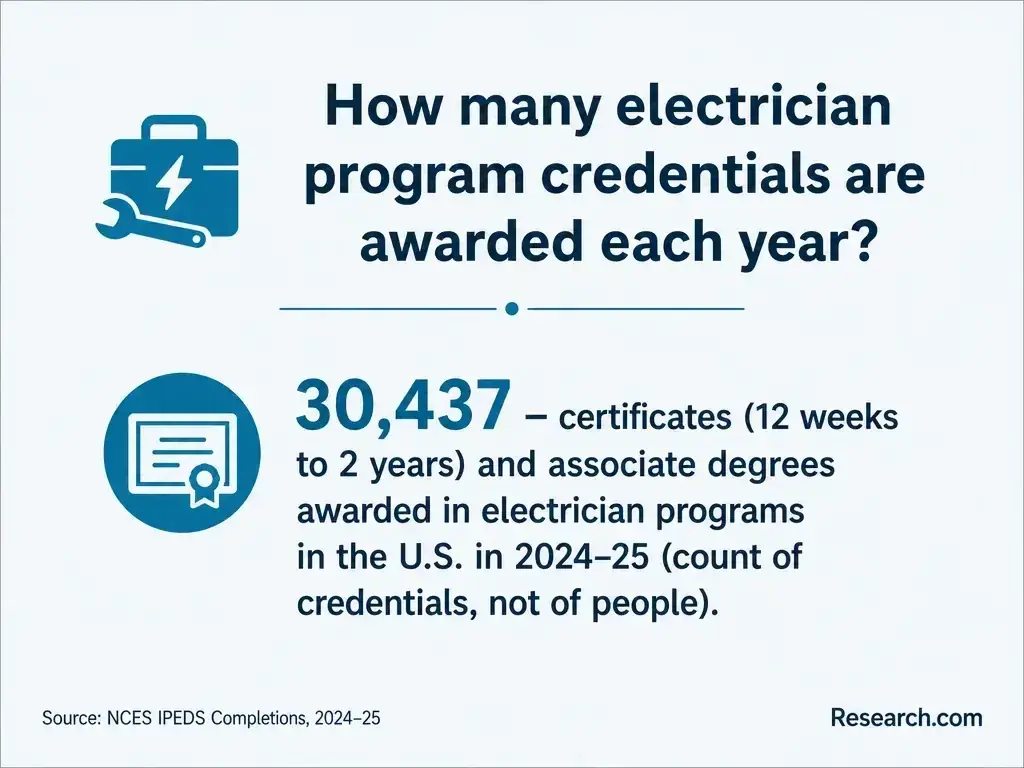
There is no defensible Park Hills-wide average without comparable, current prices for the available electrician programs. Request an itemized, current quote from Mineral Area College for any relevant offering and compare it with the entry costs and wages of apprenticeships or employer training. The table shows which costs belong in that comparison; it is not a price list.
| Cost or offset | What to verify |
| School charges | Tuition, mandatory fees, books, materials, and any separate lab charges |
| Job-readiness expenses | Tools, protective equipment, travel, and any applicable examination or application fees |
| Financial offsets | Grants, eligible aid, employer contributions, and paid apprenticeship wages |
| Time and borrowing | Lost earnings during training, loan balance, and repayment obligations |
Confirm federal-aid eligibility for the specific program through Federal Student Aid and the provider; eligibility of a school does not make every course eligible. Ask about Missouri workforce-training assistance through the relevant workforce office. Even readers comparing an affordable bachelor's degree online should use a different cost model here: tools, commuting, and the opportunity to earn apprenticeship wages are central to this trade decision.
It depends on the program: a provider may award a certificate, diploma, or associate degree; a registered apprenticeship leads to its own completion credential. A completion document confirms training undertaken, not automatic qualification to work independently or hold a local contractor license.
Before paying a deposit, ask for the exact credential name, transcript or documented hours, and any written agreement for apprenticeship credit or advanced standing. Institutional accreditation concerns the school; state authorization concerns permission to operate; apprenticeship registration concerns the work-based program. None is interchangeable with occupational licensure.
Requirements vary by provider and route. Ask Mineral Area College for the current application requirements of the relevant program, including any prerequisite coursework, placement assessment, or safety equipment. Apprenticeship sponsors may have separate eligibility, selection, and employer hiring processes; school admission does not secure an apprenticeship position.
If you already have construction experience, request a formal assessment of prior learning rather than assuming it reduces required coursework or supervised hours. Confirm the decision in writing before enrolling.
Relevant training covers electrical quantities and circuits, blueprint interpretation, code navigation, grounding, wiring methods, motors or controls where offered, testing instruments, and jobsite safety. BLS identifies reading technical diagrams, installing and maintaining electrical systems, and troubleshooting as core electrician duties.
Compare syllabi with the work you want: a residential-wiring lab may not provide much practice with industrial controls, while a controls-focused course may not prepare you equally well for residential service calls. Ask to see the lab equipment and find out which tasks students perform independently under supervision.
Do not assume a single school-issued credential authorizes electrical work throughout Missouri. Electrical-contractor and individual work requirements can depend on the jurisdiction and role. Before choosing a program, check requirements with the authority having jurisdiction where you plan to work and, for contractor credentials, the Missouri Division of Professional Registration. Ask an apprenticeship sponsor or prospective employer how it documents supervised experience and whether an examination is required for your intended role.
A voluntary industry certification or course completion may demonstrate a skill; it is not the same as a government license. Likewise, an accredited institution does not confer licensing eligibility merely by awarding a certificate.
Start with your intended job and commute, then test each option against the experience and credential that job requires. An affordability ranking is a useful shortlist, not proof of sufficient lab time, apprenticeship access, or local regulatory fit. The following checks can prevent an inexpensive enrollment from becoming a costly detour:
A common mistake is treating a similarly named online credential as equivalent to supervised electrical training. Lists such as best 1 year phd programs online address an entirely different educational decision; for this occupation, demonstrated hands-on competence and a workable employment route should decide the comparison.
Training can lead toward an apprentice or electrician-helper role, followed by more independent installation or maintenance work as experience and applicable local requirements permit. With additional training and employer demand, electricians may focus on commercial construction, industrial equipment, controls, or supervisory work. Contracting or self-employment introduces separate business and licensing questions.
Choose early instruction for the next role, not the eventual job title. Someone aiming for industrial maintenance should seek substantial troubleshooting and controls practice; someone seeking construction work should prioritize installation labs and a credible route onto supervised jobsites.
BLS projects 9.2% U.S. electrician employment growth from 2025 to 2035. This national outlook does not establish how many openings will exist in Park Hills or how easily a new entrant will be hired. Local prospects depend in part on construction activity, maintenance hiring, apprenticeship intake, and willingness to travel to worksites.
Use the projection as a reason to investigate - not as a guarantee. Before committing to training, ask nearby sponsors and employers about current apprentice recruitment, the kinds of electrical work available, and the geographic area new hires are expected to cover.
Education is a significant investment. Research.com created its ranking to help readers compare electrician programs against other options in the same occupation and location, rather than against unrelated schools. The most affordable ranking scores tuition, cost of attendance, median student debt, and federal loan default rates; an entropy-based method gives more weight to measures that distinguish programs. Accreditation and other quality indicators are not part of this affordability score.
Only programs with completions reported to IPEDS are eligible. That boundary helps make the comparison consistent, but it excludes some apprenticeships, employer training, and other legitimate routes. Research.com also uses broader quality measures for its separate best-program rankings, including student outcomes, earnings, accreditation, recognition, and support services. The team draws on the following sources to check institutional, cost, outcome, and occupation-relevant information; healthcare-specific sources in the list do not establish electrician-program approval.
Use the ranking to narrow your search, then confirm each program's current price, hands-on instruction, and connection to the work you want. More detail on the approach appears in Research.com's methodology.
# 1 position
# 2 position
Not necessarily. A registered apprenticeship or employer-sponsored route may combine instruction with paid, supervised work. Check the requirements for the role and jurisdiction where you intend to work.
It may reduce the need to give up earnings, but compare any fees, tools, travel, entry requirements, and time to completion. A school program may still be worthwhile if it provides useful skills or documented apprenticeship credit.
Theory may be taught online, but installation, testing, safety practice, and supervised field experience require in-person participation. Verify exactly where and when those components occur.
Do not assume so. A certificate documents education, while independent work may be subject to experience, examination, employer, and local licensing requirements.
Ask for its full cost, credential, supervised lab hours, completion requirements, and evidence that its training connects to the apprenticeship or job you want. Confirm current details directly before enrolling.