# 1 position

Audited and Verified:
Our Editorial and Data Verification Process
Research.com uses government datasets, official education statistics and primary institutional information to support its career and degree guides. Our review process checks factual accuracy, occupational definitions, source dates and the requirements associated with the credentials discussed.
How This Article Was Fact-Checked
Our editorial team verifies salary estimates, employment projections, education requirements and program information against original data providers and official organizations. Salary figures are checked against the relevant occupational definitions and reporting periods. Information about licensure, accreditation and required in-person training is reviewed separately.
Fact-checked and verified on:

Co-Founder and Chief Data Scientist

Reviewed by Karolina Broda
Fact-Checker and Data Verification
Choosing electrician training in Kalispell means comparing more than tuition: a short classroom program and a paid apprenticeship may lead to very different amounts of supervised experience. The U.S. Bureau of Labor Statistics projects electrician employment to grow 9.2% nationally from 2025 to 2035. This guide explains local training choices, costs, wages, and Montana licensing so you can assess the investment. It also features a Most Affordable Electrician Trade Schools in Kalispell for 2027 ranking created by the Research.com team of data scientists to help students make an informed choice about programs worth considering.
Expect electrical theory paired with supervised practice - not an immediate license. A school-based program may teach circuitry, blueprint reading, the National Electrical Code, troubleshooting, and safe use of meters in a lab. A registered apprenticeship combines related instruction with paid, documented work under experienced electricians. Both can be useful, but only the latter inherently includes an organized work-based training arrangement; ask a school whether it has one and how participation is secured.
Flathead Valley Community College is a local institution to investigate for current electrical offerings. Confirm the credential, schedule, lab access, and any apprenticeship relationship in its current catalog rather than assuming every course is a complete licensing pathway. Best accelerated online associate degree programs may be useful for comparing academic scheduling, but speed and remote coursework cannot replace the electrical field experience Montana requires.
Potential worksites include residential construction, commercial buildings, industrial facilities, and maintenance operations in the Flathead Valley. The type of work matters: an employer offering general maintenance tasks may not provide the supervised electrical experience a licensing applicant needs. Before accepting a position, ask whether the employer employs appropriately licensed supervisors and how it records qualifying hours.
Kalispell's smaller labor market can also affect the choice of specialty and commute. Compare available placements throughout the surrounding area rather than assuming a local classroom seat comes with a nearby apprenticeship or job. The Montana State Electrical Board governs electrical licensing statewide; an employer's willingness to hire someone does not replace its requirements.
A reliable, current Kalispell-specific electrician median is not established here, so the national figure is a benchmark - not a local pay quote. The U.S. median annual wage for electricians was $63,190 in May 2025 (U.S. Bureau of Labor Statistics, Occupational Outlook Handbook). Half of workers in that national occupation earned less; apprentices and newly trained workers should not treat the median as expected starting pay.
For a realistic local estimate, ask prospective apprenticeship sponsors for their current starting wage, scheduled increases, benefits, and expected hours. Compare those figures with local electrician wage estimates from the Montana Department of Labor & Industry when available, using the same occupation and reference period. Wage progression during paid training may change the value of a longer apprenticeship relative to an unpaid, faster school program.
School and apprenticeship timelines answer different questions. A certificate can finish before a trainee has accumulated enough supervised experience to seek journeyman licensure. Registered apprenticeships generally span several years because they combine related instruction with extensive on-the-job learning (U.S. Department of Labor, Apprenticeship.gov). Montana State Electrical Board journeyman pathways commonly involve 8,000 hours of qualifying practical experience, with training conditions that depend on the applicable eligibility route; verify the current rules and acceptable documentation with the board.
Ask any provider for three separate timelines: time to finish its credential, time to secure a supervised position, and likely time to meet Montana's examination and experience requirements. A shorter course is valuable if it improves apprenticeship entry, but it does not necessarily shorten the time to independent electrical work.
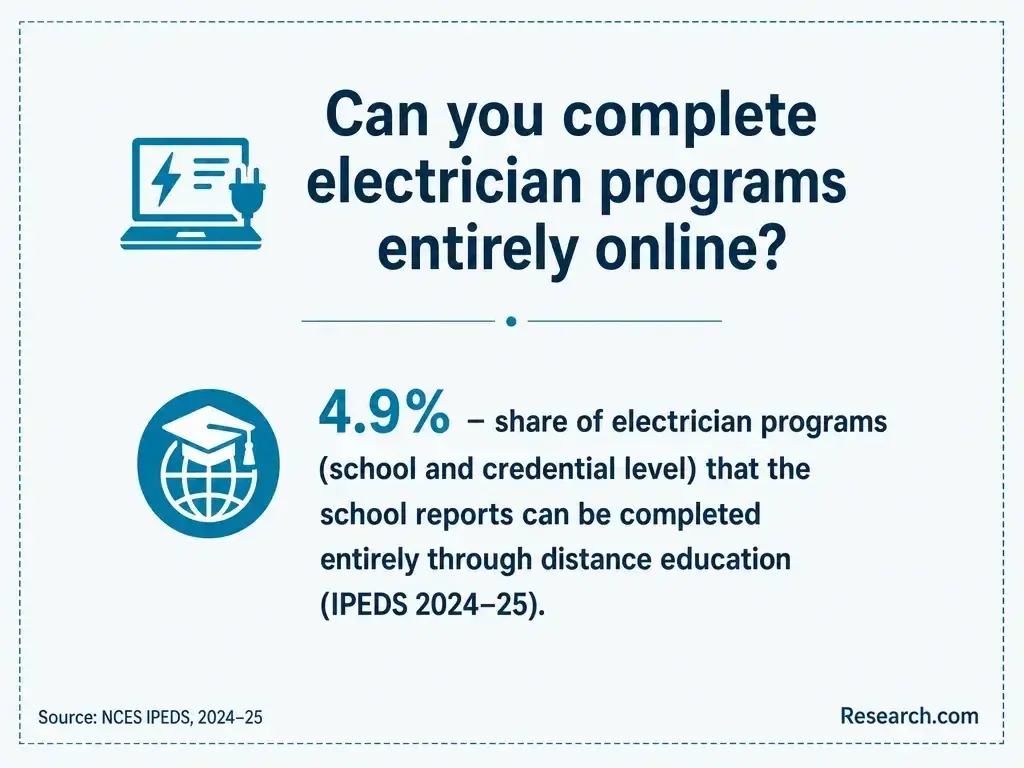
Online instruction can cover code concepts, calculations, and some theory. Wiring, testing circuits, using tools safely, and demonstrating jobsite practices require in-person labs or supervised fieldwork. A hybrid program may reduce trips for lectures, but a fully online course should not be assumed to provide licensing-qualifying practical experience.
For someone commuting into Kalispell, the useful comparison is the required in-person schedule, not just an "online" label. Ask where labs occur, whether attendance is mandatory, who arranges worksite supervision, and whether completed coursework can count toward an apprenticeship's related instruction. Online colleges open enrollment resources may explain flexible admissions, but flexible entry is not evidence that an electrical program meets Montana's experience requirements.
There is no defensible single Kalispell average without comparable, current prices for the same credential length and included expenses. Request a written, program-specific estimate from Flathead Valley Community College and any other training provider you are considering. Separate tuition from mandatory fees, books and code materials, tools, personal protective equipment, transportation, and any examination or license-application costs.
A paid apprenticeship may have lower upfront school charges and provide wages while training, although tool purchases, travel, and a longer training period still matter. Financial aid eligibility depends on the provider and program; check federal student aid, Montana workforce assistance, and any sponsor-paid instruction rather than assuming every short course qualifies. For a sound return-on-investment comparison, consider aid and debt alongside completion prospects, wages during training, expected earnings afterward, and the time each route takes. Lists of best money making majors cannot substitute for that electrician-specific calculation.
The credential depends on the actual offering: a school may award a certificate or, where available, an associate degree; a registered apprenticeship documents completion of its structured training. A course-completion certificate, an industry credential such as NCCER training recognition, apprenticeship registration, and a Montana electrician license are different things. None should be advertised as an automatic substitute for another (NCCER; U.S. Department of Labor; Montana State Electrical Board).
Ask what appears on the final credential and whether any coursework receives credit toward a registered apprenticeship. Obtain the sponsor's answer in writing; similar course titles do not prove advanced standing. Dual degree colleges address a different credential question - the priority here is whether electrical training and documented work experience support the intended licensing route.
Requirements vary by provider and pathway. A school may set its own application, placement, prerequisite, and lab-safety requirements. Apprenticeship sponsors separately select trainees and may assess math readiness, work eligibility, transportation, and the ability to meet jobsite schedules. Ask for the current written criteria before paying an application fee; admission to a school does not guarantee an apprenticeship placement.
Prospective apprentices should also confirm the sponsor's registration status through the U.S. Department of Labor's Apprenticeship.gov resources and ask how applicants are matched with employers. Someone who needs immediate income may prefer to pursue paid entry while building technical skills, whereas a classroom-first route may fit a learner who needs more preparation before applying.
Useful instruction connects electrical calculations and code reading to physical tasks: identifying conductors, installing and testing circuits, interpreting plans, diagnosing faults, and working safely around energized equipment. Employers also need reliable documentation, communication, and the judgment to stop unsafe work. The U.S. Bureau of Labor Statistics identifies installation, maintenance, troubleshooting, and safety as core electrician duties.
Ask to see a course-by-course outline and lab schedule. Specifically, find out which tasks students perform themselves, which are demonstrations only, and how instructors assess safe tool and meter use. That distinction is more informative than a broad claim that a program is "hands-on."
Yes, Montana regulates electrical work, but the required status depends on the work and the worker's stage of training. Apprentices work under applicable supervision and registration rules; journeyman licensure requires qualifying experience and examination under the Montana State Electrical Board's current rules. Further experience and requirements apply to higher license classifications. Verify your intended pathway directly with the board before assuming school hours count toward an application.
Institutional accreditation concerns a school, while state authorization concerns its permission to operate. Apprenticeship registration concerns a training arrangement; industry certification documents a particular standard; occupational licensure authorizes regulated work. None automatically grants the others. Before enrolling, ask the board and provider exactly which instruction, supervised hours, and records you will need for the license you intend to seek.
Start with the end goal: paid apprentice entry, stronger technical preparation, or eventual Montana journeyman eligibility. Then compare a school program with registered apprenticeship opportunities on the same practical measures. An affordability ranking can identify lower reported school costs, but its score does not measure lab quality, apprenticeship placement, or licensing eligibility.
Use these checks before committing money or time:
Red flags include a promise that an online certificate alone makes you a licensed electrician, an unexplained "job placement" claim, or a price that omits tools and travel. Search results for a one year online doctorate illustrate why program labels and speed can distract from the real test here: documented electrical practice and Montana eligibility.
An entry route typically leads to supervised apprentice work, followed - when Montana's experience and examination requirements are met - by journeyman practice. With additional qualifying experience, an electrician may pursue higher licensing classifications, supervise work, or explore contracting where the required licenses apply (Montana State Electrical Board). Training alone does not confer those permissions.
Specialization can develop through the work available locally: building wiring, service and repair, industrial equipment, or electrical maintenance. Choose initial training with enough fundamentals to move between these settings, then ask employers which added skills they actually use. Someone interested only in a narrow maintenance role should confirm whether it offers qualifying electrical hours before counting on it as a journeyman pathway.
The U.S. Bureau of Labor Statistics projects 9.2% electrician employment growth nationally from 2025 to 2035. That indicates demand across the country, not a guaranteed vacancy in Kalispell. Local openings depend on employers' projects, turnover, and their capacity to supervise apprentices; a small market may offer fewer entry points than the national trend suggests.
Before choosing a program, ask local sponsors whether they are accepting apprentices and how often trainees obtain work placements. Consider the surrounding Flathead Valley when assessing commute and job options. A training seat is a stronger investment when there is a credible route to the supervised employment needed to turn classroom learning into a license-eligible career.
Education is a significant investment, so Research.com evaluates affordable programs against other programs in the same occupation and location rather than against unrelated schools. Only programs with completions reported to the Integrated Postsecondary Education Data System (IPEDS) are eligible for this ranking. That makes the comparison more consistent, but it also means a registered apprenticeship or employer training program may be a worthwhile option without appearing in the ranking.
For most affordable rankings, Research.com scores tuition, cost of attendance, median student debt, and federal loan default rate. Indicator weights are assigned using an entropy-based method, which gives more weight to measures that differ more across eligible programs. Accreditation, support services, earnings, and completion are not included in the affordability score. Readers should check those factors separately before enrolling. The team reviews multiple data sources to improve the ranking's credibility and accuracy; some sources below inform Research.com's broader trade-program research but do not establish electrician licensing eligibility.
The ranking methodology draws on these data sources:
The resulting ranking is a starting point for finding lower-cost school programs, not a verdict on the cheapest route to a Montana electrician license. See Research.com's methodology for more about how rankings are created.
# 1 position
# 2 position
There is no universal cheapest option. Compare a school's full cost with a paid registered apprenticeship's wages, tool expenses, travel, and training duration. The lowest tuition does not necessarily mean the lowest cost to become job-ready.
No certificate by itself replaces Montana's applicable licensing requirements. Ask the Montana State Electrical Board how your coursework, documented supervised experience, and examination plans fit the license you want.
It is a local institution worth checking. Review its current electrical offerings, credential, lab access, total charges, and any documented apprenticeship connection before deciding whether a particular program fits your goal.
Theory may be available online, but electrical lab skills and supervised jobsite experience require in-person participation. Do not assume an online course meets Montana's practical-experience requirements.
It may be if you can secure a place and need wages while gaining documented experience. School-first training may make more sense if you need foundational skills before applying. Compare entry requirements, costs, instruction, and placement rather than treating either route as automatically superior.