# 1 position
Humacao Community College - Electrician.
associate

Audited and Verified:
Our Editorial and Data Verification Process
Research.com uses government datasets, official education statistics and primary institutional information to support its career and degree guides. Our review process checks factual accuracy, occupational definitions, source dates and the requirements associated with the credentials discussed.
How This Article Was Fact-Checked
Our editorial team verifies salary estimates, employment projections, education requirements and program information against original data providers and official organizations. Salary figures are checked against the relevant occupational definitions and reporting periods. Information about licensure, accreditation and required in-person training is reviewed separately.
Fact-checked and verified on:

Co-Founder and Chief Data Scientist

Reviewed by Karolina Broda
Fact-Checker and Data Verification
Choosing electrician training in Humacao means looking beyond the school name: you need practical experience, an affordable route into work, and a clear understanding of Puerto Rico's licensing rules. The U.S. Bureau of Labor Statistics projects electrician employment to grow 9.2% nationally from 2025 to 2035, but that is not a local job guarantee. The Research.com team of data scientists created the Best Electrician Trade Schools in Humacao for 2027 ranking to help students identify programs worth considering. This guide explains how to compare those options with apprenticeships, costs, credentials, and career requirements.
Expect a combination of electrical theory and supervised practice: reading diagrams, measuring circuits, selecting conductors and protective devices, installing wiring, and troubleshooting faults. A credible provider should identify where practice happens - in a lab, shop, employer worksite, or apprenticeship - and how an instructor assesses safe performance. Ask for the actual curriculum and contact-hour breakdown rather than assuming two certificates with similar names teach the same skills.
For a prospective student, the principal choice is between school-based preparation and training tied directly to a job. The U.S. Bureau of Labor Statistics describes apprenticeship as a common route into electrician work, combining paid on-the-job learning with technical instruction. A short school program may help someone qualify for an entry-level opportunity sooner; it should not be mistaken for completion of an apprenticeship or a Puerto Rico occupational license.
If you are considering an associate credential, compare its extra time and cost with the practical training and employment access it provides. A search for the fastest online associates degree is not a substitute for checking whether the electrician pathway includes required in-person work.
Potential settings include electrical contractors working on homes and commercial buildings, industrial maintenance teams, and businesses installing or servicing electrical equipment. Solar and backup-power projects may create relevant work, but those jobs call for installation and safety skills that should be checked against a program's actual curriculum. The U.S. Bureau of Labor Statistics identifies contractors and manufacturing among electrician employment settings; it does not establish how many openings are available in Humacao.
Ask local employers whether they hire trainees and where their crews travel. A role based in Humacao may involve worksites elsewhere in eastern Puerto Rico, making transportation and paid travel time important parts of the job decision. Utility linework is a different occupation with different training; do not assume a building-wiring credential qualifies you for it.
The U.S. Bureau of Labor Statistics reports a $63,190 national median annual wage for electricians in May 2025. It is a midpoint across experienced and less-experienced workers throughout the United States - not a Humacao wage estimate or a likely first-year offer. Use it to understand the occupation's national earning potential, then request current local pay ranges from employers or apprenticeship sponsors before estimating a return on training.
Compare offers on more than base pay. Paid training hours, benefits, overtime availability, travel between sites, and the cost of supplying tools can materially change what a new worker keeps. Advancement to more complex installation or supervisory work generally depends on experience and any applicable Puerto Rico credential requirements, not simply on finishing a school program.
There is no single program length that establishes electrician readiness in Humacao. A school certificate may focus on initial classroom and lab instruction, while an apprenticeship adds structured work experience and related instruction over a longer period. The U.S. Bureau of Labor Statistics describes most electrician apprenticeships as lasting four or five years; a particular sponsor's schedule and entry requirements must be verified directly.
Before choosing an accelerated course, request its total clock hours, supervised lab hours, schedule, and any documented work-placement arrangement. Then ask the Puerto Rico Department of State's Junta Examinadora de Peritos Electricistas whether that training and any subsequent experience meet the requirements for the credential you intend to pursue. Faster completion helps only if it moves you toward the work you are legally able to perform.
Online instruction can cover topics such as electrical calculations, diagrams, and safety concepts. It cannot by itself demonstrate that you can install, test, and troubleshoot equipment safely. Campus labs and supervised worksites provide opportunities for observed practice; a hybrid program is useful when its in-person sessions are accessible and sufficiently substantial for your goal.
The distinction matters particularly if travel from Humacao to a training site is difficult. Obtain the location and frequency of required labs before enrolling, and ask who provides tools and evaluates your work. Even when researching nationally recognized online colleges, verify the electrician program's practical component and Puerto Rico credential implications separately; institutional accreditation alone does not establish occupational eligibility.
A verifiable Humacao-wide average is not available here, and a quoted tuition figure would not represent the full price of becoming job-ready. Request a written, itemized estimate from each provider before comparing programs. A shorter option is not necessarily cheaper if it leaves you to arrange additional practical training afterward.
The following cost categories distinguish a school quote from the amount you may actually need to budget. Check which items are included, required later, or supplied by an employer.
| Cost category | What to verify |
| Instruction | Tuition, mandatory fees, books, materials, and lab charges |
| Equipment | Required tools, test instruments, protective equipment, and uniforms |
| Career entry | Any applicable examination, application, or licensing costs |
| Attendance | Travel to labs or worksites and earnings forgone while studying |
| Offsets | Grants, eligible aid, scholarships, employer-paid instruction, or apprenticeship wages |
A paid apprenticeship may lower out-of-pocket costs, though earnings while training and time to independent work still matter. Ask the provider whether the specific program qualifies for federal aid; the U.S. Department of Education's Federal Student Aid program treats eligibility as program- and institution-dependent. When comparing quick degrees with high pay, do not apply their tuition or salary claims to electrician training without checking the occupation and credential involved.
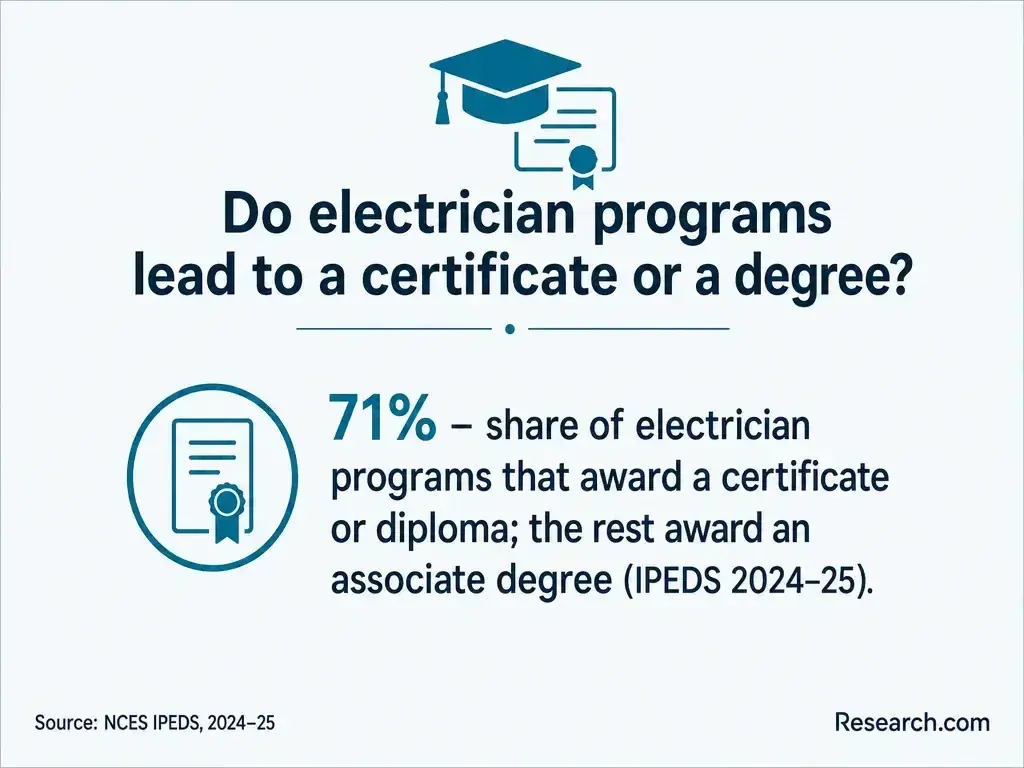
That depends on the provider and pathway. A school may award a completion certificate, diploma, or associate degree; a registered apprenticeship documents completion of its own structured training. These are educational or training credentials. None should be described as a Puerto Rico electrician license unless the issuing authority confirms it is one.
Ask to see the exact credential name on the provider's sample completion document and whether employers recognize it for the role you want. If industry credentials are advertised, ask which organization issues them and whether assessment is included. Institutional accreditation, school authorization, industry certification, apprenticeship registration, and occupational licensure answer different questions; one does not replace the others.
Entry requirements vary by provider. Schools may ask for evidence of prior schooling and assess readiness for arithmetic or technical reading; employers and apprenticeship sponsors set their own application and worksite requirements. Request the current written admissions policy, including any safety equipment, physical-task, scheduling, or transportation expectations, rather than assuming that admission to a course secures an apprenticeship position.
Working adults should ask whether evening instruction is paired with labs they can actually attend and whether prior electrical experience can be assessed for advanced standing. Someone exploring programs for seniors online should make the same practical check: electrician training may offer flexible theory coursework, but safe hands-on participation remains central regardless of age.
Useful entry-level training connects electrical theory to tasks a trainee can perform and explain: circuit calculations, plan reading, wiring methods, use of meters, fault diagnosis, and protection against shock and other hazards. The U.S. Bureau of Labor Statistics identifies installing, maintaining, and repairing electrical power, communications, lighting, and control systems among electricians' work. Ask which of those tasks students perform under supervision rather than only seeing in demonstrations.
For work involving solar equipment or backup power, check whether the curriculum addresses the relevant equipment and testing procedures instead of relying on a broad "green energy" label. Strong programs also teach documentation, communication with other trades, and how to stop work when conditions are unsafe. The right balance depends on the jobs you plan to pursue.
Puerto Rico regulates electrician credentials through the Department of State's Junta Examinadora de Peritos Electricistas. Before enrolling, confirm with the board which credential corresponds to the duties you want to perform, what education or supervised experience it accepts, and whether an examination and application are required. Do not assume that rules from a U.S. state apply in Humacao or that school graduation alone authorizes independent electrical work.
A provider's institutional accreditation concerns the institution; authorization concerns permission to operate; an industry certification documents a particular organization's assessment. Neither automatically establishes Puerto Rico licensing eligibility. Ask the board and the provider separately for written confirmation of how a program's hours, instruction, and work experience relate to the intended credential. Requirements can change before a 2027 start date.
Start with the job you want - supervised entry-level installation, a longer apprenticeship route, or later independent work - and compare programs against that goal. The most useful questions expose gaps that a ranking or tuition advertisement cannot show:
Compare a school offer with an available apprenticeship before committing. School may suit someone seeking preparation for entry-level hiring; a paid apprenticeship may suit someone who can obtain a position and wants instruction integrated with work. Neither route is automatically the better investment: account for completion likelihood, debt, wages while training, time to employment, and later earnings. Avoid treating unrelated options such as shortest master degree programs as benchmarks for the time or cost of learning this hands-on trade.
Initial training can support applications for supervised electrical work with contractors or maintenance employers. With substantial field experience and any required credentials, a worker may pursue more complex troubleshooting, crew supervision, or a business serving customers. Solar and backup-power installation are possible areas of specialization, but employers may expect equipment-specific skills beyond a general introductory course.
Separate the first job from the eventual goal when assessing a program. If you want to work independently, ask the Puerto Rico Department of State's Junta Examinadora de Peritos Electricistas about the applicable credential and experience path first. If your goal is an entry-level opening, prioritize demonstrable lab skills and access to supervised work over an advanced-sounding certificate title.
The U.S. Bureau of Labor Statistics projects 9.2% national employment growth for electricians from 2025 to 2035. That supports considering the occupation, but it does not measure Humacao vacancies or predict when a trainee will be hired. Local prospects depend on contractor workloads, maintenance needs, project timing, and willingness to travel to worksites.
Before paying for training, check current openings and ask employers or apprenticeship sponsors what skills they expect of applicants. Compare those answers with each program's labs and work-based learning arrangements. This is more actionable than assuming a national growth projection will translate into a nearby position immediately after completion.
Education is a consequential investment, so the Research.com team designed this ranking to compare electrician programs with other programs in the same occupation and location - not with unrelated schools nationwide. Only programs with completions reported to the Integrated Postsecondary Education Data System (IPEDS) are eligible. That makes the ranking useful for comparing covered programs, but it does not capture every apprenticeship, employer training route, or vocational provider.
Best-program scores assess student outcomes; earnings and return on investment; costs and debt; and quality and recognition. Occupation-relevant programmatic accreditation or industry recognition carries 20%, institutional accreditation 10%, and student support services 10%. The remaining 60% covers completion, retention, earnings, cost, and debt measures, weighted using an entropy-based method that gives more weight to indicators that vary more across programs. A separate most-affordable methodology scores only tuition, attendance cost, debt, and federal loan default rates; it does not include accreditation or other quality measures.
The team uses the following sources to check program, institutional, outcome, and occupation-relevant information. A source's inclusion does not mean every electrician program appears in that database or holds the accreditation associated with it.
Readers can use the ranking to narrow their search, then confirm current program details directly with providers. Research.com explains the scoring approach further on its methodology page.
# 1 position
# 2 position
Not necessarily. School-based training and apprenticeship or employer-based training are different routes. Confirm Puerto Rico's requirements for the particular electrician credential and duties you seek with the Department of State's Junta Examinadora de Peritos Electricistas.
Online courses can teach theory, but installation, testing, and safe tool use require supervised practical work. Ask where and when a hybrid program provides that experience.
No. A school credential documents training; occupational licensure is a separate determination by the relevant Puerto Rico authority.
It depends on available openings and your finances. An apprenticeship combines paid work and instruction but requires securing a position; a school program may offer a more immediate start without providing the same work experience.
Get the curriculum, supervised lab and work hours, total cost, exact credential name, and any documented relationship to Puerto Rico licensing requirements in writing.