Research.com is an advertising-supported site. Featured placements, sponsored links, advertising widgets and labeled paid mentions in articles involve schools, brands or advertising networks that compensate us. Some universities also pay us to process their current program data, but no payment influences our ranking methodology, scores or positions, or the other editorially independent information published on this site.

Best Criminal Justice Associate Degree Programs & Schools in Vermont for 2027

Audited and Verified:

Imed Bouchrika, PhD

by Imed Bouchrika, PhD

Co-Founder and Chief Data Scientist

Karolina Broda

Reviewed by Karolina Broda

Fact-Checker and Data Verification

Table of Contents

What can I expect from an associate criminal justice degree in Vermont?

Expect an introduction to policing, courts, corrections, criminal law, ethics, and the social context of crime, alongside general education such as writing and quantitative reasoning. An associate degree can support career entry, continued study, or both; the degree title alone does not tell you how much field experience or transferable coursework it includes.

The distinction between degree types matters most when you compare a first job with future academic flexibility. These are typical orientations, not guarantees about a particular school's curriculum or transfer decisions.

Degree typeTypical emphasisBest fit to investigate
Associate of Arts (AA)Broad general education and social-science studyStudents who prioritize transferable coursework
Associate of Science (AS)General education plus a defined criminal justice majorStudents seeking a balance of career study and transfer options
Associate of Applied Science (AAS)More occupation-focused courseworkStudents prioritizing near-term employment who will verify transfer credit course by course

Ask Community College of Vermont or Vermont State University for the current catalog and a degree audit for the exact program under consideration. Check whether practical learning consists of simulations, observation, an internship, or no required placement; similarly named degrees need not provide equivalent experience. An internship can help you test your interest in public-facing work, but it is not a substitute for an employer's required preparation.

Where can I work with an associate criminal justice degree in Vermont?

Potential settings include municipal police departments, county sheriff's offices, state public-safety agencies, correctional facilities, courts, and organizations providing community-based services. Opportunities and hiring standards differ substantially: an administrative court role is not the same route as becoming a sworn officer, and some jobs require experience or qualifications beyond the degree.

Location affects the search. A student in rural Vermont may face a longer trip to a campus, internship, shift-based job, or hiring assessment than someone near a larger employment center. Before choosing a program, compare its class and field-placement schedule with the agencies you could realistically reach, and ask whether placements can be arranged near home.

Best Criminal Justice Associate Degree Programs & Schools in Vermont for 2027

# 1 position

Vermont State University

associate

Criminal Justice/Safety Studies

Delivery mode: Online

28.89

/ 100

Final score

School graduation rate
44%
Students receiving Pell Grants
40%
In-state tuition & fees (per year)
$12,390
Out-of-state tuition & fees (per year)
$23,094
School website
vermontstate.edu

Accreditation

Institutional accreditation from New England Commission on Higher Education.

Vermont State University received a Research.com Trade Program Score of 28.89/100.

Frequently asked questions about criminal justice programs in Vermont

Is a criminal justice associate degree required to become a police officer in Vermont?

Do not assume so. Check the hiring agency's current education standards and the Vermont Criminal Justice Council's training and certification requirements. Completing an associate degree does not itself certify you as an officer.

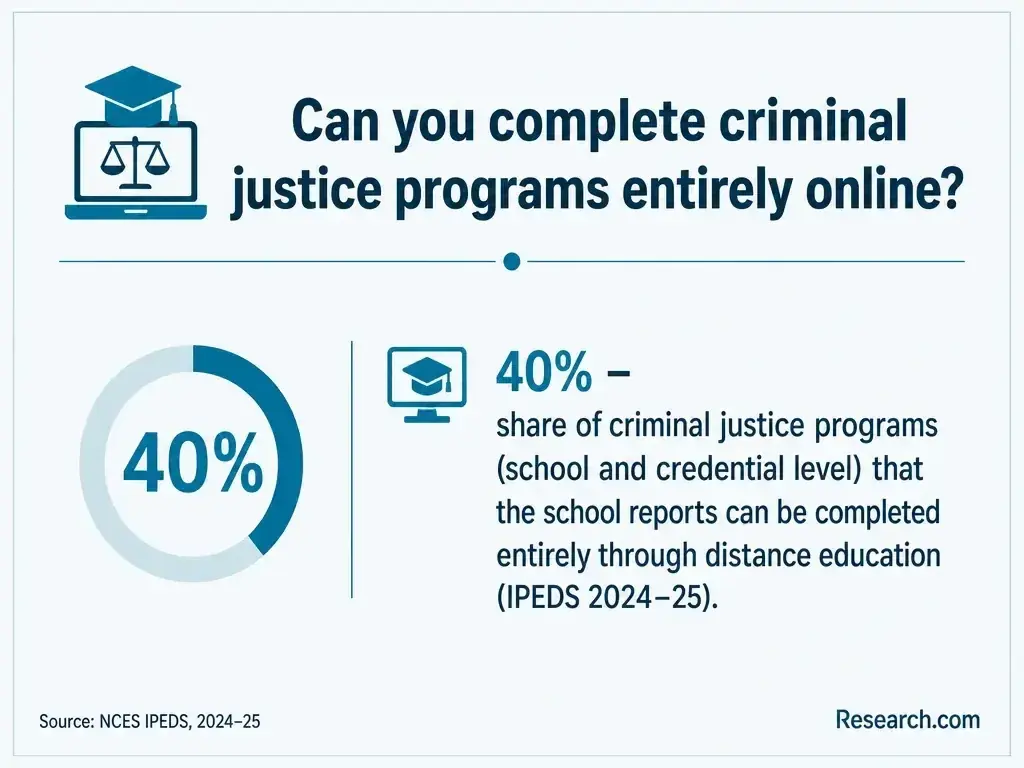
Can I complete the degree entirely online?

Possibly, depending on the specific program, but an internship or other required activity may involve travel. Get written confirmation of every in-person requirement before enrolling.

Is an AA, AS, or AAS better?

An AA or AS may be easier to align with a transfer goal; an AAS may emphasize career-focused coursework. Compare required classes and obtain a written transfer-credit evaluation rather than deciding by the degree abbreviation alone.

How do I know whether the degree is worth the cost?

Estimate your full remaining cost after aid, the time and earnings required to finish, and the entry requirements and pay for jobs you can realistically pursue. A ranking or national median wage cannot answer that personal calculation on its own.

Which Vermont schools should I ask about options?

Ask Community College of Vermont and Vermont State University about their current associate-level offerings, delivery formats, course schedules, costs, and transfer arrangements. Confirm availability for the term when you intend to start.

Do you have any feedback for this article?