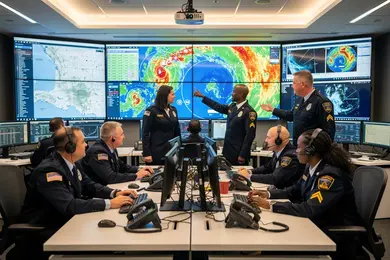
2027 Emergency Management Degree Internship Outcomes Report: Paid Experience, Placement Rates, and Career Impact

Co-Founder and Chief Data Scientist
Emergency management students face a practical question, which internship will actually lead to paid experience, stronger placement odds, and better first-job options? NOAA reported 27 U.S. billion-dollar weather and climate disasters in 2024, keeping demand high for people who can support preparedness, response, recovery, and mitigation work.
This guide is for emergency management majors comparing internships, co-ops, agency placements, and remote roles. You will learn how compensation, conversion potential, skills gained, and employer type affect career value so you can choose opportunities with clearer return on effort.
Key Things to Know About Internship Outcomes in Emergency Management Industry
- Paid emergency management internships are most common in federal, state, local government, utilities, consulting, healthcare preparedness, and corporate continuity roles; federal student roles often follow GS pay levels, with 2024 GS-4 to GS-7 base pay ranging from about $15.10 to $20.95/hour before locality pay.
- There is no single national emergency management internship placement rate, so students should judge programs by employer type, supervised field duties, post-internship references, documented school outcomes, and whether past interns moved into analyst, planner, logistics, preparedness, or continuity roles.
- The strongest career impact usually comes from internships that produce verifiable work samples, such as an after-action report, hazard vulnerability analysis, emergency operations plan update, GIS dashboard, continuity plan, exercise evaluation, or incident documentation packet.
- Key Things to Know About Internship Outcomes in Emergency Management Industry
- How important are internships for Emergency Management degree students?
- How early should a Emergency Management student look for internship opportunities?
- What kinds of internship programs should Emergency Management look for?
- What skills or experiences should Emergency Management students expect to learn from internships?
- How does a remote Emergency Management internship compare to an in-person experience?
- Are there paid internships available for Emergency Management degree students?
- How often do Emergency Management internships convert directly into full-time job offers?
- What is the impact of Emergency Management internships on long-term career outcomes?
- Do Emergency Management internships have an effect on starting salaries after graduation?
- Top Trending Emergency Management Rankings
How important are internships for Emergency Management degree students?
Internships are especially important in emergency management because entry-level hiring is rarely based on classroom knowledge alone. Employers want evidence that a candidate understands incident command, interagency coordination, public communication, documentation discipline, and the pressure of real operational timelines.
An emergency management internship is a supervised work experience in a setting that prepares for, responds to, recovers from, or reduces the risk of disasters and disruptions. Day-to-day responsibilities often include updating emergency operations plans, supporting tabletop exercises, reviewing hazard data, maintaining resource inventories, drafting public preparedness materials, taking notes during planning meetings, organizing training records, or helping an emergency operations center during drills or activations.
The value is not only "experience" on a resume. It is proof that the student can work with public agencies, nonprofit partners, utilities, hospitals, schools, or private employers where decisions affect safety, continuity, and compliance. The U.S. Bureau of Labor Statistics reported a May 2024 median annual wage of $86,130 for emergency management directors, which shows that the field can lead to stable professional roles, but most students do not start at director level. Internships help bridge that gap by showing readiness for coordinator, analyst, planner, specialist, and program assistant roles.
The table below summarizes common internship settings and the outcome signals students should look for before accepting an offer. These are not guarantees, but they help identify experiences that are more likely to support placement after graduation.
| Internship setting | Typical work | Strong outcome signal | Possible limitation |
| Local or county emergency management office | Planning, community preparedness, EOC support, exercises | Direct exposure to public-sector coordination and incident documentation | May be unpaid or part-time in smaller jurisdictions |
| State emergency management agency | Grant support, planning, mitigation, logistics, training records | Broader view of statewide systems and federal coordination | Competitive openings and fixed application windows |
| Federal agency or Pathways role | Program support, resilience planning, data review, preparedness projects | Paid structure, federal resume value, potential eligibility pathways | Longer hiring process and strict eligibility rules |
| Healthcare emergency preparedness | Continuity plans, drill support, regulatory documentation, supply readiness | Strong fit for hospital preparedness, public health, and safety roles | May require immunization, background checks, or site onboarding |
| Private-sector business continuity | Risk assessment, continuity planning, crisis communications, vendor tracking | Transferable experience for corporate resilience roles | May focus less on public disaster response |
For students comparing emergency management with healthcare-related public safety paths, it can also help to understand adjacent career routes. For example, a student interested in medication access during disasters may compare this field with a PharmD degree, while still using emergency management internships to test whether planning, logistics, or clinical operations is the better fit.
How early should a Emergency Management student look for internship opportunities?
Emergency management students should begin looking for internship opportunities at least two semesters before they want to start. Federal and larger public-sector programs may post months in advance, while local agencies, nonprofits, and hospital preparedness teams may recruit closer to the start date but expect students to already have basic FEMA coursework, a tailored resume, and availability during business hours.
The earlier timeline matters because emergency management internships are often tied to budgets, grant cycles, academic credit approvals, background checks, and supervisor availability. Waiting until late spring can still work for small local offices, but it usually leaves fewer paid and structured options.
The table below shows how a student can think about timing by academic stage. It is meant to clarify trade-offs, not to replace school-specific career office deadlines.
| Student timing | Best target opportunities | Why it works | Main risk |
| First year or early sophomore year | Volunteer emergency preparedness, CERT, campus safety projects, short micro-internships | Builds credibility before applying to competitive placements | May not be paid or deeply technical |
| Sophomore spring to junior fall | County emergency management, healthcare preparedness, nonprofit disaster services | Good stage to turn coursework into supervised work samples | Students who wait may miss summer deadlines |
| Junior year to senior fall | Federal, state agency, utility, consulting, corporate continuity internships | Employers can evaluate candidates close to graduation | More competition from students with prior experience |
| Final semester | Capstone-linked internship, part-time agency placement, direct-hire networking | Can lead quickly to references or interviews | Less time to recover if the placement is weak |
A practical search plan should include employer research, credential preparation, and direct outreach. The most effective students do not wait for one perfect posting; they build several pathways at the same time.
- Complete FEMA Independent Study courses commonly requested by employers, such as ICS-100, ICS-200, IS-700, and IS-800, if they fit the role and your school's guidance.
- Create a one-page resume that highlights emergency planning projects, GIS or data tools, public communication, volunteer response work, language skills, and incident command familiarity.
- Ask your department, career center, and local emergency management office about academic-credit requirements before you apply, especially if the internship may be unpaid.
- Track fall, spring, and summer deadlines in a spreadsheet so you can compare pay, supervision, location, credit, and expected deliverables.
- Contact alumni in emergency preparedness, public health, transportation, utilities, and continuity planning with a short message asking about intern hiring cycles, not a generic job request.
Some students also compare emergency management internships with faster workforce credentials in adjacent public-service fields. If you are weighing whether to keep pursuing a bachelor's pathway or enter healthcare support sooner, a list of 6-month LPN programs can provide a useful timeline comparison, although the career duties and licensing requirements are very different.
What kinds of internship programs should Emergency Management look for?
Emergency management students should look for internship programs that offer structured supervision, real deliverables, and exposure to more than one phase of the disaster cycle. A strong placement does not have to be glamorous; it needs to connect the student's work to preparedness, response, recovery, mitigation, continuity, public health readiness, or resilience planning.
The best program type depends on the student's target career. A student who wants a local government role may gain more from a county emergency management office than a remote corporate compliance internship. A student interested in business continuity may benefit more from a utility, hospital system, insurer, consulting firm, or large employer with crisis management operations.
The comparison below can help students match internship types with career direction. Use it to avoid accepting a role only because it has an emergency-related title.
| Program type | Best fit for students interested in | Career value | Watch for |
| Emergency operations and local government | Public-sector emergency management, EOC support, community preparedness | Strong practical understanding of local response systems | Limited pay in some smaller jurisdictions |
| Mitigation and resilience planning | Hazard analysis, climate resilience, infrastructure risk, grants | Useful for analyst, planner, and resilience roles | May be research-heavy and less operational |
| Healthcare preparedness | Hospital emergency management, public health readiness, regulatory preparedness | Strong documentation and drill experience | Onboarding can be complex due to health system requirements |
| Business continuity and corporate resilience | Private-sector crisis management, continuity planning, operational risk | Often paid and transferable across industries | May not include disaster response fieldwork |
| Nonprofit disaster services | Mass care, volunteer management, community recovery, shelter support | Excellent exposure to community impact and service delivery | Schedules may change during activations |
Students should also consider specialized intersections. Emergency management connects with public health, athletics safety, campus recreation risk planning, occupational health, and community resilience. If that overlap appeals to you, an exercise science degree online may be worth comparing as an adjacent education path, especially for students interested in human performance, injury prevention, or health promotion rather than disaster operations.
Before accepting an offer, students should ask specific questions that reveal whether the internship will produce usable experience. These questions help separate meaningful training from administrative support with little career value.
- What project or deliverable will I be able to describe in a future interview?
- Will I observe or support exercises, drills, EOC operations, planning meetings, or after-action review processes?
- Who will supervise me, and how often will I receive feedback?
- Will the work involve FEMA doctrine, incident command, GIS, emergency alerting, continuity planning, grant documentation, or public communication?
- Can the supervisor provide a reference or verify completed competencies at the end of the placement?
How can Emergency Management students land competitive internship programs?
Competitive emergency management internships usually go to students who can show preparation before the first interview. Employers do not expect undergraduates to be incident commanders, but they do expect reliability, writing ability, professionalism, and a basic understanding of how emergency systems are organized.
A strong application should connect coursework to real tasks. Instead of saying "interested in disasters," a better resume shows that the student has drafted a continuity plan section, mapped flood-prone facilities, completed FEMA Independent Study training, volunteered with a preparedness organization, or helped design a tabletop exercise.
Use the following steps to build a stronger application package. The sequence matters because each step gives the next one more credibility.
- Choose a target lane, such as local emergency management, healthcare preparedness, mitigation, business continuity, disaster nonprofits, logistics, or public information.
- Build a small portfolio with two or three samples, such as a hazard profile, GIS map, public preparedness flyer, exercise inject, continuity checklist, or after-action memo from a class project.
- Tailor each resume to the employer's operating environment, using role-specific terms such as EOC support, ICS, HSEEP, COOP, hazard mitigation, mass care, WebEOC, ArcGIS, or crisis communications only when you can discuss them honestly.
- Prepare concise interview stories about teamwork, ethical judgment, public service, documentation accuracy, and how you respond when information is incomplete.
- Follow up after interviews with a short message that restates your fit for the specific project, not just your interest in the organization.
Common mistakes can reduce a student's odds even when they have the right major. The most damaging errors are usually avoidable.
- Applying late to federal or state roles and assuming local agencies will always have openings.
- Submitting the same resume to a hospital preparedness office, county agency, and business continuity team without changing the skills emphasized.
- Overvaluing a paid internship with vague duties while ignoring a structured role that produces better references and portfolio evidence.
- Claiming advanced incident command or GIS skills after only brief exposure, then struggling in interviews.
- Accepting an internship without confirming schedule expectations, academic credit rules, transportation costs, or background check requirements.
What skills or experiences should Emergency Management students expect to learn from internships?
Emergency management internships should build both technical and judgment-based skills. The technical side includes plans, data, maps, documentation, software, and compliance. The judgment side includes communication under uncertainty, coordination across agencies, and understanding when to escalate issues.
The table below connects common internship roles with the skills students should expect to practice. It also helps students evaluate whether an internship description is specific enough to support career growth.
| Internship focus | Skills likely to develop | Useful work sample | Entry-level roles it can support |
| Preparedness planning | Plan review, policy writing, stakeholder coordination, documentation control | Updated annex, checklist, or planning memo | Emergency management assistant, preparedness coordinator |
| Exercises and training | HSEEP concepts, inject writing, evaluator notes, after-action tracking | Exercise evaluation guide or improvement plan summary | Training and exercise specialist, program assistant |
| Mitigation and resilience | Hazard analysis, grant support, risk mapping, community vulnerability review | Hazard profile or mitigation project summary | Mitigation analyst, resilience planner |
| Business continuity | Business impact analysis, continuity procedures, vendor dependency tracking | Continuity plan section or recovery priority matrix | Business continuity analyst, risk coordinator |
| Public information and outreach | Plain-language writing, alert templates, community education, accessibility review | Preparedness campaign or message library | Public information assistant, community preparedness specialist |
Technology expectations are also changing. AI-assisted writing, mapping dashboards, emergency alert systems, crisis management platforms, and data visualization tools can speed up routine work, but they do not replace professional judgment. Students should learn how to verify AI-generated summaries, protect sensitive information, and document sources because emergency management work often supports public decisions.
Students who want stronger outcomes should leave an internship with evidence. That evidence does not need to reveal confidential information; it can be a redacted sample, supervisor-approved summary, skills checklist, or reflection memo that explains the project and tools used.
How does a remote Emergency Management internship compare to an in-person experience?
Remote emergency management internships can be valuable, but they are not the same as in-person placements. The right choice depends on the student's career target, the structure of supervision, and whether the work includes real planning or just passive research.
In-person internships usually provide better exposure to emergency operations centers, stakeholder meetings, equipment, logistics, drills, and workplace culture. Remote internships can work well for hazard research, continuity documentation, GIS projects, policy analysis, public education materials, and data cleanup when the supervisor sets clear deliverables.
The table below compares formats by outcome value. Students should use it to ask better questions before assuming that one format is automatically superior.
| Format | Best use | Career advantage | Risk to manage |
| In-person | EOC support, drills, logistics, stakeholder meetings, field observation | Stronger relationship building and operational context | Transportation, housing, and schedule costs may be higher |
| Remote | Planning research, GIS, continuity documentation, public information content | Flexible access to employers outside the student's region | Can become isolated or too administrative without weekly feedback |
| Hybrid | Planning work plus selected site visits, exercises, or meetings | Often balances flexibility with practical exposure | Requires clear expectations for which days matter most |
A remote internship is worth considering when it has scheduled supervision, defined outputs, access to relevant systems, and a supervisor who can evaluate performance. It is weaker when the role is described only as "research," has no emergency management mentor, or cannot explain how the work connects to preparedness, response, recovery, mitigation, or continuity.
Students comparing remote and in-person offers should focus on outcomes rather than format labels. A structured hybrid continuity internship with weekly coaching may be more valuable than an in-person role that only assigns filing and event staffing.
Are there paid internships available for Emergency Management degree students?
Yes, paid internships are available for emergency management degree students, but availability varies by employer, funding source, location, and whether the role is tied to academic credit. Paid roles are more common in federal agencies, utilities, large healthcare systems, transportation, consulting, insurance, corporate security, and business continuity teams. Smaller local agencies and nonprofits may offer unpaid or stipend-based placements because their budgets are more limited.
Federal student positions provide one of the clearest pay structures. OPM's 2024 base General Schedule shows GS-4 at about $15.10/hour and GS-7 at about $20.95/hour before locality adjustments, so students applying to federal emergency management-adjacent roles should check the grade, duty station, and locality pay rather than relying only on the job title.
The table below outlines common compensation structures and what students should consider before accepting them. The main decision is not simply paid versus unpaid; it is whether the compensation, supervision, and career value justify the time and costs.
| Compensation model | Where it appears | Financial benefit | Decision concern |
| Hourly paid internship | Federal programs, utilities, healthcare systems, corporate continuity, consulting | Most predictable income and easier to compare across offers | May require competitive applications and fixed work hours |
| Stipend internship | Nonprofits, grant-funded projects, university partnerships | Can offset travel or living costs | Effective hourly value may be low if hours expand |
| Academic-credit unpaid internship | Local agencies, small nonprofits, some public offices | May satisfy degree requirements and build local references | Tuition, fees, transportation, and lost wages can create real costs |
| Project-based micro-internship | Remote planning, data, mapping, research, continuity projects | Can fit around classes and produce a portfolio sample | May not provide deep mentorship or conversion potential |
An unpaid internship may be worth accepting when it is short, local, supervised by an experienced emergency manager, tied to required academic credit, and produces a strong reference or work sample. It is less attractive when the duties are vague, the commute is costly, the schedule blocks paid work, or the employer cannot explain what skills the student will gain.
Students should calculate the real cost before deciding. Include transportation, parking, housing, professional clothing, background checks, tuition for internship credit, and wages lost from reducing other work hours. A paid internship with weak mentoring is not automatically better, but students should not ignore financial strain when comparing offers.
How often do Emergency Management internships convert directly into full-time job offers?
Emergency management internships can convert into full-time jobs, but direct conversion is less predictable than in fields with large standardized campus recruiting programs. Many emergency management employers hire based on budget approvals, civil service rules, grant funding, retirements, and vacancy timing, so a strong intern may receive a reference or later interview rather than an immediate offer.
For broader U.S. recruiting context, NACE's 2024 employer research continued to show internships as a major full-time hiring channel across industries, with employers using internship performance to reduce hiring risk. Emergency management students should interpret that trend carefully: conversion is more likely when the employer has recurring entry-level roles and less likely when the office has only one or two permanent staff members.
The table below gives practical conversion expectations by employer type. It is not a guaranteed placement chart; it shows where direct offers are structurally more or less likely.
| Employer type | Direct conversion likelihood | Why conversion may happen | Why it may not happen |
| Federal agency or large public employer | Moderate when the role is part of a formal student pipeline | Defined hiring pathways and recurring workforce needs | Eligibility rules, security checks, and budget timing can slow offers |
| County or municipal emergency management office | Variable | Intern becomes known to local decision-makers | Small teams may not have entry-level openings every year |
| Healthcare system | Moderate | Preparedness, safety, compliance, and continuity teams may need coordinators | Hiring may require healthcare-specific onboarding or experience |
| Corporate continuity or resilience team | Moderate to stronger when the company has a campus pipeline | Intern work can map directly to analyst roles | Openings may depend on business priorities |
| Nonprofit disaster organization | Variable | Strong volunteer and deployment experience can build trust | Permanent roles may be grant-dependent or geographically limited |
Students can improve their chance of a return offer by managing the internship like an extended interview. This does not mean working unreasonable hours; it means making performance visible and easy to evaluate.
- Ask during the first week what a successful intern outcome looks like and how it will be measured.
- Keep a weekly record of projects completed, meetings supported, tools used, and problems solved.
- Request mid-placement feedback early enough to correct gaps before the final evaluation.
- Build relationships with more than one staff member so your reputation is not limited to a single supervisor.
- Before the internship ends, ask whether the organization expects openings, contract roles, temporary assignments, or referrals in related agencies.
What is the impact of Emergency Management internships on long-term career outcomes?
The long-term career impact of an emergency management internship is strongest when it helps a student choose a lane, build evidence, and enter a professional network. Emergency management careers often grow through credibility: supervisors, partner agencies, and project references matter because many roles involve trust, coordination, and judgment under pressure.
An internship can shape the first several years after graduation. A student who completes a mitigation internship may be more competitive for resilience planning or hazard mitigation roles. A student who supports hospital drills may move toward healthcare emergency preparedness. A student who works in business continuity may later qualify for corporate resilience, operational risk, or crisis management roles.
The career path below shows how internship experience can translate into early advancement. Timelines vary by employer, region, civil service systems, and whether the student continues into graduate study or specialized certifications.
| Career stage | Typical role direction | How internship experience helps | Evidence employers value |
| During degree | Intern, volunteer, student assistant, micro-intern | Tests fit and builds basic professional habits | Training records, supervisor feedback, project samples |
| 0 to 2 years after graduation | Emergency management assistant, planner, coordinator, analyst, public safety specialist | Provides role-specific examples for interviews | Plans, maps, exercise notes, outreach materials, continuity documents |
| 2 to 5 years after graduation | Program coordinator, training and exercise specialist, mitigation analyst, continuity analyst | Supports specialization and stronger references | Completed projects, incident support, certifications, measurable program contributions |
| 5+ years after graduation | Emergency manager, resilience manager, continuity lead, preparedness program manager | Early exposure helps clarify leadership style and sector fit | Cross-agency coordination, exercises, plans, activations, team leadership |
Internships also help students decide whether emergency management is the right career. Some discover they prefer public health, healthcare operations, environmental planning, logistics, cybersecurity continuity, or clinical service. If you are comparing emergency management with health data and compliance careers, reviewing health information management salary information can help you compare a more data-centered healthcare path with preparedness-focused work.
The most valuable long-term outcome is clarity. A student who learns that they prefer planning over response, data over outreach, or healthcare preparedness over local government can choose electives, certifications, graduate programs, and job searches more strategically.
Do Emergency Management internships have an effect on starting salaries after graduation?
Emergency management internships can affect starting salaries indirectly, but they do not create a fixed salary premium. The impact usually comes from qualifying for better-fit roles, demonstrating practical skills, negotiating from a stronger position, and avoiding underemployment after graduation.
The BLS May 2024 median wage of $86,130 for emergency management directors should be read as a mid-career or leadership benchmark, not a typical starting salary for new graduates. Entry-level salaries vary widely by city, agency size, sector, civil service classification, union rules, grant funding, and whether the role is in public emergency management, healthcare preparedness, consulting, utilities, or corporate continuity.
The table below shows how internship quality can influence salary positioning without implying guaranteed earnings. Students should use it to compare the career value of different experiences.
| Internship outcome | Salary-related value | Why it matters in hiring | Limitation |
| Paid internship with formal evaluation | Shows employer investment and documented performance | Can support stronger references and clearer resume claims | Pay during internship does not guarantee higher post-grad salary |
| Portfolio-quality project | Helps candidate compete for analyst or planner roles | Gives interviewers evidence beyond coursework | Confidential projects may need redaction before sharing |
| Operational exposure | Can strengthen fit for EOC, logistics, preparedness, or public safety roles | Shows comfort with real emergency management workflows | Experience may be episodic if no incidents or exercises occur |
| Specialized technical skill | May improve competitiveness for GIS, continuity, mitigation, or data-heavy roles | Employers can map the skill to immediate tasks | Skill level must be demonstrable, not just listed |
| Strong supervisor reference | Can reduce employer uncertainty about entry-level readiness | References matter in trust-based public safety environments | Reference value depends on the supervisor's credibility and detail |
To improve salary outcomes, students should target internships that align with sectors that commonly have structured entry-level positions. Corporate continuity, utilities, healthcare systems, transportation, and larger public agencies may have clearer salary bands than very small offices, although mission fit and public-service goals may still make local government attractive.
When comparing offers, students should not focus only on the hourly internship wage. A slightly lower-paid internship that produces a strong project, direct supervision, and a likely reference may be more valuable than a higher-paid role with unrelated administrative duties.
Other Things You Should Know About Emergency Management
Sometimes. Requirements vary by school and program. Even when an internship is optional, students should consider completing one because employers often look for applied experience in planning, exercises, public communication, GIS, continuity, or response support.
It can be worth it if it is short, supervised, connected to academic credit, low-cost to attend, and produces a strong reference or work sample. It is a red flag if duties are vague, feedback is limited, or the role creates major out-of-pocket costs without clear career value.
Use supervisor-approved or class-based samples such as a hazard analysis, emergency operations plan section, tabletop exercise materials, after-action summary, GIS map, continuity checklist, public preparedness flyer, or training completion record. Remove confidential details before sharing anything publicly.
Not always, but basic FEMA Independent Study courses such as ICS-100, ICS-200, IS-700, and IS-800 can help show readiness for many roles. Check each employer's posting and your program's guidance because requirements vary by agency, state, and work setting.
Top Trending Emergency Management Rankings
References
- Internship Statistics U.S. 2026 | Trends, Studies, Data https://standout-cv.com/usa/stats-usa/internship-statistics
- The role of internships in addressing skills gaps https://internships-usa.eu/blog/the-role-of-internships-in-addressing-skills-gaps/
- Nonprofit Organizations in Disaster Response and Management: A Network Analysis https://ojs.tripaledu.com/jefa/article/view/33/32
- 105 Internship Statistics: Pay, Intern Employment, and More https://flair.hr/en/blog/internship-statistics
- Solving Most Common Problems Encountered During Internship https://www.wellspring-talent.com/blog/solving-most-common-problems-encountered-during-internship
- 9 Skills Gap Examples in the Workplace + How to Fix Them https://www.intellum.com/resources/blog/examples-of-skills-gaps-in-the-workplace
- How To Identify and Address Skills Gaps in the Workplace https://virtualspeech.com/blog/filling-skill-gaps-with-soft-skill-training