2027 Online MBA ROI Guide: Tuition vs Salary Outcomes

Co-Founder and Chief Data Scientist
An online MBA can improve your management skills, promotion prospects, and earning potential, but the degree only makes financial sense if the total cost fits the career outcome you expect. The online format changes the MBA return-on-investment calculation because many students keep working while enrolled, which can reduce or eliminate the lost salary that makes full-time MBA programs expensive.
This guide explains how to evaluate online MBA ROI using the costs that matter most: tuition, fees, loan interest, employer support, scholarships, program length, and post-MBA salary growth. It is designed for working professionals comparing affordable programs with higher-ranked options, deciding whether to borrow, or trying to estimate how long it may take to break even after graduation.
Use the sections below as a practical framework. The best program is not always the cheapest or the most prestigious; it is the one whose cost, accreditation, schedule, network, and career outcomes align with your specific goal.
Key Benefits of Learning About Online MBA ROI
- Understanding the ROI allows you to directly compare the total cost (tuition, fees, interest) against the anticipated salary increase and accelerated promotion timeline. This calculation confirms if the degree is a financially sound investment and helps determine the quickest payback period.
- ROI is often tied to specialization and school ranking, helping you pinpoint the specific, high-growth jobs the degree can lead to. You gain concrete data on the median salary for professionals with this degree in your target industry, making salary negotiations easier.
- Knowing the ROI emphasizes the unique benefit of getting this degree online—the near-elimination of the opportunity cost (foregone salary). This critical factor significantly lowers the investment denominator, mathematically guaranteeing a faster path to a positive return compared to traditional full-time programs.
- It shifts your focus from a simple ranking to a value-driven decision. By prioritizing ROI, you can confidently choose the program (affordable vs. high-prestige) that best aligns with your goals for either the fastest payback or the highest long-term net lifetime earnings.
What is the typical payback period (in years) for the full cost of an online MBA, including all fees and interest on student loans?
The typical payback period for the full cost of an online MBA, including tuition, required fees, and student loan interest, generally ranges from 2.5 to 4 years after graduation. That is often shorter than the average for a full-time residential MBA, which is often cited around 4.5 years or more, because most online MBA students continue earning a salary while enrolled.
The key difference is opportunity cost. A full-time student may give up two years of income, benefits, bonuses, and retirement contributions. An online student usually keeps working, so the amount to recover is mainly the direct program cost plus financing charges.
What determines your actual payback period?
- Total investment: Include tuition, university fees, course materials, residency travel, loan origination fees, and accumulated interest. Do not rely only on the advertised tuition rate.
- Salary increase: A larger raise, promotion, or job change after graduation shortens the time to break even. A modest salary bump can stretch the payback period even for a low-cost program.
- Program reputation and employer recognition: Highly ranked programs may cost more, but they can produce stronger salary outcomes in certain industries, especially consulting, finance, technology, and senior leadership tracks.
- How you finance the degree: Scholarships, employer reimbursement, and cash payments reduce loan interest. The less interest you pay, the faster the degree reaches positive ROI.
A useful way to estimate your payback period is to divide your total program cost by your expected annual post-MBA salary increase. For example, if your total cost is high but the program helps you move into a substantially better-paying role, the payback period may still be reasonable. If the salary increase is uncertain, a lower-cost accredited program may be the safer financial choice.
What are the average starting salaries for online MBA graduates?
The projected median starting salary for all MBA graduates in the U.S. is consistently reported by the Graduate Management Admission Council (GMAC) to be around $120,000 to $125,000 for 2025. Online MBA-specific salary data is often reported together with part-time MBA outcomes, but graduates of reputable, accredited online programs, especially well-ranked ones, can see starting salaries ranging from $95,000 to over $135,000 on average.
Salary outcomes depend less on whether the coursework was online and more on the school’s reputation, accreditation, employer relationships, location, student work experience, and target industry. Many universities award the same MBA diploma to online and on-campus students, so employers often focus on the institution and the candidate’s experience rather than the delivery format.
Students comparing value should look closely at accredited affordable MBA programs, especially if they already have solid work experience and want to minimize debt while still gaining a respected graduate business credential.
Which factors influence online MBA starting salaries?
- Pre-MBA experience: Online MBA students are often working professionals. Candidates with managerial, technical, analytical, or revenue-generating experience may command stronger salaries after graduation.
- Industry: Consulting, finance, technology, healthcare administration, and product management often produce stronger compensation than some general management or nonprofit roles.
- Specialization: Concentrations in analytics, finance, supply chain, healthcare, cybersecurity management, or strategy can improve alignment with higher-paying roles.
- School brand and alumni network: A recognized business school can improve access to recruiters, executive networks, and higher-level job opportunities.
- Geography and remote work options: Salary levels vary by labor market. A graduate working in a high-cost metropolitan area may report a different salary outcome than one in a smaller regional market.
How significant is the MBA salary increase in traditional fields two years after graduation?
The salary increase can continue to build after the first post-MBA role, especially in traditional fields where advancement depends on leadership credentials and cross-functional business knowledge. In Finance, Healthcare Administration, and Manufacturing, graduates may move into senior manager, director, operations, strategy, or administrative leadership roles after demonstrating the value of the degree.
In these fields, the strongest ROI is often not limited to the immediate starting salary. The degree can support accelerated mid-career growth, broader responsibility, and larger compensation increases over time. Some graduates may see a 160% or higher cumulative increase from their pre-MBA salary within three to five years, but that outcome depends heavily on prior experience, employer demand, performance, and the credibility of the program.
How does the length of the online MBA program (e.g., 12-month vs. 24-month) affect the overall time to recoup investment?
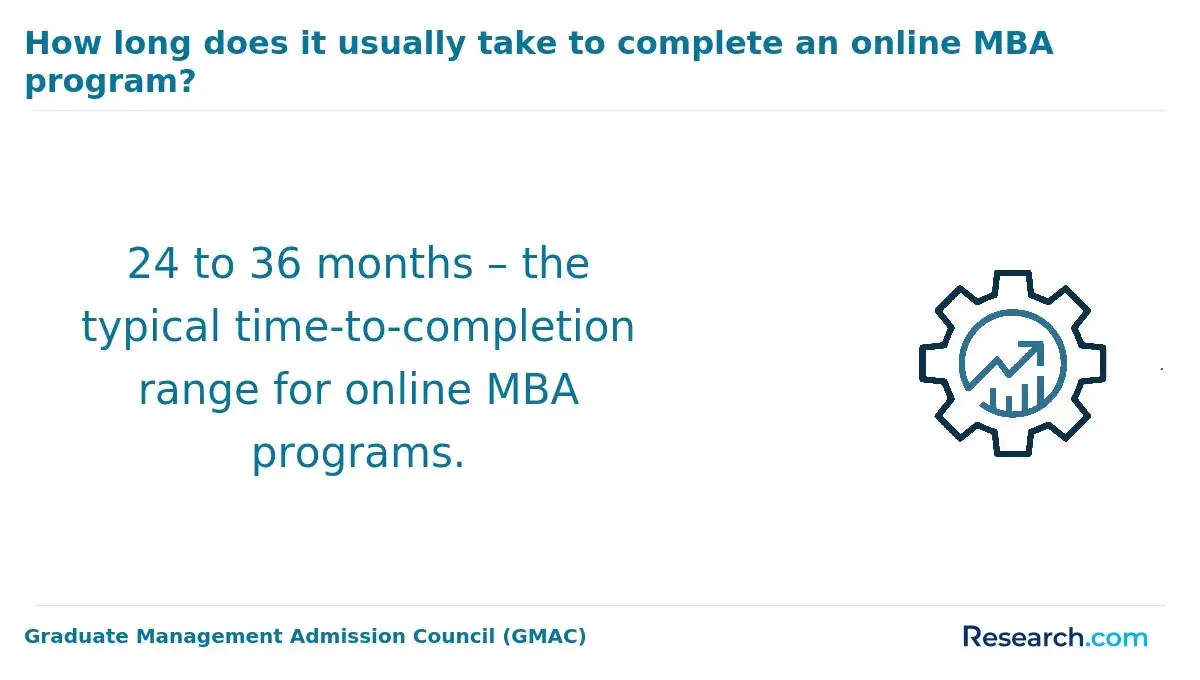
Program length affects ROI because it changes when you graduate, when you can pursue the full salary benefit of the degree, how quickly you must pay tuition, and how much flexibility you have to use employer reimbursement or current income. A 12-month program can accelerate payback, while a 24-month program may reduce financial and personal strain.
12-month accelerated online MBA
A 12-month accelerated online MBA can shorten the time to recoup investment because you finish sooner and can begin using the completed credential for promotions, salary negotiations, or job searches earlier. If the degree leads to a salary increase one year sooner than a longer program would, the ROI timeline can improve substantially.
- Faster credential value: You reach graduation sooner, which may help you qualify earlier for roles that require or prefer an MBA.
- Less time for costs to accumulate: A shorter enrollment period may reduce some semester-based fees and may limit the time that loan balances accrue interest while you are in school.
- Higher intensity: The trade-off is workload. Accelerated programs can be demanding for students with full-time jobs, family responsibilities, or frequent travel.
- Cash-flow pressure: Tuition may be due over a shorter period, which can increase the need for loans if savings or employer support cannot keep pace.
Students who want both lower cost and scheduling flexibility can compare affordable online MBA programs that offer accelerated completion options from accredited universities.
24-month or longer part-time online MBA
A 24-month or longer part-time online MBA usually delays the final credential, but it can make the degree easier to finance and manage. For many working professionals, a slightly longer program produces a better practical outcome because it protects job performance, reduces borrowing, and allows students to apply coursework at work while still enrolled.
- Better use of employer reimbursement: Employers often cap tuition benefits by year. Spreading the program over two years may allow you to use more employer funding and borrow less.
- Lower academic and career risk: A manageable course load can help you maintain performance at work and in school.
- Earlier workplace application: You may use finance, strategy, analytics, or leadership coursework immediately, which can support raises or promotions before graduation.
- Potentially longer payback clock: If your largest salary increase depends on graduating, a longer program delays the point at which the full return begins.
The best choice depends on your capacity. Choose the 12-month route if you can handle the workload and financing pace without damaging your job performance. Choose the 24-month route if lower stress, employer reimbursement, and reduced borrowing are more important to your long-term ROI.
Opportunity cost is one of the biggest differences between a part-time online MBA and a full-time MBA. For ROI purposes, opportunity cost usually means the salary, benefits, bonuses, and career progress you give up while studying. Online MBA students often avoid most of this cost because they remain employed.
Full-time MBA program
In a full-time MBA program, foregone salary is often the largest part of the total investment. Students commonly leave the workforce for a 1 to 2-year program, which means they must account for both direct costs and lost earnings.
- Direct costs: Tuition, fees, books, housing, relocation, travel, and living expenses.
- Foregone compensation: Salary, bonuses, benefits, retirement contributions, and potential promotions missed during enrollment.
- ROI impact: The total investment is much larger because it includes tuition and fees plus living expenses plus foregone salary. This can push the payback period to 4 to 5+ years, even when the post-MBA salary increase is strong.
A full-time MBA may still be worthwhile for students seeking a major career pivot, access to elite recruiting pipelines, or an immersive campus network. The financial hurdle is simply higher because the student pauses full-time earnings.
Part-time online MBA
For a part-time online MBA, foregone salary is usually close to $0 because the program is designed for working professionals. The main financial costs are tuition, fees, materials, travel for any required residencies, and financing charges.
- Direct costs remain: You still need to evaluate the full bill, including fees and loan interest.
- Income continues: Keeping your job lowers the total investment and reduces pressure to borrow for living expenses.
- ROI impact: Because the largest cost component is removed, the payback period is often shorter, commonly 2 to 4 years, depending on program cost and salary growth.
The trade-off is time and energy. Online MBA students may not lose salary, but they do give up evenings, weekends, and personal flexibility. That non-monetary cost matters, especially in accelerated programs, but it usually does not carry the same financial weight as leaving the workforce for a full-time MBA.
The value of an online MBA is not limited to salary increases. For many professionals, the degree also improves career resilience, leadership confidence, business judgment, and access to a broader professional network. These benefits are harder to quantify, but they can determine whether the program is worth the time and effort.
Professionals seeking leadership advancement may also compare affordable EMBA programs, which can offer executive-level networking and strategic training for experienced managers.
Career flexibility and lower disruption
- The benefit: Online MBA students can often keep their jobs, stay in their current location, and maintain family or personal commitments while earning the degree.
- Why it matters: This lowers career risk. You do not have to pause your income or leave an employer where you may already have advancement opportunities.
- How to factor it in: If relocating or leaving work would create financial strain, the flexibility of an online program may be a major part of its value, even if another program has a stronger brand.
Immediate application at work
- The benefit: Students can apply concepts from accounting, finance, operations, analytics, marketing, and leadership courses directly to current projects.
- Why it matters: This can produce measurable value before graduation, such as better decision-making, stronger presentations, improved team management, or more strategic contributions.
- How to factor it in: If your current employer rewards initiative, an online MBA may help you build a promotion case while you are still enrolled.
Broader professional network
- The benefit: Online cohorts often include professionals from different regions, industries, functions, and career stages.
- Why it matters: A geographically diverse network can provide referrals, industry insight, mentorship, partnerships, and long-term career support.
- How to factor it in: Review whether the program offers live classes, cohort projects, alumni events, career coaching, and optional residencies. A network is only valuable if the program creates real opportunities to build relationships.
Digital leadership and self-management skills
- The benefit: Online learning requires disciplined time management, written communication, virtual collaboration, and comfort with digital tools.
- Why it matters: These skills are increasingly relevant for managers leading distributed teams, remote employees, vendors, and cross-functional projects.
- How to factor it in: If your career path involves remote leadership, project management, consulting, or technology-enabled operations, the online format can strengthen practical skills beyond the MBA curriculum.
When comparing programs, treat non-monetary benefits as part of the total value proposition. A program with moderate salary gains may still be worthwhile if it protects your income, expands your network, and helps you move into work that is more stable, flexible, or aligned with your long-term goals.
Total program costs for public university online MBA students depend on whether the school charges one online tuition rate for all students or uses separate in-state and out-of-state rates. This is one of the first cost details applicants should verify because it can change the value of a public university program significantly.
Flat-rate online tuition model
Many public universities use a flat-rate tuition structure for 100% online MBA programs. Under this model, in-state and out-of-state students pay the same per-credit rate or the same total program price.
- How it works: The university sets a separate online MBA rate that applies to all students regardless of residency.
- Impact for out-of-state students: This can produce major savings because students avoid the non-resident surcharge often attached to campus programs.
- Impact for in-state students: The online rate may be higher than the on-campus in-state rate, but it may still be competitive compared with private universities or out-of-state campus programs.
- Example: A major state university's on-campus MBA might cost $30,000 for in-state and $60,000 for out-of-state students, but their online MBA program charges a flat rate of $45,000 to everyone.
Differential tuition model
Some public universities still charge different online MBA rates for residents and non-residents, especially when the online program is closely connected to part-time, evening, or hybrid campus formats.
- How it works: In-state students pay a lower rate, while out-of-state students pay a higher non-resident rate.
- Impact for in-state students: This can make the program one of the lowest-cost options available, especially if the business school is accredited and well regarded in the region.
- Impact for out-of-state students: The program may still be less expensive than relocating for a full-time MBA, but the tuition premium can reduce ROI compared with flat-rate online options.
Costs to check beyond residency tuition
- Technology or online learning fees: These fees are often charged to all students, regardless of residency.
- Program fees: Some business schools add per-course, per-credit, or per-term fees on top of tuition.
- Residency or immersion expenses: If the online MBA requires campus visits, students must budget for travel, lodging, meals, and time away from work.
- Course materials: Textbooks, software, cases, and simulations may not be included in tuition.
Before applying, ask the program for a full cost-of-attendance estimate for your residency status. A public university online MBA can be an excellent value, but only if you compare the full bill rather than the tuition headline.
The percentage of online MBA students who receive scholarships, assistantships, or other cost reductions varies widely by school and student profile. Full-tuition awards are uncommon, but partial scholarships, employer reimbursement, and need-based aid can meaningfully reduce the net cost for many students.
Scholarships and need-based aid
Online MBA students may qualify for institutional scholarships, merit awards, diversity scholarships, military benefits, professional association awards, or need-based aid. Availability depends on the program’s budget and admissions strategy.
- Need-based aid: Reports suggest that around 30% of online MBA students in the U.S. receive some form of need-based financial aid each year.
- Merit-based awards: Many programs consider applicants for awards based on academic achievement, professional experience, leadership potential, and GMAT/GRE scores when submitted.
- Award size: Merit awards may range from a few thousand dollars up to 50% of tuition, depending on the school and applicant pool.
Employer financial support
Employer tuition assistance is often the most important source of cost reduction for online MBA students because many remain employed while studying. According to industry data, upwards of 50% to 60% of all MBA students, a category that includes the majority of online/part-time students, report receiving some form of financial support or tuition reimbursement from their employer.
Before counting on this benefit, review your employer’s policy carefully. Some companies require a minimum grade, annual reimbursement limits, manager approval, a business-related program, or a commitment to stay with the employer for a set period after reimbursement.
Graduate assistantships
Graduate assistantships are less common for 100% online MBA programs than for residential graduate programs. Traditional assistantships often require teaching, research, or administrative work on campus, which may make online students ineligible.
Some universities may offer remote administrative assistantships or limited online support roles, but the number of positions is usually far smaller than the number available to campus-based students. Applicants should not assume a graduate assistantship will be available unless the business school specifically confirms eligibility for online MBA students.
How to improve your chances of reducing cost
- Apply early, since scholarship funds may be limited.
- Ask whether admitted students are automatically considered for merit aid or must submit a separate application.
- Compare employer reimbursement rules with the program’s billing schedule.
- Ask whether scholarships are renewable and what GPA is required to keep them.
- Check whether military, public service, alumni, or professional association discounts apply.
The net cost of an online MBA can be much lower than the published price, but only if you actively pursue aid and understand the conditions attached to each funding source.
Student loans reduce the final ROI of an online MBA because interest and fees increase the total amount you must recover after graduation. Self-funding avoids borrowing costs, but it can also reduce your savings and financial flexibility. The better choice depends on your cash reserves, loan terms, employer support, and expected salary increase.
Loans increase total investment and extend payback
When you borrow for an online MBA, the cost of the degree is no longer just tuition and fees. Graduate loans are often unsubsidized, meaning interest may begin accruing while you are enrolled. Origination fees can also raise the effective cost of borrowing.
For an online MBA that costs, for instance, $60,000, taking out loans at a common rate of 6% to 8% APR over a 10-year repayment term can easily add $20,000 to $30,000 or more in interest payments. That added cost lowers your final ROI percentage and lengthens the time required for your post-MBA salary increase to offset the investment.
Self-funding improves dollar-for-dollar ROI
Self-funding usually produces a stronger financial ROI because you avoid interest and loan fees. If you pay as you go using savings, current income, or employer reimbursement, each dollar of post-MBA salary increase is not reduced by debt service.
The risk is liquidity. Using too much cash can weaken your emergency fund, delay a home purchase, reduce retirement contributions, or limit your ability to invest. A high ROI on paper is less useful if paying cash leaves you financially exposed.
Borrowing can still be a rational choice
Borrowing may make sense if it preserves financial stability or allows you to keep savings invested. For example, if you can borrow at a low interest rate, such as 6%, and invest your savings in a portfolio that yields a higher return, such as 8% or 10%, debt may be strategically acceptable. That said, investment returns are not guaranteed, while loan payments are.
Practical ways to protect ROI when borrowing
- Borrow only what you need after scholarships, employer support, and personal contributions.
- Pay interest while enrolled if possible to reduce capitalization.
- Compare federal and private loan terms carefully, including repayment protections.
- Use signing bonuses, raises, or tax refunds to reduce principal faster.
- Avoid stretching repayment unnecessarily if your post-MBA income allows faster payoff.
Self-funding maximizes the MBA’s direct financial return, but borrowing can be reasonable when it protects cash flow and enables enrollment in a program with credible career upside.
Should I prioritize an affordable online MBA program over a higher-ranked but more expensive one for maximizing ROI?
You should prioritize an affordable online MBA if your goal is a promotion, a management credential, or a lower-risk path to business training. You may be better served by a higher-ranked and more expensive program if you need stronger recruiting access, a prestigious brand, or a major career pivot. ROI depends on the outcome you are buying, not just the tuition price.
When an affordable online MBA may maximize ROI
An affordable program is often the better financial choice when the MBA is meant to strengthen your current career path rather than transform it completely.
- You need the credential for advancement: If your employer values an MBA for promotion eligibility, an accredited lower-cost program can deliver the requirement without excessive debt.
- You plan to stay in your industry: Professionals already established in healthcare, manufacturing, government, education, operations, or regional business markets may benefit more from practical skills than from an elite brand.
- You want faster payback: A program costing $30,000 versus one costing $100,000 will be recouped much faster if both lead to the same salary increase.
- You want lower financial risk: Less borrowing means less interest, less pressure to chase a high-paying role immediately, and more flexibility after graduation.
- Accreditation matters more than rank: For many corporate roles, AACSB accreditation and institutional reputation may matter more than a top-10 ranking.
When a higher-ranked program may justify the cost
A higher-ranked online MBA can make sense when the school’s brand, alumni network, and recruiting access are central to your expected return.
- You want a major career pivot: Moving into management consulting, investment-oriented finance, product leadership, or executive-track corporate roles may require stronger brand recognition.
- You need a premium network: Higher-ranked programs may attract more senior peers, experienced faculty, and influential alumni who can support long-term mobility.
- You are targeting highly selective employers: Some firms rely on established recruiting relationships with specific business schools.
- The salary premium is credible: Graduates from top-tier, highly ranked online programs, such as UNC Kenan-Flagler or IU Kelley, may report average salaries often over $140,000 compared to under $100,000 for many affordable options.
A practical decision rule
Choose the lower-cost accredited program when the expected career outcome is similar across schools. Choose the higher-ranked program when it provides access you cannot realistically get otherwise: stronger recruiting, a more powerful network, a recognized brand in your target industry, or a credible path to a much larger salary increase.
The strongest ROI comes from fit. A prestigious MBA with heavy debt can be a poor investment if it does not change your career trajectory. A low-cost MBA can be an excellent investment if it helps you earn a promotion, switch into management, or improve long-term career stability without taking on unnecessary financial risk.
Other Things You Should Know About Online MBA ROI
An online MBA can significantly enhance your salary negotiation power in 2027. Graduates typically report an average salary increase of 20-30%, depending on the industry and prior experience, partly due to enhanced skills and network.
Salary outcomes for online MBA graduates in 2027 are influenced by factors such as the reputation of the program, industry-specific demand, alumni network, and geographical location. These elements collectively impact the return on investment by potentially increasing the salary negotiation power post-graduation.
Many online MBA graduates recover tuition in 3 to 7 years when post-degree salary rises are paired with employer tuition support. Programs with total tuition under $40,000 and salary jumps of $15,000 to $30,000 a year usually reach break-even faster, especially when students avoid lost income by studying part-time.
- BusinessBecause. (2025). MBA hiring set to outpace other degrees in 2025, new survey reveals.
- Coursera. (2025). MBA salary: 2025 guide.
- Howard University Online MBA. (n.d.). Will an MBA increase my salary if I stay with the same employer after graduating?
- Financial Planning & Analysis Concepts. (n.d.). Calculating Return on Investment (ROI) and Payback Period.
- Poets & Quants. (n.d.). Online MBA Rankings and Salary Outcomes.