2027 Online Mechanical Engineering Degrees for Students Who Want Engineering-and-Manufacturing Hybrid Careers

Co-Founder and Chief Data Scientist
Choosing an online mechanical engineering degree is a bigger decision when your goal is not just design work, but a hybrid career in manufacturing, automation, quality, or production systems. The U.S. Bureau of Labor Statistics reports a $99,510 median annual wage for mechanical engineers in May 2024, with employment projected to grow 9% from 2024 to 2034.
This guide explains degree types, accreditation, costs, online trade-offs, skills, and career outcomes so you can judge whether the investment fits your manufacturing-focused goals.
Key Things You Should Know
- For U.S. employer recognition, an online bachelor's in mechanical engineering should generally hold ABET Engineering Accreditation Commission accreditation; master's programs are usually evaluated more by institutional accreditation, curriculum, faculty expertise, and employer relevance.
- According to the College Board's 2024 Trends in College Pricing, average published tuition and fees for public four-year in-state students were $11,610 in 2024-25, making total cost, transfer credits, and lab travel requirements central ROI factors.
- Manufacturing-focused mechanical engineering students should prioritize CAD, materials, thermodynamics, controls, robotics, quality systems, data analysis, and hands-on lab access because hybrid roles often connect design decisions to production performance.
What is an online mechanical engineering degree and how does it support hybrid engineering-manufacturing careers?
An online mechanical engineering degree is a college program that teaches the principles used to design, analyze, test, and improve mechanical systems. In a manufacturing-focused path, those principles are applied to production equipment, product design for manufacturability, automation, materials selection, quality control, maintenance reliability, and process improvement.
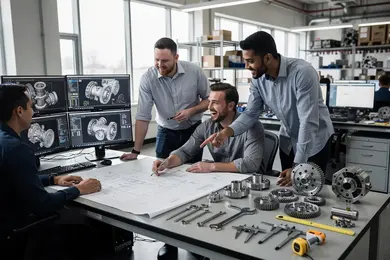
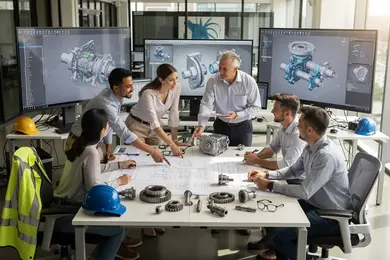
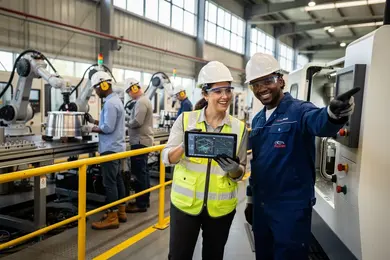
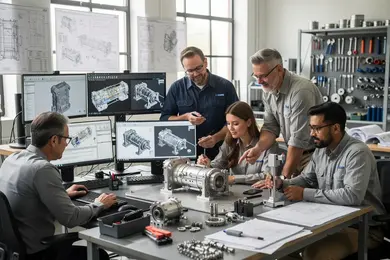
The "hybrid" part matters because many employers need engineers who can move between the design office and the plant floor. A hybrid engineering-manufacturing professional may review CAD drawings in the morning, troubleshoot a production bottleneck after lunch, and use quality data to recommend a process change before the end of the day.
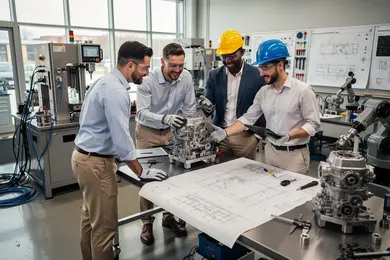
Online delivery usually means lectures, simulations, assignments, and discussions are completed remotely. However, mechanical engineering is not purely virtual. Strong programs still provide structured lab work through short campus residencies, approved local lab sites, mailed experiment kits, remote instrumentation, or partnerships with employers.
This degree can be a good fit if you want roles that combine analysis with practical implementation. It may be less ideal if you want a program with daily in-person machine-shop access, a traditional residential campus experience, or a narrow path into a field that requires a different license or major.
Students who are comparing applied STEM fields beyond manufacturing may also look at an online geology degree, especially if their interests lean toward earth materials, energy, environmental systems, or natural-resource industries rather than mechanical design and production systems.
How do online mechanical engineering programs compare to campus-based options for manufacturing-focused students?
Online and campus-based mechanical engineering programs can lead to similar academic goals, but the learning experience is different. Manufacturing-focused students should compare not only convenience but also lab access, equipment exposure, internship options, and opportunities to work on real production problems.
The table below summarizes the most important differences for students who want engineering-and-manufacturing careers. Use it to identify which format better matches your schedule, learning style, and need for hands-on support.
| Factor | Online mechanical engineering program | Campus-based mechanical engineering program | Decision point for manufacturing-focused students |
| Schedule | Often better for working adults, military students, and learners near manufacturing employers | Usually more structured around daytime classes and campus activities | Online may work better if you already work in a plant, shop, or technical role |
| Labs | May use remote labs, kits, local proctors, or short residencies | Typically offers regular access to campus labs, machine shops, and test equipment | Ask exactly how fluids, materials, controls, and manufacturing labs are completed |
| Networking | May rely on virtual teams, employer projects, and regional internships | Often provides easier access to student organizations, design teams, and career fairs | Online students should confirm employer partnerships and internship support |
| Cost | Can reduce relocation and commuting costs, but may include technology or residency fees | May include higher housing, transportation, and campus fees | Compare total cost, not just tuition per credit |
| Best fit | Self-directed students who can manage time and seek hands-on experience intentionally | Students who want frequent face-to-face support and physical lab access | Choose based on how you will build practical manufacturing experience |
For many students, online study makes the most sense when it is paired with a relevant job, internship, co-op, makerspace access, or employer-sponsored project. Without that practical component, an online degree can feel too theoretical for manufacturing roles that expect production awareness.
Common mistakes include assuming "online" means easier, ignoring residency requirements, or enrolling before confirming how labs are assessed. A better approach is to ask for a sample course sequence, a list of required lab experiences, and examples of recent manufacturing-related capstone projects.
What accreditation should online mechanical engineering degrees have to be recognized by U.S. employers?
Accreditation is one of the most important checks for any online mechanical engineering degree. In the United States, institutional accreditation verifies that the college or university meets broad academic and administrative standards, while programmatic accreditation evaluates whether a specific engineering program meets discipline-level expectations.
For bachelor's programs in mechanical engineering, the key credential is ABET accreditation through the Engineering Accreditation Commission. This is especially important if you may pursue Fundamentals of Engineering exam eligibility, professional engineering licensure, government engineering roles, defense contractors, or employers that screen for ABET-accredited engineering degrees.
The table below explains the accreditation signals students should verify before enrolling. This is especially important because "engineering," "engineering technology," and "industrial technology" can sound similar but may lead to different employer and licensure outcomes.
| Credential or approval | Why it matters | What to verify |
| Institutional accreditation | Supports federal financial aid eligibility, transferability, and general institutional legitimacy | Confirm the school is accredited by a recognized institutional accreditor |
| ABET Engineering Accreditation Commission | Strongest recognition signal for bachelor's-level mechanical engineering programs | Confirm the exact online program name appears in ABET records, not just the university |
| Engineering technology accreditation | May fit applied manufacturing and technician-to-engineer advancement paths, but is not the same as engineering accreditation | Ask employers or licensing boards whether this credential fits your target role |
| State authorization | Online programs must be authorized to enroll students in certain states | Confirm you can legally enroll from your state and complete any required placements |
| Licensure alignment | Professional engineering requirements vary by state | Check your state engineering board if PE licensure is part of your long-term plan |
A major red flag is a school that uses vague language such as "ABET-aligned" or "based on ABET standards" without holding ABET accreditation for the actual program. That wording may describe curriculum intent, but it is not the same as accreditation.
What types of online mechanical engineering degrees prepare students for engineering-and-manufacturing roles?
Online mechanical engineering options are not all designed for the same student. A first-time college student, an associate-degree holder in manufacturing technology, and a working engineer seeking automation leadership may need different credentials.
The table below compares the main online degree types and how they fit engineering-and-manufacturing career goals. Use it to decide whether you need a full engineering degree, an applied technology route, or graduate specialization.
| Program type | Typical student | Manufacturing career value | Important limitation |
| Online bachelor's in mechanical engineering | Students seeking entry-level mechanical engineering roles | Builds the broadest foundation in mechanics, thermal systems, design, materials, and analysis | Needs strong lab structure and, ideally, ABET accreditation |
| Online bachelor's completion program | Transfer students with prior credits or an associate degree | Can shorten time to degree for technicians moving into engineering roles | Transfer rules can be strict for calculus, physics, and engineering core courses |
| Online mechanical engineering technology degree | Applied learners focused on equipment, production, testing, and implementation | Can fit manufacturing supervision, applications engineering, or technical operations | May not be treated the same as engineering for some licensure or design roles |
| Online master's in mechanical engineering | Engineers or STEM graduates seeking advancement | Supports specialization in robotics, materials, thermal systems, controls, or advanced manufacturing | Usually assumes prior engineering math and core coursework |
| Graduate certificate in manufacturing or systems engineering | Professionals who need targeted skills without a full degree | Can add credentials in lean manufacturing, quality, automation, or product development | May not replace a degree for engineering job postings |
A bachelor's degree is usually the cleanest route for students seeking entry-level mechanical engineer titles. A master's degree is more strategic when you already have an engineering or closely related STEM background and want to move into technical leadership, advanced design, automation, or research-informed manufacturing work.
If your strongest interest is manufacturing software, embedded systems, industrial data, or AI-assisted automation, a mechanical engineering degree is not the only route. Some students compare it with a fast track computer science degree when they want to move faster into software-heavy automation, controls, or digital manufacturing roles.
What courses and technical skills do online mechanical engineering programs emphasize for manufacturing careers?
Mechanical engineering programs prepare students for manufacturing careers by combining engineering science with applied design, analysis, and systems thinking. The most valuable courses are the ones that teach students to understand both why a design works and how it can be produced reliably at scale.
Students should look for a curriculum that connects theory to manufacturing applications. The following skill areas are especially relevant for hybrid engineering-manufacturing roles:
- CAD and computer-aided engineering: 3D modeling, assemblies, tolerance stack-ups, finite element analysis, and design documentation used in product development and production handoff.
- Materials and manufacturing processes: metals, polymers, composites, heat treatment, machining, casting, forming, additive manufacturing, and process selection.
- Thermodynamics and fluid systems: heat transfer, energy systems, pumps, compressors, HVAC systems, and thermal management for equipment and products.
- Dynamics, mechanics, and machine design: stress, fatigue, vibration, power transmission, bearings, shafts, and mechanisms used in machinery and production equipment.
- Controls, robotics, and automation: sensors, actuators, feedback control, programmable systems, motion control, and human-machine interfaces.
- Quality and reliability: statistical process control, root-cause analysis, design of experiments, metrology, failure analysis, and continuous improvement.
- Data and programming: Python, MATLAB, simulation tools, manufacturing analytics, and basic database or spreadsheet modeling for process decisions.
AI and automation are changing expectations in manufacturing roles. Employers increasingly value engineers who can use simulation, digital twins, machine data, and AI-assisted design tools, but these tools do not replace the need to understand physics, tolerances, safety, and production constraints.
A practical way to evaluate a program is to review the capstone sequence. A strong manufacturing-relevant capstone might involve redesigning a fixture, automating a test process, reducing scrap, improving thermal performance, or validating a prototype against production constraints.
What are typical admission requirements for online mechanical engineering bachelor's and master's programs?
Admission requirements vary by school and degree level, but mechanical engineering is math-intensive. Students should expect admissions teams to look closely at calculus readiness, physics preparation, prior engineering coursework, and academic performance in technical subjects.
The table below compares common requirements for bachelor's and master's programs. Requirements can vary, so applicants should use this as a planning checklist rather than a substitute for a school's official admissions page.
| Requirement | Online bachelor's programs | Online master's programs |
| Prior education | High school diploma, GED, or transfer credits | Bachelor's degree, often in mechanical engineering or a related engineering field |
| Math preparation | College algebra, precalculus, or calculus placement may be required | Calculus, differential equations, linear algebra, or engineering math may be expected |
| Science preparation | Physics and chemistry may be required or strongly recommended | Prior engineering science coursework is commonly expected |
| Transfer review | Important for associate-degree holders and returning students | May apply to prerequisite gaps, but graduate transfer credit is often limited |
| Work experience | Usually optional, but helpful for applied manufacturing students | Helpful or preferred in practice-oriented programs |
| Test scores | Many schools are test-optional, but placement testing may still apply | GRE requirements vary and are often waived by some programs |
Applicants coming from technician, machinist, maintenance, military, or quality-control backgrounds should not undersell their experience. That background can strengthen essays and interviews, especially when it shows exposure to production problems, safety practices, equipment, and team-based troubleshooting.
Before applying, students can reduce delays by completing a focused preparation sequence. These steps are especially useful for adults returning to school after time away from formal math:
- Request an unofficial transcript review before applying so you know which credits may transfer into calculus, physics, chemistry, or engineering courses.
- Ask whether the program offers a bridge path for students who need precalculus, calculus, or physics before entering the engineering core.
- Confirm whether lab courses can be completed from your state and whether any campus visits are mandatory.
- Prepare a resume that highlights manufacturing, CAD, maintenance, quality, programming, robotics, or military technical experience.
- Ask admissions how often engineering courses are offered, because missing a prerequisite can delay graduation by a term or more.
How long do online mechanical engineering degrees take, and what do they cost?
Most online bachelor's degrees in mechanical engineering require about four years of full-time study, though transfer students may finish faster and part-time students may take longer. Online master's programs commonly take about one to three years depending on credit load, prerequisites, thesis requirements, and whether the student is working full time.
Cost varies widely by residency status, institution type, transfer credit, fees, and required labs. The College Board's 2024 Trends in College Pricing reported average published tuition and fees of $11,610 for in-state students at public four-year institutions in 2024-25; this benchmark helps students understand why public online options can be financially attractive, but it does not include housing, books, tools, software, or course-specific engineering fees.
The table below shows the main cost factors that can change the total price of an online mechanical engineering degree. This is useful because two programs with similar tuition rates can have very different total costs.
| Cost factor | Why it matters | What to ask before enrolling |
| Tuition per credit | Usually the largest direct cost | Is online tuition the same for in-state and out-of-state students? |
| Transfer credits | Can shorten time and reduce cost | How many technical credits will count toward the major, not just electives? |
| Lab requirements | May add travel, lodging, equipment, or proctoring costs | Are campus residencies required, and how often? |
| Software and hardware | CAD, simulation, and programming tools may require capable computers | Which software is included, and what computer specifications are required? |
| Course sequencing | Delayed prerequisites can extend enrollment | Are upper-level engineering courses offered every term or only once per year? |
| Financial aid eligibility | Can affect affordability and borrowing | Is the program eligible for federal aid, scholarships, employer tuition assistance, or veterans' benefits? |
Students searching specifically for the cheapest online mechanical engineering degree should still compare accreditation, lab quality, graduation timeline, and transfer policy. The lowest tuition is not always the lowest total cost if credits do not transfer, courses are unavailable when needed, or required travel is expensive.
To reduce cost without weakening career value, prioritize transferable community college math and science courses, employer tuition assistance, in-state public options, scholarships for engineering students, and programs that publish clear degree maps.
Avoid borrowing based on best-case salary assumptions; instead, estimate payments using conservative income scenarios and the specific roles you are likely to pursue.
What engineering-and-manufacturing job titles can graduates of online mechanical engineering programs pursue?
Graduates of online mechanical engineering programs can pursue several manufacturing-related paths, depending on degree level, experience, location, industry, and whether the program is engineering or engineering technology. Entry-level candidates often begin in design, process, quality, test, or production support roles before moving into more specialized engineering or leadership positions.
The table below connects common job titles with the kind of work they usually involve. Use it to identify which roles match your preferred balance of design, analysis, production, and people coordination.
| Job title | Typical manufacturing-related responsibilities | Best fit for |
| Mechanical engineer | Designs, analyzes, tests, and improves mechanical products, equipment, or systems | Students who want broad engineering flexibility |
| Manufacturing engineer | Improves production processes, tooling, workflows, equipment layouts, and manufacturability | Students who want direct plant-floor impact |
| Process engineer | Optimizes production variables, reduces waste, improves throughput, and documents process controls | Students who enjoy data-driven problem-solving |
| Quality engineer | Uses inspections, audits, root-cause analysis, and statistical tools to reduce defects | Students who like standards, measurement, and reliability |
| Product development engineer | Connects design, prototyping, testing, and production readiness | Students who want work across design and manufacturing teams |
| Automation or controls engineer | Works with sensors, actuators, robots, PLCs, motion systems, and production automation | Students who combine mechanical, electrical, and programming interests |
| Reliability engineer | Analyzes failures, maintenance patterns, equipment life, and risk reduction | Students interested in uptime, safety, and lifecycle performance |
| Applications engineer | Helps customers select, configure, and implement technical products or machinery | Students who like engineering plus communication |
Day-to-day work varies by industry. In automotive, an engineer may focus on tooling, fixtures, and launch readiness. In aerospace, documentation, tolerances, and compliance may be more intense. In medical devices, quality systems and validation can dominate. In consumer products, speed, cost, and design iteration may be central.
Advancement often depends on building both technical depth and cross-functional credibility. Engineers who can explain trade-offs to production operators, quality teams, suppliers, finance leaders, and customers are often better positioned for senior engineer, engineering manager, operations manager, or product leadership roles.
What salary ranges and job outlook can mechanical engineers expect in manufacturing-related roles?
Mechanical engineering can offer strong compensation compared with many bachelor's-level fields, but salary depends on role, industry, region, employer size, overtime expectations, security clearance requirements, and experience. Students should treat salary data as a planning benchmark, not a guarantee.
The U.S. Bureau of Labor Statistics reported a $99,510 median annual wage for mechanical engineers in May 2024. That figure is useful because it reflects the national labor market across industries, but manufacturing-focused graduates may earn more or less depending on whether they enter design engineering, production engineering, quality, automation, or a technician-to-engineer transition role.
The table below summarizes salary and outlook context for common manufacturing-related engineering paths. It uses national labor-market categories as a guide, so students should also research local employers and industry-specific pay.
| Career direction | Salary context | Outlook considerations |
| Mechanical engineering | BLS reported a $99,510 median annual wage for mechanical engineers in May 2024 | Projected employment growth of 9% from 2024 to 2034 suggests continued demand, especially where design, energy, automation, and production systems overlap |
| Manufacturing engineering | Often benchmarked against mechanical, industrial, or related engineering roles depending on employer classification | Demand is influenced by reshoring, advanced manufacturing investment, quality requirements, and automation adoption |
| Quality and reliability engineering | Pay varies by industry, with regulated sectors often valuing documentation and compliance experience | Strong fit in aerospace, automotive, medical devices, electronics, and defense supply chains |
| Automation and controls | May command higher pay when candidates combine mechanical knowledge with programming, robotics, and electrical systems | AI, robotics, and smart-factory initiatives are increasing the value of multidisciplinary engineers |
| Product development | Compensation can vary widely by product complexity, company size, and industry | Employers often value portfolios, prototypes, internships, and evidence of design-for-manufacturing experience |
Job outlook is also shaped by technology. AI-assisted design, generative design, simulation, robotics, and predictive maintenance can reduce repetitive tasks, but they also increase the need for engineers who can validate models, understand constraints, and make safe decisions in real production environments.
For ROI, compare likely local salary ranges with the total cost of attendance and your starting point. A working manufacturing technician using tuition assistance may face a very different financial equation than a first-time student borrowing for a full four-year program.
How can students evaluate and choose a reputable online mechanical engineering program for manufacturing careers?
Choosing a reputable online mechanical engineering program requires more than scanning rankings or choosing the lowest tuition. The best program is the one that aligns with your target role, has recognized accreditation, provides credible lab experiences, fits your schedule, and gives you a realistic path to graduate without unnecessary debt.
Use the following steps to evaluate programs before applying. These actions help you avoid common mistakes that can affect transferability, licensure options, cost, and employability:
- Verify institutional accreditation and, for bachelor's engineering programs, confirm whether the exact mechanical engineering program has ABET Engineering Accreditation Commission accreditation.
- Ask how every required lab is completed, including whether you must travel, buy equipment, use a local site, or attend live sessions.
- Request a degree plan showing prerequisites by term so you can see whether part-time enrollment will delay upper-level engineering courses.
- Compare total cost, including tuition, fees, software, hardware, travel, books, proctoring, and lost work time.
- Review manufacturing-relevant electives such as automation, robotics, materials, additive manufacturing, quality, thermal systems, and design for manufacturability.
- Ask for examples of capstone projects, internship support, employer partnerships, and graduate job titles.
- Check transfer policies before taking outside courses, especially calculus, physics, chemistry, statics, dynamics, circuits, and materials.
- Ask whether the program supports FE exam preparation if professional licensure may matter later.
- Talk with current students or alumni about instructor availability, online course quality, lab support, and workload realism.
- Compare the degree with alternatives if your target career is more software-heavy, operations-focused, technician-oriented, or business-oriented than engineering-centered.
Red flags include unclear accreditation language, no transparent lab plan, limited faculty access, vague career claims, missing graduation requirements, unusually aggressive admissions pressure, and refusal to provide total cost estimates. A reputable program should be able to answer detailed questions without relying on slogans.
Career fit matters, too. If you enjoy mechanical systems, production problem-solving, math, design, and hands-on improvement, this path can be a strong match. If your interests are more focused on information organization, public services, or research support outside engineering, comparing other career guides such as "Is library science a good career?" may help clarify whether a technical manufacturing path is truly the right fit.
Other Things You Should Know About Mechanical Engineering
Yes, but the program must provide legitimate engineering coursework and credible lab experiences. For bachelor's programs, ABET accreditation is often the most important recognition factor for employers and licensure-oriented students.
Internships are not always required, but they are highly valuable for manufacturing careers. They help students prove they can work with equipment, production teams, safety rules, quality systems, and real engineering constraints.
It depends on the role. Mechanical engineering is stronger for product design, machinery, thermal systems, and mechanical analysis, while industrial engineering is often stronger for workflow, operations, systems optimization, and productivity.
In 2027, online mechanical engineering degree programs typically require a reliable computer with a high-speed internet connection, a minimum of 8GB RAM, and a modern multi-core processor. Essential software often includes CAD applications like AutoCAD, MATLAB, and various simulation tools, which demand adequate processing power and graphics support.
References
- 2025 Best Online Mechanical Engineering Degrees https://www.onlineu.com/degrees/mechanical-engineering
- Mechanical Engineering Courses: Requirements & Career Prospects - AECC https://www.aeccglobal.my/popular-courses/mechanical-engineering/
- Online Mechanical Engineering Degrees 2025 https://www.affordablecollegesonline.org/degrees/engineering-programs/mechanical-engineering/
- 9 Engineering Jobs to Pursue with an Engineering Degree https://www.pointloma.edu/resources/undergraduate-studies/9-engineering-jobs-pursue-engineering-degree
- Campus vs Online Engineering Degrees - What Employers Think https://www.itcareerfinder.com/brain-food/blog/entry/what-employers-think-about-online-engineering-degrees.html
- Accreditation - ABET https://www.abet.org/accreditation/
- Faculty of Graduate and Postdoctoral Studies | University of Manitoba - Mechanical Engineering (MSc, MEng) https://umanitoba.ca/graduate-studies/admissions/programs-of-study/mechanical-engineering-msc-meng
- What Is Mechanical Engineering? A Career Guide https://www.manipaldubai.com/blogs/what-is-mechanical-engineering
- What are some Essential skills that a Mechanical Engineer Studying in Abroad University? https://bitonlinelearn.com/blogs/What-are-some-Essential-skills-that-a-Mechanical-Engineer-Studying-in-Abroad-University
- ADMISSION CRITERIA https://www.villanova.edu/university/engineering/academic-programs/mechanical/ms-mechanical-engineering/admission-criteria.html