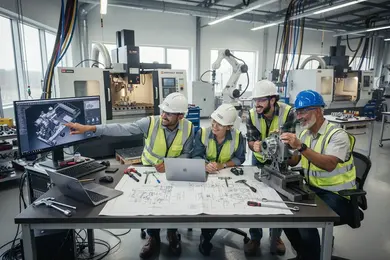
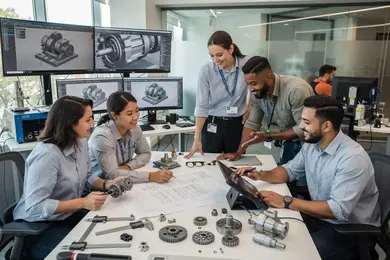
2027 Mechanical Engineering Careers That Reward Strong CAD Skills

Co-Founder and Chief Data Scientist
Mechanical engineering students often wonder whether CAD is just a class requirement or a career advantage. It can be both: the U.S. Bureau of Labor Statistics reported a $102,320 median annual wage for mechanical engineers in May 2024, and employers increasingly expect design, modeling, and simulation fluency.
This guide is for students, career changers, and early-career engineers who want CAD-intensive roles. You will learn which careers rely on CAD, which industries hire for it, what training matters, and how to choose a program that builds job-ready design skills.
Key Things You Should Know
- CAD-heavy mechanical engineering careers are strongest in product design, aerospace, automotive, robotics, manufacturing, medical devices, energy systems, and simulation-driven roles where 3D modeling supports design, testing, documentation, and production decisions.
- The BLS May 2024 median annual wage for mechanical engineers was $102,320, but CAD-focused pay varies widely by industry, software depth, simulation ability, security clearance, location, and whether the role includes engineering authority beyond drafting.
- The smartest preparation combines an ABET-accredited mechanical engineering degree, hands-on CAD projects, exposure to simulation and manufacturing, and a portfolio that shows constraints, design decisions, tolerances, assemblies, and revisions.
What mechanical engineering careers rely most heavily on advanced CAD skills today?
Advanced CAD skills matter most in careers where engineers turn requirements into physical products, validate those products virtually, and prepare them for manufacturing or field use. In these roles, CAD is not just drawing; it is a decision-making system for geometry, materials, tolerances, assemblies, simulation, documentation, and collaboration.
The most CAD-intensive mechanical engineering careers usually fall into four categories: design engineering, product development, manufacturing engineering, and simulation-supported engineering. A product design engineer may spend much of the week building assemblies, checking fit and motion, revising models after prototype testing, and preparing drawings for suppliers.
A manufacturing engineer may use CAD to design fixtures, tooling, jigs, workholding, or layout changes that make production more reliable. A simulation engineer may import CAD geometry into finite element analysis or computational fluid dynamics tools to test strength, heat transfer, vibration, or flow before a physical prototype is built.
The table below compares common CAD-heavy career paths by how CAD is used and what separates entry-level users from advanced practitioners:
| Career path | How CAD is used | What advanced skill looks like | Best fit for |
| Mechanical design engineer | Creates parts, assemblies, drawings, and design revisions | Parametric modeling, design intent, GD&T, manufacturability, tolerance stackups | Students who enjoy product form, function, and technical problem-solving |
| Product development engineer | Turns concepts into tested, manufacturable products | Rapid iteration, prototyping, design reviews, cross-functional collaboration | Engineers who like balancing customer needs, cost, performance, and deadlines |
| Manufacturing engineer | Designs fixtures, tooling, equipment layouts, and process improvements | Design for manufacturability, fixture design, CAM awareness, quality constraints | Students who want to connect design decisions to factory performance |
| Aerospace or automotive design engineer | Models structures, housings, brackets, mechanisms, and subsystems | Large assemblies, configuration control, lightweighting, standards compliance | Engineers comfortable with regulated, documentation-heavy environments |
| Simulation or CAE engineer | Prepares geometry for virtual testing and interprets results | FEA, CFD, meshing, boundary conditions, model simplification, validation | Students who like math, physics, and evidence-based design decisions |
| Robotics or mechatronics engineer | Models robot frames, end effectors, actuators, enclosures, and mechanisms | Motion studies, packaging, sensor integration, electromechanical design | Engineers interested in machines that combine mechanics, controls, and software |
Readers should distinguish CAD-heavy engineering from pure drafting. Drafting roles often focus on producing or updating drawings from engineer instructions, while engineering roles require analysis, requirements interpretation, design responsibility, and technical trade-off decisions. Strong CAD skills can help with both, but the highest-value roles usually pair CAD with physics, materials, manufacturing, and communication.
Which industries hire mechanical engineers specifically for strong CAD and modeling expertise?
Industries that build complex physical products tend to value CAD-intensive mechanical engineers the most. These employers use digital models to reduce prototype cycles, coordinate suppliers, document compliance, and avoid expensive redesigns after production begins.
Aerospace, automotive, medical device, defense, industrial equipment, consumer products, energy, and robotics companies are especially likely to screen for CAD depth. The same is true for engineering services firms that support manufacturers through contract design, tooling, testing, or plant upgrades.
According to BLS occupational employment data released in 2024, architectural, engineering, and related services remained one of the major employment settings for mechanical engineers, which matters because these firms often hire engineers for project-based design and modeling work across multiple industries.
Use the following comparison to think beyond "which industry sounds exciting" and evaluate where your CAD skills may translate into stronger job fit:
| Industry | Typical CAD-intensive work | What employers often value | Trade-off to consider |
| Aerospace and defense | Structures, brackets, mechanisms, propulsion support hardware, interiors | Configuration management, standards, documentation, lightweight design | Hiring may require U.S. work authorization, security clearance eligibility, or strict documentation habits |
| Automotive and mobility | Components, battery enclosures, chassis parts, thermal systems, tooling | Large assemblies, supplier coordination, design for manufacturing | Fast development cycles can mean frequent design changes and tight deadlines |
| Medical devices | Device housings, mechanisms, fixtures, test equipment, ergonomic designs | Precision, documentation, risk awareness, human factors | Regulatory expectations can slow changes and require careful traceability |
| Industrial machinery | Equipment frames, conveyors, actuators, guards, fixtures, custom machines | Robust design, maintenance access, welding and machining knowledge | Work may be less glamorous but can provide excellent hands-on engineering exposure |
| Energy and HVAC | Piping layouts, thermal systems, pumps, turbines, enclosures, heat exchangers | Thermal-fluid reasoning, standards, system integration | Some roles may lean more toward systems and analysis than daily 3D modeling |
| Robotics and automation | End effectors, robot cells, frames, sensor mounts, custom mechanisms | Packaging, motion, controls awareness, rapid prototyping | Employers may expect interdisciplinary skills beyond mechanical design |
Students who are open to adjacent engineering fields can also compare mechanical design with electrical hardware paths, especially in robotics, power electronics packaging, or electromechanical products. For example, reviewing an online bachelor's in electrical engineering can help students understand when an electrical or mechatronics-focused route may be a better fit than a purely mechanical path.

What CAD-focused job titles can mechanical engineers pursue and what do they do?
CAD-focused titles vary by employer, and the same title can mean different responsibilities at a startup, manufacturer, engineering services firm, or federal contractor. The key is to read job descriptions for evidence of engineering responsibility, not just software names.
The following job titles commonly reward strong CAD skills. They differ in how much time is spent modeling versus testing, coordinating suppliers, improving production, or analyzing performance.
- Mechanical design engineer: Develops parts and assemblies, creates drawings, conducts design reviews, and revises models based on performance, cost, and manufacturability constraints.
- Product design engineer: Works from customer or market needs to create concepts, prototypes, production-ready designs, and supporting documentation.
- CAD engineer: Builds and manages complex models, templates, assemblies, and design automation workflows; in some companies, this role overlaps with mechanical design engineering.
- Tooling or fixture design engineer: Designs tools, fixtures, jigs, molds, dies, or workholding systems that support manufacturing quality and repeatability.
- Manufacturing engineer: Uses CAD to improve production equipment, line layouts, ergonomics, tooling, and process reliability.
- CAE or simulation engineer: Uses CAD geometry with simulation tools to evaluate stress, heat, vibration, fatigue, fluid flow, or motion before physical testing.
- Applications engineer: Helps customers apply mechanical products correctly, often using CAD models, layouts, and custom configurations to solve customer-specific problems.
Entry-level roles may begin with drawing updates, model cleanup, bill-of-material checks, or support for senior engineers. That is normal, but students should look for positions that gradually add analysis, design ownership, supplier communication, and test involvement. A role that never moves beyond redlining drawings may build software fluency but limit long-term engineering growth.
What degrees and training best prepare you for CAD-intensive mechanical engineering roles?
The strongest foundation for CAD-intensive mechanical engineering work is usually a bachelor's degree in mechanical engineering from an ABET-accredited program. CAD skills alone can qualify someone for drafting or technician work, but engineering roles typically require mechanics, materials, thermodynamics, design, manufacturing, and laboratory coursework.
Degree choice should depend on the level of responsibility you want. A certificate may help you learn software quickly, but it usually does not replace the engineering theory expected for design authority.
An associate degree can lead to CAD technician, mechanical drafter, or engineering technician roles. A bachelor's degree is the standard path for mechanical engineer positions. A master's degree can help for simulation, robotics, advanced manufacturing, thermal systems, or research-heavy design roles.
The table below summarizes common preparation routes and when each makes sense:
| Path | Typical length | Best career use | When it makes sense | Important limitation |
| CAD certificate | Several months to one year | CAD operator, drafter support, portfolio building | You already have technical experience or need software proof quickly | May not qualify you for mechanical engineer roles by itself |
| Associate degree in drafting, CAD, or mechanical engineering technology | About two years | Drafter, CAD technician, engineering technician | You want a faster workforce route or plan to transfer later | Transfer credits and engineering eligibility vary by school and employer |
| Bachelor's in mechanical engineering | About four years full-time | Mechanical design engineer, product engineer, manufacturing engineer | You want full engineering roles and advancement options | Requires stronger math, science, lab, and design coursework |
| Master's in mechanical engineering or related field | One to two years after a bachelor's | CAE, robotics, advanced design, R&D, specialized systems | You want deeper technical specialization or research-oriented work | Best value when tied to a clear career goal or employer support |
Students should also check whether the curriculum includes a multi-semester design sequence, manufacturing labs, GD&T, materials, machine design, FEA, and industry-standard CAD tools. For students comparing very different online majors, it can be useful to look at how hands-on requirements are handled across fields; even an online animal science bachelor degree shows why lab access, applied projects, and in-person components can matter when a program claims to teach practical skills online.
How do online mechanical engineering programs build practical CAD skills versus campus programs?
Online mechanical engineering programs can build strong CAD skills when they include project-based design work, remote CAD labs, cloud collaboration, simulation assignments, and instructor feedback on actual models.
Campus programs often have an advantage in machine shops, makerspaces, physical prototyping, and in-person design reviews, but online students can still build a strong portfolio if the program is intentionally designed for applied work.
The most important question is not whether the program is online or campus-based. It is whether students repeatedly use CAD to solve engineering problems, receive critique, and connect models to manufacturing, testing, and documentation.
The table below compares online and campus formats for CAD-intensive preparation:
| Program feature | Online mechanical engineering programs | Campus mechanical engineering programs | What to verify |
| CAD software access | Often uses student licenses, virtual desktops, or cloud platforms | Often uses computer labs and campus license servers | Whether software access continues outside scheduled class time |
| Design feedback | May use recorded critiques, file submissions, screen sharing, and peer reviews | May use studio sessions, lab meetings, and in-person reviews | Whether instructors review model quality, not just final screenshots |
| Prototyping | May rely on home kits, local fabrication, mailed lab kits, or partner facilities | Often includes makerspaces, machine shops, and rapid prototyping labs | Whether students physically build or test at least some designs |
| Team projects | Can mirror distributed engineering teams using cloud CAD and project management tools | Often easier for hands-on team assembly and testing | Whether team projects include version control and clear design roles |
| Career networking | May require more student initiative for internships and local employer contacts | May provide easier access to campus career fairs and local labs | Whether the program supports co-ops, internships, and portfolio reviews |
Online learning can be a good fit for working adults, military students, transfer students, and learners who already have access to a technical workplace. Campus programs may be better for students who need structured lab access, frequent in-person mentoring, or extensive team prototyping. Either way, avoid programs that treat CAD as a single introductory course rather than a skill used throughout the design curriculum.
Which CAD software tools should mechanical engineering students master for top careers?
Students do not need to master every CAD platform, but they should become deeply competent in at least one major parametric 3D modeling tool and broadly familiar with how CAD connects to drawings, simulation, product data management, and manufacturing. Employers usually care less about memorized button sequences and more about whether you can model cleanly, revise efficiently, and document design intent.
The best software priorities depend on the industry. SOLIDWORKS is common in product design, machinery, and smaller manufacturers. CATIA and Siemens NX are common in aerospace, automotive, and large enterprise environments. Creo appears in industrial products and complex mechanical systems. Autodesk Inventor and Fusion are common in education, small manufacturing, and integrated CAD/CAM workflows. ANSYS, Abaqus, Simcenter, and SOLIDWORKS Simulation support CAE work, while AutoCAD remains relevant for 2D layouts and legacy documentation.
Students should prioritize the following skill sequence because it builds from employable fundamentals to advanced engineering value:
- Learn parametric part modeling, sketches, constraints, features, design intent, configurations, and clean model history.
- Build assemblies with mates, motion checks, interference detection, exploded views, and bill-of-material awareness.
- Create production drawings with dimensions, tolerances, section views, notes, materials, and revision control.
- Study GD&T, tolerance stackups, fasteners, fits, materials, and design for manufacturing so models can become real parts.
- Add simulation basics, including simplified geometry, loads, boundary conditions, meshing, convergence, and result interpretation.
- Practice collaboration tools such as product data management, version control, model-based definition, and cloud review workflows.
AI-assisted design, generative design, and automated modeling tools are changing the workflow, but they do not remove the need for engineering judgment. Engineers still need to define constraints, check assumptions, evaluate manufacturability, and explain why a design is safe, efficient, and buildable.
Students interested in the data-heavy side of simulation, optimization, and digital twins may also find it useful to understand how advanced analytics programs, such as an online PhD data science, connect modeling decisions with large-scale data and machine learning methods.
What salary ranges can CAD-heavy mechanical engineering roles offer at different career levels?
CAD-heavy mechanical engineering pay depends on whether the job is classified as engineering, drafting, design technology, manufacturing, or analysis. The distinction matters: a worker who uses CAD all day may earn very different pay depending on whether they are responsible for engineering calculations, product decisions, compliance, supplier communication, or only drawing production.
The BLS reported a May 2024 median annual wage of $102,320 for mechanical engineers in the United States. Use that figure as a national benchmark, not a guaranteed outcome. Actual compensation can shift with region, employer size, industry, overtime eligibility, clearance requirements, advanced degrees, software specialization, and whether the role includes simulation or project leadership.
The table below gives practical salary context by career stage using role expectations rather than guaranteed pay bands:
| Career level | Common CAD-heavy roles | Typical responsibility level | Salary context |
| Entry level | Associate mechanical engineer, junior design engineer, CAD designer, engineering technician | Model updates, drawings, prototype support, basic calculations, documentation | Often below the national mechanical engineer median until the engineer gains design ownership and industry experience |
| Early to mid-career | Mechanical design engineer, product engineer, manufacturing engineer, tooling engineer | Owns components, manages revisions, works with suppliers, supports testing and manufacturing | Can approach or exceed the national median when responsibilities include engineering judgment and project accountability |
| Specialized technical track | CAE engineer, robotics mechanical engineer, aerospace design engineer, medical device engineer | Applies advanced analysis, regulated documentation, complex assemblies, or specialized domain knowledge | May command stronger pay when paired with simulation, compliance, security clearance, or high-demand industry expertise |
| Senior or lead level | Senior mechanical engineer, lead design engineer, principal engineer, engineering manager | Leads design reviews, mentors teams, approves technical direction, manages risk and cost trade-offs | Often depends more on leadership, system-level judgment, and business impact than CAD speed alone |
Students should be cautious about salary claims from bootcamps, software vendors, or informal forums. A realistic approach is to compare job postings in your target region, note whether they require a mechanical engineering degree, and separate CAD technician roles from degreed engineering roles. The same software may appear in both, but the pay ceiling and advancement path can be different.
What is the job outlook for mechanical engineers with advanced CAD and simulation skills?
The job outlook is favorable for mechanical engineers who combine CAD with analysis, manufacturing, and systems thinking. The BLS projected employment of mechanical engineers to grow 11% from 2023 to 2033, which is faster than the average for all occupations.
For readers, the important point is that demand is not just for people who can create 3D shapes; it is for engineers who can help organizations design better products, automate production, modernize equipment, and reduce costly physical trial-and-error.
Several trends are strengthening the value of CAD and simulation skills. Manufacturers are using digital twins and model-based engineering to connect design models with testing, operations, and maintenance data.
Additive manufacturing is making geometry more flexible but also more dependent on design rules, material behavior, and validation. Robotics and automation are increasing demand for engineers who can package sensors, actuators, frames, and end effectors into reliable systems. AI tools can speed ideation and repetitive tasks, but employers still need engineers who understand constraints, failure modes, safety, and manufacturability.
The outlook is not equal across all CAD-related roles. Basic drafting tasks may be more vulnerable to automation and outsourcing than roles that require engineering analysis, cross-functional collaboration, or domain expertise.
Students who want stronger long-term resilience should build skills that are harder to automate.
The best outlook belongs to candidates who can move between the digital model and the physical product. If you can design, analyze, revise, document, and communicate why the design works, CAD becomes a career multiplier rather than a narrow software skill.
Are any certifications or portfolios recommended to showcase CAD skills to employers?
Certifications can help prove software familiarity, especially for students, career changers, and entry-level applicants. However, employers usually view certifications as supporting evidence, not a substitute for a strong degree, internship, project record, or design portfolio.
Common options include SOLIDWORKS certifications such as CSWA and CSWP, Autodesk certifications for Inventor or Fusion, Siemens NX training credentials, PTC Creo credentials, GD&T training, and simulation-related certificates.
The best choice is the one that matches the software used in your target industry. A SOLIDWORKS certificate may help with machinery and product design roles, while CATIA or NX experience may matter more in aerospace and automotive environments.
A portfolio is often more persuasive than a certificate because it shows how you think. Strong portfolios do not need dozens of projects; they need a few well-explained examples that demonstrate engineering judgment.
- Include three to five complete projects: Show a mechanism, assembly, fixture, product, or simulation model rather than only isolated parts.
- Explain constraints: Identify the problem, requirements, materials, loads, manufacturing method, cost limits, or user needs.
- Show design evolution: Include sketches, rejected concepts, revisions, test results, or simulation comparisons to prove you can iterate.
- Use proper documentation: Add drawings, tolerances, exploded views, bills of materials, and notes where appropriate.
- Protect confidential work: Never publish employer-owned models, proprietary dimensions, restricted defense work, or customer information without permission.
Common mistakes include posting only renderings, ignoring tolerances, using impossible manufacturing features, and overstating your role in team projects. A better portfolio clearly separates what you personally designed, what tools you used, what decisions you made, and what you learned from testing or feedback.
How can students evaluate mechanical engineering programs for strong CAD and design training?
Students should evaluate mechanical engineering programs by looking for repeated, applied design experiences rather than a single CAD course. A strong program helps students move from basic modeling to engineering design, manufacturing awareness, simulation, prototyping, teamwork, and professional documentation.
Start with accreditation. In the United States, ABET accreditation is important for many engineering employers and can matter later for professional licensure. Then examine the curriculum, lab access, capstone projects, internship support, software availability, faculty expertise, and student project outcomes.
Do not choose based on tuition or rankings alone; the best value is a program that fits your career target, budget, schedule, and need for hands-on design experience.
Ask admissions advisors, faculty, or department staff these questions before enrolling:
- Is the mechanical engineering program ABET-accredited, and does accreditation apply to the online format if one is offered?
- Which CAD, CAE, CAM, and product data management tools do students use, and in which courses?
- How many design projects require students to create assemblies, drawings, tolerances, prototypes, or simulations?
- Do students receive feedback on model quality, manufacturability, and design reasoning, or only on final submissions?
- What labs, makerspaces, machine shops, 3D printers, or partner facilities are available to online and campus students?
- Are internships, co-ops, undergraduate research, competition teams, or industry-sponsored capstones available?
- Can students graduate with a portfolio that includes documented design decisions and not just class exercises?
- What is the total cost after fees, software, equipment, travel, housing, and lost work time are considered?
Cost transparency matters in every field, not just engineering. When comparing programs, students can learn from how other disciplines present affordability and fees; for example, resources on MLIS degree cost show why tuition alone rarely captures the full financial picture.
Red flags include unclear accreditation status, outdated software, no capstone detail, limited faculty feedback, weak internship support, and program pages that promise career outcomes without explaining evidence. A strong choice should make it easy to see how students practice design, build projects, document work, and connect coursework to real engineering roles.
Other Things You Should Know About Mechanical Engineering
Many mechanical engineers do not need a PE license for private-sector product design roles, but it can matter in consulting, public infrastructure, HVAC, energy systems, forensic engineering, or roles where engineers sign and seal work. Requirements vary by state, so students should check their state licensing board if licensure may be part of their long-term plan.
Personal traits that benefit mechanical engineers include problem-solving skills, attention to detail, and creativity. These traits are essential in designing and improving mechanical systems. Effective communication and teamwork abilities are also crucial for collaborating on complex CAD projects in 2027.
Some mechanical engineers work remotely or hybrid, especially in design documentation, simulation, supplier coordination, and software-heavy roles. However, many positions still require time in labs, factories, test facilities, or design reviews where physical prototypes and equipment are involved.
References
- What Can I Do With an AutoCAD Cert? Reasons to Get Certified https://protrain.edu/what-can-i-do-with-an-autocad-cert-reasons-to-get-certified/
- Thinking of a Mechanical Engineering Degree? Why not consider CAD Designer? - Morrison Tech https://www.morrisontech.edu/thinking-of-a-mechanical-engineering-degree-why-not-consider-cad-designer/
- Top Value-Added Courses After Mechanical Engineering in 2025 https://caddcentre.com/blog/top-6-value-added-courses-after-mechanical-engineering-to-boost-your-career-in-2025/
- 9 Industries and Careers That Use AutoCAD - ONLC https://www.onlc.com/blog/autocad-jobs-different-industries/
- Best CAD Courses Mechanical Engineers | EduCADD https://educaddkammanahalli.com/best-cad-courses-mechanical-engineers/
- Mechanical Engineering Salary Guide 2026 https://turn2engineering.com/mechanical-engineering/mechanical-engineering-salary
- 7 Top CAD Skills Every Mechanical Engineer Must Learn in 2026 - CADCAMGURU Institute https://cadcamguru.com/blogs/7-top-cad-skills-every-mechanical-engineer-must-learn-in-2026/
- CAD courses for engineering major https://talk.collegeconfidential.com/t/cad-courses-for-engineering-major/465516
- Top 10 Mechanical Engineering Software to Learn in 2026 https://www.upes.ac.in/blog/advanced-engineering/mechanical-engineering-software
- Top-10 Design Software for Mechanical Engineers - GaugeHow – Mechanical Engineering Skills Platform https://gaugehow.com/blog/top-10-design-software-for-mechanical-engineers