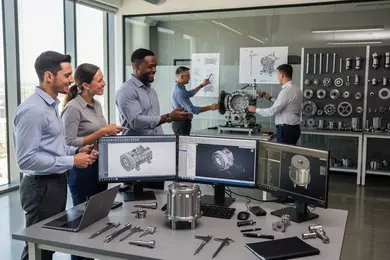
2027 Online Mechanical Engineering Degrees That Help Build CAD Skills

Co-Founder and Chief Data Scientist
Choosing an online mechanical engineering degree is harder when your goal is strong CAD training, not just a credential. CAD matters because design, simulation, automation, and digital manufacturing now shape many engineering roles. The U.S. Bureau of Labor Statistics projects mechanical engineer employment to grow 11% from 2023 to 2033, which makes skill-focused program selection especially important.
This guide is for students, transfer learners, working technicians, and career changers who want to compare online options, understand accreditation and cost, and choose a program that can support CAD-centered engineering careers.
Key Things You Should Know
- For engineering licensure-oriented paths, prioritize ABET-accredited mechanical engineering programs, for applied CAD drafting, manufacturing, or technician roles, an engineering technology degree or certificate may also fit.
- CAD strength depends on the curriculum, not the delivery format, look for courses in engineering graphics, solid modeling, finite element analysis, design for manufacturing, capstone design, and software such as SolidWorks, AutoCAD, MATLAB, ANSYS, or Creo.
- According to 2024-25 College Board data, published tuition and fees average $11,610 for in-state public four-year colleges and $30,780 for out-of-state public four-year colleges, so residency, transfer credit, and lab requirements can materially change total cost.
What is an online mechanical engineering degree and how can it build CAD skills?
An online mechanical engineering degree is a college program that teaches mechanics, materials, thermodynamics, manufacturing, controls, design, and engineering analysis through remote coursework, digital labs, simulations, and sometimes short in-person lab sessions. When the program is designed well, CAD is not treated as a single drawing class. It becomes part of how students model parts, test assemblies, document tolerances, simulate loads, and communicate design intent.
CAD stands for computer-aided design. In mechanical engineering, it usually includes 2D drafting, 3D solid modeling, parametric modeling, assembly modeling, geometric dimensioning and tolerancing, and design documentation. More advanced programs connect CAD to CAE, or computer-aided engineering, where students use simulation tools to evaluate stress, heat transfer, motion, vibration, or manufacturability before a physical prototype is built.
This path is best for students who want to design machines, products, tools, robotics systems, HVAC components, vehicles, manufacturing equipment, or medical devices. It may be less efficient for someone who only wants to become a CAD drafter quickly; in that case, a shorter CAD certificate or associate degree may provide faster entry into drafting work. Students comparing broader engineering degrees should check whether the program leads to mechanical engineering, mechanical engineering technology, or a related engineering concentration because those labels can affect coursework, licensure options, and employer expectations.
The main degree types differ in depth, career preparation, and time commitment. The table below summarizes the most common options so readers can match the credential to their goal rather than choosing based on the word "online" alone.
| Credential | Typical CAD depth | Best fit | Important limitation |
| CAD certificate | Focused on drafting tools, drawings, and modeling workflows | Students seeking entry-level drafting or upskilling | Usually not enough for mechanical engineer roles |
| Associate degree in CAD or engineering technology | Applied CAD, manufacturing drawings, and technical documentation | Future CAD technicians, mechanical drafters, or transfer students | Transferability varies by school |
| Bachelor's in mechanical engineering | CAD plus engineering science, design analysis, and capstone work | Students targeting mechanical engineer or product design roles | Requires strong math, physics, and lab commitment |
| Bachelor's in mechanical engineering technology | Applied design, manufacturing, testing, and CAD implementation | Hands-on learners aiming for applied engineering or technician roles | May not satisfy every employer or PE licensure pathway |
| Master's in mechanical engineering | Advanced modeling, simulation, optimization, robotics, or design electives | Engineers seeking specialization or advancement | Usually assumes prior engineering preparation |
How do online mechanical engineering programs teach and assess core CAD competencies?
Strong online programs teach CAD by combining recorded lectures, live demonstrations, virtual labs, cloud-based software access, peer design reviews, and project submissions. The best programs make students show evidence of skill: dimensioned drawings, constrained assemblies, simulation reports, design notebooks, and prototypes or capstone deliverables.
Core CAD competencies usually build in a sequence. Students first learn engineering visualization and drawing standards, then move into parametric 3D modeling, assemblies, tolerancing, simulation, and design optimization. This matters because employers rarely need someone who can only "use software"; they need people who can apply engineering judgment inside the software.
Online assessment is usually more rigorous than simply uploading screenshots. A well-designed CAD course may ask students to submit native model files, drawing packages, revision histories, finite element analysis results, and short presentations defending their design choices. In advanced courses, students may be graded on whether their model is editable, properly constrained, manufacturable, and documented according to engineering standards.
Students should expect several assessment formats that mirror real engineering work. These formats help faculty evaluate both technical skill and decision-making.
- Modeling assignments that require fully constrained sketches, clean feature trees, part families, and editable design parameters.
- Assembly projects that test mates, interference checks, exploded views, bill of materials creation, and motion constraints.
- Drawing packages that include orthographic views, section views, tolerances, notes, revision blocks, and manufacturing-ready documentation.
- Simulation reports that explain loads, boundary conditions, mesh assumptions, safety factors, and design revisions.
- Capstone or team projects where students move from requirements to concept selection, CAD modeling, analysis, and final presentation.
AI and automation are also changing CAD instruction. Generative design, topology optimization, and AI-assisted modeling can speed up concept generation, but students still need fundamentals in materials, mechanics, manufacturing, and tolerancing. A program that teaches students to critique software output is usually more valuable than one that only teaches button-by-button commands.
Which accredited online mechanical engineering schools offer strong CAD-focused curricula?
Several U.S. universities offer online or primarily online mechanical engineering-related programs that can support CAD development. The key is to distinguish institutional accreditation from programmatic ABET accreditation. Institutional accreditation confirms the college meets broad academic standards, while ABET accreditation is especially important for many engineering roles, graduate study, and potential professional engineering licensure pathways.
The examples below are not a ranking. They are the types of accredited online options students commonly investigate when looking for mechanical engineering programs with meaningful design, modeling, or applied CAD components. Always verify current accreditation directly through the school and ABET's public listings before enrolling because program titles, delivery formats, and accreditation status can change.
| School | Online mechanical engineering option | Accreditation point to verify | Why CAD-focused students may consider it |
| University of North Dakota | Online Bachelor of Science in Mechanical Engineering | ABET Engineering Accreditation Commission status | Mechanical design, engineering graphics, lab work, and senior design support a full engineering pathway. |
| The University of Alabama | Distance Bachelor of Science in Mechanical Engineering | ABET Engineering Accreditation Commission status and any campus lab requirements | Useful for students who want a traditional mechanical engineering curriculum with design and analysis components. |
| Mississippi State University | Online Bachelor of Science in Mechanical Engineering through distance education | ABET Engineering Accreditation Commission status and course delivery requirements | Can fit transfer or working students seeking mechanical design, modeling, and engineering fundamentals. |
| Arizona State University Online | Online engineering degree pathway with mechanical systems focus | Exact program title and ABET listing for the student's catalog year | May appeal to students seeking a large online engineering environment with design, systems, and modeling coursework. |
| Old Dominion University | Online mechanical engineering technology-related options | ABET Engineering Technology Accreditation Commission status where applicable | Can be a better match for applied CAD, manufacturing, testing, and technical implementation roles than a theory-heavy engineering program. |
A strong school choice depends on the student's endpoint. If the goal is to become a licensed professional engineer, an ABET-accredited mechanical engineering bachelor's program is usually the safer option. If the goal is CAD design support, manufacturing documentation, or applied product development, an engineering technology route may be practical, especially for students who already work in industry.
What courses and software tools in these programs develop advanced CAD and modeling skills?
CAD skill grows fastest when courses connect modeling to engineering decisions. A program that includes one introductory CAD course may be useful, but it may not be enough for product design, simulation, manufacturing engineering, or robotics work. Students should look for a sequence that starts with design communication and ends with analysis-backed design projects.
The most valuable courses tend to fall into several clusters. These course areas show whether the curriculum teaches CAD as a professional engineering tool rather than as isolated software training.
- Engineering graphics and design communication, where students learn sketches, projections, standards, dimensioning, and technical drawings.
- Computer-aided design and solid modeling, where students build parametric parts, assemblies, configurations, and model-based documentation.
- Mechanics of materials and machine design, where CAD models are connected to stress, deflection, fatigue, fasteners, shafts, gears, and bearings.
- Manufacturing processes and design for manufacturability, where students learn how machining, additive manufacturing, casting, welding, and tolerances affect design decisions.
- Finite element analysis and simulation, where students evaluate performance under loads, heat, vibration, or motion assumptions.
- Controls, robotics, or mechatronics, where CAD may connect to mechanisms, sensors, actuators, and dynamic systems.
- Senior design or capstone, where students build a complete design package and explain trade-offs to faculty, teammates, or industry sponsors.
Software names vary by institution, but students often encounter tools such as SolidWorks, AutoCAD, Fusion 360, Creo, CATIA, Siemens NX, MATLAB, Simulink, ANSYS, Abaqus, or COMSOL. The exact brand is less important than the transferable concepts: parametric modeling, tolerance control, assemblies, documentation, simulation assumptions, and design iteration. Employers can train a graduate on a different platform faster if the graduate understands the engineering workflow behind the interface.
Students who enjoy simulation, optimization, automation, and AI-assisted design may eventually combine mechanical engineering with analytics. For example, an engineer who wants to work with digital twins, predictive maintenance, or manufacturing data may later compare an online masters data science pathway with a mechanical engineering master's focused on modeling and simulation.
When reviewing course catalogs, students should not stop at course titles. Ask for sample syllabi, software access details, project examples, and whether student work can be used in a professional portfolio. A portfolio with clean assemblies, drawings, simulation reports, and capstone documentation can be more persuasive than a transcript alone for CAD-heavy roles.
How does studying mechanical engineering online compare to campus-based programs for CAD learning?
Online mechanical engineering can teach CAD effectively because CAD itself is digital. Students can model, revise, simulate, and submit design files from home if they have adequate hardware and licensed software access. The harder parts to replicate online are physical labs, machine shop experience, prototype testing, and informal peer collaboration, which is why many reputable programs use lab kits, remote labs, local proctoring, intensive campus sessions, or transfer lab credits.
The table below compares online and campus-based formats for CAD learning. Use it to decide which trade-offs matter most for your schedule, learning style, and career goal.
| Factor | Online mechanical engineering | Campus-based mechanical engineering | Decision point |
| CAD software practice | Often strong because assignments are file-based and repeatable | Also strong, especially with design studios and in-person support | Online can work well if software access and faculty feedback are reliable. |
| Labs and prototyping | May require kits, local labs, simulations, or short residencies | Usually easier access to shops, test equipment, and lab staff | Students who need hands-on fabrication should ask detailed lab questions. |
| Schedule flexibility | Better for working adults and transfer students | Better for students who can attend full time on a fixed schedule | Flexibility can reduce opportunity cost but requires self-discipline. |
| Peer collaboration | Depends on discussion tools, team platforms, and project design | Often more natural through studios, clubs, and labs | Look for online programs with structured team design projects. |
| Career networking | May rely on virtual career fairs and student initiative | Often easier through campus recruiting and engineering clubs | Online students should build portfolios and seek internships early. |
Online study makes the most sense for students who are self-directed, already employed, need geographic flexibility, or have transfer credits. Campus study may be better for first-time students who want daily access to faculty, machine shops, student engineering teams, and in-person tutoring.
There is also a middle ground. Some students complete general education, calculus, physics, or introductory CAD online, then transfer into a campus engineering program for upper-division labs and design projects. Others choose an online engineering technology degree because they want applied CAD and manufacturing skills more than a traditional engineering theory track. Students drawn mainly to software development, CAD automation, or computational tools may also compare computer science degrees online before committing to a mechanical engineering curriculum.

What admission requirements do online mechanical engineering degrees with CAD training typically have?
Admission requirements vary by school and degree level, but online mechanical engineering programs are usually more math-intensive than many online majors. Applicants should be ready for calculus, physics, chemistry, programming or computing, and lab-based science. Transfer students may also need specific prerequisite grades before entering upper-division engineering courses.
Most bachelor's programs review a combination of academic preparation and readiness for engineering coursework. These are the requirements students should confirm before applying.
- High school diploma or equivalent, with transcripts showing strong preparation in algebra, trigonometry, precalculus, chemistry, and physics where available.
- College transcripts for transfer applicants, especially calculus, calculus-based physics, chemistry, engineering graphics, statics, and programming courses.
- Minimum GPA requirements that may be higher for engineering admission than for general university admission.
- Placement testing or prerequisite checks for calculus and physics readiness.
- Technology requirements, including a computer capable of running CAD or remote desktop tools, reliable internet, webcam access, and sometimes a graphics-capable workstation.
- Lab participation requirements, which may include campus visits, approved local lab arrangements, or scheduled synchronous sessions.
Master's programs usually require a bachelor's degree in mechanical engineering or a closely related engineering field. Applicants from physics, mathematics, engineering technology, or another engineering discipline may be admitted conditionally, but they may need bridge courses in thermodynamics, fluid mechanics, mechanics of materials, or machine design.
Students should pay special attention to transfer policies. Engineering curricula are highly sequenced, so a missing prerequisite can delay graduation even when many credits transfer. Before enrolling, ask for an official degree plan that shows exactly where previous credits apply and which courses remain.
How long do online mechanical engineering programs take and what do they cost?
Program length depends on credential level, transfer credit, course load, and lab scheduling. A first-time bachelor's student should usually plan for about four years of full-time study, while part-time online students often take longer. Transfer students with completed calculus, physics, and general education credits may shorten the timeline, but only if those credits fit the engineering sequence.
The table below summarizes common timelines. It is meant for planning, not as a promise, because engineering course availability and prerequisites can change the actual schedule.
| Program type | Common time to complete | What can speed it up | What can slow it down |
| CAD certificate | Several months to one year | Prior drafting experience and self-paced software labs | Limited course availability or portfolio requirements |
| Associate degree | About two years full time | Placement into college-level math and transfer-friendly credits | Developmental math or part-time enrollment |
| Bachelor's in mechanical engineering | About four years full time; longer part time | Calculus, physics, and general education transfer credit | Sequential labs, co-op terms, or missing prerequisites |
| Master's in mechanical engineering | About one-and-a-half to three years | Prior engineering degree and focused elective plan | Bridge courses, thesis option, or employer-funded part-time study |
Cost can vary widely because online students may pay in-state tuition, out-of-state tuition, a flat online rate, technology fees, lab fees, software costs, or residency travel expenses. College Board's 2024-25 published tuition and fee averages provide a useful benchmark for four-year institutions:
- In-state public four-year colleges: $11,610
- Out-of-state public four-year colleges: $30,780
- Private nonprofit four-year colleges: $43,350
Those figures are published tuition and fees, not total cost of attendance. Housing, books, software, hardware, travel for labs, and lost work hours can change the real investment. Online students should also ask whether CAD licenses are included, whether remote access is available, and whether a high-performance computer is required.
Federal loan rates can affect the affordability calculation. For loans first disbursed in the 2024-25 award year, the fixed interest rate is 6.53% for undergraduate Direct Loans and 8.08% for graduate Direct Unsubsidized Loans. This means a lower tuition program is not automatically the best value if it delays graduation, lacks required accreditation, or does not support the student's target career.
What entry-level and advanced careers use CAD skills from mechanical engineering degrees?
CAD skills from a mechanical engineering degree can support both design-centered and analysis-centered careers. Entry-level graduates may begin by preparing models, drawings, test plans, or manufacturing documentation, then move into design ownership, simulation, project engineering, or technical leadership as they gain experience.
The table below connects common career paths with how CAD is used on the job. Use it to compare whether a role is mainly drafting, engineering analysis, manufacturing support, or product development.
| Career path | How CAD skills are used | Typical education fit | Advancement direction |
| Mechanical engineer | Designs and analyzes mechanical systems, components, machines, or products | Bachelor's in mechanical engineering | Senior engineer, project engineer, engineering manager |
| Product design engineer | Creates 3D models, prototypes, tolerance plans, and design revisions | Mechanical engineering degree with strong design portfolio | Lead designer, product development manager |
| CAD designer or mechanical drafter | Produces technical drawings, assemblies, and manufacturing documentation | Certificate, associate degree, engineering technology, or engineering degree | Design lead, CAD manager, engineering technician |
| Manufacturing engineer | Uses CAD to improve tooling, fixtures, work cells, and production processes | Mechanical engineering or engineering technology degree | Process engineering lead, operations engineering manager |
| Simulation or CAE engineer | Runs FEA, thermal, motion, or vibration studies based on CAD models | Mechanical engineering degree; often master's preferred | Analysis lead, specialist engineer, R&D engineer |
| Robotics or automation engineer | Models mechanisms, end effectors, fixtures, and automated systems | Mechanical engineering with controls or mechatronics coursework | Automation lead, systems engineer |
Students can strengthen employability by building a portfolio while in school. A useful CAD portfolio should show not just attractive renderings but also engineering reasoning: requirements, constraints, material choices, tolerances, simulations, failure considerations, and design revisions.
Mechanical engineering CAD skills also appear in adjacent industries such as aerospace, automotive, medical devices, renewable energy, consumer products, industrial equipment, and biomechanics. Students interested in human movement, rehabilitation technology, ergonomics, or sports equipment may want to compare engineering design paths with exercise science degrees online, especially if their primary interest is health and performance rather than machine design.
What salary ranges and job outlook can graduates with mechanical engineering CAD skills expect?
Salary depends on role, industry, region, education level, experience, and whether the position is engineering, drafting, technology, or management oriented. CAD skill can improve a candidate's usefulness, but it does not override the importance of engineering fundamentals, internships, communication, and industry-specific experience.
The U.S. Bureau of Labor Statistics reported a median annual wage of $102,320 for mechanical engineers in May 2024. This median is useful as a national benchmark, but it should not be read as an entry-level guarantee; new graduates, CAD drafters, and engineering technicians may start below the mechanical engineer median depending on the job and location.
The outlook is favorable for mechanical engineers compared with many occupations. BLS projects 11% employment growth for mechanical engineers from 2023 to 2033, supported by demand in automation, manufacturing, research and development, energy systems, and emerging technologies. For students, the practical takeaway is that a mechanical engineering degree with CAD and simulation depth can align with growing technical needs, but job outcomes still depend on portfolio quality, internship experience, and geographic labor markets.
CAD-heavy roles can follow different salary trajectories. Drafting-focused jobs may offer faster entry with less education, while engineering and simulation roles usually require deeper math, analysis, and design responsibility. Students deciding between a short CAD credential and a full mechanical engineering degree should compare the upfront cost against the type of work they want to do for the next decade, not just the first job title after graduation.
How can students evaluate and choose a reputable online mechanical engineering CAD program?
Choosing a reputable online mechanical engineering CAD program requires more than checking whether classes are online. Students should evaluate accreditation, curriculum depth, software access, lab requirements, faculty feedback, transfer policies, and career support. A cheaper program that lacks the right engineering pathway can cost more in the long run if it limits licensure, graduate school, or employer acceptance.
Use the following steps before applying or depositing. They are designed to help students avoid the most common mistakes in online engineering enrollment.
- Verify institutional accreditation through a recognized accreditor and confirm whether the specific engineering program has ABET accreditation if your goal involves engineering licensure or traditional mechanical engineer roles.
- Ask for the exact degree title, because mechanical engineering, mechanical engineering technology, engineering with a mechanical systems concentration, and CAD design are not identical credentials.
- Request a degree plan showing prerequisites, lab requirements, campus visits, course rotation, and estimated graduation date based on your transfer credits.
- Review CAD-related syllabi and confirm which software is taught, whether licenses are included, and whether students submit native model files, drawings, and simulation reports.
- Check hardware requirements before enrolling, especially if the program expects students to run CAD or FEA software locally instead of through a virtual lab.
- Ask how online labs work and whether any required in-person components involve travel, extra fees, or time away from work.
- Compare total cost, not just tuition, including fees, software, computer upgrades, proctoring, travel, textbooks, and potential loan interest.
- Look for career support that fits engineering students, such as internship guidance, employer projects, portfolio review, virtual career fairs, and alumni outcomes.
Red flags include vague accreditation language, no clear lab plan, no faculty feedback on CAD files, limited upper-division design coursework, unclear transfer credit policies, and admissions advisors who cannot explain whether the degree supports licensure-oriented engineering pathways. Another common mistake is choosing a program only because it is accelerated. Mechanical engineering is sequential, and rushing through calculus, physics, mechanics, and design can weaken the very skills employers expect.
The best choice is the program that fits your target role. Choose an ABET-accredited mechanical engineering bachelor's if you want the broadest engineering foundation. Consider engineering technology if you prefer applied design, testing, manufacturing, or CAD implementation. Choose a shorter CAD credential if you need a faster path into drafting support work and do not need the full engineering science curriculum.
Other Things You Should Know About Mechanical Engineering
Often, yes. Some schools provide virtual desktop access, but others expect students to run CAD or simulation software locally. Before enrolling, ask for the official hardware specifications, graphics requirements, and software access policy.
Sometimes, but transfer is not automatic. CAD certificate credits may count as electives or technical courses, but engineering programs often require specific calculus, physics, and accredited engineering coursework. Ask for a written transfer evaluation.
It can help demonstrate software proficiency, especially for internships or CAD-heavy entry roles. However, certification is strongest when paired with a portfolio that shows engineering judgment, tolerancing, assemblies, and design analysis.
Yes, many online mechanical engineering programs in 2027 offer virtual internships or project-based learning to enhance CAD skills. Others may have partnerships with companies to provide practical experience. It's essential to research each program's specifics to understand their offerings.
References
- Easiest CAD software: Top picks for beginners in 2026 https://www.shapr3d.com/content-library/easiest-cad-software-to-learn
- Ilaria Digital School (/en/) @ 1783551976400 https://www.ilaria-academy.com/en/course/cad-software-en
- Best AutoCAD Courses for Mechanical Engineering - ONLC https://www.onlc.com/blog/best-autocad-courses-mechanical-engineering/
- Learn Mechanical Engineering in 2026: Beginner Roadmap - GaugeHow – Mechanical Engineering Skills Platform https://gaugehow.com/blog/learn-mechanical-engineering
- Choosing the Best 3D CAD Software: A Comprehensive Guide https://formlabs.com/eu/blog/cad-software/
- Faculty of Engineering and Computing Online & Flexible Learning - Atlantic Technological University https://www.atu.ie/study/online-flexible-and-professional-development/faculty-of-engineering-and-computing-online-flexible-learning
- How to Become a Mechanical Engineer - Degree & Steps https://www.onlineengineeringprograms.com/faq/how-to-become-a-mechanical-engineer
- Best PG Program in CAD for Engineers | Mechanical Design courses https://skill-lync.com/mechanical-engineering-courses/masters-design
- Online Mechanical Engineering Degrees 2025 https://www.affordablecollegesonline.org/degrees/engineering-programs/mechanical-engineering/
- What Degree Do You Need to be A Mechanical Engineer? https://www.onlineu.com/resources/college-planning/what-degree-to-be-a-mechanical-engineer