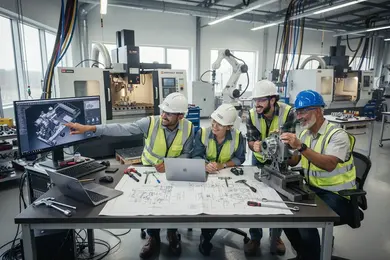
2027 Online Mechanical Engineering Degrees That Prepare Students for Energy and Thermal Systems Work

Co-Founder and Chief Data Scientist
Choosing an online mechanical engineering degree is harder when your goal is energy, heat transfer, HVAC, power systems, or thermal design. The field matters because the Bureau of Labor Statistics projects mechanical engineer employment to grow 11% from 2023 to 2033, much faster than the average for all occupations. This guide is for working adults, transfer students, and engineers planning graduate study. You will learn how online programs work, what they cost, which accreditation signals matter, and how to connect coursework with realistic energy and thermal systems careers.
Key Things You Should Know
- ABET accreditation is most critical for online bachelor's degrees in mechanical engineering; graduate programs are usually evaluated by institutional reputation, faculty depth, curriculum fit, and employer recognition rather than ABET program accreditation.
- Energy and thermal systems study usually centers on thermodynamics, heat transfer, fluid mechanics, combustion, HVAC, renewable energy systems, numerical simulation, and design projects using tools such as CAD, MATLAB, Python, CFD, or finite element analysis.
- BLS data show mechanical engineers had a median annual wage of $102,320 in May 2024, while projected employment growth of 11% from 2023 to 2033 suggests stronger demand than many engineering and non-engineering occupations.
What is an online mechanical engineering degree focused on energy and thermal systems?
An online mechanical engineering degree focused on energy and thermal systems is a mechanical engineering program that emphasizes how energy is generated, transferred, stored, converted, and controlled. Students study the behavior of heat, fluids, materials, machines, and engineered systems so they can design equipment such as heat exchangers, turbines, batteries, HVAC systems, thermal management systems, pumps, engines, and renewable energy components.
The degree may be offered as a bachelor's degree, master's degree, or sometimes a professional engineering master's with electives in thermal sciences. At the bachelor's level, students need a broad foundation in mechanics, materials, manufacturing, design, circuits, and controls before specializing. At the graduate level, students usually enter with an engineering background and use electives, projects, or a thesis to focus on energy systems, thermal-fluid sciences, or advanced simulation.
This pathway fits students who want to work on practical engineering problems involving energy efficiency, building systems, clean energy, advanced manufacturing, aerospace thermal control, vehicle electrification, data center cooling, or industrial process systems. It may not be the best fit for students who primarily want electrical power grid design, software engineering, environmental policy, or business-focused sustainability roles unless they plan to add coursework or credentials in those areas.
One important distinction is that "online" rarely means "hands-off." Mechanical engineering is applied and design-heavy, so reputable programs still require labs, team projects, proctored exams, design reviews, simulation assignments, and sometimes short campus visits or approved local lab arrangements. The strongest programs make the online format flexible without removing the engineering rigor employers expect.
How do online mechanical engineering programs compare to campus-based options for thermal systems?
Online and campus-based mechanical engineering programs can lead to similar academic outcomes when the curriculum, faculty, labs, and assessments are comparable. The trade-off is usually not academic legitimacy versus convenience; it is flexibility versus access to physical facilities, live lab spaces, research groups, and informal networking.
The table below summarizes the main differences students should weigh before choosing an online or campus-based route. Use it to identify which format fits your schedule, learning style, and career goal in energy or thermal systems.
| Factor | Online mechanical engineering option | Campus-based mechanical engineering option | Best fit |
| Schedule | Often asynchronous or evening-friendly, especially at the graduate level | Usually fixed class, lab, and project meeting times | Online works well for working adults; campus works well for full-time students who want daily structure |
| Laboratory access | May use remote labs, simulations, lab kits, local proctors, or short residencies | Direct access to wind tunnels, thermal labs, machine shops, and instrumentation | Campus may be stronger for students seeking intensive hands-on research or prototyping |
| Thermal systems specialization | Strong if electives include heat transfer, fluids, energy conversion, HVAC, and simulation | Strong if the department has active thermal-fluid faculty and labs | Choose based on course availability, not simply delivery format |
| Networking | Depends on virtual project teams, faculty access, employer partnerships, and alumni support | Often easier through labs, student chapters, career fairs, and research groups | Campus has a networking advantage unless the online program has strong career infrastructure |
| Cost structure | May reduce relocation and commuting costs, but tuition varies widely | May offer more assistantships or campus employment at the graduate level | Compare total cost, not tuition alone |
For thermal systems specifically, the biggest concern is whether the online program teaches the same mathematical and design depth as the campus program. A flexible format is valuable only if students still complete rigorous work in thermodynamics, heat transfer, fluids, and engineering design.
Students should also consider hybrid expectations. Some online bachelor's programs may require in-person exams, lab intensives, or approved local testing sites. Graduate programs are more likely to be fully online, but thesis-based pathways may require closer faculty coordination than coursework-only options.
Which U.S. schools offer accredited online mechanical engineering degrees in energy systems?
Several U.S. universities offer online mechanical engineering degrees that can support energy and thermal systems preparation, but students need to verify the exact degree title, delivery mode, and accreditation status before applying. ABET accreditation is especially important for bachelor's degrees because it can affect eligibility for the Fundamentals of Engineering exam, Professional Engineer licensure steps, and some employer screening processes.
The following examples show how prospective students can compare accredited or institutionally reputable online options. Program details can change, so confirm the current catalog, ABET listing, and available thermal or energy electives directly with the school.
| School | Online mechanical engineering option | Accreditation or quality signal to verify | Energy and thermal systems relevance |
| University of North Dakota | Online Bachelor of Science in Mechanical Engineering | ABET accreditation for the mechanical engineering bachelor's program should be verified in the current ABET database | Suitable for students seeking a full undergraduate mechanical engineering pathway with thermodynamics, fluids, heat transfer, and design |
| Arizona State University | Online mechanical engineering bachelor's pathway | Confirm the exact ABET-accredited degree title and modality because accreditation applies to specific programs | Can support energy, thermal, manufacturing, and systems design interests through core mechanical engineering coursework |
| The University of Alabama | Distance or online Bachelor of Science in Mechanical Engineering | Verify ABET accreditation and any campus or lab requirements for distance students | Relevant for students who want a broad mechanical engineering foundation before moving into HVAC, power, fluids, or energy roles |
| Purdue University | Online master's-level mechanical engineering options | Institutional accreditation, engineering faculty strength, and graduate mechanical engineering reputation are key signals | Best for engineers who already hold a bachelor's degree and want advanced thermal-fluid or energy-related electives |
| Penn State World Campus | Online master's-level mechanical engineering option | Institutional accreditation and department-level engineering reputation should be reviewed | Relevant for working engineers seeking advanced coursework tied to mechanical systems, design, and applied engineering analysis |
Students comparing engineering disciplines should note that energy systems can also be approached through electrical engineering, especially for power electronics, electric machines, grids, and renewable integration. If that direction sounds closer to your goal, compare top online electrical engineering schools before committing to a mechanical engineering program.
A common mistake is assuming that a school's regional or institutional accreditation automatically means the specific online engineering degree is ABET-accredited. Institutional accreditation matters for financial aid and academic legitimacy, but ABET is program-specific and must be checked separately for bachelor's-level engineering programs.
What courses and technical skills do energy and thermal systems concentrations typically include?
Energy and thermal systems concentrations typically combine mechanical engineering fundamentals with specialized coursework in energy conversion, thermal-fluid behavior, simulation, and design. The goal is to help students understand both the physics of energy systems and the engineering workflow used to model, build, test, and improve them.
The table below connects common courses with the practical skills they build. This can help you evaluate whether a program's curriculum matches your intended career path.
| Course or technical area | What students learn | Career relevance |
| Thermodynamics | Energy, work, heat, power cycles, refrigeration cycles, and system efficiency | Core preparation for power generation, engines, HVAC, and energy analysis |
| Heat transfer | Conduction, convection, radiation, heat exchangers, and thermal resistance | Essential for battery cooling, electronics cooling, building systems, and industrial equipment |
| Fluid mechanics | Flow behavior, pressure losses, pumps, turbines, boundary layers, and pipe networks | Useful in HVAC, aerospace, process engineering, and renewable energy systems |
| Energy systems or renewable energy | Solar, wind, geothermal, fuel cells, storage, and energy conversion trade-offs | Supports roles in clean energy design, system integration, and energy consulting |
| Combustion or propulsion | Fuel behavior, combustion efficiency, emissions, and propulsion cycles | Relevant for aerospace, engines, turbines, and industrial combustion systems |
| Numerical methods, CFD, or FEA | Computational modeling, mesh setup, boundary conditions, validation, and interpretation | Important for design optimization, simulation engineering, and advanced R&D roles |
| Controls and instrumentation | Sensors, feedback systems, data acquisition, and automated control | Useful in HVAC controls, manufacturing, robotics, and energy management systems |
Students should look beyond course titles and ask how technical skills are assessed. A strong online course should include realistic design problems, software-based modeling, calculation-heavy assignments, and opportunities to explain engineering assumptions, not just multiple-choice exams.
Important tools and skills often include the following. These skills matter because energy and thermal systems jobs increasingly blend physics-based engineering with digital modeling and data-informed decision-making.
- CAD and product design tools such as SolidWorks, Creo, or Autodesk Inventor for mechanical components and assemblies
- MATLAB, Python, or similar tools for numerical analysis, energy modeling, and automation of engineering calculations
- CFD or multiphysics software for airflow, heat transfer, combustion, cooling, or pressure-drop simulations
- Engineering communication skills for design reports, trade studies, technical presentations, and stakeholder reviews
- Understanding of codes and standards used in HVAC, pressure systems, safety, energy efficiency, and building performance
AI-assisted engineering tools are also changing the field. Students do not need to become software engineers, but they should understand data quality, model validation, simulation limits, and responsible use of automation. Engineers who want to move deeper into analytics, optimization, or research leadership may later consider advanced study such as an online PhD data science, especially if their work involves predictive maintenance, digital twins, or energy system optimization.
What admission requirements and prior preparation do these online programs expect?
Admission requirements depend heavily on degree level. Online bachelor's programs usually expect strong preparation in math and science, while online master's programs typically expect an ABET-accredited or equivalent engineering bachelor's degree, although some schools admit students from related fields with prerequisite coursework.
The table below shows common expectations by program level. Use it to identify gaps you may need to close before applying.
| Program level | Typical prior preparation | Common application materials | Preparation concerns |
| Online bachelor's in mechanical engineering | High school or transfer coursework in algebra, trigonometry, pre-calculus, chemistry, and physics | Transcripts, application form, placement results, and sometimes standardized test scores depending on school policy | Students weak in calculus readiness may need extra time before starting engineering core courses |
| Online degree-completion pathway | Completed general education, calculus sequence, physics, chemistry, and introductory engineering courses | College transcripts, transfer evaluation, syllabus review, and GPA documentation | Transfer credits may not apply cleanly to engineering prerequisites or ABET-required design sequences |
| Online master's in mechanical engineering | Bachelor's degree in mechanical engineering or a closely related engineering field | Transcripts, resume, statement of purpose, recommendations, and sometimes GRE scores | Applicants from physics, math, technology, or non-ME engineering backgrounds may need prerequisite courses |
| Graduate certificate in thermal or energy systems | Usually a bachelor's degree in engineering, physical science, or a technical field | Transcripts, resume, and proof of quantitative preparation | Certificates can be useful, but they may not substitute for a full engineering degree in licensed or design-authority roles |
Before applying, students should complete a realistic self-check. This is especially important in online engineering because falling behind in calculus, physics, or programming can make later thermal-fluid courses much harder.
- Review the program's first-year math placement expectations or graduate prerequisite list before submitting an application.
- Ask whether online students take the same engineering courses and exams as campus students.
- Confirm how labs are completed, including whether travel, kits, local proctors, or synchronous sessions are required.
- Request a transfer-credit review before enrolling if you have prior college coursework.
- Ask whether the curriculum supports FE exam preparation if you may pursue Professional Engineer licensure.
A common red flag is an online engineering program that advertises speed but gives little detail about labs, design projects, faculty credentials, or accreditation. Mechanical engineering is sequential; shortcuts in fundamentals often become expensive later when students cannot move into advanced thermal systems coursework or licensure pathways.
How long do online mechanical engineering degrees take and what do they cost?
Program length and cost vary by degree level, transfer credits, residency status, tuition model, and whether students attend full time or part time. Online learning can reduce relocation and commuting costs, but it does not automatically make engineering inexpensive because lab support, software, proctoring, and upper-division engineering instruction can add fees.
For a current tuition benchmark, College Board's 2024 Trends in College Pricing reported average published tuition and fees for full-time undergraduates at four-year institutions as follows. These figures are not online mechanical engineering prices, but they help students judge whether a quoted tuition rate is unusually low, typical, or high.
- Public four-year in-state tuition and fees: $11,610
- Public four-year out-of-state tuition and fees: $30,780
- Private nonprofit four-year tuition and fees: $43,350
The table below summarizes typical completion timelines. Actual time can change if you study part time, need prerequisites, repeat a lab course, or transfer fewer credits than expected.
| Credential | Typical time to complete | Main cost drivers | Best-fit student |
| Online bachelor's in mechanical engineering | About four to six years, depending on course load and transfer credits | Tuition, lab fees, software, textbooks, proctoring, and possible travel for labs or exams | Students seeking entry-level engineering eligibility and a full ABET-oriented pathway |
| Online bachelor's completion pathway | About two to four years after prerequisites or an associate degree | Transfer-credit acceptance, upper-division tuition, repeated prerequisites, and residency rules | Transfer students with strong calculus, physics, and engineering fundamentals already completed |
| Online master's in mechanical engineering | About one and a half to three years | Graduate tuition, employer reimbursement limits, software, and thesis or project requirements | Working engineers seeking advancement, specialization, or technical leadership |
| Graduate certificate | Often less than one year to two years | Per-credit tuition and whether credits can later apply to a master's degree | Engineers who need targeted thermal, energy, or simulation coursework without a full degree immediately |
Students trying to control costs should compare the total program price, not just the per-credit rate. Engineering programs can differ in required credits, lab fees, residency pricing, technology fees, and the number of prerequisite credits that do not count toward the major.
Practical ways to reduce cost include the following. Each step can affect the real price of attendance more than a small difference in advertised tuition.
- Complete calculus, chemistry, physics, and general education courses at a regionally accredited community college only after confirming transferability.
- Ask whether online students qualify for in-state tuition, flat-rate tuition, military benefits, or employer tuition reimbursement.
- Check whether required engineering software is included, discounted, or separately billed.
- Compare part-time and full-time pacing because taking too few courses can extend fees and delay earnings gains.
- For graduate programs, ask whether a certificate can stack into a master's degree before paying for standalone credits.
The affordability trade-off is simple: the cheapest program is not always the best value if it delays graduation, lacks required accreditation, or does not offer the thermal systems coursework you need. The best financial choice is usually the lowest-total-cost accredited program that directly supports your target role.
What energy and thermal systems careers can graduates pursue with this degree?
Graduates with energy and thermal systems preparation can work across industries that need heating, cooling, power conversion, fluid flow, energy efficiency, and mechanical design expertise. Common employers include manufacturing firms, utilities, aerospace companies, HVAC and building systems firms, automotive and battery companies, national laboratories, consulting firms, data center operators, and clean energy developers.
The table below connects common roles with the kind of work graduates may perform. Job titles vary by employer, so students should read job descriptions closely rather than relying on titles alone.
| Role | Typical responsibilities | Useful preparation |
| Thermal systems engineer | Designs and analyzes heat transfer systems, cooling loops, heat exchangers, and thermal controls | Heat transfer, thermodynamics, CFD, testing, and instrumentation |
| HVAC or building systems engineer | Designs heating, ventilation, air conditioning, energy efficiency, and building mechanical systems | Thermodynamics, fluids, building codes, controls, and energy modeling |
| Energy engineer | Evaluates energy use, efficiency upgrades, renewable integration, and system performance | Energy systems, data analysis, economics, measurement, and verification |
| Mechanical design engineer | Creates components, assemblies, equipment layouts, and design documentation | CAD, mechanics, materials, manufacturing, and design for reliability |
| Combustion or propulsion engineer | Works on engines, turbines, burners, propulsion systems, or industrial combustion equipment | Combustion, fluids, thermodynamics, testing, and safety standards |
| Battery or electronics cooling engineer | Develops thermal management systems for batteries, power electronics, servers, or devices | Heat transfer, CFD, materials, controls, and experimental validation |
| Test or validation engineer | Plans experiments, collects data, validates models, and troubleshoots mechanical systems | Instrumentation, statistics, lab methods, programming, and technical reporting |
Students should choose electives based on the work environment they want. HVAC roles value codes, psychrometrics, building systems, and Professional Engineer pathways; battery and electronics cooling roles value heat transfer, CFD, materials, and testing; energy consulting roles value communication, economics, and energy modeling.
Some students discover that their interests are adjacent to mechanical engineering but not centered on machines or energy infrastructure. If your strongest interest is biomechanics, human performance, rehabilitation technology, or movement science, compare a best exercise science degree online option before committing to a mechanical engineering curriculum.
Career outcomes also depend on degree level. A bachelor's degree can support entry-level engineering roles, while a master's degree may help with specialization, technical leadership, or movement into advanced simulation and R&D. A certificate can help experienced engineers reskill, but it may not carry the same weight as a full degree for positions requiring engineering design authority.
What salary ranges and earning potential exist in energy and thermal systems roles?
Salary potential in energy and thermal systems depends on job title, industry, region, clearance requirements, licensure, degree level, software expertise, and years of experience. The safest way to interpret salary data is to use broad occupational benchmarks, then compare them with local job postings for your target industry.
The Bureau of Labor Statistics reported a median annual wage of $102,320 for mechanical engineers in May 2024. This is a useful benchmark for thermal systems careers because many roles in HVAC, energy equipment, thermal design, and mechanical systems fall under or near the mechanical engineering occupation, but it should not be treated as a guaranteed salary for any specific graduate.
The table below explains how different factors can influence earning potential. It avoids promising outcomes because compensation varies significantly by employer and market.
| Factor | How it can affect pay | What students can do |
| Industry | Aerospace, advanced manufacturing, energy equipment, data centers, and high-tech thermal management may pay differently from local building services firms | Compare job postings in the industries where you actually plan to work |
| Location | Pay often reflects regional cost of living, industrial concentration, and demand for specialized engineers | Use state or metro salary data when evaluating relocation or remote-work expectations |
| Licensure | Professional Engineer licensure can matter in HVAC, consulting, public infrastructure, and building systems design | Choose an ABET-aligned bachelor's pathway if PE eligibility may be important |
| Software and simulation skills | CFD, FEA, controls, Python, and data analysis can support higher-value technical assignments | Build a portfolio with validated models, not just course certificates |
| Graduate education | A master's degree can support specialization, but the payoff depends on employer needs and tuition cost | Compare tuition against likely advancement paths before enrolling |
Students should be cautious with salary claims from schools or third-party rankings that do not show methodology. A better approach is to review BLS data, employer postings, alumni outcomes when available, and internship or co-op hiring patterns in the region where you expect to work.
What is the job outlook for mechanical engineers in energy and thermal systems fields?
The job outlook for mechanical engineers is favorable compared with many occupations, but energy and thermal systems demand is not evenly distributed. BLS projects mechanical engineer employment to grow 11% from 2023 to 2033, with about 19,800 openings per year on average. For students, this suggests opportunity, but not automatic placement; internships, project experience, and specialization still matter.
Several trends are shaping opportunities in energy and thermal systems. Electrification is increasing attention on battery thermal management, power electronics cooling, heat pumps, and efficient building systems. Data center growth is raising demand for advanced cooling and energy optimization. Manufacturing modernization is increasing the need for engineers who can combine mechanical design, controls, sensors, and simulation.
AI and automation are also changing engineering work. They can speed up modeling, documentation, code generation, optimization, and design iteration, but they do not remove the need for engineering judgment. Thermal systems engineers still need to define boundary conditions, validate models, interpret test data, and make safety-conscious design decisions.
Students should prepare for the outlook by building evidence of applied competence. Employers often value project portfolios, internship experience, lab or testing exposure, and the ability to explain trade-offs clearly.
- Complete at least one substantial thermal or energy design project that includes assumptions, calculations, simulation, and validation.
- Learn one programming or numerical analysis tool well enough to automate engineering calculations and analyze test data.
- Pursue internships, co-ops, or employer-sponsored projects in HVAC, utilities, manufacturing, aerospace, energy consulting, or clean technology.
- Join student or professional groups related to ASME, ASHRAE, SAE, energy engineering, or renewable energy systems.
- Track job postings early so elective choices match real employer requirements in your target region.
The strongest candidates are not simply "mechanical engineers interested in energy." They can show focused preparation in a specific problem area such as heat exchangers, building energy modeling, electronics cooling, turbomachinery, battery systems, or industrial energy efficiency.
How can students evaluate and choose a reputable online mechanical engineering program?
Choosing a reputable online mechanical engineering program requires more than comparing rankings. The right program should match your career target, meet accreditation expectations, fit your schedule, and provide enough technical depth to make you competitive for energy and thermal systems work.
Use the following steps as a practical decision process. They are ordered to help you eliminate risky options before comparing finer details such as electives or tuition discounts.
- Verify accreditation first. For bachelor's degrees, check whether the specific mechanical engineering program is ABET-accredited; for graduate programs, confirm institutional accreditation and department reputation.
- Map the curriculum to your goal. Look for thermodynamics, heat transfer, fluids, energy systems, controls, design, and simulation rather than relying on a general "mechanical engineering" label.
- Ask how labs and design projects work online. Reputable programs should clearly explain lab kits, remote labs, residencies, local proctors, project teams, and assessment methods.
- Compare total cost. Include tuition, fees, software, travel, repeated prerequisites, transfer-credit loss, and the opportunity cost of a longer timeline.
- Review faculty and employer connections. Thermal-fluid faculty, industry projects, career services, and alumni outcomes can matter more than broad university branding.
- Check licensure alignment. If you may pursue PE licensure, ask how the program supports FE exam preparation and whether your state board has specific education rules.
- Evaluate flexibility honestly. Confirm whether required courses are offered frequently enough for part-time students to graduate on schedule.
The table below highlights common mistakes and better alternatives. This can help you avoid decisions that look convenient at enrollment but create problems later.
| Common mistake | Why it creates risk | Better alternative |
| Choosing the cheapest program without checking accreditation | It may limit licensure options or employer recognition | Start with accredited or clearly reputable options, then compare cost |
| Assuming every online degree is fully asynchronous | Labs, exams, and team projects may require scheduled participation | Ask for a term-by-term schedule before enrolling |
| Ignoring transfer-credit rules | Lost credits can increase both cost and completion time | Request a written transfer evaluation before committing |
| Picking a program with few thermal electives | The degree may not support energy systems specialization well | Review the last two years of actual course offerings, not just catalog descriptions |
| Relying only on school prestige | A strong university name does not guarantee fit for online learners | Compare advising, course availability, labs, career support, and faculty access |
Students comparing related online degrees should be clear about the problem they want to solve. Mechanical engineering is best for machines, energy conversion, thermal design, fluids, and physical systems. If your goal is health, wellness, coaching, or human performance rather than engineered thermal systems, reviewing exercise science degrees online may lead to a more appropriate path.
The best choice is usually the program that passes four tests: it is properly accredited, it teaches the thermal and energy topics you need, it fits your life without weakening academic rigor, and it has a total cost you can justify based on realistic career options.
Other Things You Should Know About Mechanical Engineering
Possibly, but requirements vary by state. For the clearest path, choose an ABET-accredited bachelor's program, pass the FE exam, gain qualifying engineering experience, and later meet your state board's PE exam requirements.
No. Many entry-level roles are available with a bachelor's degree in mechanical engineering. A master's degree can help if you want advanced simulation, research, specialized thermal-fluid work, or technical leadership roles.
They can be, if the program is rigorous and transparent about lab methods. Employers typically care whether you can test, model, analyze, document, and defend engineering decisions, not just whether every lab occurred on campus.
An online mechanical engineering degree with a focus on energy and thermal systems offers flexibility and specialized knowledge. It provides skills in sustainable energy solutions, heating and cooling systems, and energy efficiency, which are crucial for careers in the evolving energy sector. This specialization also broadens employment opportunities in various industries.
References
- The Significance of Thermal Systems in Mechanical Engineering https://keninstitute.com/the-significance-of-thermal-systems-in-mechanical-engineering/
- Top 9 in-demand UK renewable energy roles | Astute People https://www.astutepeople.co.uk/blog/top-9-in-demand-uk-renewable-energy-roles/
- Renewable Energy Jobs - EKT Interactive https://ektinteractive.com/renewable-energy-jobs/
- Careers in Energy Engineering - What Are Your Professional Options? | Electrum https://electrum.pl/en/careers-in-energy-engineering-what-are-your-professional-options/
- Thermal Engineering Engineer - Thermal Engineer https://www.energierecrute.com/en/energy_trainings/thermal-engineering-engineer-thermal-engineer-job~306.html
- Renewable Energy Salaries: How Much Can You Earn in the Industry? - The Renewable Energy Institute https://www.renewableinstitute.org/renewable-energy-salaries/
- Transforming Construction with Renewable Energy - WRS https://www.worldwide-rs.com/blog/highest-paid-jobs-across-the-us-energy-industry/
- Top 20 Careers in Renewable Energy (Ranked by Salary, Demand & Future Growth) - AscendurePro https://ascendurepro.com/careers-in-renewable-energy/
- Thermal Fluid and Energy Systems - Mechanical Engineering https://mechanical.mines.edu/thermal-fluids/
- Introduction to Thermal Management and Mechanical Properties of Packages https://asuengineeringonline.com/introduction-thermal-management-and-mechanical-properties-packages