2027 Online Mechanical Engineering Degrees That Help Build Technical Modeling Skills

Co-Founder and Chief Data Scientist
Choosing an online mechanical engineering degree is really a choice about how well a program can teach design, simulation, and modeling without a traditional campus schedule. That matters because the U.S. Bureau of Labor Statistics projects mechanical engineer employment to grow 11% from 2023 to 2033, much faster than average.
This guide is for working adults, transfer students, and future engineers comparing online options. You will learn how programs teach CAD and simulation, what accreditation to verify, what costs to expect, and how to judge whether the degree fits your career goals.
Key Things You Should Know
- For professional engineering roles, prioritize online mechanical engineering programs accredited by the ABET Engineering Accreditation Commission, especially if you may later pursue a Professional Engineer license.
- Modeling-heavy programs should include CAD, finite element analysis, computational methods, controls, thermodynamics, fluid mechanics, and a design capstone that uses industry software.
- The BLS reported a median annual wage of $102,320 for mechanical engineers in May 2024, but outcomes vary by industry, region, experience, software portfolio, and whether the role involves advanced simulation or design responsibility.
What is an online mechanical engineering degree focused on developing technical modeling skills?
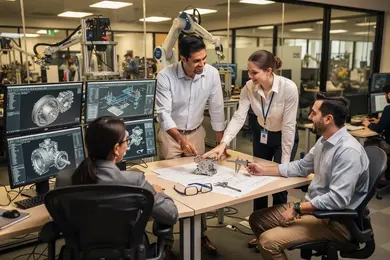
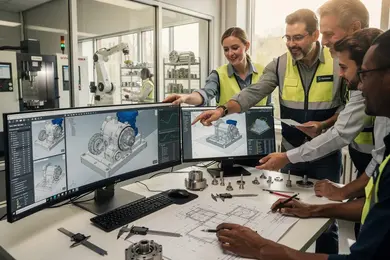
An online mechanical engineering degree focused on technical modeling is a program that teaches core mechanical engineering theory while emphasizing digital design, analysis, and simulation. Students learn how to represent physical systems mathematically and visually, then test how those systems may behave under heat, motion, load, vibration, pressure, or manufacturing constraints.
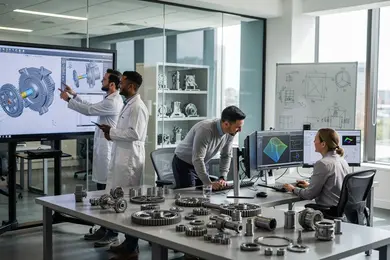
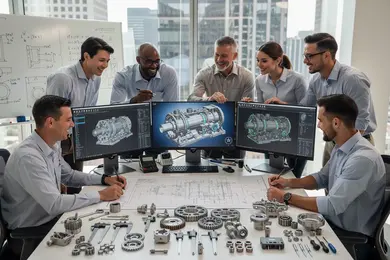
Technical modeling usually includes two connected skill sets. The first is geometric modeling, where students use computer-aided design software to build parts, assemblies, mechanisms, and manufacturing drawings. The second is engineering simulation, where students use computational tools to analyze stress, fluid flow, heat transfer, dynamics, controls, or system performance before a prototype is built.
Online programs can appear under several degree names. The right choice depends on whether you need a first engineering degree, a career-change pathway, or graduate-level specialization.
| Program type | Best fit | Modeling emphasis | Decision point |
| Bachelor of Science in Mechanical Engineering | Students seeking entry-level mechanical engineering roles | Broad modeling foundation across CAD, mechanics, thermodynamics, fluids, and design | Best option if you do not already have an engineering degree and want the widest eligibility for engineering jobs |
| Bachelor of Science in Mechanical Engineering Technology | Students interested in applied design, testing, manufacturing, or product support | Often more hands-on and application-focused, with less advanced theory than engineering programs | Can be useful, but check whether employers or licensing boards treat it differently from engineering |
| Master of Science in Mechanical Engineering | Engineers who want deeper expertise in simulation, robotics, thermal systems, materials, or design | Advanced numerical methods, computational modeling, optimization, and specialized electives | Best when you already have an engineering background and want technical advancement |
| Graduate certificate in modeling or simulation | Working engineers who need targeted upskilling | Narrow focus on tools such as FEA, CFD, controls, or product lifecycle systems | Lower commitment than a degree, but may not substitute for required engineering credentials |
The strongest online programs do not treat software as a shortcut around engineering fundamentals. They teach students why a model works, how to choose assumptions, how to check boundary conditions, and how to interpret results responsibly. That distinction matters because employers often expect modeling specialists to explain their engineering judgment, not just operate a software interface.
How do online mechanical engineering programs compare to campus-based options for modeling training?
Online mechanical engineering programs can deliver strong modeling training when the curriculum is intentionally designed for remote learners. The biggest difference is not whether lectures happen online; it is whether the program provides credible lab access, licensed software, instructor feedback, and team-based design work.
The table below compares common strengths and trade-offs so you can decide whether online or campus-based study better supports your goals.
| Factor | Online mechanical engineering program | Campus-based mechanical engineering program | What it means for modeling skills |
| CAD and simulation practice | Often delivered through cloud software, virtual desktops, remote labs, and project submissions | Often supported by in-person computer labs and live studio sessions | Online can work well if students receive enough project feedback and software access |
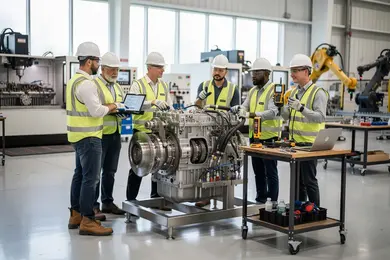
| Physical labs | May use lab kits, short residencies, partner labs, recorded demonstrations, or remote instrumentation | Typically uses scheduled in-person labs with equipment access | Campus may be stronger for students who need frequent hands-on testing and fabrication |
| Team design | Uses collaboration platforms, version control, shared CAD files, and virtual presentations | Uses in-person meetings, machine shops, and design studios | Online students should confirm how capstone collaboration is structured |
| Schedule flexibility | Better for working adults and military students who need asynchronous coursework | Better for students who want fixed schedules and in-person support | Flexibility helps, but self-discipline is essential for advanced modeling assignments |
| Career networking | Depends on virtual career services, alumni access, internships, and employer partnerships | Often includes campus recruiting and local employer events | Online students should be proactive about internships and portfolio-building |
Online study tends to make the most sense for students who are comfortable learning software independently, can manage long technical projects, and need a flexible schedule. Campus-based study may be better for students who want extensive machine-shop access, frequent in-person mentoring, or a highly structured daily routine.
Students comparing engineering disciplines should also consider whether their modeling interests are mechanical, electrical, or electromechanical. If circuits, embedded systems, power systems, or electronics are central to your goals, an online electrical engineering degree ranking can help you compare a related but distinct path.
Which accreditation and ABET standards should online mechanical engineering programs meet?
Accreditation is one of the most important checks for an online mechanical engineering degree. For engineering programs in the United States, the key programmatic accreditor is ABET, especially the Engineering Accreditation Commission for mechanical engineering degrees. Institutional accreditation also matters because it affects federal financial aid eligibility, credit transfer, and graduate school recognition.
ABET accreditation signals that a program has been reviewed for outcomes such as engineering problem-solving, design ability, experimentation, teamwork, communication, ethics, and the application of math, science, and engineering principles. For modeling-focused students, those outcomes matter because simulation work requires both technical skill and professional judgment.
Before enrolling, students should verify these accreditation-related details directly with the school and relevant licensing board if licensure may be part of their future plan.
- Confirm that the specific online mechanical engineering degree, not just the university, is ABET-accredited if you need an engineering credential for licensure-sensitive roles.
- Check whether the program is accredited by the ABET Engineering Accreditation Commission or another ABET commission, because engineering and engineering technology credentials may be treated differently.
- Ask whether online students complete the same curriculum, labs, exams, design projects, and capstone requirements as campus students.
- If you may pursue a Professional Engineer license, review your state board's education requirements before you enroll, because licensing rules vary by state.
- Confirm whether transfer credits, prior technical coursework, or international coursework will count toward ABET-aligned degree requirements.
A common mistake is assuming that a well-known university automatically offers an accredited online engineering program. Accreditation applies at specific levels and sometimes to specific delivery formats, so students should verify the exact degree name, campus or online designation, and accreditation status before making a financial commitment.
What courses and software tools typically build strong mechanical modeling and simulation skills?
Strong modeling skills come from a sequence of courses, not from one software class. Students first need calculus, physics, statics, dynamics, and materials, then they apply those foundations in design and simulation courses where models are tested against engineering constraints.
The table below shows common courses and the modeling capabilities they usually support. Course names vary by school, but the underlying competencies are useful for comparing programs.
| Course area | Modeling skill developed | Why it matters |
| Engineering graphics and CAD | Part modeling, assemblies, drawings, tolerances, and design documentation | Forms the baseline for product design, manufacturing, and mechanical communication |
| Statics and mechanics of materials | Load paths, stress, strain, deformation, and failure analysis | Prepares students for structural modeling and finite element analysis |
| Dynamics and vibrations | Motion, forces, oscillation, damping, and rotating systems | Supports modeling of vehicles, machines, robotics, and mechanical systems |
| Thermodynamics and heat transfer | Energy systems, thermal behavior, conduction, convection, and radiation | Essential for HVAC, energy, engines, electronics cooling, and thermal design |
| Fluid mechanics | Pressure, flow, drag, pumps, ducts, and fluid-system behavior | Builds the foundation for computational fluid dynamics and fluid-system design |
| Numerical methods and computational engineering | Approximation, discretization, error checking, and algorithmic problem-solving | Helps students understand what simulation software is doing behind the interface |
| Controls and mechatronics | System response, sensors, actuators, feedback loops, and dynamic modeling | Useful for robotics, automation, vehicles, and smart mechanical systems |
| Capstone design | Integrated modeling, prototyping, testing, documentation, and presentation | Often becomes the strongest portfolio evidence for employers |
Software changes by employer and industry, so students should look for transferable modeling concepts as well as exposure to common tools. Many programs use combinations of CAD, FEA, CFD, programming, and mathematical computing platforms.
- CAD and product design tools may include SolidWorks, PTC Creo, Autodesk Inventor, AutoCAD, Siemens NX, or CATIA.
- Simulation and CAE tools may include ANSYS, Abaqus, COMSOL Multiphysics, Siemens Simcenter, or Autodesk Fusion simulation features.
- Programming and numerical tools may include MATLAB, Python, Simulink, Mathematica, or similar computational environments.
- Manufacturing and product lifecycle tools may include CAM software, additive manufacturing workflows, geometric dimensioning and tolerancing, and product data management systems.
- Collaboration tools may include version control, shared CAD repositories, project management systems, and technical documentation platforms.
AI is also changing modeling work. Engineers increasingly use automation to generate design alternatives, accelerate meshing, screen design parameters, and interpret large simulation outputs. Students interested in the data side of simulation, optimization, or machine learning may eventually compare engineering graduate study with a doctorate in data analytics online, especially if their long-term goal is research leadership in computational engineering or digital twins.
What are the admission requirements and prerequisites for online mechanical engineering degrees?
Admission requirements depend on whether the program is undergraduate or graduate. Mechanical engineering is math-intensive, so schools usually look closely at calculus readiness, physics preparation, and prior engineering coursework. Online programs may be flexible in format, but reputable programs rarely remove the technical prerequisites.
The table below summarizes common requirements so applicants can identify gaps before applying.
| Program level | Common admission requirements | Prerequisites to watch | Best preparation strategy |
| Online bachelor's degree | High school diploma or equivalent, transcripts, placement testing, and sometimes prior college credits | Precalculus, calculus readiness, physics, chemistry, and computer skills | Complete math and science prerequisites before starting upper-division engineering courses |
| Online bachelor's completion program | Transfer credits from community college or another institution, minimum GPA, and completed lower-division courses | Calculus sequence, calculus-based physics, statics, programming, and introductory engineering | Request a formal transfer evaluation before enrolling |
| Online master's degree | Bachelor's degree in mechanical engineering or a related engineering field, transcripts, resume, statement of purpose, and sometimes recommendations | Undergraduate thermodynamics, fluids, mechanics, dynamics, and differential equations | Ask whether bridge courses are required if your degree is in physics, math, engineering technology, or another engineering field |
| Online graduate certificate | Bachelor's degree or professional experience, depending on the school | Varies by topic, but simulation certificates often require mechanics, calculus, and programming basics | Choose a certificate that stacks into a master's degree if you may continue later |
Applicants should be realistic about time and math preparation. Struggling through calculus or physics while also learning CAD and programming can slow progress. A good program will provide advising, tutoring, prerequisite maps, and a clear course sequence.
Before applying, take these practical steps to reduce delays and avoid paying for courses that will not count.
- Collect syllabi for previous math, physics, engineering, drafting, and programming courses so the school can evaluate transfer credit accurately.
- Ask whether online students have access to the same tutoring, software licenses, library databases, faculty office hours, and career services as campus students.
- Confirm whether any labs, exams, orientations, or capstone presentations require travel or scheduled live attendance.
- Review the recommended computer specifications because modeling software may require a stronger processor, graphics capability, memory, or remote desktop access.
- Ask how often required courses are offered, because missing a prerequisite can delay graduation by a term or more.
How long do online mechanical engineering degrees take, and what do they cost?
Online mechanical engineering degrees vary widely in length because students enter with different amounts of transfer credit and choose different course loads. A first bachelor's degree often takes about four years of full-time study, while bachelor's completion options can be shorter for students who already completed lower-division math, science, and general education courses. Online master's programs commonly take one to three years, depending on whether the student enrolls full time or part time.
Cost is harder to compare than tuition alone. Students should account for tuition, mandatory fees, software, lab kits, remote proctoring, travel for residencies if required, textbooks, and the opportunity cost of reducing work hours. College Board's 2024 reporting placed average published tuition and fees for four-year institutions at these levels, which can help students frame the broader U.S. cost environment even though individual online programs may differ substantially.
Those figures are not engineering-specific, and they do not include living expenses or all program fees. Still, they show why online students should compare total program cost rather than assuming online delivery is automatically cheaper.
The most useful cost comparison is usually a total-completion estimate. Ask each school for a degree audit, a list of remaining credits, per-credit tuition, all required fees, and an expected graduation term.
| Cost factor | Why it matters for mechanical engineering students | What to ask before enrolling |
| Per-credit tuition | Engineering programs often require many sequential credits, so small per-credit differences add up | Is tuition the same for online, in-state, and out-of-state students? |
| Software access | CAD and simulation tools can be expensive if not included | Are required licenses included, discounted, or accessed through virtual labs? |
| Lab requirements | Some online programs require kits, local lab arrangements, or short campus visits | Are there lab fees or travel requirements? |
| Transfer-credit policy | Accepted credits can significantly reduce time and cost | How many engineering, math, and science credits can transfer? |
| Course availability | Infrequent course offerings can extend enrollment and increase costs | Are required upper-division courses offered every term or only once per year? |
Students looking for value should not simply choose the lowest tuition. A slightly more expensive ABET-accredited program with stronger labs, software access, advising, and employer connections may offer a better fit than a cheaper program that delays graduation or lacks the credential needed for target jobs.
What mechanical engineering careers rely most on advanced technical modeling skills?
Mechanical engineers with strong modeling skills are valuable in roles where design decisions are expensive, safety-critical, or difficult to test physically. Modeling helps teams reduce prototype cycles, compare design alternatives, diagnose failures, and improve performance before manufacturing or deployment.
The table below summarizes career areas where technical modeling is especially important.
| Career area | Typical responsibilities | Modeling skills used |
| Mechanical design engineer | Create parts, assemblies, drawings, design changes, and product documentation | 3D CAD, tolerance analysis, design for manufacturing, assembly modeling |
| CAE or simulation engineer | Analyze stress, vibration, thermal behavior, fluid flow, or multiphysics performance | FEA, CFD, meshing, boundary conditions, validation, numerical methods |
| Thermal systems engineer | Design and analyze HVAC, electronics cooling, engines, batteries, or energy systems | Heat transfer modeling, thermodynamics, CFD, system simulation |
| Robotics or mechatronics engineer | Work on automated systems, sensors, actuators, mechanisms, and control strategies | Dynamic modeling, controls, kinematics, simulation, programming |
| Manufacturing engineer | Improve production processes, tooling, quality, and manufacturability | Process simulation, CAD/CAM, tolerance analysis, fixture design |
| Aerospace or automotive engineer | Develop vehicles, propulsion systems, structures, interiors, or mechanical subsystems | Structural analysis, fluid dynamics, vibration, thermal modeling, system integration |
| Biomechanical or product ergonomics engineer | Design devices, equipment, or products involving human motion, comfort, or safety | Motion modeling, materials, product testing, human-centered design |
Students interested in biomechanics, prosthetics, sports equipment, or human-performance product design may benefit from mechanical engineering plus anatomy, physiology, or kinesiology coursework. For those who decide they are more interested in health and movement science than machine design, an online degree in exercise science can be a related alternative to compare.
For entry-level applicants, a modeling portfolio can be as important as a course list. Employers often want to see evidence that the candidate can define a problem, build a model, test assumptions, explain results, and revise a design based on constraints.
- Include CAD assemblies, drawings, and design iterations rather than only polished final renderings.
- Show simulation setup, assumptions, mesh choices, boundary conditions, and validation checks.
- Explain trade-offs involving cost, weight, manufacturability, safety, or performance.
- Document team roles clearly if the project came from a capstone or group assignment.
- Use concise project summaries that a hiring manager can understand without opening every file.
What salary ranges and earning potential exist for mechanical engineers with modeling expertise?
Mechanical engineering salaries vary by role, industry, geography, degree level, experience, and technical depth. Modeling expertise can support access to specialized roles, but it should not be treated as a salary guarantee. The most reliable way to use salary data is to compare it with program cost, debt, local job markets, and the kinds of employers recruiting from the program.
The BLS reported a median annual wage of $102,320 for mechanical engineers in May 2024. That median is a useful national reference point, but individual compensation can be lower for entry-level roles and higher for experienced engineers in specialized industries or leadership positions.
The table below explains how modeling expertise can influence earning potential without overstating outcomes.
| Career stage | Typical salary context | How modeling skill can affect opportunity |
| Entry-level engineer | Often evaluated on degree, internships, GPA, projects, and software readiness | A strong portfolio can help candidates compete for design, test, manufacturing, or analyst roles |
| Early-career specialist | Compensation often rises with responsibility for design decisions, validation, and cross-functional work | FEA, CFD, controls, or thermal modeling skills can support movement into more technical assignments |
| Experienced engineer | Pay depends heavily on industry, leadership scope, and technical specialization | Advanced modeling can support roles in simulation leadership, product architecture, R&D, or systems engineering |
| Engineering manager or technical lead | Compensation is usually tied to team leadership, budgets, product outcomes, and risk management | Modeling expertise helps leaders evaluate design evidence and guide technical teams |
When evaluating return on investment, compare the total cost of the degree with the roles you are realistically targeting. A bachelor's degree may be necessary for entry into mechanical engineering, while a master's degree may make more sense for someone already employed who wants to move into simulation, thermal systems, robotics, or research-focused engineering work.
Students should also be cautious with school-level salary claims. Ask whether outcomes are based on mechanical engineering graduates specifically, how many graduates responded, whether figures include bonuses, and whether the data reflects local or national employment.
What is the job outlook and industry demand for mechanical engineers skilled in modeling?
The job outlook for mechanical engineers is strong by national standards. The BLS projects employment for mechanical engineers to grow 11% from 2023 to 2033, which suggests broad demand across industries such as manufacturing, transportation, energy, automation, aerospace, and product development. For students, the key takeaway is not that any degree will lead to the same result, but that modeling skills align with several areas where employers are modernizing design and production.
Current demand is shaped by several technology trends. Digital twins allow companies to connect physical assets with virtual models. Additive manufacturing changes how engineers design parts and evaluate structures. Electrification increases demand for thermal, mechanical, and systems modeling in vehicles and energy products. Automation and robotics require engineers who understand motion, control, sensors, and mechanical integration.
AI is also affecting mechanical engineering work, but it is not eliminating the need for engineering judgment. AI-assisted design tools can suggest shapes, optimize parameters, or speed up repetitive tasks, yet engineers still need to define constraints, verify physical assumptions, interpret results, and ensure that designs meet safety, reliability, and manufacturing requirements.
Students who want to stay competitive should build both tool fluency and engineering reasoning. The following skill combinations are especially useful in a modeling-heavy job market.
- CAD plus manufacturing knowledge, so designs can move from screen to production efficiently.
- FEA or CFD plus mechanics fundamentals, so simulations are interpreted correctly rather than accepted blindly.
- Programming plus numerical methods, so engineers can automate workflows and understand computational limits.
- Controls plus mechatronics, so mechanical systems can integrate sensors, actuators, and software.
- Communication plus visualization, so technical findings can influence design decisions across teams.
Industry demand can still vary by region. Students should review local employer clusters, internship availability, defense or aerospace restrictions, manufacturing hubs, and remote-work policies before assuming that a national outlook applies equally to their location.
How can students evaluate and choose a reputable online mechanical engineering program?
Choosing a reputable online mechanical engineering program requires more than scanning tuition and rankings. The best choice is the program that matches your career goal, academic background, schedule, budget, and need for accreditation.
Use this step-by-step process before committing to a program.
- Start with your target role, such as mechanical design engineer, CAE analyst, manufacturing engineer, robotics engineer, or thermal systems engineer.
- Verify institutional accreditation and, when needed, ABET programmatic accreditation for the exact degree you plan to complete.
- Compare the curriculum against your modeling goals, especially CAD, FEA, CFD, controls, numerical methods, programming, and capstone design.
- Ask how online labs work and whether any campus visits, lab kits, proctored exams, or live sessions are required.
- Request a transfer-credit evaluation and a written plan showing remaining courses, estimated time to completion, and total cost.
- Confirm software access, technical support, remote desktop options, and minimum computer specifications.
- Review faculty expertise, project examples, research areas, employer connections, internship support, and career services for online students.
- Ask for graduate outcome data specific to mechanical engineering when available, including job titles, industries, and response rates.
The table below highlights common mistakes and better alternatives. Use it as a final checklist before you apply or pay an enrollment deposit.
| Common mistake | Why it can hurt you | Better approach |
| Choosing a program without checking ABET status | It may limit licensure options or employer recognition in some engineering roles | Verify accreditation for the exact program and delivery format |
| Focusing only on tuition | Fees, software, labs, travel, and delayed graduation can change the real cost | Compare total cost to completion |
| Assuming all credits will transfer | Engineering sequences are strict, and missing prerequisites can delay progress | Get a formal transfer audit before enrolling |
| Ignoring lab and capstone format | Weak project experience can make it harder to demonstrate practical skill | Ask to see sample lab structures and capstone expectations |
| Relying only on rankings | A highly ranked school may not match your schedule, budget, or specialization | Compare accreditation, curriculum, support, software, cost, and outcomes together |
| Choosing a degree that does not match the job target | Engineering, engineering technology, data science, and technical management degrees can lead to different roles | Map each program to specific job postings you would actually pursue |
Finally, be honest about whether mechanical engineering is the right path. If you prefer technical research organization, digital archives, information systems, or managing specialized knowledge resources rather than designing and modeling mechanical systems, a masters of library science may be a better fit than an engineering degree.
Other Things You Should Know About Mechanical Engineering
Often, yes, but requirements vary. Some programs provide virtual desktops or cloud-based software, while others expect students to run CAD or simulation tools locally. Ask for the official hardware specifications before enrolling.
Yes. Save CAD models, drawings, simulation reports, design calculations, capstone documentation, and short project summaries. A clear portfolio can help employers see how you solve engineering problems.
Short software certificates alone are not sufficient to become a mechanical engineer. A bachelor's degree in mechanical engineering is typically required, as it provides a comprehensive understanding of mechanical systems and design principles. However, software certificates can complement a degree by enhancing technical skills, like computer-aided design (CAD) or simulation tools.
References
- Top 10 Mechanical Engineering Software to Learn in 2026 https://www.upes.ac.in/blog/advanced-engineering/mechanical-engineering-software
- Online Mechanical Engineering Degrees 2025 https://www.affordablecollegesonline.org/degrees/engineering-programs/mechanical-engineering/
- Criteria for Accrediting Engineering Programs, 2025 - 2026 - ABET https://www.abet.org/accreditation/accreditation-criteria/criteria-for-accrediting-engineering-programs-2025-2026/
- Learn Mechanical Engineering in 2026: Beginner Roadmap - GaugeHow – Mechanical Engineering Skills Platform https://gaugehow.com/blog/learn-mechanical-engineering
- Mechanical Engineering Associate Degree (Online/In Person) | NEIT https://www.neit.edu/academics/associate-degrees/mechanical-engineering-technology-as
- Can you teach 'real' engineering at a distance? | Tony Bates https://www.tonybates.ca/2009/07/05/can-you-teach-real-engineering-at-a-distance/
- Mechanical Engineer Software Skills | EduCADD Kammanahalli https://educaddkammanahalli.com/mechanical-engineer-software-skills/
- Online ABET-Accredited Engineering Degree Guide - Educating Engineers https://educatingengineers.com/online-engineering-schools/abet-accredited-degree/
- How to Evaluate If an Engineering Program Is a Good Fit - Your College-Bound Kid https://yourcollegeboundkid.com/2023/03/10/how-to-evaluate-if-an-engineering-program-is-a-good-fit/
- Mechanical Engineering Salary Guide 2026 https://turn2engineering.com/mechanical-engineering/mechanical-engineering-salary