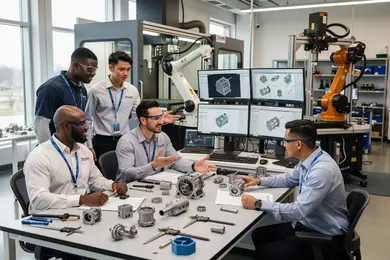
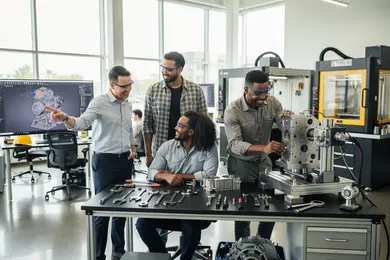
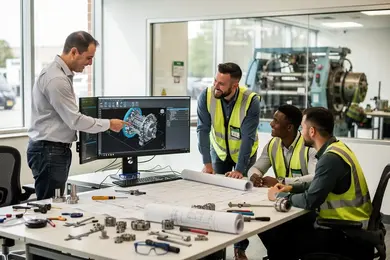
2027 Online Mechanical Engineering Degrees That Prepare Students for Robotics and Automation-Adjacent Roles

Co-Founder and Chief Data Scientist
Choosing an online mechanical engineering degree for robotics or automation means weighing flexibility against hands-on training, accreditation, cost, and career fit. The decision matters because the U. S. Bureau of Labor Statistics reported a May 2024 median annual wage of $99,510 for mechanical engineers, while manufacturers, logistics firms, and product companies continue adding automation expertise. This guide is for students, career changers, and working technicians who want a practical path into robotics-adjacent engineering roles. You will learn how programs compare, what to verify, and how to choose a degree that supports your goals.
Key Things You Should Know
- For robotics-related mechanical engineering careers, ABET accreditation is the most important quality signal because it affects employer recognition, graduate school options, and eligibility for the Fundamentals of Engineering exam in many states.
- Online mechanical engineering bachelor's programs commonly take about four years full time, while master's programs often take one to three years depending on course load, prerequisites, and whether a thesis or project is required.
- BLS May 2024 wage data places mechanical engineers at a $99,510 median annual wage, but robotics-adjacent pay varies by role, industry, software skill level, region, and whether the job leans toward design, controls, manufacturing, or systems integration.
What is an online mechanical engineering degree focused on robotics and automation?
An online mechanical engineering degree focused on robotics and automation is a mechanical engineering program delivered mostly or fully online with coursework that supports automated systems, mechatronics, controls, machine design, sensors, manufacturing systems, and computer-aided engineering. It is not always labeled "robotics." Many strong options use broader names such as mechanical engineering, mechanical engineering technology, manufacturing engineering, or mechatronics, then let students choose electives, projects, or concentrations tied to automation.
For most students, the degree is useful because robotics is not a single-discipline field. A robotic system combines mechanical structures, motors, power transmission, controls, electronics, software, safety requirements, and real-world manufacturing constraints. Mechanical engineering prepares students to understand the physical system: how parts move, fail, transfer heat, withstand loads, and interact with users or production environments.
This path can fit several types of learners:
- First-time undergraduates who want an engineering foundation that can lead to robotics, automation, manufacturing, product design, or graduate study.
- Working technicians or drafters who want to move from maintenance, CAD, or production support into engineering-level design and automation roles.
- Engineers in adjacent areas who want mechanical systems knowledge for automated equipment, smart manufacturing, or electromechanical product development.
It may not be the best fit if your main goal is purely software engineering, artificial intelligence research, or embedded software development. In those cases, computer science, electrical engineering, robotics engineering, or data-focused programs may be more direct.
Students interested in sustainable infrastructure, sensors, fluid systems, or environmental automation can also compare an environmental engineering degree online if their career target is closer to water systems, energy monitoring, or environmental compliance technology than industrial robotics.
How do online mechanical engineering programs compare to campus options for robotics training?
Online and campus mechanical engineering programs can lead to similar academic outcomes when the online option is properly accredited, mathematically rigorous, and built with credible lab solutions. The main difference is not whether students can learn theory online; it is how each format handles labs, prototyping, teamwork, faculty access, and exposure to equipment.
The table below summarizes the practical trade-offs students should evaluate before deciding whether online, campus, or hybrid study fits their robotics goals.
| Factor | Online mechanical engineering program | Campus mechanical engineering program | Best fit |
| Hands-on robotics exposure | May use remote labs, mailed lab kits, simulation software, local proctored labs, or short campus residencies. | Usually offers direct access to machine shops, robotics labs, wind tunnels, test rigs, and faculty-supervised equipment. | Campus or hybrid is usually better for students who need frequent hardware access. |
| Flexibility | Often better for working adults, military learners, parents, and students far from engineering campuses. | Less flexible because lab schedules, design studios, and project meetings often require physical presence. | Online is often better for students who must keep working while studying. |
| Team projects | Can be strong if the program uses collaborative CAD, simulation, capstone teams, and structured online meetings. | Usually easier for physical prototyping, peer troubleshooting, and informal design collaboration. | Either can work if the capstone includes real engineering deliverables. |
| Career networking | Depends heavily on virtual career fairs, employer partnerships, alumni access, and student initiative. | Often stronger for local internships, lab assistant roles, and on-campus recruiting. | Campus may help traditional students; online can work well for employed students already near automation employers. |
| Cost control | May reduce relocation, commuting, and opportunity costs, but technology fees and out-of-state tuition can still matter. | May offer more facilities but can require housing, transportation, and full-time attendance costs. | Online can be more affordable when tuition and fees are transparent. |
The best online programs do not pretend robotics can be learned only through videos. They require students to solve engineering problems using modern tools, document designs, test assumptions, and complete projects that resemble workplace tasks. If a program has no meaningful lab plan, no capstone, and no clear software or hardware expectations, that is a red flag.
What accreditation should online mechanical engineering degrees have for robotics-related careers?
For an online mechanical engineering degree aimed at robotics-adjacent careers, the strongest accreditation signal is ABET accreditation through the Engineering Accreditation Commission for engineering programs or the Engineering Technology Accreditation Commission for engineering technology programs. ABET is important because many employers, graduate schools, and state licensing boards use it as a benchmark for engineering curriculum quality.
Students should understand the difference between mechanical engineering and mechanical engineering technology before enrolling. Both can support automation careers, but they are not identical.
| Credential type | Typical focus | Robotics and automation relevance | Important caution |
| Mechanical engineering | Engineering theory, calculus-based analysis, design, thermodynamics, mechanics, controls, and modeling. | Strong fit for design engineering, systems engineering, controls-adjacent work, graduate study, and roles requiring deeper analytical preparation. | Look for ABET Engineering Accreditation Commission recognition when available. |
| Mechanical engineering technology | Applied engineering, implementation, testing, manufacturing support, CAD, instrumentation, and practical systems work. | Good fit for automation support, manufacturing engineering technology, equipment testing, and applied product roles. | Some employers or graduate programs may distinguish it from an engineering degree. |
| Mechatronics or robotics engineering technology | Integrated mechanical, electrical, controls, and automation systems. | Strong practical fit for automation technicians, controls support, system integration, and industrial robotics environments. | Verify whether the credential supports your target job title and licensure goals. |
Regional or institutional accreditation also matters because it affects federal financial aid eligibility, transfer credit, and graduate admissions. However, institutional accreditation alone does not replace ABET programmatic accreditation for engineering-specific quality assurance.
If professional engineering licensure may matter later, students should check state board rules before enrolling. Licensure requirements vary, and not every online or technology-focused program creates the same pathway to the FE exam, PE exam, or engineering titles regulated by state law.
What core courses and specializations cover robotics and automation in these programs?
Robotics and automation draw from several parts of the mechanical engineering curriculum. The strongest programs do not rely on a single robotics elective; they build a chain of courses that helps students understand motion, forces, energy, materials, controls, manufacturing, and computational design.
The table below shows common course areas and how they connect to robotics-adjacent work. Exact course names vary by school, so students should compare learning outcomes rather than titles alone.
| Course or specialization area | What students learn | Why it matters for robotics and automation |
| Statics, dynamics, and mechanics of materials | Forces, motion, stress, strain, vibration, and structural behavior. | Supports robot arm design, end-effector loads, machine frames, and failure prevention. |
| Machine design | Gears, bearings, shafts, fasteners, actuators, tolerances, and design safety factors. | Helps students design reliable mechanisms used in automated equipment. |
| Controls and dynamic systems | Feedback, stability, sensors, actuators, transfer functions, and system response. | Connects directly to motion control, process automation, and robotic movement. |
| Mechatronics | Integration of mechanical systems, electronics, sensors, microcontrollers, and actuators. | Often the most directly relevant course area for robotics-focused mechanical engineers. |
| Manufacturing processes and automation | Production methods, quality, CNC, robotics cells, lean systems, and factory workflows. | Prepares students for smart manufacturing, automated production, and systems integration roles. |
| CAD, CAE, and simulation | 3D modeling, finite element analysis, motion simulation, and design validation. | Builds skills used in product development, digital twins, and prototype testing. |
| Programming for engineers | Python, MATLAB, C, data analysis, numerical methods, or automation scripting. | Improves communication with software and controls teams and supports simulation-heavy roles. |
Students who want to move closer to autonomous systems, predictive maintenance, machine vision, or AI-enabled automation may eventually need stronger data and programming preparation. A mechanical engineering degree can be paired with electives, certificates, or an online master data science program if the long-term goal involves modeling sensor data, optimizing industrial systems, or working with robotics analytics.
When comparing curricula, look for evidence of applied work. A strong program should include design projects, lab reports, simulation portfolios, team-based engineering communication, and a senior capstone or thesis that can be explained to employers.
What are the typical admissions requirements for online mechanical engineering degrees?
Admissions requirements depend on degree level. Bachelor's programs usually focus on high school preparation, transfer credits, math placement, and science readiness. Master's programs focus on prior engineering coursework, GPA, prerequisite math, professional experience, and whether the applicant can handle graduate-level analysis.
Most online mechanical engineering programs ask for some combination of the following materials because they need to verify both academic readiness and technical fit:
- Official transcripts from high school, community college, or prior universities.
- Completed prerequisite coursework in calculus, physics, chemistry, engineering graphics, or programming, depending on entry level.
- Minimum GPA requirements, often with higher expectations for upper-division engineering or graduate admission.
- Placement testing or proof of college-level math readiness for bachelor's students.
- Resume, statement of purpose, recommendation letters, or professional experience documentation for master's applicants.
- English language proficiency documentation for applicants whose prior education was not in English.
Students without a strong math background should be cautious about accelerated programs. Mechanical engineering is math-intensive, and rushing through calculus, physics, differential equations, and mechanics can make later robotics coursework harder. A slower path with bridge courses may be more effective than entering quickly and struggling through foundational classes.
Transfer students should ask how prior credits apply to the major, not just whether the university accepts them. General education credits may transfer easily, while engineering courses often require syllabus review because ABET-aligned programs must verify specific outcomes.

How long do online mechanical engineering programs take, and what do they cost?
Program length and cost vary by degree level, transfer credit, enrollment intensity, residency status, and whether the school charges online students the same tuition as campus students. A bachelor's degree commonly requires about 120 credits, while a master's degree often requires about 30 credits, though exact totals vary by institution.
For cost context, the College Board reported average published tuition and fees for full-time undergraduates at public four-year in-state institutions of $11,610 for 2024-25. That figure is not specific to engineering or online programs, but it helps students benchmark whether a quoted annual tuition is unusually high or low.
Students should compare total cost, not just tuition. The main cost categories usually include the following:
- Tuition per credit or per term, including whether online students pay in-state, out-of-state, or separate distance-learning rates.
- Engineering, laboratory, technology, simulation software, exam proctoring, and graduation fees.
- Required hardware such as a capable laptop, webcam, calculator, lab kit, microcontroller kit, or CAD-compatible workstation.
- Optional or required travel for campus residencies, intensives, exams, or capstone demonstrations.
- Books, digital course materials, software subscriptions, and certification exam preparation materials.
The table below summarizes typical timeline trade-offs. Use it to decide whether speed, affordability, workload balance, or career continuity matters most.
| Path | Typical timeline | Advantages | Trade-offs |
| Full-time online bachelor's | About four years for first-time students | Fastest standard undergraduate route and may support earlier entry into engineering roles. | Demanding workload, especially with labs, calculus, physics, and design courses. |
| Part-time online bachelor's | Often five to six years or longer | Better for working adults and students with family responsibilities. | Longer time before degree completion and possible curriculum changes along the way. |
| Transfer-completion bachelor's | Often two to three years after approved credits | Can reduce cost and time if lower-division math, science, and general education credits transfer well. | Engineering major credits may not transfer as easily as general education credits. |
| Online master's in mechanical engineering | Often one to three years | Good for engineers who want deeper technical specialization without earning another bachelor's degree. | Usually requires a related undergraduate background and may not replace ABET bachelor's requirements for licensure. |
To reduce cost, students should ask about transfer evaluations before applying, employer tuition assistance, military benefits, scholarships for engineering students, payment plans, and whether summer courses are charged differently. The cheapest option is not always the best value if it lacks accreditation, delays graduation, or does not provide robotics-relevant labs and projects.
Which robotics and automation-adjacent roles can graduates pursue with this degree?
A mechanical engineering degree can support several robotics and automation-adjacent roles, especially when paired with controls, programming, manufacturing, CAD, simulation, or mechatronics experience. The degree is most directly aligned with jobs that involve physical systems rather than purely software-defined robotics.
The table below shows common roles, what they involve, and how close each role is to robotics. Job titles vary by employer, so students should read descriptions carefully instead of relying on titles alone.
| Role | Typical responsibilities | How the degree helps | Robotics proximity |
| Mechanical design engineer | Designs components, assemblies, fixtures, housings, mechanisms, and test equipment. | Uses CAD, mechanics, materials, tolerances, and machine design. | High when designing robotic arms, grippers, automated equipment, or electromechanical products. |
| Automation engineer | Improves automated production systems, integrates equipment, troubleshoots processes, and works with controls teams. | Provides understanding of machines, motion, safety, and manufacturing constraints. | High in manufacturing, logistics, packaging, and process industries. |
| Manufacturing engineer | Designs production workflows, tooling, quality processes, and factory improvements. | Connects design, production, materials, and process optimization. | Moderate to high when factories use robots, conveyors, CNC, and automated inspection. |
| Mechatronics engineer or specialist | Works across mechanical systems, sensors, actuators, electronics, and controls. | Builds on mechanical fundamentals while requiring added electrical and programming skill. | Very high for electromechanical automation systems. |
| Robotics systems engineer | Coordinates mechanical, electrical, software, controls, and safety requirements for robotic systems. | Supports system-level thinking, requirements analysis, testing, and design trade-offs. | Very high, though many roles prefer experience or graduate study. |
| Test or validation engineer | Plans experiments, measures performance, analyzes failures, and validates prototypes or automated systems. | Uses instrumentation, mechanics, statistics, and design verification. | Moderate to high in robotics product companies and automated equipment firms. |
Students who want software-heavy robotics roles, such as perception, autonomous navigation, embedded systems, or robotics middleware, should consider adding computer science coursework. In some cases, an affordable online computer science degree may be a more direct route than mechanical engineering if the target job is primarily coding rather than designing machines.
To improve employability, students should build a portfolio that shows engineering judgment. Strong examples include a CAD assembly with drawings, a mechatronics prototype, a controls simulation, a finite element analysis report, a manufacturing automation improvement proposal, or a capstone project with test data and design revisions.
What salary ranges and earning potential exist in robotics and automation-related roles?
Salary potential in robotics and automation-adjacent roles depends on the specific job family, industry, region, degree level, internship history, and software or controls skills. National wage data is useful for benchmarking, but it should not be treated as a promise for any individual graduate.
The table below uses May 2024 U.S. Bureau of Labor Statistics median annual wage data for closely related occupational categories. Robotics-specific jobs may be classified differently by employers, so use these figures as broad salary context rather than exact robotics pay.
| Occupation category | May 2024 median annual wage | How it relates to robotics and automation |
| Mechanical engineers | $99,510 | Core benchmark for machine design, product development, thermal systems, mechanical analysis, and automation equipment roles. |
| Industrial engineers | $101,140 | Relevant for manufacturing systems, process improvement, production automation, and factory optimization. |
| Electrical and electronics engineers | $118,780 | Relevant when automation work leans toward controls, sensors, drives, circuit integration, and electronic systems. |
| Software developers | $133,080 | Relevant for robotics software, simulation platforms, autonomy, perception, and industrial automation software roles. |
The wage spread shows why course selection matters. A mechanical engineering degree can be a strong foundation, but students who add programming, controls, electrical systems, data analysis, and simulation skills may qualify for a wider range of automation roles. Students comparing software-oriented pathways can also review the cheapest data science degree options if their goal is closer to sensor analytics, machine learning, or industrial AI than mechanical design.
When evaluating return on investment, compare expected debt, time to completion, local internship access, employer tuition assistance, and whether the program's alumni work in industries you want to enter. A higher-cost program may be worthwhile if it has strong labs, employer connections, and completion support, but a lower-cost ABET-accredited option can be a better value for disciplined students who already have industry access.
What is the job outlook for mechanical engineers in robotics and automation fields?
The job outlook for mechanical engineers is positive but uneven across industries. The U.S. Bureau of Labor Statistics projected mechanical engineer employment to grow 11% from 2023 to 2033, which is faster than the average for all occupations. For students, the key takeaway is that demand is not limited to traditional machinery firms; automation is also affecting logistics, medical devices, energy, aerospace, electronics, food production, and advanced manufacturing.
Robotics and automation are influencing mechanical engineering in several practical ways. Employers increasingly value engineers who can work with digital design tools, simulation, sensors, data from connected equipment, and cross-functional teams. AI may automate some drafting, documentation, optimization, and simulation setup tasks, but it also raises expectations: engineers need to validate model outputs, understand safety constraints, and make decisions that software cannot make alone.
Students should prepare for a labor market where "mechanical engineer" roles often include hybrid responsibilities. A job description may ask for CAD, finite element analysis, PLC familiarity, Python, MATLAB, SolidWorks, automation cell design, machine safety, or experience with data acquisition. You do not need all of these skills for every job, but the more robotics-adjacent your goal is, the more useful interdisciplinary preparation becomes.
Geography also matters. Automation opportunities are often concentrated around manufacturing corridors, aerospace hubs, automotive suppliers, semiconductor facilities, robotics startups, defense contractors, warehousing and logistics centers, and medical device companies. Online students should research employers near them early because internships and project partnerships can be as important as coursework.
How can students choose a reputable online mechanical engineering program for robotics?
Choosing a reputable online mechanical engineering program requires more than searching for the lowest tuition or fastest completion time. The right program should match your career target, provide credible engineering rigor, and make online learning practical without weakening labs, projects, or faculty support.
Use the following steps to compare programs in a structured way before enrolling:
- Verify institutional accreditation and, when available, ABET programmatic accreditation for the exact degree and delivery format you plan to enter.
- Compare the curriculum against your target role by checking for controls, mechatronics, manufacturing automation, CAD, simulation, programming, and capstone requirements.
- Ask how labs are completed, including whether the program uses remote labs, at-home kits, simulations, local partners, or required campus visits.
- Request a transfer-credit evaluation before committing, especially if you have community college, military, technical, or previous engineering credits.
- Review total cost, including fees, software, hardware, travel, and the number of credits you must complete after transfer evaluation.
- Check career support, employer partnerships, internship resources, alumni outcomes, and whether online students receive the same services as campus students.
- Ask whether the degree supports FE exam eligibility or professional engineering licensure in your state if licensure may matter later.
- Look for evidence of student work, such as capstone examples, design portfolios, lab reports, competition teams, research opportunities, or industry-sponsored projects.
Several red flags should make you pause. Be careful with programs that avoid direct questions about accreditation, advertise unrealistic completion timelines, provide no clear lab plan, refuse to explain transfer policies, or imply that a degree alone will guarantee a robotics job. Also be cautious if the program has no calculus-based engineering sequence but markets itself as equivalent to a traditional mechanical engineering degree.
The best choice depends on your intended role. If you want to design mechanisms or automated equipment, prioritize ABET-aligned mechanical engineering depth. If you want to program robots, compare computer science and electrical engineering options.
If you want to analyze industrial data, predictive maintenance, or AI-driven operations, a data-oriented path may be more efficient. The smartest program is the one whose curriculum, accreditation, cost, timeline, and project work align with the job descriptions you actually want.
Other Things You Should Know About Mechanical Engineering
Yes, but only if the program has a credible lab and project model. Look for remote labs, mailed kits, simulation tools, capstone projects, and optional in-person intensives. If the program relies almost entirely on lectures and quizzes, it may not provide enough applied preparation.
Not always. Many bachelor's programs introduce programming for engineers, but prior exposure to Python, MATLAB, C, or Arduino-style projects can make robotics and controls coursework easier. Master's applicants may need stronger preparation depending on the program.
In 2027, an online mechanical engineering degree offers comprehensive preparation for robotics and automation roles by covering fundamental engineering principles, advanced robotics design, and integration. While a certificate focuses on specific skills, the degree provides a broader, more in-depth foundation crucial for tackling complex projects.
Yes, if possible. Internships, co-ops, technician roles, research projects, and employer-sponsored capstones can make online students more competitive because they provide real hardware, teamwork, and workplace evidence that a transcript alone may not show.
References
- Online Robotics Engineering Degree Programs https://www.onlineengineeringprograms.com/robotics
- Robotics Technician Career Paths & Salaries | UTI https://www.uti.edu/programs/robotics-automation/career-path
- Online Mechanical Engineering Degrees 2026: Costs & Salary Compared https://www.fernstudi.net/en/onlinestudies/technology/mechanical-engineering
- News and Events https://www.roboticscareer.org/news-and-events/news/27854
- Automation and Robotics https://international.pwsztar.edu.pl/studying/polytechnic-faculty/automation-and-robotics/
- Future Scope Of Robotics And Automation Engineering https://www.mituniversity.ac.in/blog/future-scope-of-robotics-and-automation-engineering-
- What to Study for a Career in Robotics? https://blog.robotiq.com/what-to-study-for-a-career-in-robotics
- What Are The Top 10 Careers in Robotics in 2026? | NEIT https://www.neit.edu/blog/careers-in-robotics
- 2025 Best Online Mechanical Engineering Degrees https://www.onlineu.com/degrees/mechanical-engineering
- Online Mechanical Engineering Degrees 2025 https://www.affordablecollegesonline.org/degrees/engineering-programs/mechanical-engineering/