2027 Most Valuable Skills Taught in AI Degree Programs

Co-Founder and Chief Data Scientist
Professionals from non-technical backgrounds often struggle to identify which skills are essential when transitioning into the field of artificial intelligence. The rapid evolution of this sector demands a clear understanding of core competencies that align with industry needs. Without guidance, learners risk focusing on outdated or overly theoretical knowledge, limiting career prospects. This article clarifies the most valuable skills taught in recognized AI degree programs, emphasizing practical and applicable expertise. It aims to help readers make informed decisions about their education path and enhance their readiness for roles in artificial intelligence-driven industries.
Key Things You Should Know
- Proficiency in machine learning algorithms and data analysis remains the core skill set, with 78% of AI graduates citing these as essential for employment in 2025.
- Ethical AI development and bias mitigation have become critical, as 65% of degree programs now include dedicated coursework on responsible AI practices.
- Expertise in programming languages like Python and exposure to AI frameworks equip 72% of graduates with practical skills demanded by leading tech companies.
What core technical and analytical skills do AI degree programs teach today?
Degree programs in artificial intelligence develop core technical skills in artificial intelligence degree programs that prepare students for the evolving demands of the field. Central to these programs are machine learning and deep learning foundations, covering supervised, unsupervised, and reinforcement learning approaches. Emphasis is placed on model training, optimization, and evaluation, essential for building effective algorithms that learn from data.
Programming expertise, especially in Python and frameworks like TensorFlow and PyTorch, enables students to create and deploy AI models while managing large-scale datasets. Alongside programming, knowledge of data structures, algorithms, and software engineering principles supports scalable, production-ready AI applications.
Analytical techniques taught in AI degree curricula include data analytics, statistical inference, and feature engineering, all finely tuned to enhance model accuracy. This training also cultivates critical thinking skills vital for problem formulation and experimental design, connecting real-world challenges with computational solutions.
Domain-specific courses often focus on natural language processing, computer vision, and robotics, equipping graduates to tackle specialized AI challenges such as autonomous systems and human-computer interaction. Additionally, ethical AI practices and interpretability techniques are integrated to address fairness and bias in deployed AI systems.
According to AiAgentsKit (2025), professionals with AI skills like machine learning earn about 56% higher salaries than similar roles lacking these competencies. For students seeking accelerated education paths, an accelerated bachelor's degree computer science online can offer efficient entry into this dynamic field.
How do AI programs develop machine learning and deep learning expertise for real-world use?
AI programs focus on building machine learning and deep learning skills development in AI programs by integrating hands-on projects with core theoretical knowledge. Students gain practical experience in building, training, and deploying models using frameworks like TensorFlow and PyTorch. They learn end-to-end workflows, including data preprocessing, feature engineering, model selection, and hyperparameter tuning, essential for real-world applications of AI degree machine learning training.
Training increasingly covers scalable machine learning pipelines and production-level deployment using MLOps, which blends machine learning with software engineering principles. Containerization with Docker, orchestration via Kubernetes, and CI/CD pipelines are taught to ensure models transition smoothly from development to live environments.
Strong emphasis is placed on cloud platforms such as AWS and Google Cloud, alongside collaboration skills for working with cross-functional teams managing real-time data streams, model versioning, and reliability. These elements equip graduates for rapidly evolving AI infrastructure demands, which recently grew over 70% in job postings, highlighting the value of MLOps expertise.
For those exploring cost-effective pathways to acquire these skills, exploring AI degrees online offers flexible options. By combining rigorous theory with industry-aligned projects and emerging tools, AI degree programs prepare students to tackle production challenges and develop scalable AI solutions effectively.
Which data science, statistics, and programming languages are most emphasized in AI degrees?
Data science and programming languages emphasized in AI degree programs focus heavily on Python and R. Python is the industry standard for its comprehensive libraries like TensorFlow, PyTorch, and scikit-learn, supporting machine learning and data analysis. R remains vital for statistical modeling and hypothesis testing, especially in research-heavy tracks.
Statistics and coding skills prioritized in artificial intelligence curricula include courses on probability theory, regression analysis, and inferential statistics. Bayesian statistics is increasingly incorporated to address uncertainty in AI models.
Natural language processing (NLP) and large language model (LLM) expertise have grown significantly. Job postings for LLM specialists tripled between 2023 and 2025, offering a 25-35% salary premium over traditional NLP roles. Students learn about transformers, attention mechanisms, and pre-training methods alongside classical NLP tools.
Hands-on experience with SQL, Hadoop, and Spark prepares students to manage and analyze large datasets. Training emphasizes data pipelines, cleaning, and exploratory data analysis to meet real-world data challenges. Advanced programs add reinforcement learning, computer vision, and ethical data practices to broaden technical and programming capabilities, equipping graduates for roles from research scientist to applied data engineer.
Those interested can explore more options, including MS data science online programs, which integrate these vital skills into modern curricula.
How do online AI degree programs compare to campus-based options in quality and outcomes?
Online AI degree programs increasingly match campus-based quality in curriculum rigor and student outcomes. These programs provide exposure to essential skills like machine learning, natural language processing, and data ethics through interactive platforms, virtual labs, and real-time collaboration tools. Such experiential learning mirrors in-person opportunities while offering flexibility for varied schedules and locations. This balance is critical when comparing how online AI degree programs compare to campus-based quality.
Graduate outcomes from online and on-campus AI degrees converge, particularly in technical skills and job placement. Employers in manufacturing, retail, and healthcare seek candidates proficient in multimodal AI and computer vision. Reports like Great Learning's 2025 study reveal a nearly 50% rise in demand for these applied AI skills from 2023 to 2025. Online programs often incorporate project-based assessments and industry partnerships to prepare students for seamless workforce integration.
Campus programs retain advantages such as direct access to physical research facilities, face-to-face mentorship, and networking events important for career advancement. Prospective students should weigh factors like accreditation, faculty expertise, and specialized lab availability. Those managing work or geographic constraints may find online degrees a strong choice without sacrificing competence or career prospects.
For those considering advanced options, exploring the online data science PhD can offer further career growth. Comparing career outcomes of online versus campus AI degrees reveals that both pathways support high-quality education when aligned with individual goals and evolving technical demands.
What accreditation standards should AI degree programs meet in the United States?
AI degree programs in the United States must hold regional accreditation from agencies like the Higher Learning Commission (HLC) or the Middle States Commission on Higher Education to confirm institutional credibility. Equally important is programmatic accreditation such as from the Accreditation Board for Engineering and Technology (ABET), which ensures the curriculum aligns with industry standards in computing and engineering fields.
ABET-accredited AI programs focus on essential skills including algorithms, data structures, machine learning, and ethical considerations. They also emphasize practical training in AI workflow automation and agentic systems-skills increasingly required in AI job descriptions, appearing in over 40% of mid-to-senior roles by 2025 according to LinkedIn market analysis summarized by Brij Pandey (2025).
When selecting a program, prospective students should look for strong foundational coursework in computer science and mathematics, plus classes on automation, workflow orchestration, and decision-making frameworks. Accreditation bodies also evaluate faculty expertise, research engagement, and partnerships with industry to ensure the program remains relevant and innovative.
Substandard or unaccredited AI degrees can limit employment opportunities and professional licensing. Prioritizing programs with both regional and ABET or equivalent accreditation guarantees comprehensive preparation for careers in automation and agentic AI systems.
What typical courses and hands-on projects define a modern AI curriculum?
AI degree programs blend foundational knowledge with practical experience to meet evolving industry needs. Core courses focus on machine learning, deep learning, natural language processing, and computer vision, emphasizing programming languages like Python and frameworks such as TensorFlow and PyTorch. These technical skills are supported by essential studies in data science, statistics, linear algebra, and probability theory to strengthen algorithmic understanding.
Hands-on projects often include building predictive models, training neural networks, and deploying applications on cloud platforms, enhancing real-world problem-solving abilities. Increasingly, courses address responsible AI, covering ethics, governance, and compliance, with growing importance on algorithmic fairness, transparency, and privacy regulations. According to a recent TechTarget survey, demand for skills in AI governance and compliance is expected to rise by over 80% in the near term.
Practical experiences like capstone projects and internships expose students to challenges such as bias detection and explainability tools for AI systems. Collaboration with industry partners develops teamwork and communication skills needed to navigate complex regulatory environments effectively.
The curriculum balances technical expertise, ethical awareness, and applied learning, preparing graduates to excel in the AI workforce.
What admission requirements, prerequisites, and math background do AI programs expect?
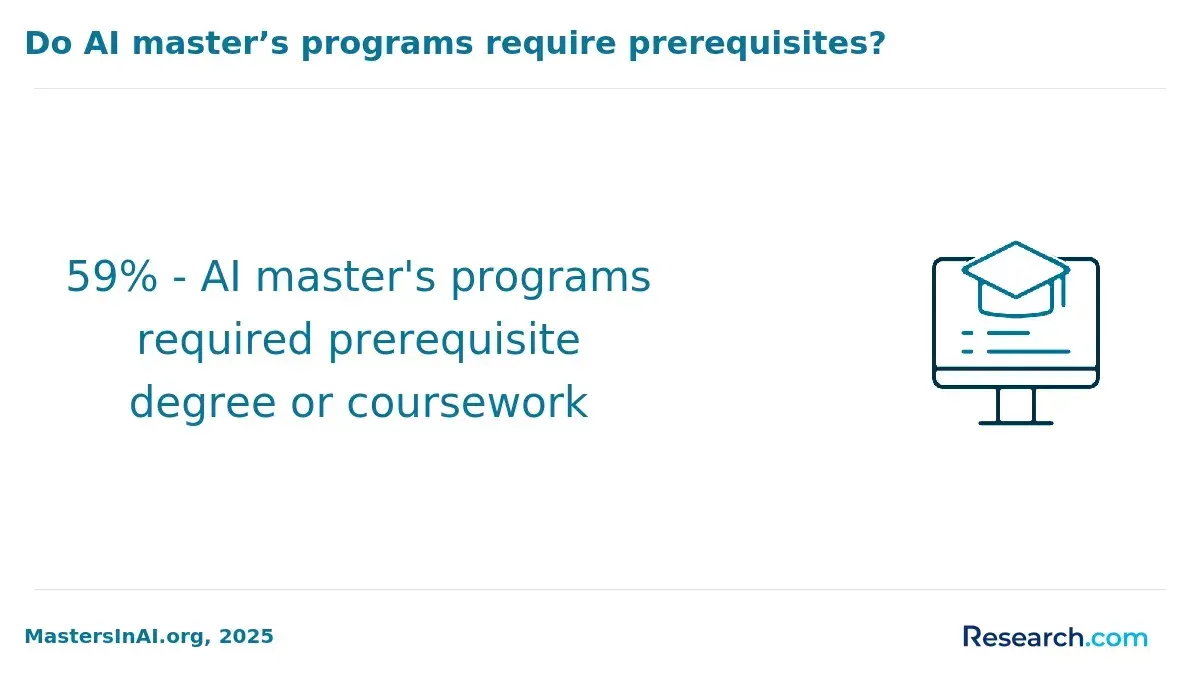
Admission to AI degree programs typically demands a strong foundation in mathematics and technical skills. Most require a bachelor's degree in fields like computer science, engineering, mathematics, or statistics. Core prerequisites often include calculus (single and multivariable), linear algebra, probability, and statistics, which support understanding of machine learning, neural networks, and data analysis.
Applicants must be proficient in programming languages such as Python, Java, or C++, essential for developing AI models and handling data. Experience with data structures, algorithms, and software engineering principles is often expected. Graduate programs may look for research experience or professional exposure in AI, data science, or computational disciplines.
Advanced knowledge in discrete mathematics and optimization methods, like gradient descent or convex optimization, is increasingly important. Those without technical backgrounds may need foundational coursework prior to admission.
Interdisciplinary skills are valued as well, with backgrounds in cognitive science, linguistics, or management combined with technical expertise rising in demand. Roles like AI product management offer median salaries exceeding $200,000 in 2025, roughly 30-40% higher than traditional product manager positions, according to Intuit's analysis of AI careers and salaries.
Meeting these standards prepares students for rigorous AI study and high-paying, strategic leadership roles integrating AI innovation and product development.
What AI-related careers, job roles, and industries do graduates commonly enter?
Graduates of AI degree programs often pursue diverse careers across industries like technology, finance, healthcare, automotive, and retail. Key roles include machine learning engineer, data scientist, AI researcher, and software developer specializing in intelligent systems. Specialized careers such as prompt engineer and human-AI interaction designer have emerged rapidly due to strong market demand for these skills.
For instance, fintech companies hire machine learning engineers for fraud detection and algorithmic trading, while healthcare organizations apply AI expertise to diagnostic tools and personalized treatment plans. The automotive industry seeks AI specialists to advance autonomous vehicle systems, and retail businesses use AI to optimize customer behavior predictions and supply chains.
Prompt engineering notably appeared in over 30% of AI-related job postings in 2025, up from nearly zero in 2022, emphasizing the importance of professionals who can effectively communicate with AI models and design user-friendly interfaces.
Other promising careers include AI product management, AI ethics, and AI policy roles within tech firms and government agencies committed to responsible AI deployment. Academic research and consulting also offer pathways for graduates to influence AI strategy and implementation.
Graduates targeting these roles should align their studies and internships accordingly to gain a competitive edge in this evolving job market.
What salary ranges and earning potential can AI graduates realistically expect?
AI graduates in the United States typically start with salaries ranging from $80,000 to $120,000 annually. Mid-career professionals earn between $120,000 and $180,000, influenced by specialization and geographic location. Salaries rise notably in domain-specific fields like FinTech and HealthTech, where specialized AI engineers earn 15-25% more than generalists, often starting around $100,000 and exceeding $200,000 for experienced roles, as highlighted in Emeritus's 2026 review of top-paying AI skills.
Combining domain expertise with AI skills significantly enhances earning potential. For example, AI engineers working on healthcare data analysis or algorithmic trading in finance command higher salaries compared to those focused on general AI solutions. Employers value this expertise for accelerating the development and deployment of AI applications.
Entry-level positions include AI software developer, data scientist, or machine learning engineer, with salaries on the lower end. Advanced roles such as AI research scientist, AI product manager, or lead engineer are at the upper salary range. In addition, tech hubs like San Francisco, New York, and Boston generally offer salaries that are 10-20% above the national average.
Graduates should focus on continuous skill development and consider certifications in their chosen domain to increase earning potential. Negotiating salaries based on specialized AI subfields can result in better offers. This knowledge aids in setting realistic salary expectations and choosing the most promising areas within AI degree programs.
How can students evaluate and choose a reputable AI degree program or school?
Evaluating AI degree programs requires careful attention to multiple quality indicators. One key factor is how well a program combines AI literacy with critical thinking and cross-functional collaboration skills. A Skillsoft 2025 survey found that candidates with AI literacy and critical thinking skills are 2.5 times more likely to obtain AI-adjacent jobs than those focusing only on coding skills. This underscores the importance of holistic skill development alongside technical training.
Faculty expertise also matters. Programs led by instructors engaged in research or with strong industry ties often provide up-to-date and practical insights. Accreditation by recognized regional or national bodies ensures reliable educational standards. Curriculum depth should cover foundational AI topics such as machine learning, natural language processing, and ethical AI, as well as interdisciplinary subjects like data science and communication to build well-rounded expertise.
Flexible learning formats, access to labs, and internship opportunities enhance hands-on experience. Additionally, reviewing student outcomes-graduation rates, job placements, and alumni career progress-offers valuable evidence of program effectiveness. Engaging with current students or alumni can provide firsthand perspectives on program rigor, support, and industry connections.
These elements together help students make an informed and strategic choice when selecting an AI degree program.
Other Things You Should Know About Artificial Intelligence
In 2027, Python continues to be essential for AI degree programs due to its extensive libraries and ease of use. R is also valuable for statistical analysis and data visualization, while TensorFlow and PyTorch are crucial for deep learning applications. These languages foster effective development and innovation in AI.
Interdisciplinary skills are crucial in AI education because artificial intelligence projects often require collaboration across fields such as psychology, linguistics, computer science, and engineering. Effective AI practitioners need to understand domain-specific knowledge along with technical expertise to create applicable and robust AI solutions.
Research forms a core component of many AI degree programs, enabling students to explore cutting-edge advancements and contribute to innovations. Through research projects, students develop critical thinking and problem-solving skills while gaining hands-on experience with emerging AI techniques and tools.
AI degree programs often incorporate ongoing curriculum updates to reflect the latest developments in technology and theory. They also encourage lifelong learning by teaching students foundational principles that are adaptable, alongside offering opportunities for specialization in trending AI subfields.
References
- Most Important Programming Languages for AI https://www.alexanderthamm.com/en/blog/programming-languages-for-ai/
- Machine Learning: Key Concepts and Real-World Applications https://cid.com/blog/machine-learning-key-concepts-and-real-world-applications/
- Blog https://admissiongoals.com/post/ai-machine-learning-programs-europe-admission-guide-international-students
- Artificial Intelligence Degree Admission Requirements: What You Need https://hakia.com/degrees/artificial-intelligence/admission-requirements/
- The Ultimate Guide to Evaluating AI Tools in Your School https://www.toddleapp.com/learn/blog-post/the-ultimate-guide-to-evaluating-ai-tools-in-your-school/
- AI Engineering Salary: Understanding Compensation Trends in 2026 https://nexusitgroup.com/ai-engineering-salary-understanding-compensation-trends/
- 5 Benefits of an Online AI MS Degree | University of Bridgeport https://www.bridgeport.edu/news/benefits-of-online-ms-ai-degree/
- Machine Learning Use Cases: Practical Industry Applications https://www.databricks.com/blog/machine-learning-use-cases
- How Does Artificial Intelligence Learn? - Univio https://www.univio.com/blog/how-does-artificial-intelligence-learn/
- Colleges face a choice: Try to shape AI’s impact on learning, or be redefined by it https://theconversation.com/colleges-face-a-choice-try-to-shape-ais-impact-on-learning-or-be-redefined-by-it-275653