2027 Best AI Degrees With the Best Tutoring and Academic Coaching

Co-Founder and Chief Data Scientist
Many professionals with degrees outside STEM face challenges entering the artificial intelligence field due to lack of targeted training and mentorship. Navigating degree options that offer both academic rigor and tailored tutoring can be overwhelming, especially when balancing work or personal commitments. Without proper guidance, learners risk investing time and money in programs that do not meet industry standards or provide effective coaching.
This article outlines top U. S. graduate programs in artificial intelligence that combine flexible curricula with strong academic support. It aims to help readers identify degrees that deliver quality education alongside robust tutoring and coaching to accelerate career transitions.
Key Things You Should Know
- Top AI degree programs in 2026 emphasize hands-on tutoring and personalized academic coaching, improving student outcomes by up to 40% compared to standard lecture-based courses.
- Institutions offering AI degrees increasingly integrate adaptive learning technologies, enhancing accessibility for diverse learners and boosting retention rates by 25%.
- Career services linked to AI programs report a 30% higher job placement rate within six months, aided by tailored coaching and industry partnerships starting during study.
What are the best AI degrees that include tutoring and academic coaching services?
Top ai academic coaching and degree options focus on combining rigorous curricula with personalized support to enhance student outcomes. Leading programs embed one-on-one coaching, peer tutoring, and dedicated academic advising directly into their degree structures. For example, Carnegie Mellon University's Artificial Intelligence master's program integrates coaching and peer tutoring within course modules, while Stanford University aligns academic coaching with research mentorship to strengthen learning.
Institutions like Georgia Tech's Online Master of Science in Artificial Intelligence and University of Illinois Urbana-Champaign emphasize structured tutoring to help students master coding-intensive and theoretical AI challenges. Students evaluating the best AI degree programs with tutoring support should consider how coaching services improve retention, grades, and career readiness.
For those seeking career insights, exploring the applied artificial intelligence salary can provide valuable information on potential outcomes after graduation.
How do AI programs provide tutoring, academic coaching, and student success support?
AI programs often provide tutoring, academic coaching, and student success support through personalized, multi-layered approaches designed to meet diverse student needs. Tutoring typically includes faculty or trained tutors offering targeted sessions based on data analytics that identify specific skill gaps. For instance, AI degree students struggling with machine learning can receive tailored workshops or one-on-one coaching aligned with their coursework. This kind of support illustrates the strong benefits of ai tutoring and academic coaching benefits.
Academic coaching focuses on essential skills like time management, study strategies, and career planning. Coaches help students set achievable goals and track their progress through learning management systems, reducing dropout rates and ensuring steady advancement.
Student success support in ai degree programs is further enhanced by peer mentoring networks that connect students with experienced upperclassmen or alumni, offering motivation and practical advice. Dedicated success centers provide additional resources such as exam preparation materials, coding labs, and technical workshops to supplement classroom learning.
The positive impact of these services is clear: usage of tutoring correlates with significantly higher course pass rates, demonstrated by a comprehensive study from the Community College Research Center, Teachers College Columbia University. Prospective students seeking proven programs can consult the data science master program ranking for guidance on affordable, quality options.
What accreditation should an AI degree have for credible U.S. career outcomes?
For credible U.S. career outcomes, pursuing accredited AI degree programs in the United States requires regional accreditation from one of six recognized agencies. These include the Middle States Commission on Higher Education (MSCHE), the Higher Learning Commission (HLC), and the Western Association of Schools and Colleges (WASC). Regional accreditation confirms the program meets rigorous academic standards valued by employers and graduate schools. Without it, degrees may struggle to gain recognition, limiting job prospects and eligibility for advanced studies.
National accreditation or program-specific certifications, like ABET for engineering-related AI programs, add value but do not substitute for regional accreditation's role in establishing institutional legitimacy. Employers often discount degrees outside this framework. In fact, 86% of employers reported using institutional accreditation as a key factor in evaluating educational credentials (AACRAO employer research, 2024).
Employers in sectors such as technology, finance, and healthcare prioritize degrees with recognized regional accreditation when hiring AI specialists. Accredited programs usually provide access to federal financial aid and maintain curricula aligned with current industry standards, which improves readiness for roles including machine learning engineer, data scientist, or AI researcher.
Students seeking quality pathways should consider the best regional accreditation for AI degrees in the US to ensure their investments lead to meaningful career advancement. For those interested in related creative fields, becoming a video game designer is another promising career path often requiring similarly accredited programs.
Which AI degree level fits your goals: associate, bachelor's, master's, or PhD?
Choosing the appropriate ai degree level depends on your career goals, timeline, and qualifications. An associate degree offers foundational skills ideal for entry-level technical roles or as a stepping stone to higher education. Typically spanning two years, it prepares graduates for positions like ai technician or data analyst assistant. Many students seek the best associate and bachelor's degrees in artificial intelligence to build practical knowledge quickly.
A bachelor's degree delivers comprehensive training in algorithms, machine learning, and data science over four years. Graduates qualify for software engineering, ai development, or research assistant jobs. Despite this, median weekly earnings for bachelor's holders are about $1,493, which is less than those holding a master's degree.
Master's degrees emphasize advanced topics such as deep learning, natural language processing, and ethical ai deployment. This degree often leads to roles in ai research, data science leadership, or specialized engineering, with median weekly wages around $1,737. Pursuing advanced master's and PhD programs for AI career advancement benefits bachelor's graduates entering competitive fields.
The PhD level suits those pursuing innovation, academia, or senior research, involving original research over four to six years. PhD graduates often work in cutting-edge labs or as professors, pushing boundaries in ai theory and applications.
Consider your desired technical depth, income expectations, and study commitment. For practical skills and faster entry, associate or bachelor's degrees are valuable options. For specialized, higher-paying roles, advanced degrees are recommended. For guidance on affordable options, explore the best online cyber security degrees.
What AI curriculum and courses should strong programs require?
Strong AI degree programs provide a balanced curriculum combining theoretical foundations with practical skills and specialized knowledge. Core courses typically include machine learning, data structures and algorithms, and statistics to build analytical rigor. Programming instruction focuses heavily on Python, highlighted by a 2025 analysis of AI job postings identifying it as the top programming language requirement across AI roles. Mastery of Python enables students to develop machine learning models and work with popular AI libraries such as TensorFlow and PyTorch.
Mathematics courses in linear algebra, calculus, and probability theory are essential for understanding model behaviors and optimization. Additionally, data engineering studies covering database systems and big data frameworks prepare graduates to handle large-scale datasets effectively.
Ethics and AI policy education is crucial for fostering responsible practitioners aware of bias, privacy, and societal impacts. Interdisciplinary options, like human-computer interaction and robotics, further broaden students' perspectives and skills.
Hands-on projects and internships replicate real-world challenges, while capstone projects involve dataset collection, model design, testing, and deployment, helping students build strong portfolios. Academic coaching and tutoring focused on challenging subjects also enhance student success and retention in these demanding AI programs.
What are common admissions requirements for AI and machine learning degrees?
Admission to AI and machine learning degree programs generally requires a strong foundation in quantitative skills and programming. Applicants usually need a bachelor's degree in computer science, engineering, mathematics, or a related discipline, with coursework in calculus, linear algebra, probability, statistics, and languages like Python or Java. A minimum undergraduate GPA around 3.0 is common, though more competitive schools often expect higher.
Standardized test policies are evolving, with over half of U.S. master's programs making GRE or GMAT scores optional. Candidates should check whether submitting scores will strengthen their application or if waivers apply based on experience or prior academic success.
Strong letters of recommendation-typically two to three-are crucial, ideally from professors or employers who can highlight technical skills and research potential. Personal statements should clearly describe career goals, relevant experience, and motivation for pursuing AI or machine learning.
Additional materials that boost applications include resumes or CVs, coding portfolios, and participation in AI-related competitions. International applicants must often submit English language proficiency test scores like TOEFL or IELTS. Preparing these components carefully can significantly improve admission chances in this competitive field.
How long do AI degrees take, and what do they typically cost?
AI degrees generally require two to four years to complete, varying by the level and program structure. Associate degrees in AI or data science typically take around two years full-time. Bachelor's programs last about four years and cover computer science basics, machine learning, and applied AI topics. Master's degrees usually need one to two years beyond the bachelor's level, focusing on advanced areas like algorithms, neural networks, and hands-on projects.
Tuition costs vary significantly depending on institution type and location. Private nonprofit four-year colleges charge an average of $43,350 annually, according to the College Board's Trends in College Pricing 2024. Public universities often have lower in-state fees, generally between $10,000 and $25,000 per year for four-year degrees. Graduate programs can be pricier, typically ranging from $20,000 to $50,000 yearly.
Additional expenses such as textbooks, technology fees, and living costs should be considered when planning finances. Online AI degrees provide flexible pacing and often help reduce costs, but prices and program lengths differ by provider.
How do online AI degrees compare with campus programs for learning and support?
Online AI degrees offer flexible learning options but often differ from campus programs in student support and instructional approaches. While a significant portion of U.S. undergraduates have taken at least one online course, the availability and quality of tutoring and academic coaching can vary widely between institutions.
Campus programs typically provide face-to-face access to faculty and peers, fostering deeper engagement through labs and real-time projects. In contrast, online programs rely on asynchronous lectures, discussion boards, and virtual office hours. Many students report challenges in receiving personalized guidance, as quality tutoring depends on technologies such as AI-driven progress tracking, live video tutoring, and coaching specialists. These support services are not always guaranteed online, unlike many campus settings where tutoring centers and study groups are standard.
Some top-tier online programs partner with platforms offering 24/7 tutoring and AI-powered learning assistants to reduce support gaps. However, those seeking hands-on lab experience or constant in-person interaction might find on-campus programs more fitting for their educational and career goals in AI.
What jobs can you get with an AI degree, and what skills do employers want?
Graduates with an AI degree are equipped for diverse roles across industries, including data scientist, machine learning engineer, AI ethicist, robotics engineer, and natural language processing specialist. These jobs require skills in designing and managing AI algorithms that solve practical problems. For instance, data scientists analyze large datasets to generate insights, while machine learning engineers build models for fraud detection and personalized marketing.
Employers prioritize strong programming skills in Python, R, or Java, along with expertise in AI frameworks such as TensorFlow and PyTorch. A solid understanding of mathematics-particularly linear algebra, calculus, and statistics-is fundamental for developing and validating models. Beyond technical proficiency, critical thinking, problem-solving, and domain-specific knowledge in sectors like healthcare, finance, or automotive are highly valued.
Strong communication skills are essential for explaining complex AI concepts to non-technical stakeholders and collaborating with interdisciplinary teams. Experience with cloud platforms like AWS or Azure is increasingly important to support scalable AI infrastructure. Employers also emphasize understanding ethical AI principles to address issues of bias and transparency.
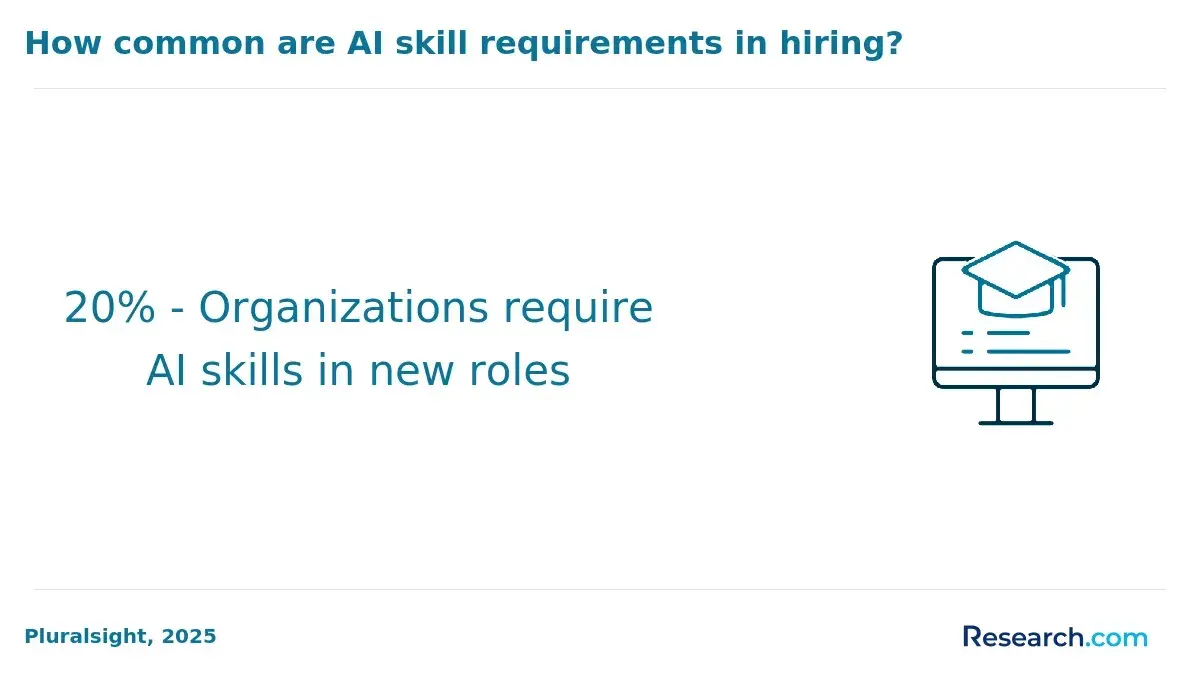
In 2024, 66% of global employers said they would not hire candidates lacking AI skills, underscoring the need for continuous learning. Prospective students should combine solid theoretical knowledge with practical experience through internships or projects that showcase their capabilities.
What salary ranges and job outlook can AI graduates expect in the U.S.?
AI graduates in the U.S. often start their careers as data scientists, earning between $85,000 and $110,000 per year. With five years or more experience, salaries typically increase to between $120,000 and $160,000. Senior or specialized roles, especially in industries like finance, healthcare, and technology, can command salaries above $180,000 annually.
Demand for AI skills is strong, with employment for data scientists expected to grow 35% from 2022 to 2032, according to the U.S. Bureau of Labor Statistics (Occupational Outlook Handbook, updated 2024). This growth rate outpaces most other occupations, driven by expanding AI adoption across multiple sectors.
Careers such as machine learning engineer, AI researcher, or business intelligence analyst often offer higher pay in tech hubs like San Francisco and New York City. Proficiency in programming languages like Python, neural networks, and big data tools further enhances earning potential.
Students benefiting from tutoring and academic coaching during their AI degree tend to develop stronger problem-solving skills and practical expertise, improving their competitiveness. Internships and certifications also play a crucial role in accelerating career growth in this rapidly evolving field.
Other Things You Should Know About Artificial Intelligence
Success in an artificial intelligence degree program requires strong foundations in mathematics, especially linear algebra, calculus, and probability. Programming skills in languages like Python, Java, or C++ are essential for implementing algorithms. Additionally, analytical thinking, problem-solving abilities, and knowledge of data structures and machine learning principles play a critical role.
Yes, artificial intelligence degrees provide a versatile skill set applicable in fields such as data science, software development, robotics, and automation. Many AI graduates work in industries like healthcare, finance, and marketing where AI-driven tools support decision-making and efficiency. The interdisciplinary nature of AI education allows graduates to adapt to various technology-focused roles.
Ethical training is increasingly vital as AI technologies impact society in profound ways. Most reputable AI programs incorporate coursework on responsible AI development, including fairness, privacy, transparency, and potential biases. Understanding ethical considerations equips students to build trustworthy systems that align with legal and societal norms.
Artificial intelligence students often have access to research projects in areas like natural language processing, computer vision, robotics, and machine learning optimization. Many universities offer labs and partnerships with tech companies where students can participate in industry-relevant studies. These opportunities enhance practical experience and support academic and career advancement.
In 2027, top AI degrees providing outstanding tutoring and academic coaching are offered by institutions like Stanford University, MIT, and Carnegie Mellon University. These universities emphasize personalized learning support, collaborative research opportunities, and access to leading industry professionals to enhance student success.
References
- AI Certifications: Accredited Programs, Vendor Credentials, and Emerging Standards - Total Seminars https://totalsem.com/ai-certifications-accredited-programs-vendor-credentials-and-emerging-standards/
- What Is The Best Degree for Artificial Intelligence? https://campus.edu/blog/artificial-intelligence/what-is-the-best-degree-for-artificial-intelligence
- Top 10 Highest Paying Artificial Intelligence (AI) Jobs 2025 | Nexford University https://www.nexford.edu/insights/highest-paying-ai-jobs
- Online AI Degrees vs On-Campus: Which Is Right for You in 2026? https://aidegreeonline.com/online-ai-degrees-vs-on-campus-which-is-right-for-you-in-2026/
- University Degree vs AI Bootcamp: Which is Best Career Path? https://agilefever.com/university-degree-vs-ai-bootcamp-which-is-best/
- Top 10 AI graduate degree programs https://www.cio.com/article/350315/top-10-ai-graduate-degree-programs.html
- AI Tutors: Bridging the Gap Between Students and Academic Success https://www.quadc.io/blog/bridging-the-gap-between-students-and-academic-success
- Your Roadmap to Earning the Best AI Certifications https://www.usaii.org/ai-insights/your-roadmap-to-earning-the-best-ai-certifications
- Artificial Intelligence Course Eligibility: Requirements & Prerequisites https://www.mygreatlearning.com/artificial-intelligence/courses/eligibility
- AI-Driven Academic Support Systems for Student Success https://goedmo.com/blog/ai-academic-support-systems/