2027 AI Bachelor's Degrees With Evening and Weekend Classes

Co-Founder and Chief Data Scientist
Many working professionals with non-technical backgrounds find it challenging to enter the field of Artificial Intelligence due to rigid course schedules and full-time commitments. Balancing a current job, family responsibilities, and education can create significant barriers to career change. Evening and weekend classes present a viable solution by allowing students to learn new skills without sacrificing income or personal obligations.
This article highlights accredited bachelor's degree programs in Artificial Intelligence that offer flexible scheduling designed to fit diverse lifestyles. It aims to guide readers toward programs that enable a seamless transition into the growing AI industry while maintaining their existing commitments.
Key Things You Should Know
- Evening and weekend AI bachelor's programs grew by 22% nationwide from 2024 to 2025, catering to working adults seeking flexible schedules.
- Over 60% of these programs integrate practical AI tools like machine learning and data analytics, enhancing job readiness for diverse industries.
- Tuition for evening/weekend AI degrees typically runs 15-30% lower than full-time daytime options, making them more accessible for budget-conscious students.
What are AI bachelor's degrees with evening and weekend classes?
AI bachelor's degrees with flexible evening classes provide undergraduate students with the opportunity to study core topics such as machine learning, data analysis, and computational theory outside traditional daytime hours. These programs accommodate working professionals and part-time students by offering classes during evenings or weekends, often combining in-person weekend sessions with online coursework.
This hybrid approach enables students to attend focused lectures on Saturdays while completing assignments online during the week. Some programs also offer fully online tracks that include interactive live sessions or on-demand videos to suit varied learning preferences. Such weekend and evening AI degree programs help those balancing work or family commitments to advance their education without disrupting daily responsibilities.
With the growing demand for flexible scheduling, students should carefully assess program details such as accreditation, access to hands-on AI labs during accessible hours, faculty support, and career services tailored to part-time learners. The option for flexible AI bachelor's degrees opens pathways for many who might otherwise delay education due to rigid daytime schedules.
For those interested in accelerating their studies, consider exploring a computer science accelerated program that integrates AI coursework and flexible scheduling.
Which accredited schools offer AI bachelor's programs with flexible class schedules?
Several accredited U.S. schools offer bachelor's degrees in artificial intelligence with flexible evening and weekend classes, catering to working students. Arizona State University provides an online bachelor of science in computer science with an AI concentration combining asynchronous coursework and periodic live sessions. The University of North Texas features a multidisciplinary AI bachelor's program with evening classes ideal for commuters. Southern New Hampshire University delivers a fully online AI-focused technology degree with no fixed classroom hours but optional weekend discussions.
Universities with AI bachelor programs and adaptable class schedules for working students often emphasize the importance of accreditation. Regional accrediting bodies like WASC, MSCHE, and HLC frequently accredit top flexible programs, ensuring credits transfer smoothly and employers recognize the degrees. The Council for Higher Education Accreditation (CHEA) maintains a comprehensive list of recognized accrediting agencies, helping students verify program legitimacy before enrolling.
When selecting flexible AI programs, students should consider factors such as class frequency, synchronous versus asynchronous formats, and instructor availability. Many institutions also offer academic advising and career services tailored to nontraditional schedules, which support student progress and job placement.
For those exploring options, it's helpful to compare programs alongside other fields; for example, insights into a mechanical engineering degree online can highlight different schedule flexibilities and cost factors.
Are evening and weekend AI bachelor's degrees available online or on campus?
Many universities now offer evening and weekend artificial intelligence bachelor programs online and on campus, catering to working students and career changers. According to the National Center for Education Statistics, 60% of U.S. institutions provided at least one fully online degree or certificate program recently, highlighting strong support for flexible AI study schedules.
Online programs typically combine asynchronous lessons with scheduled live sessions during evenings or weekends. This lets students learn AI fundamentals, data science, machine learning, and programming at their own pace while maintaining work commitments. Schools like Arizona State University and the University of Florida provide online AI bachelor's degrees or minors featuring evening live classes or weekend labs.
Campus-based AI bachelor degrees with evening and weekend classes are also increasingly available. Many community colleges and state universities offer hybrid formats, blending online lectures with hands-on weekend workshops. These flexible options accommodate part-time attendance outside regular daytime hours.
Students should consult academic advisors or program websites to confirm scheduling details. Those interested in related fields could explore options like a video game design degree, which also adapts well to flexible learning formats to suit diverse lifestyles.
What courses and skills are covered in a bachelor's degree in AI?
A bachelor's degree in artificial intelligence combines foundational and advanced subjects designed to prepare students for real-world AI challenges. Core coursework covers machine learning, data structures, algorithms, and programming languages like Python and R. Students also learn data engineering techniques to collect, clean, and manage large datasets efficiently. Many programs offer evening and weekend courses for ai bachelor's degree candidates to accommodate working professionals and nontraditional students.
Key skills developed include supervised and unsupervised learning, natural language processing, computer vision, and neural networks. Practical training emphasizes model development, evaluation, and deployment, mirroring industry requirements for end-to-end AI pipelines. Curriculum frequently incorporates cloud computing and distributed systems to prepare students for scalable AI solutions.
The 2024 DataCamp State of Data & AI Literacy Report revealed that 70% of organizations face significant data and AI skills gaps. This highlights the focus on applied machine learning and data handling in degree programs, equipping graduates to build operational AI systems. Elective courses often explore reinforcement learning, robotics, or advanced statistical methods, allowing students to specialize in areas such as healthcare or finance.
Ethics and AI governance are integral parts of the curriculum to ensure responsible AI deployment. Students gain experience through hands-on projects, internships, and teamwork, building portfolios that showcase proficiency in AI tools and frameworks. Graduates typically pursue roles in AI model design, data pipeline management, or AI research support, aligning skills with workforce demands.
Prospective students looking to advance their expertise can also consider an online master data science degree to further develop their skills.
What admission requirements apply to AI bachelor's programs for adult learners?
Admission requirements for AI bachelor's programs targeting adult learners typically include a high school diploma or GED. Many programs also accept transfer credits from previous college coursework, often allowing up to 60 credits to shorten degree completion and lower costs. Prior learning assessment (PLA) is common, letting students convert work experience, certifications, or military training into academic credits. This flexibility suits adults balancing education with careers and family.
Standardized tests like the SAT or ACT are increasingly optional or waived for adult applicants, acknowledging their academic or professional experience. Schools may require official transcripts from all post-secondary institutions attended to verify transfer eligibility. Some programs request a statement of purpose describing career goals and motivation, helping admissions evaluate applicant commitment and fit.
Technical expectations usually include foundational mathematics and programming skills. Applicants might need to complete preparatory courses, and letters of recommendation from employers or academic advisors are often required to confirm readiness for rigorous study.
Adult learners form a substantial part of the undergraduate population, with 34% aged 25 or older according to NCES IPEDS data. This has led to admissions policies emphasizing flexibility and credit recognition to better support this group.
How long do part-time evening and weekend AI bachelor's programs take?
Part-time evening and weekend bachelor's programs in artificial intelligence usually take four to eight years to complete. These programs accommodate working students by offering fewer courses each semester, extending the overall timeframe compared to full-time studies. Many schools schedule classes two or three evenings a week or on weekends to fit around job commitments.
Completion time depends on factors like credit load per term and course availability. Students taking 6 to 9 credit hours per semester might finish in about six years, while those with lighter course loads could take up to eight. Some programs shorten this period by offering summer classes or online options, though limited evening or weekend courses may slow progress.
Prospective students should carefully assess key factors before enrolling, including:
- Evening and weekend AI course availability each semester
- Options for summer or intersession classes
- Transfer credits or prior certifications acceptance
- Academic advising to plan course sequences efficiently
Reviewing these elements helps set realistic expectations about the time and commitment needed to earn a bachelor's degree in artificial intelligence through part-time, flexible scheduling.
What is the total cost of an AI bachelor's degree with flexible scheduling?
The total cost of an AI bachelor's degree with flexible scheduling varies by institution but often aligns with average public university tuition. The College Board's Trends in College Pricing 2024 reports an average in-state tuition and fees of $11,610 annually for public four-year schools, estimating around $46,440 for a four-year degree by 2026. Private or specialized programs may charge between $30,000 and $60,000 in total tuition.
Flexible scheduling options, such as evening and weekend classes, usually maintain standard tuition rates at public institutions. Costs can increase with textbooks, technology fees, and required AI software, which may add $1,000 to $2,000 each year. Many students balance work while studying, which can extend their degree duration and increase expenses through additional semester fees and living costs.
Some online and hybrid AI programs offer per-credit pricing, enabling students to pay only for courses taken each term, which helps manage finances more effectively.
Financial aid, scholarships, and employer tuition assistance are crucial in offsetting costs. Grants focused on STEM fields, including those from tech companies supporting AI education, can significantly reduce expenses. Students should consider all related costs beyond tuition and explore available funding options to plan comprehensively.
What AI jobs can you get with a bachelor's degree in artificial intelligence?
A bachelor's degree in artificial intelligence equips graduates for specialized, high-demand roles across varied industries. Common positions include data scientist, machine learning engineer, AI software developer, and AI research analyst. These roles require strong programming skills, statistical analysis, and algorithm development, all of which form the core curriculum of most AI bachelor's programs.
Key roles include:
- Data scientist: Analyzing large datasets to generate insights through AI models. The U.S. Bureau of Labor Statistics forecasts a 36% increase in data scientist jobs, adding over 100,000 positions in the coming decade.
- Machine learning engineer: Creating systems that allow computers to learn and improve automatically.
- AI software developer: Developing AI-powered applications applicable to healthcare, finance, and autonomous systems.
- AI research analyst: Assessing AI algorithms to refine their efficiency and practical use.
Graduates can also explore careers in robotics, natural language processing, and computer vision, applying AI to niche challenges. Evening and weekend programs are designed for working professionals who want to transition into AI without leaving their jobs.
Hands-on experience is crucial; internships and projects in AI frameworks and data manipulation significantly boost employability. Employers highly value practical skills and critical problem-solving abilities in AI applications.
What salary can AI bachelor's degree graduates expect in the United States?
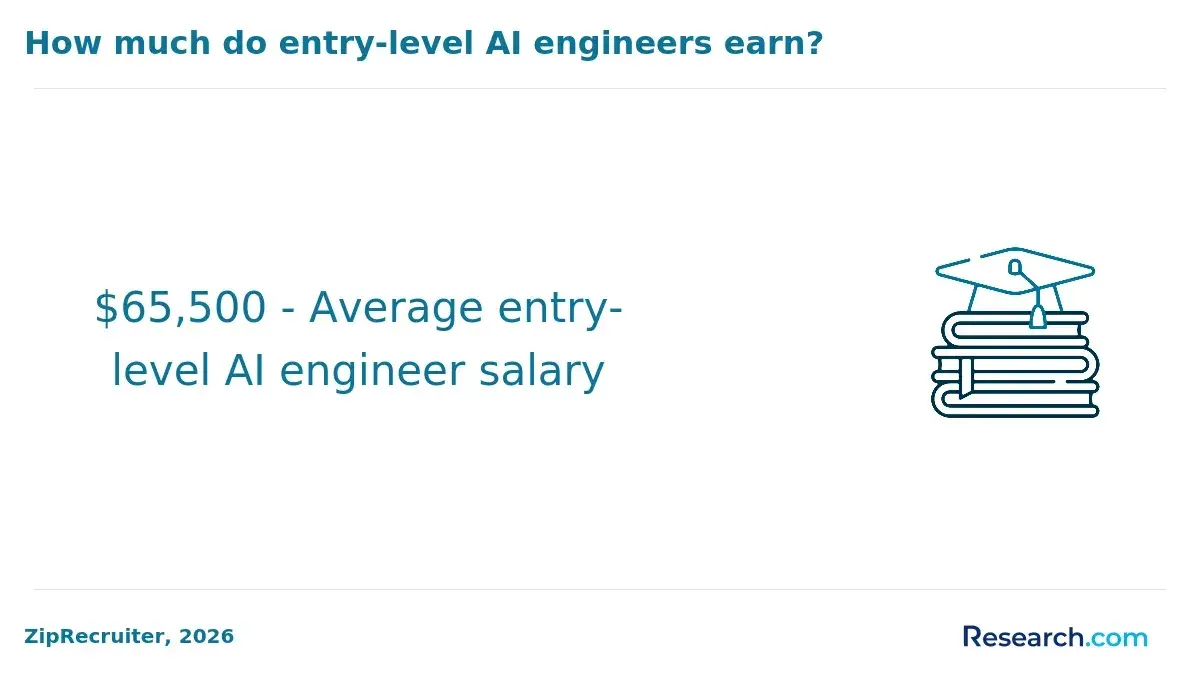
Graduates with a bachelor's degree in artificial intelligence in the United States can expect competitive salaries that reflect the strong demand for AI skills. According to the U.S. Bureau of Labor Statistics, the median annual wage for data scientists-roles closely connected to many AI careers-was $108,020 in May 2024. This serves as a solid benchmark for entry-level and mid-level positions in AI and related fields.
Starting salaries typically range from $80,000 to $100,000, varying by location, industry, and skill level. Major tech centers like San Francisco, Seattle, and New York often offer salaries that exceed this range, sometimes topping $120,000 for candidates proficient in programming and data analysis.
Specialist positions such as machine learning engineers, AI software developers, and research analysts may earn salaries at or above the median, especially in industries like finance, healthcare, or autonomous systems. Salary variation also reflects industry demand and job function.
Factors influencing earning potential include:
- Professional experience and internships during studies
- Advanced skills in Python, TensorFlow, or PyTorch
- Relocating to metropolitan areas with high demand
- Obtaining certifications or pursuing graduate degrees
These benchmarks allow students and professionals to weigh the return on investment of an AI bachelor's degree, particularly when balancing education with work commitments. Practical skills and relevant experience remain critical for maximizing career prospects.
What certifications complement an AI bachelor's degree for better job prospects?
Certifications greatly enhance an AI bachelor's degree by validating specialized skills and improving employability in competitive job markets. CompTIA's Workforce and Learning Trends report reveals that 71% of IT leaders view certifications as strong indicators of employee success. Graduates should therefore select certifications aligned with their specific career objectives to maximize benefits.
Important certifications for AI professionals include:
- Certified TensorFlow Developer - Demonstrates proficiency in neural networks and deep learning using a leading AI framework.
- Microsoft Certified: Azure AI Engineer Associate - Focuses on creating and deploying AI solutions within Azure cloud environments.
- IBM AI Engineering Professional Certificate - Covers machine learning, deep learning, and model deployment with Python and IBM tools.
- Certified Data Scientist (CDS) - Emphasizes data analytics and statistical techniques essential for AI-driven decision-making.
- Google Professional Machine Learning Engineer - Validates skills to design and productionize ML models on Google Cloud Platform.
Additional credentials in programming languages such as Python or R, alongside data management certifications like Certified Data Management Professional (CDMP), broaden skill sets. Project management certifications such as PMP can also strengthen applied roles.
By combining a bachelor's degree with these targeted certifications, graduates can close skill gaps prioritized by employers, aligning their expertise with industry demands. This strategic approach increases the return on investment for education and enhances career prospects in artificial intelligence fields.
Other Things You Should Know About Artificial Intelligence
A bachelor's degree in artificial intelligence provides foundational knowledge and practical skills that are highly valuable in today's job market. Graduates often find opportunities in various industries including technology, healthcare, and finance. The degree also opens pathways to advanced studies, which can lead to more specialized roles and higher salaries.
To apply for an AI bachelor's degree with evening and weekend classes in 2027, research universities offering flexible schedules, gather necessary documents such as transcripts, and complete the application process either online or by mail. Check specific deadlines and requirements directly on the university's website.
Yes, many artificial intelligence bachelor's programs with evening and weekend classes are designed to accommodate working adults. Part-time enrollment options and flexible scheduling make it feasible to balance work and study. Some programs also offer online components to further enhance accessibility.
Graduates with a bachelor's degree in artificial intelligence can pursue roles such as data scientist, machine learning engineer, AI researcher, and software developer. The demand for professionals skilled in AI is growing rapidly, with many companies investing in automation, natural language processing, and predictive analytics. Career growth potential remains strong in this evolving field.
References
- How Long Do AI Courses Take? https://www.nobledesktop.com/learn/ai/how-long-do-ai-courses-take
- A Complete 4-Year Course Plan for an Artificial Intelligence Undergraduate Degree https://www.mihaileric.com/posts/complete-artificial-intelligence-undergraduate-course-plan/
- AI certifications: What employers actually want in 2026 - Spiceworks https://www.spiceworks.com/it-careers/ai-certifications-what-employers-actually-want-in-2026/
- What Are the Career Paths After a Bachelor of Science in AI https://tetr.com/blog/what-are-the-career-paths-after-a-bachelor-of-science-in-ai
- Prepare for the Future of Tech with a Bachelor’s in AI | UMGC https://www.umgc.edu/blog/umgc-bachelors-degree-artificial-intelligence
- AI Engineer salary in US https://builtin.com/salaries/us/ai-engineer
- Blog https://admissiongoals.com/post/ai-machine-learning-programs-europe-admission-guide-international-students
- Bachelor in Management and Artificial Intelligence https://www.kozminski.edu.pl/en/programs/undergraduate-programs-bachelor/bachelor-management-and-artificial-intelligence
- Artificial Intelligence - Vistula University https://vistula.edu.pl/en/major/artificial-intelligence
- BS in Artificial Intelligence Abroad - Top Universities, Costs & Career Prospects 2026 https://findcourse.io/programs/bs-artificial-intelligence