2027 How to Make a Career Change from Teacher to SLP Speech Pathologist

Co-Founder and Chief Data Scientist

Reviewed by Rhea Paul, PhD
SLP Education & Research Expert
Changing careers from teaching to speech-language pathology involves more than transferring your existing education experience. Teachers may need to complete communication sciences and disorders prerequisites before earning a qualifying SLP master’s degree, followed by supervised clinical training and a post-degree clinical fellowship. This guide explains the education, clinical requirements, and career considerations involved in making the transition, so you can understand the steps to becoming an SLP before committing to a new career path.
Key Things You Should Know
- Teachers generally need communication sciences and disorders prerequisites followed by a qualifying SLP master's degree; a second bachelor's degree is not always necessary.
- Plan for supervised graduate clinical training and a post-degree clinical fellowship. ASHA's certification standards generally require at least 400 supervised clinical hours and a 36-week, 1,260-hour fellowship.
- The U.S. median annual SLP wage was $97,870 in May 2025, and employment is projected to grow 17% from 2025 to 2035. Neither figure predicts an individual career changer's pay or hiring prospects.
- How can teachers become speech-language pathologists through the most efficient career-change pathway? Teacher-to-SLP Pathway
- What education and prerequisite courses do aspiring SLPs need after teaching? Required Education
- How long does it take to transition from teaching to speech-language pathology? Transition Timeline
- Which SLP master's programs accept applicants with teaching degrees? Program Admissions
- What mistakes should teachers avoid when changing careers to speech-language pathology? Career-Change Mistakes
How can teachers become speech-language pathologists through the most efficient career-change pathway?
For most teachers, the efficient route is to keep the existing bachelor's degree, complete only the missing prerequisite courses, and enter a qualifying speech-language pathology master's program. The degree is followed by supervised post-graduate practice and the credentials required in the state where you intend to work. Teaching experience can strengthen an application, particularly for school-focused work, but it does not waive SLP requirements.
The best route depends on what your transcript already covers. These options differ mainly in when you complete foundational coursework and how much schedule flexibility you need.
| Route | Best fit | Main trade-off |
| Standalone prerequisite or "leveling" courses, then a master's | Teachers who need several communication sciences and disorders courses and want to compare graduate schools | Requires checking that each target program will accept the courses |
| Master's program with an integrated foundation phase | Applicants without an SLP-related bachelor's who want a coordinated sequence | May limit school choices or extend time in the program |
| Full-time master's after prerequisites already completed | Teachers whose transcripts meet admission requirements and who can accommodate intensive clinical placements | Less room to maintain a full-time teaching schedule |
Start by sending your transcript to several programs for a prerequisite review rather than assuming you must earn another bachelor's. If speed matters, compare actual prerequisite and placement schedules - not just advertisements for online speech pathology master's programs in two years.
What education and prerequisite courses do aspiring SLPs need after teaching?
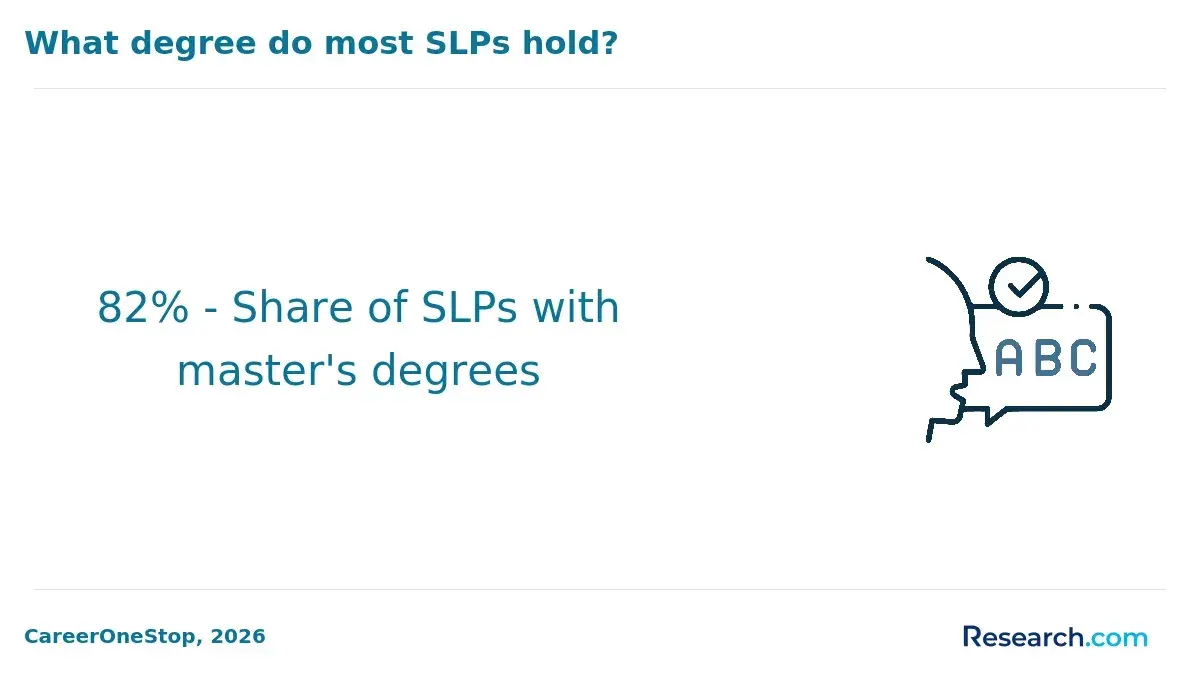
SLPs typically enter practice with a master's degree in speech-language pathology. An education degree may cover child development or statistics, but it rarely includes every foundation course a graduate SLP program requires. Common subject areas include phonetics, speech and hearing anatomy, audiology, language development, and communication disorders. Programs set their own admission prerequisites, so a course that satisfies one school may not satisfy another.
ASHA certification standards also specify undergraduate-level knowledge in biological sciences, physical sciences, statistics, and social or behavioral sciences. Do not assume a general math course meets the statistics requirement or that an education course automatically meets a science requirement. Ask admissions staff to assess course titles, descriptions, grades, and any recency rules in writing.
Teachers comparing language development courses for slp prerequisites should distinguish an admissions prerequisite from a course required for certification or the graduate degree. That distinction helps avoid paying twice for similar material.
How long does it take to transition from teaching to speech-language pathology?
A teacher who already meets all prerequisites might complete a full-time master's in roughly two years, then undertake the clinical fellowship required for ASHA certification. A teacher who needs substantial leveling coursework, chooses part-time study, or must wait for the next admission cycle should plan for longer. Clinical placements occur during the master's; the fellowship comes afterward.
The calendar matters as much as the advertised degree length. A school-year teaching contract may conflict with weekday placements, and an online academic program does not mean its clinical training can be completed online. Ask when full-time placements begin and whether you can realistically retain your current job.
An accelerated timetable can reduce time away from full-time earnings but may reduce your capacity to work while studying. Compare net cost and placement feasibility alongside scholarships for accelerated online slp study; a shorter program is not necessarily the less expensive transition.
Which SLP master's programs accept applicants with teaching degrees?
Some SLP master's programs consider applicants whose bachelor's degree is in education or another non-communication-sciences field, provided they complete specified prerequisites. Emerson College's Speech@Emerson and NYU Steinhardt's Speech@NYU are examples of programs to investigate for non-CSD applicants. Their current prerequisite, admission, clinical-placement, and state-eligibility policies should be confirmed directly before applying; eligibility to apply is not an offer of admission.
Accreditation is a separate check. Use the ASHA Council on Academic Accreditation's program information to confirm a program's current status, and ask how its degree supports certification and licensure in your intended state. For an online option, also ask who secures placements, whether campus visits are required, and whether residents of your state may enroll.
Build a shortlist around admission fit, clinical logistics, total cost, and state eligibility rather than a ranking alone. Guidance on choosing a balanced list of slp programs can help you compare realistic options without treating any program as a guaranteed admit.
How can career changers complete speech-language pathology prerequisites affordably?
The cheapest useful prerequisite is one that a target master's program will actually accept. Public institutions, online post-baccalaureate offerings, and nondegree enrollment may provide different ways to complete missing courses, but tuition alone does not show the full cost. Compare required fees, course availability, transcript requirements, and whether financial aid is available for your enrollment status.
Before paying for a course, use this sequence to avoid unnecessary credits:
- Request prerequisite evaluations from the graduate programs on your shortlist.
- Identify courses that satisfy more than one target program's requirements.
- Get written confirmation of any outside course equivalents before enrolling.
- Compare the combined cost of prerequisites and the master's, including fees and potential lost income during placements.
For the graduate degree, use the same total-cost approach when comparing tuition and aid for online slp programs. Ask financial aid offices about your eligibility rather than assuming that aid available to degree-seeking students also covers standalone prerequisites.
What clinical practicum and supervised experience must teacher-to-SLP candidates complete?
Clinical practicum is supervised work with clients during the graduate program - not observation of a teacher's classroom. Under ASHA's certification standards, candidates generally complete at least 400 supervised clinical hours: 25 hours of observation and 375 hours of direct client or patient contact. At least 325 of the supervised clinical hours must be completed at the graduate level. Programs also arrange experiences that develop competence across relevant ages and communication or swallowing needs.
After the degree, an applicant pursuing ASHA's Certificate of Clinical Competence in Speech-Language Pathology (CCC-SLP) completes a supervised clinical fellowship of at least 36 weeks and 1,260 hours. A school-based fellowship may be possible, but a teaching position does not become an SLP fellowship simply because you work with students.
Before accepting a place, ask who finds and approves clinical sites, when placements occur, whether travel is expected, and what happens if a placement falls through. Those answers may determine whether you can keep teaching while enrolled.
How does the ASHA certification process work for future speech-language pathologists?
The CCC-SLP is ASHA's professional certification; it is distinct from a state license. The usual route involves a qualifying graduate degree and coursework, supervised clinical practicum, a passing score on the Praxis Speech-Language Pathology examination, and a supervised clinical fellowship. ASHA reviews the certification application and supporting documentation against its standards.
You can prepare early by keeping records of prerequisite courses and confirming that your graduate program documents clinical hours appropriately. Later, verify your fellowship supervisor's eligibility and the documentation process before accepting a position. Because certification standards and procedures can change, check ASHA's current requirements for your application period rather than relying on an older checklist.
Which state licenses and exams are required to practice as an SLP?
SLPs generally need a license from the state where they practice, including when providing services remotely to a client in another state. States commonly require graduate education, supervised experience, and an examination such as the Praxis Speech-Language Pathology test, but application procedures and timing vary. Some provide a provisional or temporary credential for the clinical fellowship period.
If you want to work in a public school, check the state education agency as well as the SLP licensing board. A school credential, educator endorsement, or employer-specific requirement may apply separately from the professional license. Your existing teaching license should not be assumed to authorize SLP practice.
Before enrolling, identify the state where you expect to work and ask the program for its professional-licensure disclosure for that state. Repeat the check before arranging a fellowship or accepting a telepractice role, especially if your location or your clients' locations change.
How do SLP salaries, work settings, and job duties compare with teaching?
Teachers and school-based SLPs both support learning, but SLPs assess and treat speech, language, communication, and swallowing disorders rather than lead a general classroom. Depending on the setting, an SLP's day may include evaluations, individualized treatment, documentation, and coordination with families and other professionals.
The U.S. Bureau of Labor Statistics reports a median annual wage of $97,870 for speech-language pathologists in May 2025. That national, occupation-wide figure is not a school-SLP starting salary and should not be compared directly with your teaching contract without considering work schedule, location, benefits, and years of experience. BLS projects 17% SLP employment growth from 2025 to 2035, indicating strong national demand but not a guaranteed local opening.
Setting changes the work as well as the pay comparison. This overview can help a teacher decide which roles to observe or explore before committing to graduate study.
| Setting | Typical emphasis | Consider if you value |
| Public schools | Student evaluations, intervention, educational teams, and school documentation | Continued work with children and familiarity with school systems |
| Outpatient clinics | Scheduled assessment and treatment across the clinic's client population | Direct therapy work in a clinical setting |
| Hospitals and rehabilitation | Medical-team collaboration, including communication or swallowing care | A healthcare environment and medically focused practice |
Career changers considering clinics can explore how roles and experience affect outpatient speech-language pathologist salary. Earnings vary substantially by employer, region, specialty, and schedule.
What mistakes should teachers avoid when changing careers to speech-language pathology?
The largest avoidable mistake is committing money or resigning from teaching before checking the complete pathway. A promising degree format is only useful if its coursework, placements, and state eligibility match your goal.
Watch for these common planning errors and replace assumptions with written answers from programs and licensing authorities:
- Taking prerequisites without approval: Get target programs to review course equivalents before you enroll.
- Confusing online classes with remote clinical training: Confirm placement hours, travel, and any campus attendance.
- Budgeting for tuition only: Include fees, prerequisite study, placement-related expenses, and possible reductions in teaching income.
- Assuming certification equals licensure: Check both ASHA's requirements and the rules for your intended practice state.
- Choosing solely by advertised speed or salary: Compare the feasible completion schedule and likely roles in your local market.
If the time or cost is not workable now, consider observing an SLP, taking an approved prerequisite while employed, or investigating related support roles. These steps can test your interest without assuming that a support role substitutes for an SLP license.
References:
- U.S. Bureau of Labor Statistics - Speech-Language Pathologists https://www.bls.gov/ooh/healthcare/speech-language-pathologists.htm
- ASHA EdFind - Accredited Speech-Language Pathology Programs https://find.asha.org/ed/
- ETS Praxis - Speech-Language Pathology (5331) https://praxis.ets.org/test/speech-language-pathology-5331.html
- University of Wisconsin-Eau Claire - Master of Science in Speech-Language Pathology (Online) https://www.uwec.edu/speech-language-and-hearing-sciences-department/graduate-program/speech-language-pathology-online
- Pepperdine University - Master of Science in Speech-Language Pathology https://healthscience.pepperdine.edu/online-masters-in-speech-language-pathology/
- James Madison University - Master of Science (M.S.) in Speech-Language Pathology (Distance Education / Online) https://www.jmu.edu/chbs/csd/online_ms/index.shtml
- California State University-Northridge - Master of Science in Communicative Disorders (Online) https://tsengcollege.csun.edu/programs/CDS
- New England Institute of Technology - Master of Science in Speech Language Pathology https://www.neit.edu/academics/graduate-degrees/speech-language-pathology-ms
Other Things You Should Know About Speech Pathology
Usually not. SLP clinical hours must meet supervised practicum requirements; ordinary teaching duties do not qualify simply because they involve communication or students with speech needs. Ask the graduate program to evaluate any prior experience rather than assuming it counts.
Most state licensing boards require a criminal background check and fingerprint-based screening before issuing a speech-language pathologist license. You may also need a child abuse registry check and proof of a clean record for school-based placements, along with supervised clinical practicum documented under ASHA-accredited program rules.
Not necessarily. Some programs accept applicants with teaching degrees after specified prerequisite courses, while others structure foundational study within their pathway. Compare those requirements before paying for another degree.
Some programs allow prerequisites to be in progress at application time; others require completion earlier. Check each program's deadline and whether an offer would be conditional on finishing courses with required grades.